
Rental Property Inspection: London Landlord Guide 2026

You're probably in one of two positions right now. Either you haven't inspected your rental for a while and you're hoping everything's fine, or a tenant has finally reported something minor that turns out not to be minor at all. That's how it usually starts in London, a slow leak behind a washing machine in a Brockley flat, condensation building into mould in a Victorian terrace in Lewisham, or a crack above a chimney breast in a Southwark conversion that nobody noticed early enough.
A proper rental property inspection isn't a box-ticking exercise. It's how you stop small defects becoming expensive repairs, avoid arguments with tenants and work out when a routine landlord check is no longer enough and a surveyor needs to step in.
Table of Contents
- Why Regular Inspections Protect Your Property Investment
- Legal Notice and Communicating with Your Tenants
- Your Room by Room Inspection Checklist
- Verifying Essential Safety and Compliance
- Documenting Defects and Creating a Clear Report
- When to Call a Chartered Surveyor
- Frequently Asked Questions
Why Regular Inspections Protect Your Property Investment
The landlord who says, “I didn't want to bother the tenant,” usually pays for it later.
A small leak under a kitchen sink doesn't stay small. In a London flat it can track into chipboard flooring, blow kitchen carcasses, stain the ceiling below and create a mould problem in two rooms instead of one. In Victorian houses around Catford, Forest Hill and New Cross, poor ventilation in one bathroom can lead to persistent damp around cold external walls and timber decay around window reveals. By the time it smells musty, the repair bill has already grown.
That's why I take a hard view on inspections. If you only turn up when the tenant complains, you're managing reactively. You're waiting for the defect to get worse.
PropertyWire's report on an Inventory Base survey found that 46% of landlords plan to inspect no more than once annually after the Renters' Rights Act changes in May 2024. Within that group, 26% said annual inspections, 3% said less than once per year and 18% said they would only inspect when tenants reported problems. That's the wrong direction if you want to protect a London property.
Practical rule: A tenant reports what they notice. An inspection picks up what they don't.
What inspections catch early
A good rental property inspection often reveals issues before they become claims, disputes or major works:
- Water ingress: Staining to ceilings, swollen skirtings, failed mastic and damp behind furniture.
- Ventilation faults: Dead extractor fans, blocked trickle vents and condensation patterns in corners.
- Movement signs: New cracking around openings, distorted floors and doors starting to bind.
- Wear that's no longer normal: Broken handles, loose sockets, damaged flooring and failed sealant.
In areas like Bermondsey and Rotherhithe, converted flats can hide service issues behind boxed-in pipework. In Dulwich and Blackheath, older houses often show early warning signs around roof slopes, parapets and chimney details. If you inspect regularly, you can act while the defect is still localised.
Routine checks also protect the tenancy
Inspections aren't just about the building fabric. They show the tenant that repairs are being taken seriously. They create a record. They reduce the chance of that awkward end-of-tenancy argument where everyone remembers the property differently.
A landlord's inspection is basic asset management. Skip it and you'll end up paying for ignorance.
Legal Notice and Communicating with Your Tenants
The law is simple on the starting point. You can't just turn up and let yourself in because you own the place.
Give notice properly
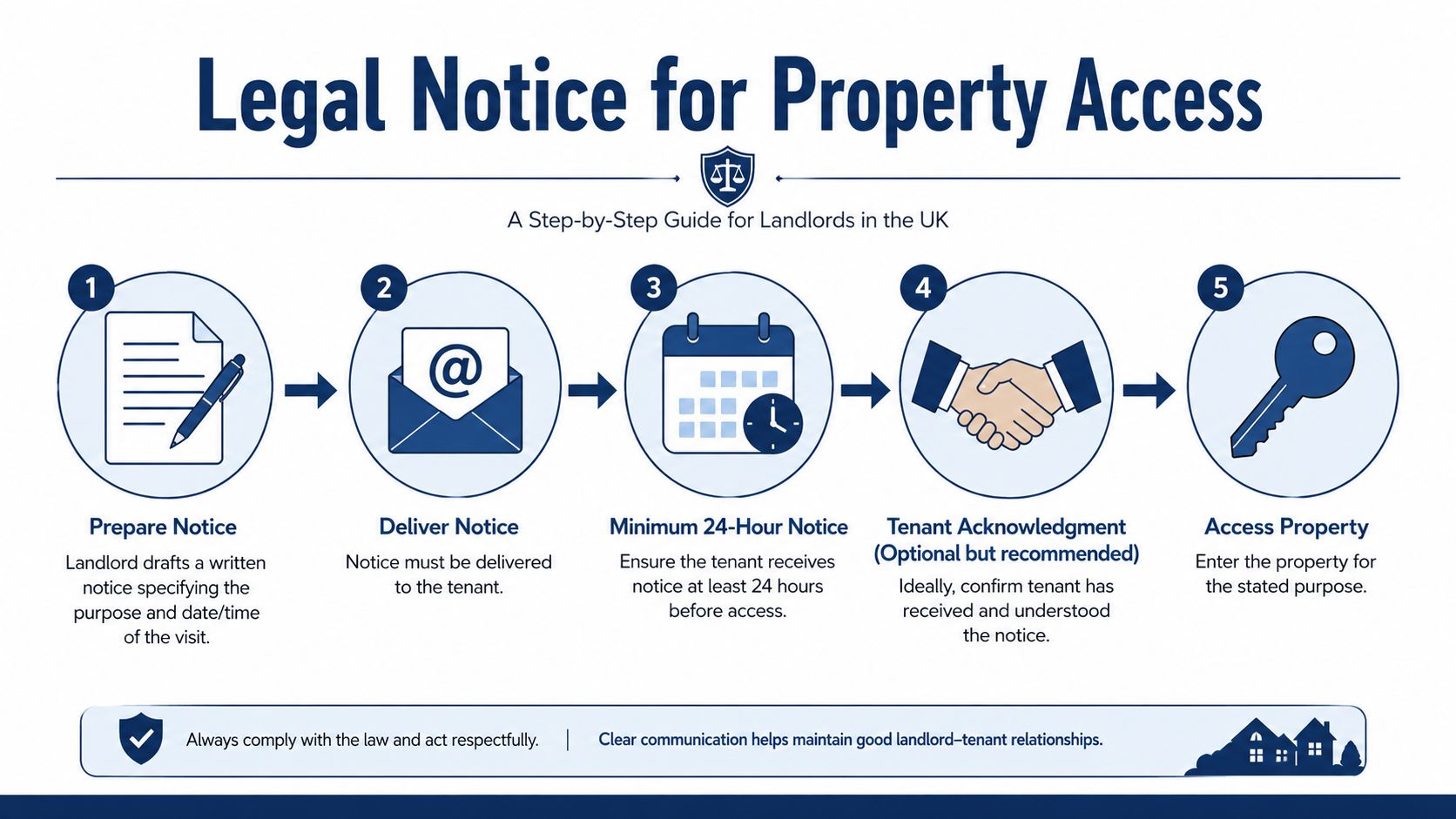
Guidance on landlord inspections in the UK states that the Housing Act 1988 requires at least 24 hours' written notice before non-emergency access, and industry guidance suggests inspections at three, four or six month intervals to reflect seasonal changes.
That's the minimum. Minimum is not always sensible.
If you want fewer problems, do this:
- Write the notice clearly. State the date, the time window and the reason for access.
- Send it in a form you can evidence. Email is usually practical. If your tenancy agreement specifies a method, follow it.
- Choose a reasonable time of day. Mid-morning or early evening usually avoids pointless friction.
- Ask for confirmation. You may not always need agreement, but acknowledgement helps.
- Keep a record. Save the email, message or letter and note the date sent.
A tenant's right to quiet enjoyment matters. If you push too hard, or turn inspections into surprise visits, you invite an argument you don't need.
If access becomes a recurring battle, the problem is often poor communication before it becomes a legal problem.
There's a useful related read on fire safety responsibilities in flats because inspections in converted and purpose-built blocks often overlap with wider building safety issues.
Speak to tenants like an adult
Don't frame the visit as a search for wrongdoing. Frame it truthfully. You're checking for repairs, safety issues and anything that might worsen if ignored.
That changes the tone straight away.
Use simple wording:
- Explain the purpose: You're checking the condition of the property and identifying any repairs early.
- Set expectations: Say roughly how long you'll be there and which rooms you need to see.
- Invite reports: Ask the tenant to mention leaks, draughts, mould, electrical concerns or anything that has changed.
- Avoid loaded language: Don't accuse. Don't lecture. Stick to the property.
What not to do
Some landlords create trouble for themselves by being careless:
| Mistake | Why it causes problems |
|---|---|
| Turning up unannounced | It can trigger complaints about harassment or unlawful entry |
| Giving vague notice | It leaves room for dispute over what was agreed |
| Using inspections to comment on lifestyle | It damages trust and distracts from genuine building issues |
| Entering at awkward times | It looks unreasonable even if the notice period was met |
In London, long tenancies and periodic arrangements make routine communication more important, not less. If the tenant sees you as organised and fair, access is usually straightforward. If they see you as intrusive, every visit becomes hard work.
Your Room by Room Inspection Checklist
You need a repeatable method. If you walk round casually, you'll miss things. Use the same order every time and record the condition the same way every time.
Start broad, then go specific.
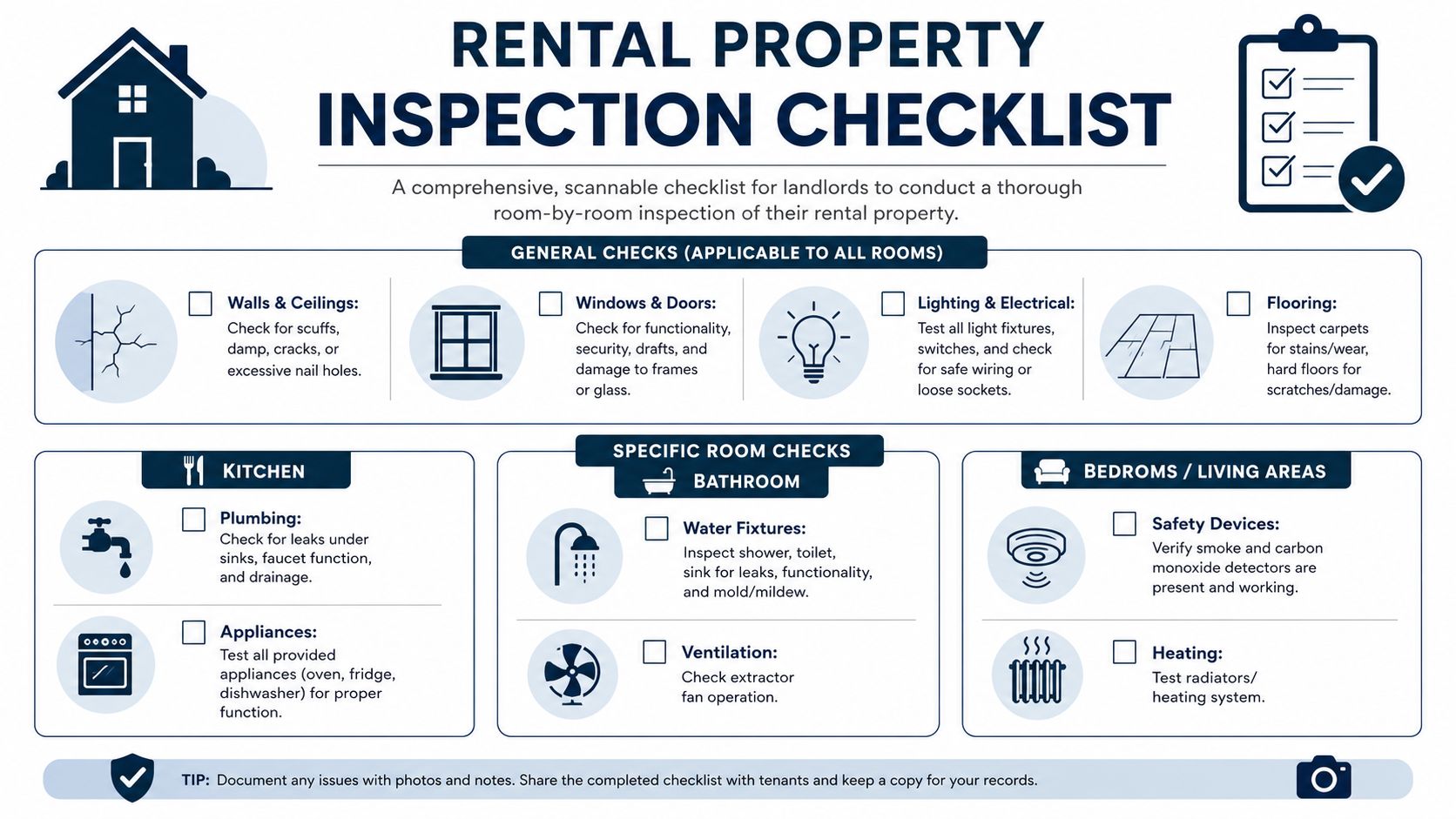
Start with what every room can tell you
Look at each room as a surveyor would. Not with technical testing, but with disciplined observation.
Check these in every room:
- Walls and ceilings: Look for staining, peeling finishes, cracking, blown plaster and mould spotting.
- Windows and doors: Open and close them. Check locks, draughts, stiff sashes and signs of water ingress.
- Flooring: Note lifting laminate, broken tiles, frayed carpet edges and uneven or springy areas.
- Electrics: Test light fittings and switches visually. Watch for scorch marks, damaged plates and loose sockets.
- Heating: Confirm radiators are presentable and apparently functioning, and note any leaks or rusting valves.
In period flats around Peckham and Camberwell, pay attention to cracks over door heads and around altered internal walls. In Victorian terraces in Sydenham and Brockley, check behind wardrobes and large furniture on external walls. That's where condensation mould often hides.
A practical guide should be something you can carry. Keep your checklist short enough to use, but detailed enough to matter.
For landlords dealing with shared houses, the HMO Fire Risk Assessment guidance is worth reviewing alongside your own routine inspection notes because common parts and escape routes need disciplined checking.
A quick visual walkthrough can help you think in sequence before you enter the property:
Kitchen and bathroom checks
These are your highest-risk rooms. Most costly defects start with water, steam or failed extraction.
Kitchen
- Under the sink: Feel for moisture, staining and swollen cabinet bases.
- Worktops and sealant: Check joints behind sinks and hobs.
- Appliances provided by the landlord: Confirm they appear to function and note visible defects.
- Extractor fan or cooker hood: Make sure it's working and venting, not just making noise.
- Floor edges: Look for lifting vinyl or staining near washing machines and dishwashers.
In ex-local authority flats in Woolwich and Deptford, kitchens often take hard use. Focus on leaks, ventilation and damaged sockets near work surfaces.
Bathroom
- Sealant lines: Blackened or failed mastic around baths and trays means water may already be getting behind finishes.
- Ceiling and corners: Look for mould, especially above showers and near external walls.
- Taps and wastes: Run them briefly if appropriate and note drainage issues.
- Toilet fixing: A loose pan can break seals and leak slowly.
- Extractor fan: If it's dead, condensation will win.
A bathroom with persistent mould is rarely just a cleaning issue. It's usually a ventilation issue, a heating issue or a hidden moisture issue.
Bedrooms living rooms and external areas
Living spaces tell you how the property is performing over time.
In bedrooms and reception rooms, check:
- Cracks: Hairline decoration cracks are one thing. Cracks that reopen, step through masonry lines or widen near window corners need attention.
- Joinery: Sticking doors and racked frames can indicate movement or swelling from moisture.
- Sash windows: Common across Greenwich, Blackheath and Clapham. Check cords, draughts, rot and paint build-up.
- Fireplaces and chimney breasts: In converted flats, look for cracking where breasts have been altered or removed below.
- Signs of overcrowding or unauthorised use: Stick to factual observations, not assumptions.
Don't ignore outside areas if you have access.
| External item | What to look for |
|---|---|
| Gutters and downpipes | Leaks, staining, misalignment, vegetation growth |
| Rear walls | Damp staining, defective pointing, cracked render |
| Roof from ground level | Slipped coverings, sagging lines, blocked valleys |
| Paths and drains | Ponding water, blocked gullies, loose covers |
Basement and lower-ground units in Southwark, Westminster and Kensington need extra care. Musty smells, tide marks and peeling finishes are warning signs. Don't let anyone tell you it's “just old London property” without checking further.
Verifying Essential Safety and Compliance
Many landlords often confuse the roles of different inspections. A routine rental property inspection is useful, but it does not replace certified safety checks.
A visual check is not a safety certificate
Total Landlord Insurance's guidance on property inspections notes that 34% of UK rental properties still lack up-to-date electrical safety certificates, and that visual inspections do not satisfy the Electrical Safety Standards rules. The same guidance warns of penalties up to £30,000 per breach.
That should settle the matter. Looking at a consumer unit, taking a photo of a boiler or pressing a light switch does not prove legal compliance.
You must separate two things in your own mind:
| Landlord visual check | Certified safety check |
|---|---|
| You notice visible damage or signs of concern | A qualified professional tests and certifies |
| You record what appears wrong | They confirm whether it is compliant |
| Useful for maintenance | Essential for legal compliance |
What you must verify every time
Your inspection should confirm that records exist and that obvious safety items are present, working and current.
Focus on these points:
- Electrical safety: An EICR is required every five years and visual checks do not replace it, as explained in this home electrical testing guide.
- Gas safety: The gas safety certificate must be current and completed by a Gas Safe engineer.
- Alarms: Test smoke and carbon monoxide alarms as part of your visit if appropriate.
- Evidence: Keep copies of certificates where you can produce them quickly.
If you manage flats and mixed residential arrangements, it also helps to look at how other jurisdictions explain alarm responsibilities. This guide for Perth strata properties is useful because it shows, in practical terms, how alarm servicing needs clear responsibility and documentation even where the legal framework differs.
Don't blur the line between observation and certification. That mistake costs landlords money.
Documenting Defects and Creating a Clear Report
A rental property inspection without a record is half done.
You don't need fancy software. You do need discipline. Photograph defects, describe them plainly and issue a short report soon after the visit while the details are fresh.
Photographs first opinions second
The NRLA guidance on periodic property inspections states that the most common failure point is the lack of time-stamped photographic evidence of leaks, mould or tampered meters, and also notes that insurers often require inspections every six months to validate policies.
That matters because memory is useless in a dispute.
Take two types of photograph:
- Context shots: The whole wall, whole room or whole item.
- Close shots: The crack, stain, leak mark, damaged fitting or meter issue itself.
Then label them by room and date. Don't leave them sitting in your phone with names like IMG_4832.
Write what you can see, not what you think the tenant has done.
Bad note: “Awful damp problem caused by tenant.”
Better note: “Dark mould growth to upper bathroom ceiling, approximately 10cm wide, concentrated above shower area. Extract fan not operating at time of inspection.”
Use a report format that can survive an argument
A clear report should be short enough to read and precise enough to rely on later.
Use this order:
- Property details
- Inspection date and attendees
- Room-by-room findings
- Immediate actions required
- Tenant-reported issues
- Landlord follow-up and target dates
A simple table works well:
| Room or item | Condition | Action |
|---|---|---|
| Kitchen sink base | Stained and damp | Check trap and feed pipes for leak |
| Bathroom ceiling | Mould present | Inspect fan, ventilation and moisture source |
| Front bedroom window | Sash sticking | Review joinery condition and local distortion |
Send the report to the tenant. That's important. It creates a shared record of what was seen and what happens next.
If you find damage, don't turn the report into a rant. If you find a likely defect in the building, don't pretend to diagnose beyond your competence. Record the symptoms clearly, then decide whether the next step is a contractor, an engineer or a surveyor.
When to Call a Chartered Surveyor
A landlord can spot a problem. A chartered surveyor works out what it is, how serious it is and what else it may be affecting.
That distinction matters most in London, where housing stock is mixed, altered and often older than landlords assume. A 1930s semi in Bromley behaves differently from a Georgian flat in Islington or a Victorian terrace conversion in Brixton. The symptoms may look similar. The cause often isn't.

Red flags landlords should not diagnose themselves
If you see any of these, stop pretending it's just routine maintenance:
- Cracks that are pronounced or changing: Especially near windows, doors and chimney breasts.
- Spongy or sloping floors: Could be rot, failed joists or structural distortion.
- Persistent damp despite ventilation measures: Often means defects in the building fabric, not just condensation.
- Uneven roof lines or recurring leaks: These need proper investigation.
- Alteration concerns in conversions: Removed walls, altered lofts and boxed-in structure deserve professional scrutiny.
For serious concerns, a building survey explanation for property owners is a sensible starting point because these are exactly the situations where a standard landlord walkthrough runs out of road.
What a professional survey adds
RICS guidance on Level 3 surveys uses a mandatory traffic light system, and Condition Rating 3 means the defect is serious or urgent and needs immediate repair or investigation.
That's useful because it forces clarity.
A surveyor doesn't just say “there's a crack”. A surveyor asks:
- Is it cosmetic, historic or progressive.
- Is it linked to movement, moisture or poor alteration.
- Is further opening up or specialist testing needed.
- What happens if you leave it alone.
For some buildings, survey choice matters as well. RICS explains that a Level 2 Home Survey suits conventional properties built after 1890 from common materials and includes inspection of roof spaces and drainage chambers beyond Level 1. For older, altered or unusual London stock, a Level 3 Building Survey is often the wiser option. It goes further, and the RICS standard also requires specific checks such as assessing floors for excessive deflection by heel-drop testing and lifting corners of loose floor coverings where practicable in a Level 3 inspection, as set out in the RICS Home Survey Standard.
If you're facing the sort of defect that could affect value, safety or major repair cost, bring in somebody independent. Corinthian Surveyors London LTD is exactly the sort of firm landlords should look for, independent, regulated by RICS, led by Clive Thompson with RICS and CABE qualifications, and with no ties to lenders, estate agents or developers. If you need that level of defect analysis in London, call 0800 00 16 422.
Frequently Asked Questions
How often should a landlord carry out a rental property inspection
Use a sensible cycle written into the tenancy and applied consistently. For most London rentals, that means an inspection after move-in, then periodic visits through the tenancy. Older properties, basement flats and heavily altered conversions usually justify closer attention than modern flats in stable condition.
What if the tenant refuses access after I've given notice
Don't force entry in a non-emergency. Keep the written record, ask for an alternative appointment and stay calm. If refusal becomes repeated and unreasonable, take advice and follow the legal route. A forced confrontation nearly always makes the wider tenancy worse.
What's the difference between a landlord inspection and a survey
A landlord inspection is a management visit. You look for visible defects, maintenance issues and safety concerns.
A survey is professional defect analysis. It is there to diagnose causes, assess seriousness and advise on repair priorities. If you're dealing with cracking, damp that won't resolve, sagging floors or structural alteration concerns, you've gone beyond a landlord check.
Can I use one checklist for every property
Use one core checklist, then adapt it to the building. A flat in Bermondsey needs attention to service risers, common parts and fire separation. A Victorian house in Lewisham needs close attention to roof coverings, sub-floor ventilation, chimney details and original joinery.
Here's a basic format that works well.
Sample Checklist for a London Flat
| Area/Item | Condition (Good/Fair/Poor) | Notes / Action Required |
|---|---|---|
| Entrance door and lock | ||
| Hall walls and ceiling | ||
| Living room windows | ||
| Kitchen sink plumbing | ||
| Kitchen extractor fan | ||
| Bathroom sealant | ||
| Bathroom extractor fan | ||
| Bedroom external wall | ||
| Radiators and heating | ||
| Smoke and CO alarms | ||
| Meter readings |
If your inspection has moved beyond routine upkeep and into cracks, damp, structural movement or questions over what sort of survey is needed, Corinthian Surveyors London LTD is the sort of independent practice worth speaking to. Based in Forest Hill and serving London and the South East, the firm is regulated by RICS, led by Clive Thompson with RICS and CABE qualifications, and focused on clear residential advice rather than lender or agent interests. You can also review relevant services such as RICS HomeBuyer Surveys, RICS Building Surveys and Market Rent Valuations. For practical guidance on the next step, call 0800 00 16 422.