
What Is a Building Survey? Essential Guide 2026
A RICS Building Survey (Level 3) is the most detailed property inspection you can get, and it usually costs £630 to £1,500 depending on the property's size, value and location. It's the right survey for older, altered or complicated homes, especially the sort of London property where the attractive bits can hide expensive defects.
If you're buying in London, you're probably looking at a place with history, quirks and a few unknowns. That might be a Victorian terrace in Brockley, a 1930s semi in Bromley or a flat conversion in Bermondsey. A building survey is what tells you what you're buying, before you're committed.
Most buyers don't need jargon. They need a straight answer. A building survey is a professional health check of the property. It gives you an independent view of the condition, points out significant defects, explains what may have caused them and helps you decide whether to proceed, renegotiate or walk away.
Table of Contents
- What Is a Building Survey?
- Building Survey vs Other RICS Reports
- Who Needs a Building Survey for a London Property
- What a Surveyor Actually Checks from Roof to Foundations
- Common Defects Found in London Properties
- The Limits of a Survey and What Is Not Included
- How to Commission a Surveyor and Use the Report
- Building Survey Frequently Asked Questions
What Is a Building Survey?
You agree a price on a Victorian terrace in Walthamstow. The kitchen extension looks smart, the walls are freshly painted, and the estate agent says the house has been “well maintained”. A week later, your survey flags damp trapped by cement render, cut roof timbers in the loft, and movement around the rear addition. That is what a building survey is for. It shows you the actual condition of the property before you are committed.
A building survey is a detailed visual inspection carried out by a qualified surveyor. In RICS terms, this usually means a Level 3 survey. It is the fullest residential survey and the right choice where the building is older, altered, neglected, or harder to judge from a viewing.
For a London purchase, that is often the sensible option. The housing stock is rarely straightforward. A Greenwich house may have two generations of extensions. A Camberwell flat may sit within a poorly converted terrace. A Forest Hill property may present well but still show signs of damp routes, roof spread, timber decay, or cracking that need proper interpretation by someone who sees these patterns every week.
What the survey is really for
A building survey gives you three things:
- A clear record of significant defects: damp, roof problems, timber decay, structural movement, defective windows, poor repairs, and substandard alterations.
- An explanation of cause and seriousness: a crack, stain, or uneven floor only becomes useful information when a surveyor explains what is likely behind it and how urgent it is.
- A basis for action: you can proceed with confidence, renegotiate the price, ask for further specialist reports, or walk away before the property becomes your problem.
London buyers need that clarity more than most. Victorian terraces in boroughs such as Islington or Haringey often hide defects behind recent decoration. Many 1930s semis in places like Bromley or Ealing have had walls removed, bays repaired badly, or original ventilation blocked. Modern flat conversions across Southwark, Hackney, and Lambeth can come with fire separation issues, poor sound insulation, roof defects, and confusing responsibility between leaseholder and freeholder.
A good building survey does not just list faults. It helps you judge risk, likely repair work, and whether the agreed price still makes sense. If you are comparing survey types, this guide to a homebuyer report vs building survey explains where a Level 3 survey goes further.
If you want the plain answer, here it is. A building survey is the report that helps you avoid paying London prices for someone else's hidden repair bill.
Building Survey vs Other RICS Reports
Not every property needs a Level 3 survey. Some do. Many London homes do. The mistake is choosing the cheaper report because the house looks presentable.
The short version
A Level 1 survey is basic. A Level 2 survey suits a more standard property in reasonable condition. A Level 3 Building Survey is for older, larger, altered, dilapidated or non-standard homes.
A Level 3 survey is explicitly intended for older pre-1950, larger, altered or non-standard construction properties, while Level 2 is suited to conventional homes built after 1950 in good condition with no visible movement or damp, as explained in this guide to Level 3 and Level 2 suitability.
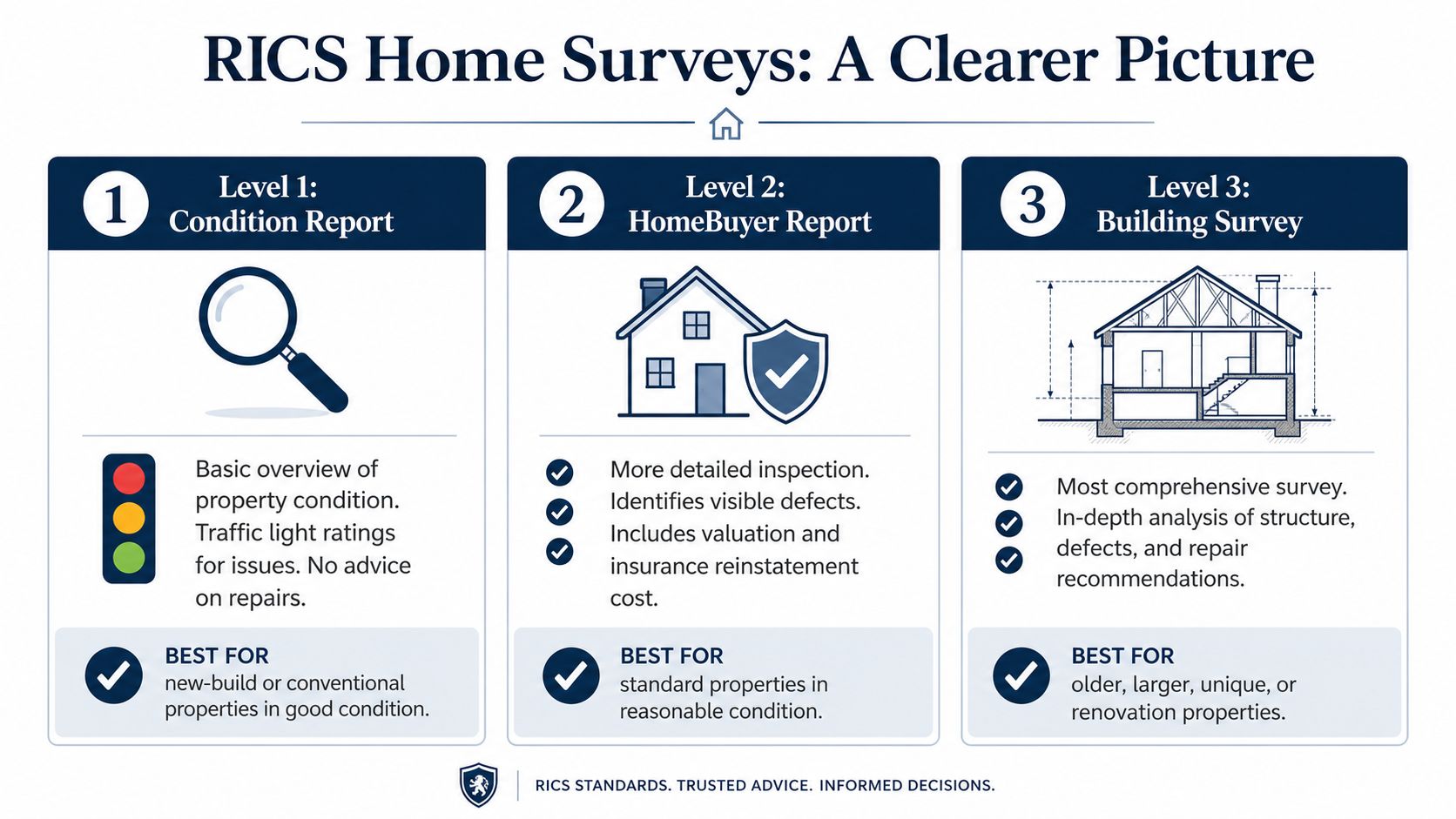
If you want a more detailed side-by-side explanation, this comparison of homebuyer report vs building survey is worth reading.
RICS survey levels compared
| Feature | Level 1 (Condition Report) | Level 2 (HomeBuyer Report) | Level 3 (Building Survey) |
|---|---|---|---|
| Inspection depth | Basic visual overview | More detailed visual inspection | Most detailed visual inspection |
| Best for | Newer or straightforward homes in good condition | Conventional properties in reasonable condition | Older, altered, larger, dilapidated or non-standard homes |
| Defect analysis | Limited | Identifies visible defects | Detailed analysis of defects and likely causes |
| Repair advice | No real repair advice | Some guidance | Clear remedial options, with estimated costs where practicable |
| Accessible areas checked | Limited scope | Standard scope | Wider range of accessible areas |
| Valuation included | No | Often available in the Level 2 survey and valuation option | No, not as standard |
| When I'd recommend it in London | Rarely for period stock | A modern flat or straightforward post-war house | Victorian terraces, conversions, listed buildings, loft-altered homes |
A mortgage valuation isn't a survey. It exists for the lender, not for you.
That's the point buyers need to grasp. In places like Peckham, Dulwich, Blackheath and Westminster, the value often sits in older buildings with layers of alteration. Those are not Level 1 properties. Quite often they are not Level 2 properties either.
Who Needs a Building Survey for a London Property
If the property is older, unusual or has been messed about with, get a building survey. That's the simple advice.
Properties that need Level 3
Some categories are obvious:
- Older houses: Victorian, Edwardian and earlier homes.
- Listed buildings: These need careful assessment because repair methods and materials matter.
- Heavily altered properties: Loft conversions, rear extensions, basement works and internal wall removals all change risk.
- Non-standard construction: Anything outside ordinary brick cavity wall housing needs a closer look.
According to the English Housing Survey collection, approximately 23% of dwellings in England were built before 1919. That matters because a large share of the homes buyers chase in London fall into the age bracket where a Level 3 survey makes sense, and it is strongly recommended for pre-1900 properties and listed buildings.
London examples that matter
In Lewisham, Brockley and New Cross, Victorian terraces often hide long-term patch repairs. Fresh paint can cover damp staining. New plaster can disguise earlier movement or chimney issues.
In Bromley, Beckenham and Sidcup, many 1930s semis look solid and often are, but the weak points tend to be different: flat roof additions, old bay window defects, roof spread and alterations carried out over time without much thought for the whole structure.
In Bermondsey, Rotherhithe and parts of Southwark, converted flats can be awkward. The individual flat may look smart, but the key questions sit in the parent building: roof condition, fire separation, damp penetration, timber structure and how the conversion was executed.
Then there are central London properties in places like Westminster, Kensington and Islington. These may have had multiple refurbishments, lower ground floor tanking, chimney breast removals or rear additions. The nicer the finish, the more careful I'd be. Expensive kitchens don't strengthen a wall.
If you're concerned about historic leaks, staining or concealed moisture, practical reading such as this expert advice on water damaged homes can help you understand what to watch for before exchange.
Buyers often focus on décor. Surveyors focus on what had to be cut, moved, covered or supported to create that décor.
That's why a building survey works best on London stock. It deals with the building as it is, not as the brochure presents it.
What a Surveyor Actually Checks from Roof to Foundations
A proper building survey follows the building logically. Top to bottom. Outside and inside. The job is to inspect all accessible parts and make sense of how the building behaves.
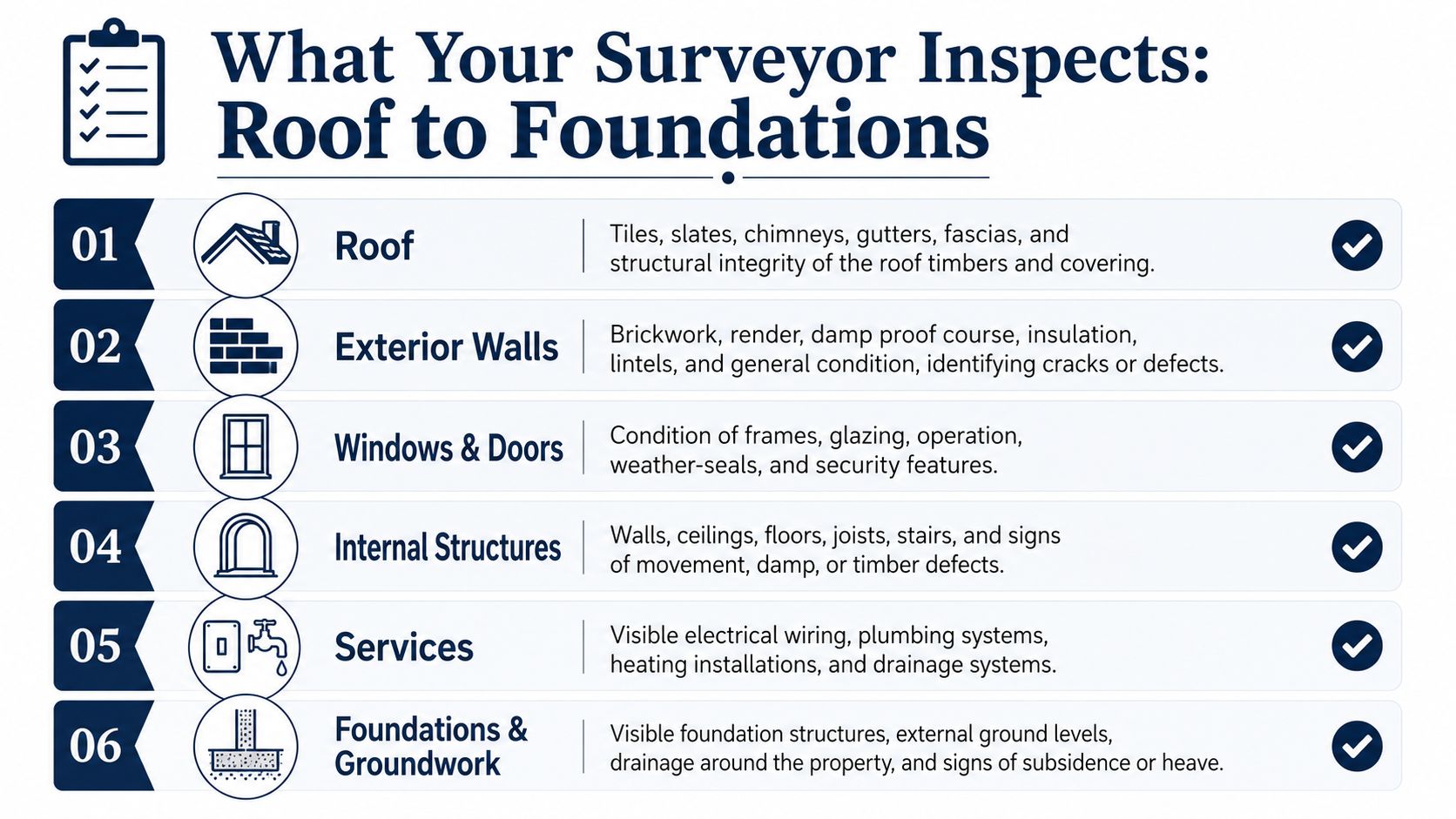
A UK building survey involves a technical examination of all accessible parts, including roof voids and subfloor spaces, and can last from two hours to a full day. Surveyors may also use thermal imaging cameras to detect hidden moisture and moisture meters at floor-wall junctions, as explained in the HomeOwners Alliance guide to building surveys.
What accessible areas means
Accessible doesn't mean everything. It means the surveyor inspects what can reasonably be reached and seen without damaging the property.
That may include lofts, roof voids and subfloor spaces where there is safe access. It does not mean ripping out plaster, lifting fitted finishes or opening up sealed construction.
If you want a plain-English explanation of what a full structural survey involves, that term is often what buyers still use for a Level 3 building survey.
What gets checked
The inspection usually covers:
- Roof coverings and structure: Tiles, slates, flashings, chimney stacks, gutters and the condition of roof timbers.
- Walls and external envelope: Brickwork, pointing, render, cracks, bulging, movement and damp entry points.
- Floors and internal structure: Joists, unevenness, spring, staining, timber decay and signs of previous alterations.
- Windows and doors: Condition, operation, decay, failed seals and defects that let in water.
- Services visible during inspection: Plumbing, heating, drainage and electrics as far as can be seen, though specialist testing is separate.
- Site and ground: Drainage falls, external ground levels and visible evidence of movement or risk around the building.
A short video can help if you want to picture the process before instructing a survey.
On roofs in particular, the principles are similar across sectors. This guide to protecting commercial roofing assets is aimed at a different market, but it's useful for understanding why early roof inspection matters and why small defects are often not small for long.
Good surveying is not just spotting a defect. It's explaining why it has appeared and what you need to do next.
That's the difference between a checklist and professional judgement.
Common Defects Found in London Properties
London property has patterns. Different boroughs throw up different headaches, but the same themes keep coming back.
Period houses
In Lewisham, Catford, Sydenham and Walthamstow, older terraces often suffer from damp in rear additions and lower ground areas. Sometimes it's defective rainwater goods. Sometimes high external ground levels. Sometimes cement render or hard repointing has trapped moisture in walls that were meant to breathe.
In Islington, Camberwell and parts of Lambeth, I'd pay close attention to chimney breast removals and internal wall alterations. Buyers often see the extra room and forget to ask what is now holding up the masonry above. Poor support can create cracking, distortion and expensive remedial work.
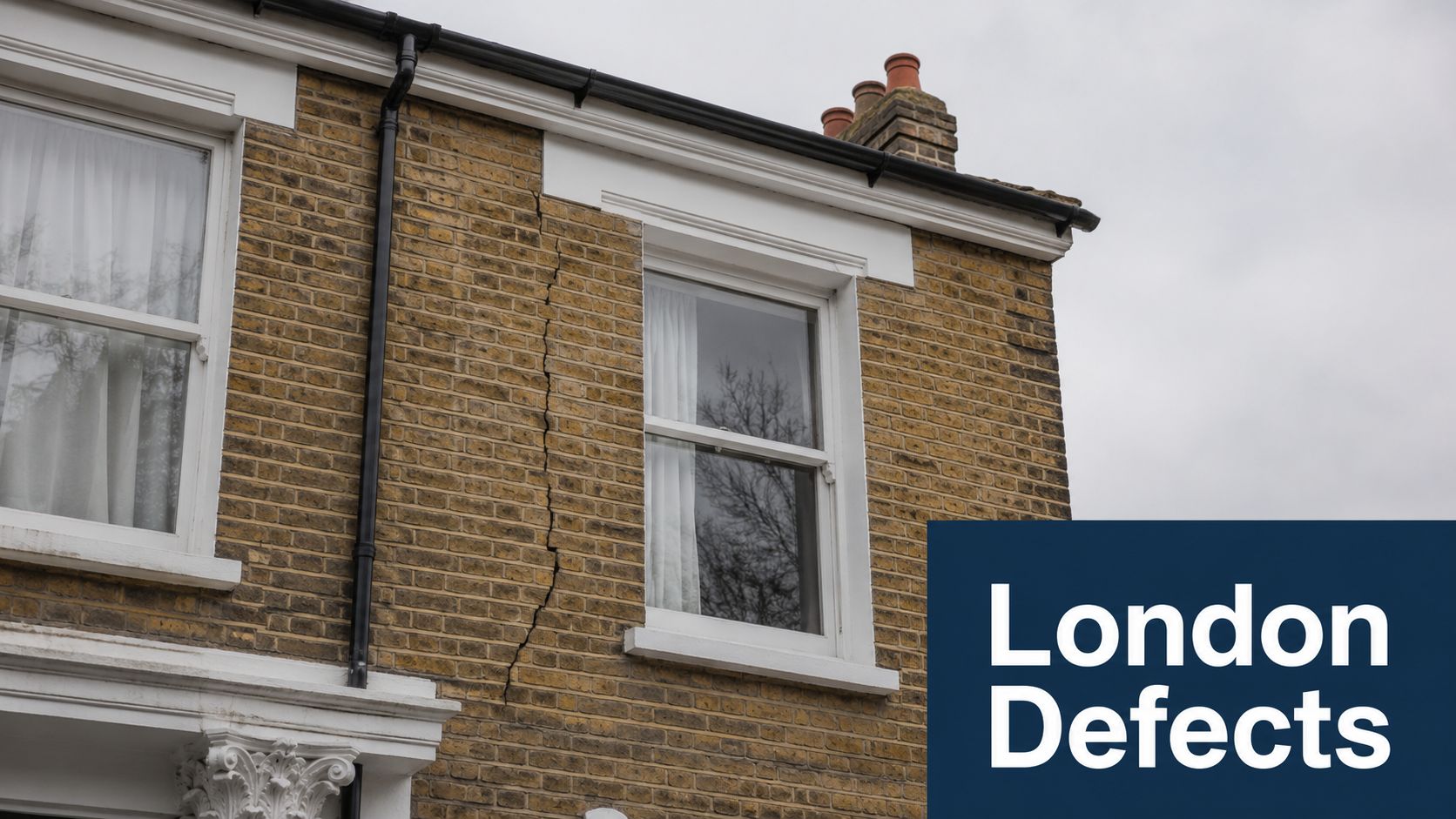
In Greenwich, Blackheath and Hackney, the issue may be historic movement. Not every crack means active subsidence. Some cracking is old and stable. Some isn't. The surveyor's job is to read the pattern, width, location and surrounding evidence, then tell you if further structural advice is needed.
Conversions and later housing
In Bermondsey and Southwark, warehouse and terrace conversions can bring a different set of concerns. Uneven floors, crude steelwork, damp bridging, poor sound insulation and awkward service routes are all common enough to deserve scrutiny.
In Bromley, Eltham and Bexley, 1930s semis usually present more predictable construction, but they're often altered. Watch the junctions between the original house and later extensions. Flat roof additions, widened openings and dated roof coverings are regular trouble spots.
In Croydon, Crystal Palace and Norwood, you may also see signs of structural movement that need proper interpretation. London clay, drainage defects and tree influence can all play a part, but the survey needs to focus on what the building is showing, not on guesswork.
A survey is valuable here because defects don't arrive one at a time. A leaking valley can lead to rotten timbers. A blocked gutter can become internal damp. A removed breast can crack the party wall. Buildings fail in chains, not in neat categories.
The expensive problem is often the second problem. The first one was the leak or the alteration that nobody dealt with properly.
That is why local knowledge matters. Victorian stock in Peckham behaves differently from a 1930s semi in Orpington or a conversion flat in Westminster.
The Limits of a Survey and What Is Not Included
Buyers need a straight answer. A building survey is detailed. It is not magical.
What a Level 3 survey can't do
A Level 3 survey is still a visual inspection of physically accessible areas. Surveyors don't normally lift floorboards, move heavy furniture, pull down ceilings or break into construction to see what is hidden.
That matters more than most buyers realise. A consumer review cited here found that 34% of homeowners who bought older London properties built before 1900 discovered major structural defects after the sale that were not flagged in their Level 3 survey, mainly because floorboards were not lifted and the inspection was limited to physically accessible areas.
So if a seller has laid new carpets over weak floors, boxed in plumbing or packed the loft with belongings, there are limits to what can be seen. A good surveyor should say so plainly in the report.
What is not included as standard
A standard Level 3 survey also does not include everything buyers assume it does.
For example:
- Market valuation: A Level 3 survey does not include a valuation as standard.
- Insurance reinstatement cost: That is a separate service, not bundled into the usual Level 3 report.
- Specialist testing: Electrical testing, gas safety checks, drain surveys and invasive damp investigations are separate instructions where needed.
If the report raises concerns about wiring, follow that up with proper home electrical testing advice. Visible signs can point to risk, but they don't replace specialist inspection.
If a surveyor says further investigation is needed, that isn't a cop-out. It's the correct professional advice when the visible evidence points to a hidden issue.
That honesty protects you. It doesn't waste your time.
How to Commission a Surveyor and Use the Report
You are about to exchange on a London property. The estate agent says the flat in Walthamstow is “in great condition”, the seller wants a quick commitment, and the photos look tidy. That is exactly when you need a surveyor who knows London stock properly, not someone who treats a Victorian terrace in Haringey the same as a 1930s semi in Bromley or a loft conversion in Southwark.
Pick the surveyor with as much care as the survey type. A weak inspection can leave you with a polished report that tells you very little.
How to choose properly
Ask blunt questions before you instruct:
- Are you RICS regulated? You want a surveyor working to a recognised professional standard with a formal complaints process.
- Do you inspect this type of London property regularly? Period houses, mansion flats and converted houses all fail in different ways.
- Are you independent? Keep clear of anyone too close to the estate agent, lender or developer.
- Who will inspect the property, and what are their qualifications? Ask for the actual surveyor's name, not just the firm's branding.
- What will the report tell me in practical terms? You need defects, likely causes, repair priorities and clear advice on what to do next.
- How quickly can you inspect and report? In London, delay can cost you the property. Slow reporting can also leave you scrambling before exchange.
One firm that fits that brief is Corinthian Surveyors London LTD, an independent practice based in Forest Hill, regulated by RICS, with Clive Thompson holding both RICS and CABE qualifications. The firm covers London boroughs and focuses on residential property, which is the sort of relevant experience buyers should look for.
How to use the report
Use the report as a buying tool.
A good Level 3 report should give you enough detail to make a decision with your eyes open. That means understanding what is wrong, what needs urgent attention, what can wait, and where a specialist should step in. In London, that matters because repair costs rise quickly once scaffolding, party wall issues, parking suspensions and access restrictions are involved.
Use the report in three clear ways:
- Set a real repair budget. If the survey flags slipped slate tiles on a Victorian roof in Islington, rotten sash windows in Greenwich, or defective rainwater goods on a 1930s semi in Ealing, get prices before you exchange.
- Renegotiate on evidence. Send the relevant pages to your solicitor and estate agent, then ask for a price reduction that reflects the actual defects. Keep it specific and costed.
- Decide whether to proceed at all. Some defects are manageable. Others point to a building that will absorb cash for years, especially in older conversions where the wider structure has been neglected.
Do not send the whole report to the seller and hope for the best. Pull out the main defects, the likely consequences, and the items that affect value or safety. Then get quotes where the surveyor recommends further investigation or repair. That puts you in a stronger position than vague complaints about “issues raised in the survey”.
If anything in the report is unclear, call the surveyor and ask them to explain it in plain English. A decent surveyor will tell you, directly, whether you are looking at routine maintenance, a serious defect, or a reason to walk away.
If you're buying in London and need a clear view on what you're taking on, speaking to a qualified surveyor before exchange is the sensible step. For practical guidance, call 0800 00 16 422.
Building Survey Frequently Asked Questions
| Question | Answer |
|---|---|
| Is a building survey the same as a structural survey? | In everyday use, many people still say structural survey. For most homebuyers, they mean a RICS Level 3 Building Survey. |
| How long does a building survey take? | A typical building survey can take from two hours to a full day, depending on the property and access, as noted earlier in the HomeOwners Alliance guidance. |
| Does a building survey include a valuation? | No. A Level 3 survey does not include a market valuation or insurance reinstatement cost as standard. Those are separate reports. |
| Is a building survey worth it on a flat? | Often, yes. It can be very useful for older conversions, unusual buildings and flats where the main risk sits in the structure of the wider building, not just inside the unit. |
If you need a plain-English view of a London property before you commit, Corinthian Surveyors London LTD provides residential surveys across London and the South East, including Level 1, Level 2 and Level 3 inspections, along with valuations and related advice. The sensible move is to choose the survey that matches the actual building, not the one that looks cheapest on paper.