
Home Electrical Testing: EICR for London Properties
You've found a flat in Peckham, a terrace in Forest Hill or a conversion in Brockley. The kitchen looks new. The walls are freshly painted. The lights come on, so everyone carries on as if the electrics are fine.
That's exactly how buyers get caught out.
Electrics are one of the easiest things to miss during a viewing and one of the worst things to inherit after completion. You can see damp staining. You can often spot cracked render or movement. You cannot see old cable insulation, loose connections or a tired consumer unit buried behind a cupboard door. If you're buying in London, especially older stock, home electrical testing belongs on your list with the survey, not as an afterthought.
Table of Contents
- Beyond Fresh Paint The Hidden Dangers in Your Walls
- Understanding Your Electrical Testing Options
- When Is Electrical Testing a Legal Duty
- What Happens During an Electrical Inspection
- How to Read an Electrical Installation Condition Report
- Using Electrical Reports in a Property Sale
- How Corinthian Surveyors Integrates Electrical Findings
- FAQ
Beyond Fresh Paint The Hidden Dangers in Your Walls
A lot of London homes sell on appearance. New flooring, spotlights, smart kitchen, neat bathroom. Buyers walk through and think the expensive work has already been done.
Sometimes it has. Sometimes someone has spent money on the parts you can photograph and ignored the parts that can hurt you.
That matters because electrical hazards are the single most significant identifiable cause of accidental dwelling fires in the UK, accounting for 53.4% of accidental home fires in England, which translates to over 20,000 domestic fires annually caused by electricity according to UK electrical fire statistics. A significant portion comes from faults in fixed wiring, which is exactly what an EICR, an Electrical Installation Condition Report, is meant to pick up.
In London, the risk often hides in plain sight. Victorian terraces in Lewisham, Edwardian houses in Dulwich and conversions in Camberwell can all look tidy while still carrying old wiring routes, poor alterations or consumer units that belong to another era. A seller may not know there's a problem. Equally, they may know and hope nobody asks.
Surface condition tells you very little
A socket faceplate can look fine and still have loose connections behind it. A fuse box can sit in a hallway cupboard and appear serviceable to a buyer who has no reason to question it. A recent redecoration can hide chasing, patch repairs and old cable runs.
That is why home electrical testing matters. It goes beyond what you can see during a viewing.
Practical rule: If the property is older and there is no recent electrical report, assume nothing.
An EICR is not a fussy extra. It is part of proper due diligence. Buyers understand the need to check for damp, subsidence and roof defects. Electrics deserve the same treatment because the consequences are immediate. Shock risk. Fire risk. Expensive remedial work after you already own the place.
If you are buying a flat in a converted house in New Cross or a period maisonette in Brixton, do not let cosmetic condition persuade you that the hidden services are sound. They may be. They may not. The point is that you won't know without the right test.
Understanding Your Electrical Testing Options
The jargon confuses people. That confusion costs buyers money because they order the wrong thing or think a basic check covers more than it does.
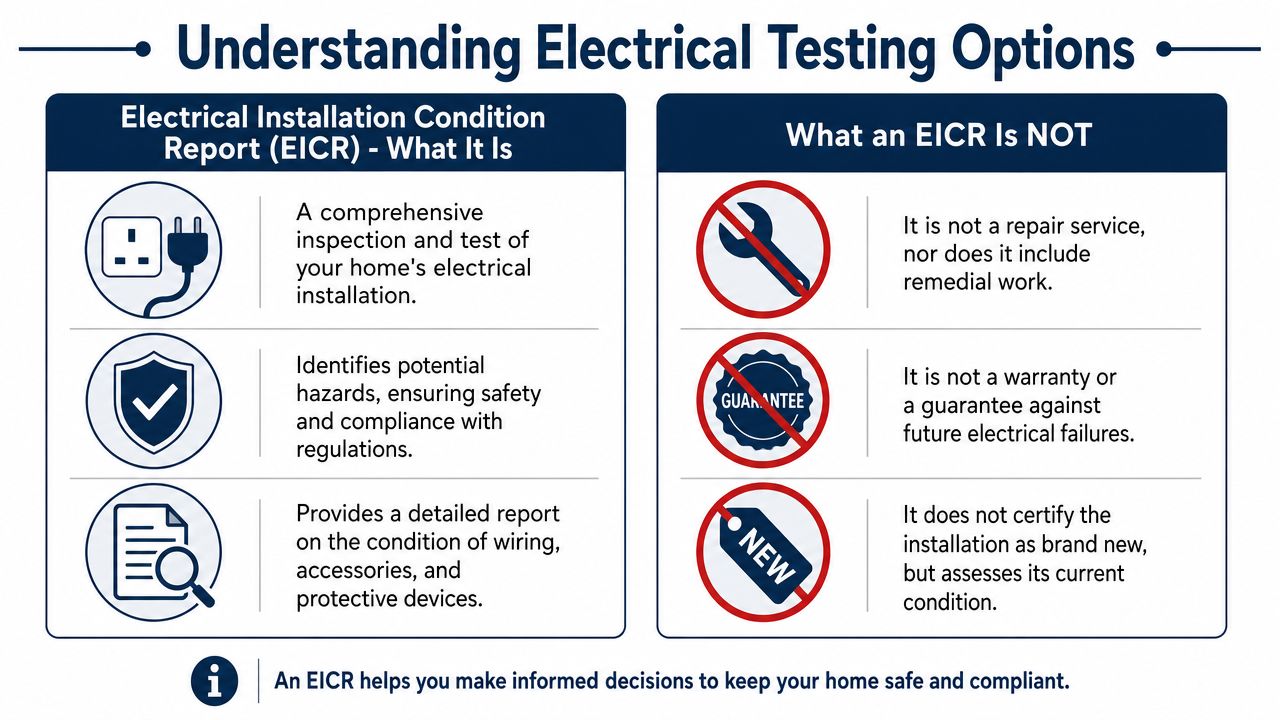
The term you need to know is Electrical Installation Condition Report, usually shortened to EICR. You'll also hear people call it a periodic inspection. Same idea. It is a proper inspection and test of the property's fixed electrical installation.
If you're unclear on where this fits alongside a property survey, this explanation of what is a RICS survey helps put the pieces in order.
What an EICR actually covers
Think of an EICR as an MOT for the home's fixed electrics. It looks at the installation that stays with the building:
- Consumer unit: The fuse box, breakers and protective devices.
- Circuits: The wiring feeding sockets, lights and fixed points.
- Accessories: Sockets, switches and light fittings that form part of the installation.
- Safety measures: Earthing, polarity, insulation resistance and protective operation.
The point is safety and condition. The electrician is checking whether the installation is satisfactory for continued use and whether there are defects that need attention.
What it does not cover
Buyers often get the wrong end of the stick. An EICR is not Portable Appliance Testing, usually called PAT.
PAT applies to moveable items with a plug. Kettles. Toasters. Lamps. Washing machines if they are plug-in appliances. Those items are not the fixed wiring of the building.
A simple way to remember it is this:
| Test | Main focus | Typical examples |
|---|---|---|
| EICR | Fixed installation | Consumer unit, sockets, switches, fixed circuits |
| PAT | Plug-in items | Kettle, toaster, lamp, office equipment |
A flat can pass a check on plug-in appliances and still have poor fixed wiring. The two jobs are different.
An EICR also isn't a repair service, a warranty or a promise that nothing will fail later. It is a condition report based on inspection and testing at the time. That distinction matters. Buyers should use it to understand risk, not as a comfort blanket.
If you are buying, selling or letting, ask for the right document by name. Say EICR. If someone starts talking about appliance checks when your concern is the wiring in the walls, you are not discussing the same thing.
When Is Electrical Testing a Legal Duty
There is a legal side and there is a sensible side. Don't confuse them.
Landlords have a clear legal duty
For landlords in England, an EICR every five years is mandatory for all 4.9 million private rented dwellings according to UK electrical safety data. The same source notes that for homeowners, the recommended interval is ten years, and the average cost is between £100 and £250.
If you're wondering where electrical checks sit within the wider buying process, this guide on whether you need a survey when buying a house is worth reading.
For landlords, this isn't optional paperwork. It is a statutory duty tied to safety and compliance. If the property is rented, regular inspection and testing is part of the job.
Homeowners should be stricter with older London stock
Owner-occupiers don't have the same legal requirement, but the ten-year recommendation is too relaxed for plenty of London properties. That is my view and I'll say it plainly.
If you're buying a Victorian terrace in Catford, a split flat in Sydenham or an Edwardian house in Greenwich, the age of the building alone should make you cautious. Many homes have been altered repeatedly. Extensions get added. Kitchens move. Loft rooms appear. Old circuits get retained beside newer work. A neat finish does not mean a coherent electrical installation.
The cost is usually modest compared with the cost of buying blind. That is the key point. Buyers will spend serious money on stamp duty, solicitors, removals and decoration, then hesitate over a report that could stop them inheriting dangerous or outdated electrics.
Use common sense:
- Rental property in England: Test at the legal five-year interval.
- Owner-occupied newer home: The ten-year recommendation may be serviceable.
- Older London property: Don't wait for a neat round number. A pre-purchase EICR or a shorter cycle is more sensible.
If the property predates modern wiring standards and no recent report exists, treat electrical testing as part of the acquisition cost.
That applies particularly in boroughs with a lot of period stock, such as Lambeth, Southwark, Lewisham and parts of Bromley. Buyers there should assume that age raises the chance of mixed standards, old alterations and incomplete upgrades. A cheap report can answer expensive questions.
What Happens During an Electrical Inspection
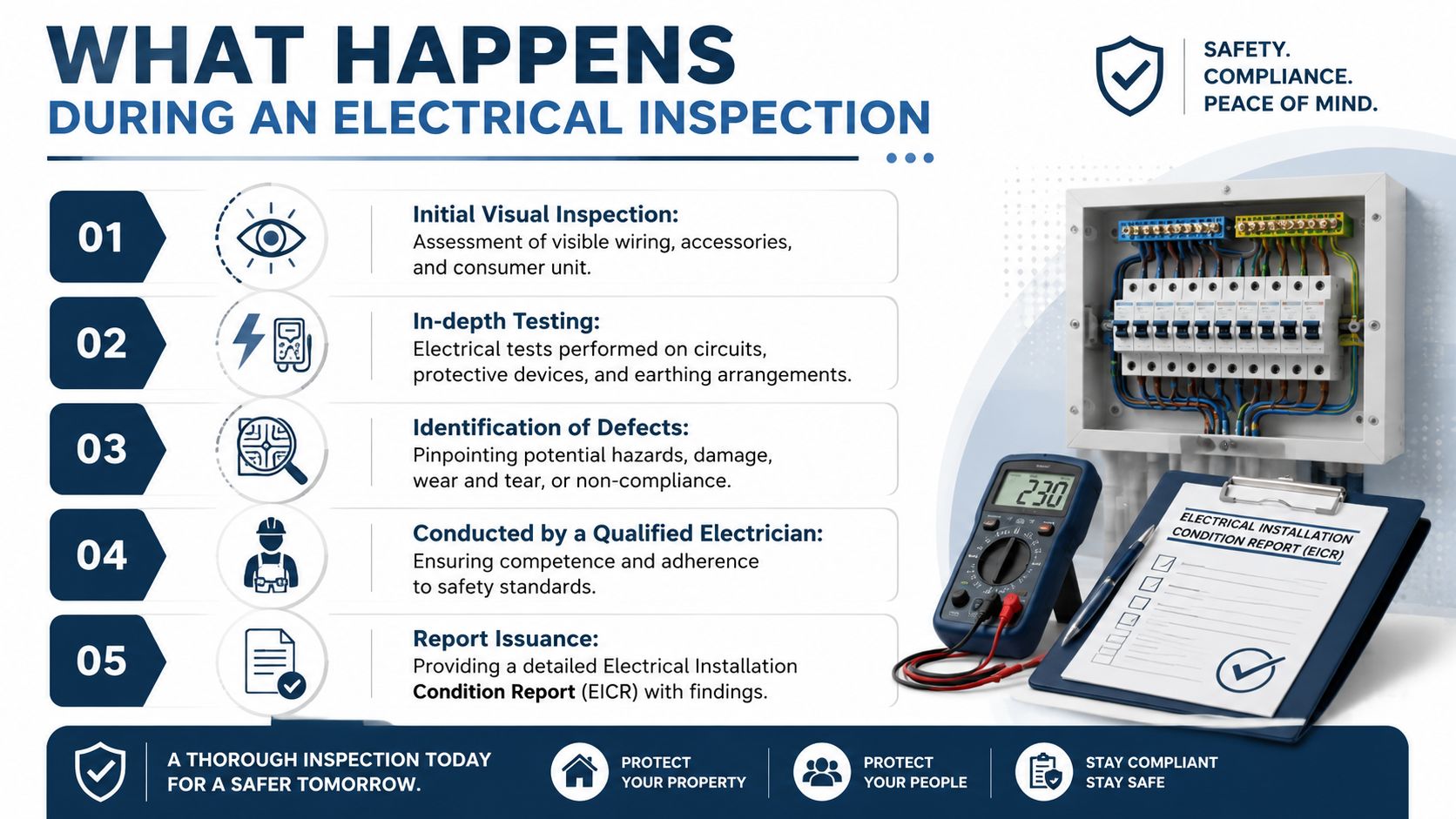
A proper EICR is carried out by a qualified electrician. Not a handyman. Not a builder having a look. Not the seller saying, “It's always been fine.”
The electrician is testing, not guessing
Under BS 7671, an EICR involves mandatory dead tests on circuits, including insulation resistance and polarity checks, and Electrical Safety First guidance on wiring regulations states that Guidance Note 3 requires the electrician to open up and internally examine at least 20% of accessories such as sockets and switches for thermal damage or loose connections.
That tells you two things. First, this is more than a glance at the fuse box. Second, some defects are found only when parts are opened up.
The inspection usually includes a visual review first. The electrician looks at the consumer unit, visible wiring, sockets, switches and signs of damage or amateur work. Then they move on to testing. Some of that is done with the power isolated, which is the dead testing. Some is done with the power on, which is live testing.
Later in the process, seeing a visual walkthrough helps buyers understand why this is specialist work.
What they are looking for in plain English
The technical labels sound dry, but the practical questions are simple:
- Is the wiring sound: Or is there deterioration that could lead to overheating or failure.
- Are safety devices working: If a fault occurs, will the installation disconnect properly.
- Are sockets and switches safe inside: Not just tidy on the outside.
- Has someone carried out poor alterations: DIY additions and ad hoc changes often create major problems.
Typical concerns include loose terminations, signs of overheating, old consumer units, poor labelling and missing or inadequate protection. In period homes across places like Balham, Walthamstow and Hackney, I often tell buyers to pay close attention where there has been piecemeal refurbishment. New lights and sockets can be fitted onto an old or muddled system.
A good inspection also sits alongside broader property safety thinking. If you are reviewing the house as a whole, this guide for residential security care is useful because buyers often need to consider alarms, entry systems and general safety measures at the same time as the electrics.
Don't ask an electrician for “a quick check”. Ask for an EICR. Those are not the same thing.
This is one of those jobs where precision matters. If you want answers you can rely on during a purchase, you need the proper test and the proper report.
How to Read an Electrical Installation Condition Report
Buyers often receive an EICR and then stare at the codes as if they're reading a foreign language. You don't need to be an electrician to understand the basic message.
What the codes mean for a buyer
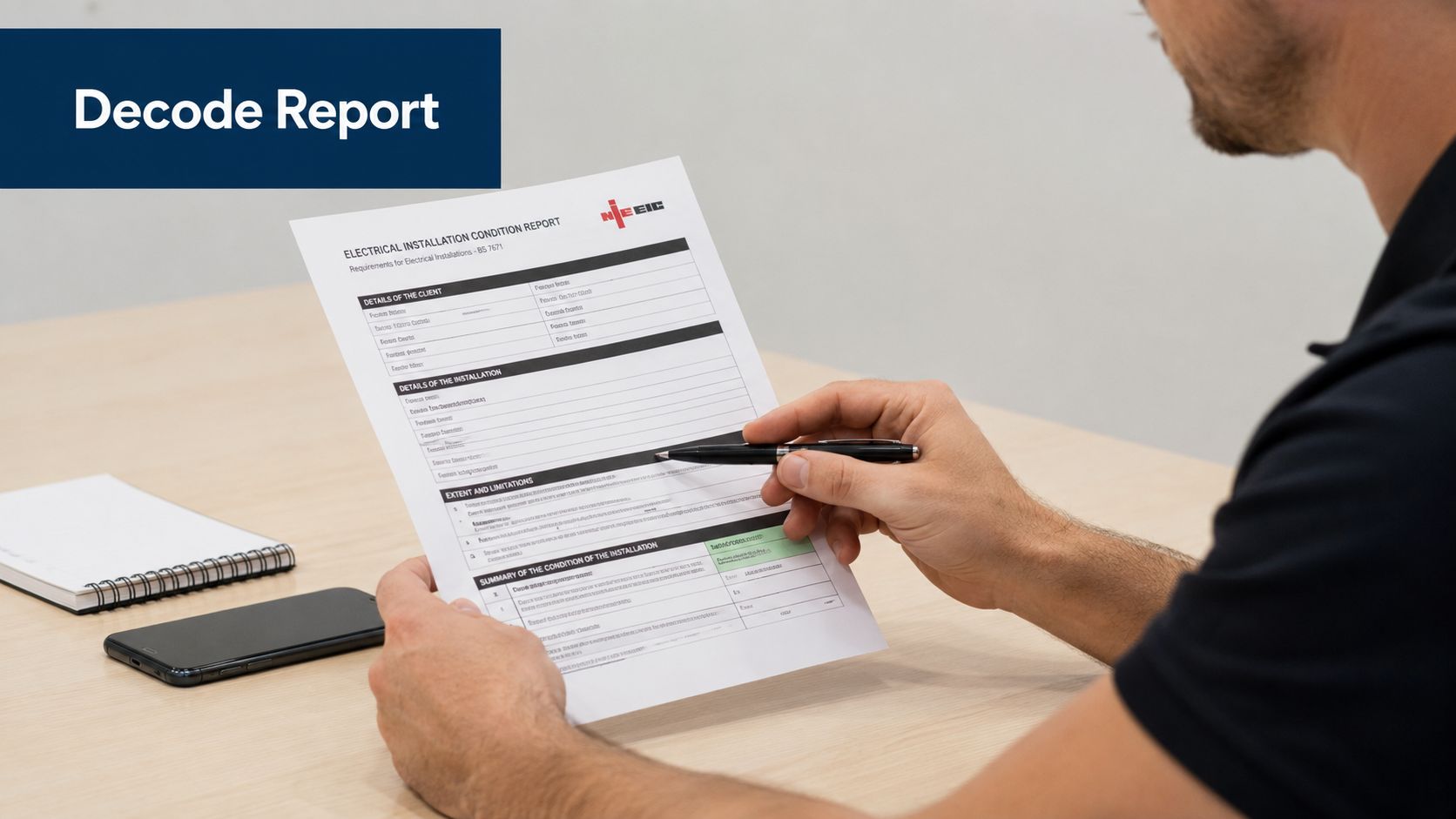
A key part of the report is the classification of defects. As explained in this guide to an Electrical Installation Condition Report, and reflected in Aspect's explanation of electrical safety checks, an old 1960s fuse board without modern RCD protection would likely be flagged as a C2, meaning potentially dangerous, while a lack of labelling on the fuse box might be a C3, meaning improvement recommended. The report covers fixed wiring, not plug-in appliances.
Here is the plain-English version:
| Code | Meaning | What it means for you |
|---|---|---|
| C1 | Danger present | Immediate risk. Sort it at once. |
| C2 | Potentially dangerous | Not good enough. Remedial work is needed. |
| C3 | Improvement recommended | Not ideal, but not usually urgent. |
| FI | Further investigation required | The electrician has seen enough to be concerned and needs more investigation. |
If you see C1 or C2, do not brush it off. Those are not cosmetic remarks. They affect safety and they affect your decision-making.
Satisfactory does not mean perfect
This catches people out. A satisfactory report does not mean the installation is new or flawless. It means the electrician considers it suitable for continued use at the time of inspection.
An unsatisfactory report means there are issues serious enough to require action. That is often where buyers gain clarity. You stop arguing about vague suspicion and start dealing with a written list of defects.
Read the schedule of observations, not just the word at the front of the report.
If you are buying an older flat in Islington or a house in Crystal Palace, the schedule matters because it tells you where the money and risk may sit. A C3 may be manageable. A C2 tied to old protection arrangements is a different matter altogether.
Using Electrical Reports in a Property Sale
The question buyers ask is simple. Who pays for the EICR.
Who pays for the EICR
There's no legal rule for who pays, but buyers in London's older property market are increasingly commissioning their own pre-purchase EICRs, and in areas like Forest Hill, where many homes pre-date modern wiring standards, a five-year check is more prudent than the recommended ten. An unsatisfactory report provides firm grounds for price negotiation, as noted in Electrical Safety First's homeowner questions and answers.
That is the practical answer. If the seller won't provide one, the buyer should consider ordering one, especially on older stock. Waiting for certainty to appear by itself is not a strategy.
If you later need to negotiate, this guide on how to negotiate house price after survey gives the right approach.
How buyers use the report properly
Treat the EICR as a decision tool.
If the report comes back satisfactory, you have reduced uncertainty. That has value on its own. If it comes back unsatisfactory, you have evidence. Not estate-agent talk. Not opinion from a relative. Evidence.
Use it in one of three ways:
- Request remedial works before exchange: Sensible where the defects are clear and the seller is cooperative.
- Renegotiate the price: Often the cleaner route. You keep control of the work after completion.
- Walk away: Sometimes the electrical findings add to other defects and tip the balance.
This matters in competitive areas such as Dulwich, Battersea and Bermondsey where buyers feel pressure to keep things moving. Don't let urgency make you careless. If the wiring is questionable, it will still be questionable after you complete.
The cheapest time to discover an electrical defect is before you own it.
That is why I tell buyers to think of home electrical testing as part safety check, part negotiation tool. It protects your position on both fronts.
How Corinthian Surveyors Integrates Electrical Findings
A RICS survey and an EICR are not the same thing. They work together.
Where the survey stops
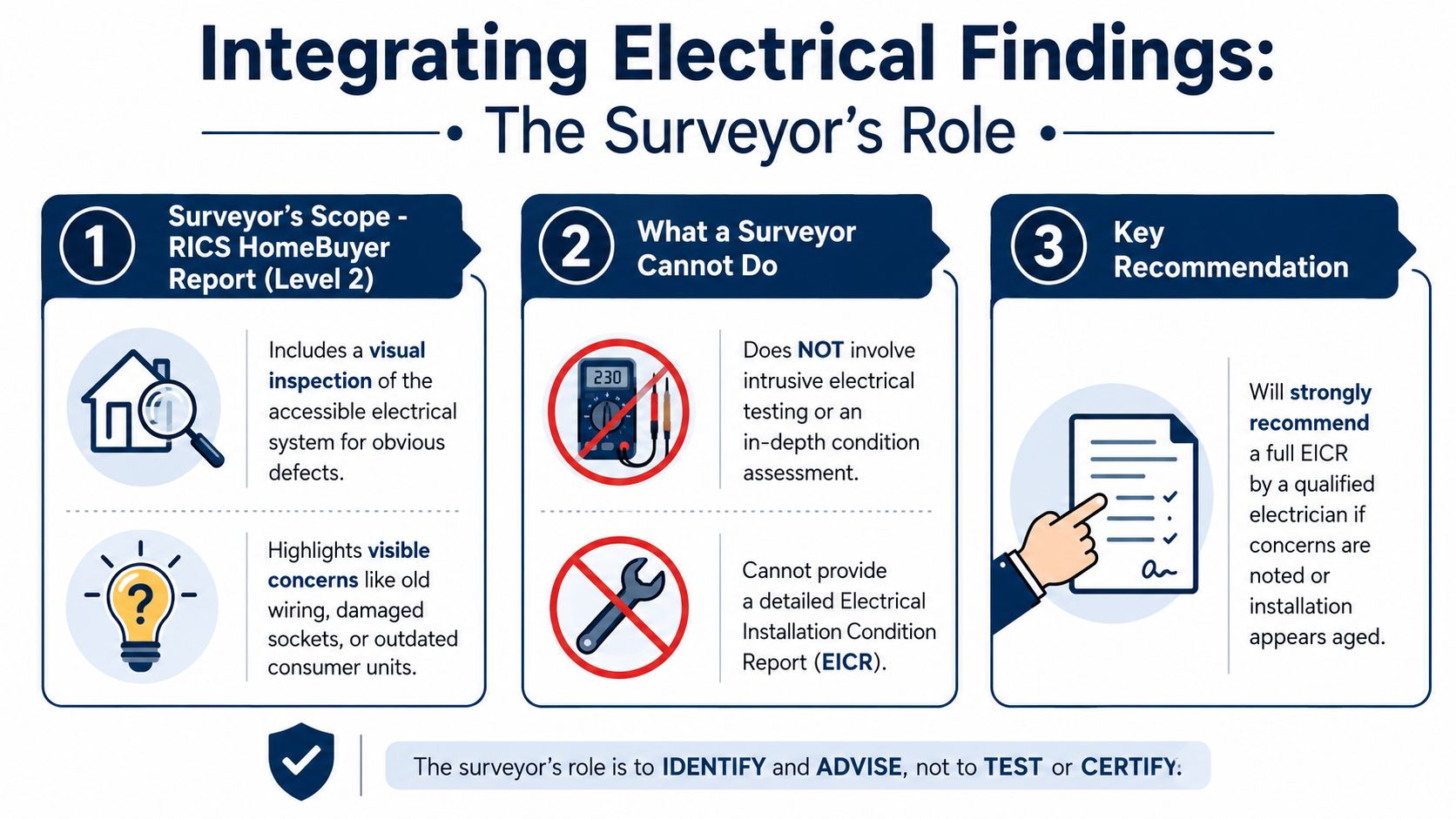
In a RICS Home Survey, the inspection of electrics is visual. That is an important limit. The surveyor looks at what is accessible and visible in the normal course of the inspection. Embedded wiring, concealed circuits and internal parts hidden behind covers are not opened up as part of the survey standard.
RICS uses a traffic light system for condition ratings. In that system, Condition Rating 3 means a serious defect requiring urgent repair, replacement or investigation, and the RICS description of the Level 3 survey condition ratings makes clear that this is the point where the need for specialist investigation becomes pressing.
In plain terms, a surveyor may see enough to say the electrics are a concern, but not enough to certify the installation. That is exactly where the EICR comes in.
How the two reports work together
This is the sensible sequence for a buyer:
- Start with the survey. The survey flags visible issues, age, alterations and warning signs.
- Read the rating properly. If the electrics are marked with a serious condition rating, act on it.
- Order the EICR. A qualified electrician then tests the fixed installation in detail.
- Put the findings together. The survey explains the wider property context. The EICR explains the electrical risk.
That joined-up view is what buyers need. A visual survey on its own can't answer hidden electrical questions. An EICR on its own won't tell you about roof spread, damp, structural movement or the broader condition of the building.
Corinthian Surveyors London LTD is an independent firm of RICS Chartered Surveyors and Valuers based in Forest Hill, run by Clive Thompson, who holds both RICS and CABE qualifications and has over 30 years of experience in the built environment. The firm covers all London boroughs and gives residential clients clear advice without ties to lenders, estate agents or developers. If a survey highlights electrical concerns, the point isn't to alarm you. It's to tell you what the concern means and what specialist step should follow.
FAQ
Does a RICS Level 2 survey include an electrical test
No. A Level 2 survey includes a visual inspection of the electrics that are accessible during the inspection. It does not replace an EICR.
Should I get an EICR when buying an older London property
Yes, especially if the property is older, has been altered over time or has no recent electrical paperwork. In much of London's period housing stock, that is the sensible approach.
What does an EICR not cover
It does not cover plug-in appliances such as kettles, lamps or toasters. It deals with the fixed wiring installation.
If the EICR is unsatisfactory, should I pull out
Not automatically. Read the defects, understand the likely remedial work and use the findings to renegotiate or require action. Sometimes the report gives you a stronger position before exchange.
If you are buying in London and want the electrical risk put in the right context, Corinthian Surveyors London LTD can help with an independent RICS survey that identifies when visual concerns about the electrics need a specialist EICR. That matters in older flats and houses across Forest Hill, Lewisham, Greenwich, Southwark, Bromley and the wider capital, where age, alterations and conversions often hide more than a viewing reveals. For straightforward advice on the right survey and the next step after a concerning condition rating, call 0800 00 16 422.