
What Is a RICS Survey? a London Buyer’s Guide 2026
A RICS survey is a professional health check for a property, carried out by a Chartered Surveyor to spot problems before you buy. It is not the same as the lender's mortgage valuation, which is for the bank and not for you.
You've viewed a flat in Bermondsey or a Victorian terrace in Lewisham. It looks fine. The estate agent says it's “in good order”. That means very little. Paint hides plenty. So do carpets, fitted wardrobes and a tidy loft hatch no one has opened for years.
If you want the plain answer to what is a RICS survey, here it is. It's an independent inspection of the property's condition, with a written report that helps you decide if you should proceed, renegotiate or walk away.
In London, that matters more than most buyers realise. Older stock, patched-up extensions, converted flats and long-standing maintenance all create risk. If you buy blind, you inherit the lot.
Table of Contents
- What a RICS Survey Is and Why You Need One
- The Three RICS Home Survey Levels Explained
- Matching the Survey to Your London Property
- What a Surveyor Actually Looks For
- The Survey Process From Instruction to Report
- How to Read Your RICS Report and What to Do Next
- Frequently Asked Questions About RICS Surveys
What a RICS Survey Is and Why You Need One
A RICS survey is a client-agreed inspection of a property. The surveyor looks at the construction and condition, reports on visible defects and, where needed, comments on maintenance and remedial work. RICS is clear on one point that buyers often miss: a survey is not a mortgage valuation. You can check that in the RICS guidance on surveying terms and definitions.
That difference matters. A mortgage valuation is for the lender's risk. A survey is for yours.
Why buyers get caught out
Most defects aren't dramatic. You don't usually walk into a house in Peckham and find half the roof missing. What you find are the expensive, dull problems. Damp around chimney breasts. Cracks that may be historic or may not. Rotten window joinery. A rear addition with poor detailing. A loft conversion that looks neat but raises questions.
Practical rule: If the property is old, altered, poorly maintained or simply expensive enough that a repair bill would hurt, don't skip the survey.
A proper survey gives you three things:
- Clarity: You know what can be seen and what can't.
- Priorities: You know which defects matter now and which can wait.
- Negotiation Support: You've got a professional report to support further enquiries or price discussions.
Why London buyers need to be stricter
London stock is rarely straightforward. In Forest Hill, Brockley and Sydenham you'll see plenty of Victorian and Edwardian houses with long histories of patch repairs. In Lambeth and Southwark, converted flats often come with altered layouts, shared responsibilities and awkward access. In Bromley and Croydon, extended family houses can hide workmanship issues behind fresh finishes.
A survey won't tell you everything. No honest surveyor says otherwise. But it will put observed defects and likely risks in front of you before you commit.
That's the key point. You're not paying for paperwork. You're paying to avoid a bad decision.
The Three RICS Home Survey Levels Explained
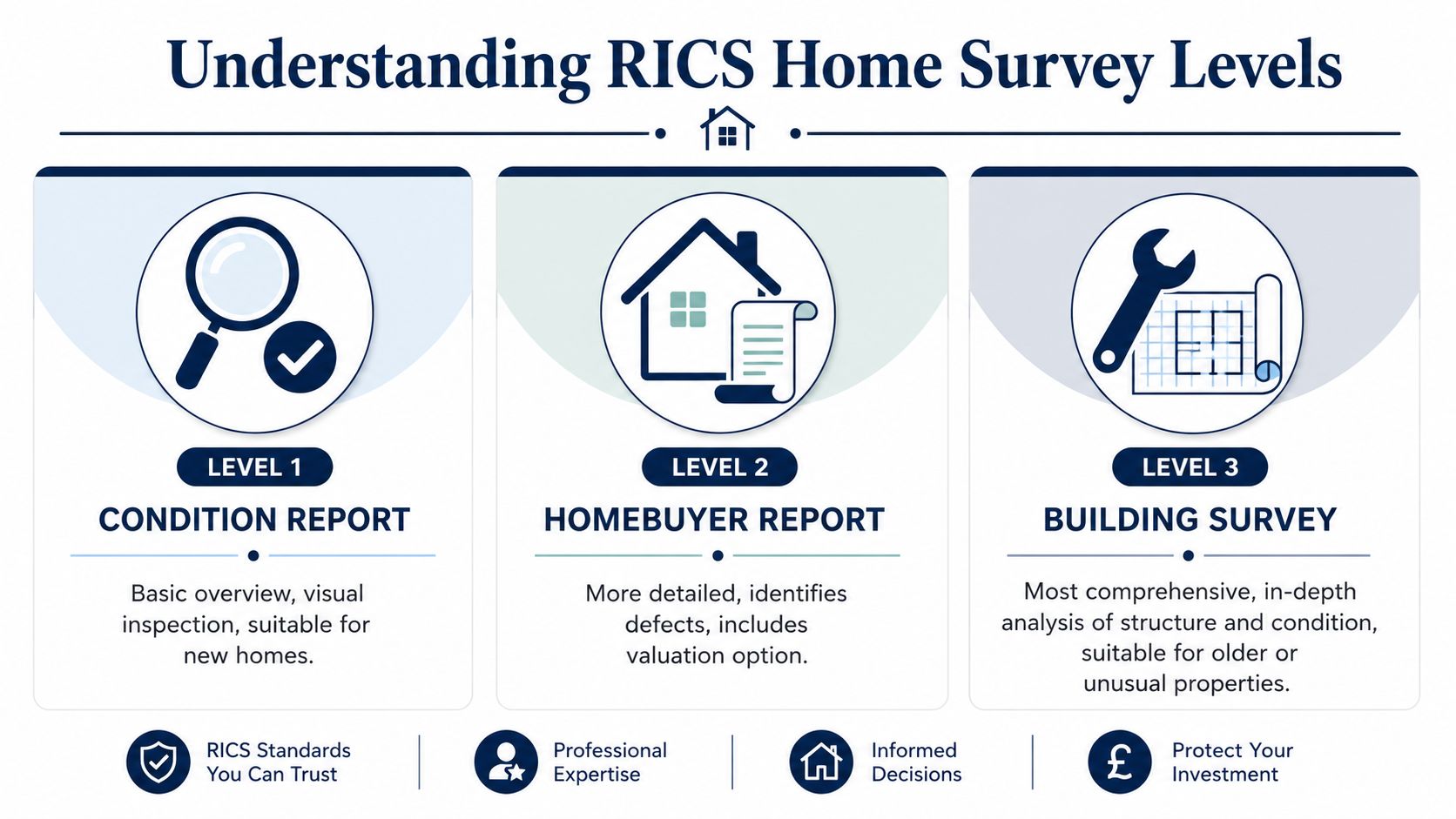
RICS doesn't treat this as one single survey product. In the UK there are three home survey levels: Level 1, Level 2 and Level 3. RICS says Level 1 identifies the property's condition, risks and urgent defects, while Level 3 is the most extensive and gives an in-depth analysis of defects, repairs and maintenance options. These surveys are carried out under the Home Survey Standard, which sets the professional rules surveyors must follow, as set out in the RICS consumer guide to home survey levels.
The three levels in plain English
Level 1
This is the lightest touch. It suits a fairly simple property where you want a basic overview of condition and obvious risks.
It is not the survey I'd choose for an older London house. It can have a place with a straightforward, newer home in decent order. Even then, buyers often need more than a basic overview.
Level 2
This is the survey many buyers mean when they say “HomeBuyer survey”. It's a visual inspection with more detail than Level 1 and is often the sensible middle ground for standard homes.
For a modern flat in Greenwich, a conventional house in reasonable order in Bromley or a newer maisonette in Woolwich, Level 2 is often enough. It tells you what's visibly wrong and where you may need further advice.
You can read a fuller breakdown in this guide to RICS survey levels explained and which one you actually need.
Level 3
This is the one for riskier buildings. RICS describes it as the most thorough option. If the property is old, altered, unusual or clearly in tired condition, this is usually the right choice.
Think Victorian terraces in Catford, Edwardian houses in Dulwich, listed homes, buildings with extensions of different ages or any property where you're already spotting warning signs. Level 3 gives more depth on defects, repairs and maintenance options. That's what you need when the building itself is part of the problem.
Buy a complicated property. Order a Level 3. Don't try to save money by choosing a lighter report and hoping for the best.
RICS Home Survey levels at a glance
| Feature | RICS Level 1 Survey | RICS Level 2 Survey | RICS Level 3 Survey |
|---|---|---|---|
| Best suited to | Simpler, newer properties | Standard homes in reasonable condition | Older, altered or unusual properties |
| Inspection style | Visual overview | More detailed visual inspection | Deeper inspection and analysis |
| Main purpose | Identify condition, risks and urgent defects | Identify visible defects and key issues | In-depth analysis of defects, repairs and maintenance |
| Repair advice | Limited | Practical advice | More detailed advice |
| Good fit for London stock | Rarely for older housing | Often suitable for standard flats and houses | Usually the right call for period buildings and altered homes |
What each level doesn't do
All three levels have limits. The surveyor visually inspects what is accessible. They don't start opening up walls and floors as part of a normal pre-purchase survey.
That means you should never read a clean report as a guarantee. Read it as a professional opinion based on what could be seen on the day.
Matching the Survey to Your London Property
The right survey depends less on your budget and more on the building in front of you. That's where buyers often get this wrong. They choose the cheaper option instead of the sensible one.
RICS survey standards are built around visual inspection of accessible areas, recording apparent defects and flagging issues that may need specialist investigation. RICS also says the survey should highlight problems that are not immediately obvious. That matters in London, where older housing, limited access and age-related deterioration can leave buyers with nasty surprises after completion, as explained in this guide to RICS property surveys and valuations.
Victorian and Edwardian houses
A Victorian terrace in Lewisham, Brockley or New Cross usually points to Level 3. Same goes for Edwardian houses in Dulwich or Forest Hill. These properties often have solid walls, ageing roofs, old chimney stacks, suspended timber floors and decades of alterations.
Typical questions include:
- Has there been movement: Cracking around openings, bay windows or party walls needs proper judgement.
- Is damp cosmetic or building-related: Old houses need the right diagnosis, not guesswork.
- Were alterations done properly: Removed chimney breasts and rear extensions can be fine or badly executed.
If you buy this sort of property with a Level 2 when a Level 3 was clearly needed, you're taking a shortcut in the wrong place.
Flats, conversions and newer homes
A purpose-built newer flat in Battersea, Stratford or Woolwich will often suit a Level 2. The structure may be simpler to assess from a purchase point of view, and the report can still flag visible defects, maintenance concerns and areas where your solicitor needs to ask questions.
Flat conversions are another matter. A converted house in Southwark or Lambeth can be more awkward than it first appears. Fire separation, sound insulation, roof responsibilities, ad hoc plumbing routes and altered walls all need careful thought. Depending on age and complexity, a Level 3 may be the wiser choice.
A few practical examples:
- 1930s semi in Bromley: Usually Level 2, unless heavily extended or poorly maintained.
- Ex-local authority flat in Camberwell: Often Level 2, but read the lease and block maintenance position carefully.
- Warehouse conversion in Bermondsey: Lean towards Level 3 if access is difficult or the structure is unusual.
- New-build flat in Nine Elms: Level 2 is usually sensible. Don't assume “new” means trouble-free.
If you want a plain checklist for picking the right surveyor as well as the right survey, this guide on how to choose a building surveyor in London without wasting time or money is worth reading.
What a Surveyor Actually Looks For
Buyers sometimes imagine a survey is vague. It isn't. A competent surveyor works through the building methodically and looks for defect patterns that tell a story.
The defects that matter
Start with the outside. Roof coverings, flashings, chimney stacks, parapets, gutters, downpipes, walls, pointing and joinery all matter because this is how water gets in.
Then move inward. Floors, ceilings, walls, signs of movement, damp staining, mould, timber decay and poor alterations often show up once you know what you're looking at.
Common trouble spots in London include:
- Roof defects: Slipped coverings, failed flashings, tired flat roofs and blocked rainwater goods
- Damp issues: Penetrating damp, condensation and moisture around solid walls or below leaking gutters
- Structural movement: Cracks around bays, extensions and party walls, especially where repairs have been cosmetic
- Timber problems: Rot in sub-floor voids, decayed sash windows and deterioration in roof timbers
- Bad alterations: Unsupported masonry changes, makeshift loft work and removed chimney breasts without obvious support
A surveyor's job isn't to frighten you. It's to tell you what the building is saying before you sign the contract.
Japanese knotweed is one of those issues that often comes up in buyer questions. A surveyor may note visible signs or recommend further advice, but mortgage implications are a separate point. If that issue appears in a report, it helps to find out about mortgage options with knotweed before you make assumptions.
What a survey can and can't confirm
A surveyor looks at accessible areas. That means they won't usually move heavy furniture, lift fitted floor finishes or carry out intrusive opening-up.
So the report may say there are visible signs consistent with damp, movement or poor workmanship, then recommend another specialist. That is not a weakness. That is the surveyor doing the job properly.
In older London property, a lot of value comes from that judgement. The issue isn't just spotting a crack. It's recognising whether the crack is probably historic, whether it lines up with a structural alteration and whether it changes the risk of the purchase.
The Survey Process From Instruction to Report
Once you've had an offer accepted, don't hang about. Instruct the survey early, while you still have room to think clearly and act on the findings.
What you need to do first
You'll usually need to provide the property address, asking price, estate agent details and the type of survey you want. If you're not sure about the level, say so. A decent surveyor should ask about the age, style and condition of the property before advising.
Keep it simple:
- Choose the survey level: Match it to the building, not your optimism.
- Book access: The surveyor will usually arrange this through the agent.
- Confirm the brief: Make sure you understand what is and isn't included.
Independence matters significantly. If the surveyor has no ties to the estate agent, lender or developer, the advice is cleaner. That's one reason many buyers use independent firms rather than relying on anyone linked to the transaction. Corinthian Surveyors London LTD is one such independent London practice, regulated by RICS, with Clive Thompson also holding CABE qualifications.
If you're comparing survey work with valuation work and trying to understand the difference in scope, this article on how much a house valuation costs helps sort out the terminology.
What happens after the inspection
The surveyor attends the property, carries out the inspection and then writes the report. The report should be clear enough that you can act on it. If it isn't, ask questions. That's part of the service.
A short video can help if you want a quick visual overview of the process.
Once the report arrives, read the summary first. Then look for urgent items, further investigations and anything your solicitor needs to raise.
Don't file the report away and hope your conveyancer will deal with it. Legal title and building condition are different jobs.
If you want to talk through the practical side before instructing, call 0800 00 16 422. That's often quicker than guessing your way through Level 2 versus Level 3.
How to Read Your RICS Report and What to Do Next
The first thing to understand is that a RICS report is there to help you decide, not to impress you with technical language.
How the traffic light ratings work
Most buyers go straight to the coloured condition ratings. Fair enough. That's where the urgency sits.
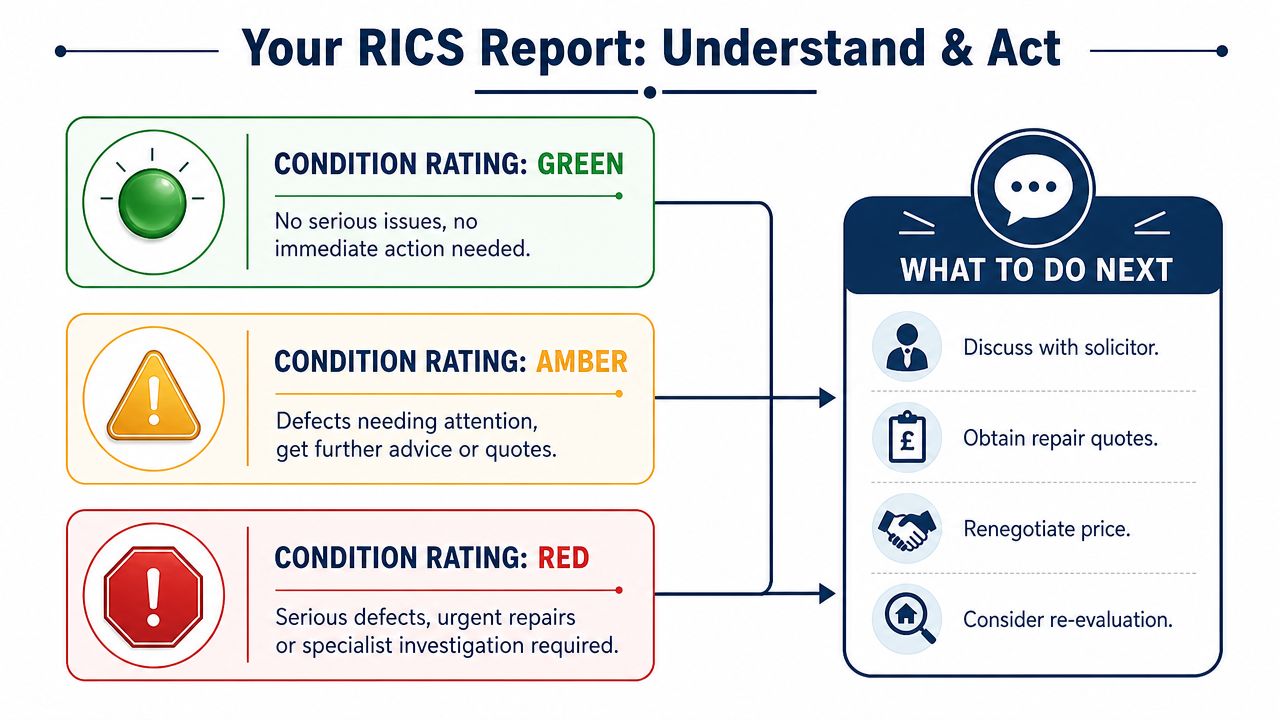
Use them like this:
- Green: No immediate action needed.
- Amber: Defects need attention. Get quotes and plan the work.
- Red: Serious concern. Investigate further, cost it properly and do not ignore it.
Then do the sensible next steps:
- Send key points to your solicitor: Especially anything involving structure, alterations, lease duties or guarantees.
- Get repair quotes: A report identifies the issue. A contractor prices the fix.
- Ask follow-up questions: If the wording is unclear, pick up the phone.
- Renegotiate if needed: Serious defects can change the deal.
- Walk away if the risk is wrong: That is sometimes the smartest outcome.
A survey has done its job if it stops you buying trouble at the wrong price.
Don't panic if the report contains defects. Most properties do. The main question is whether the defects are manageable, properly understood and reflected in the price.
Frequently Asked Questions About RICS Surveys
Does a RICS survey include a valuation
Sometimes a Level 2 can include a valuation, depending on the instruction. Don't assume it does. Ask before you book. A survey and a valuation are different pieces of work.
Can a surveyor check for asbestos or Japanese knotweed
A surveyor may note visible signs and recommend further investigation, but a normal pre-purchase survey is not the same as specialist testing. If asbestos is suspected, you need an asbestos specialist. If knotweed is suspected, you may need a specialist inspection and lender guidance.
What's the difference between an independent surveyor and a lender panel surveyor
An independent surveyor works for you. A lender panel surveyor may be acting within the lender's process and remit. For a buyer, independence usually means clearer advice and fewer mixed loyalties.
What should I do if the report looks overwhelming
Start with the summary and the urgent items. Then ask the surveyor to explain the practical meaning. If you want to see how property reports are broken down in a more digestible way, these detailed property appraisal breakdowns are useful as a format reference, even though they are not the same as a RICS home survey.
If you need a straight answer on which survey fits your purchase, Corinthian Surveyors London LTD covers London residential property and works independently of lenders, estate agents and developers. For a flat in Southwark, a terrace in Lewisham or a period house in Bromley, the sensible next step is to match the survey to the building, then read the report before you commit.