
Flats Fire Regulations a UK Guide for Buyers and Landlords
You're halfway through buying a flat in Greenwich, Croydon or Bermondsey. The mortgage looked fine. The solicitor was moving along. Then the email arrives. It mentions cladding, external wall risk or a missing EWS1 form. Suddenly the whole thing stalls.
That's the point where most buyers start hearing legal terms thrown around without anyone explaining what they mean. Sellers panic. Managing agents go quiet. Lenders start asking questions in shorthand. You need plain English, not jargon.
Flats fire regulations matter because they affect three things at once: safety, mortgageability and value. If a building has unresolved fire safety problems, you can end up with a flat that's hard to finance, hard to insure and hard to sell. If a survey flags wider defects as well, it may also change how you negotiate, much like the issues discussed in this guide on negotiating after a survey.
Table of Contents
- Your Flat Purchase is on Hold What Happens Now
- The Key Laws Governing Fire Safety in Flats
- Who Is Responsible for What A Simple Breakdown
- Decoding the EWS1 Form
- A Surveyor's Checklist for Fire Risk in Flats
- What to Do If Your Flat Has Fire Safety Problems
- Frequently Asked Questions About Flats Fire Regulations
Your Flat Purchase is on Hold What Happens Now
This is now a familiar London story. A buyer agrees a price on a flat in Tower Hamlets or Woolwich. The lender is content at first. Then the valuer, the underwriter or the solicitor asks for more information about the building's external walls, balconies or fire safety paperwork.
The result is always the same. Everyone freezes.
The seller says the flat was fine when they bought it. The managing agent says they're waiting for reports. The lender won't commit until it sees the right document. Meanwhile, you're left wondering if you're buying a home or inheriting a problem.
Practical rule: If a flat purchase pauses over fire safety, treat it as a building issue first and a paperwork issue second.
That matters because the paperwork is only useful if it reflects the block's actual condition. A missing form can delay a mortgage. A bad form can affect value. But the underlying question is simpler: is this building safe, and if not, who is dealing with it properly?
Why buyers get blindsided
Most buyers focus on the flat itself. Kitchen, bathroom, lease length, service charge. Fair enough. But with flats, you're also buying into the wider building. In places like Deptford, New Cross and Stratford, that could mean a modern block with rainscreen cladding, or a conversion where old fabric meets newer works.
The danger is assuming the solicitor or lender will sort it all out for you. They won't. The solicitor checks documents. The lender protects its lending position. Neither replaces a proper surveyor's eye on the building.
What you should do straight away
- Ask for the fire safety documents early: Don't wait until exchange is in sight.
- Read the wording carefully: “Under review” or “awaiting assessment” means uncertainty remains.
- Look beyond the flat: The entrance door, corridors, balconies and external walls all matter.
- Be ready to renegotiate or walk away: Sentiment is expensive in property.
If the building is sound and the paperwork catches up, fine. If the paperwork is exposing a deeper problem, you need to know before you commit.
The Key Laws Governing Fire Safety in Flats
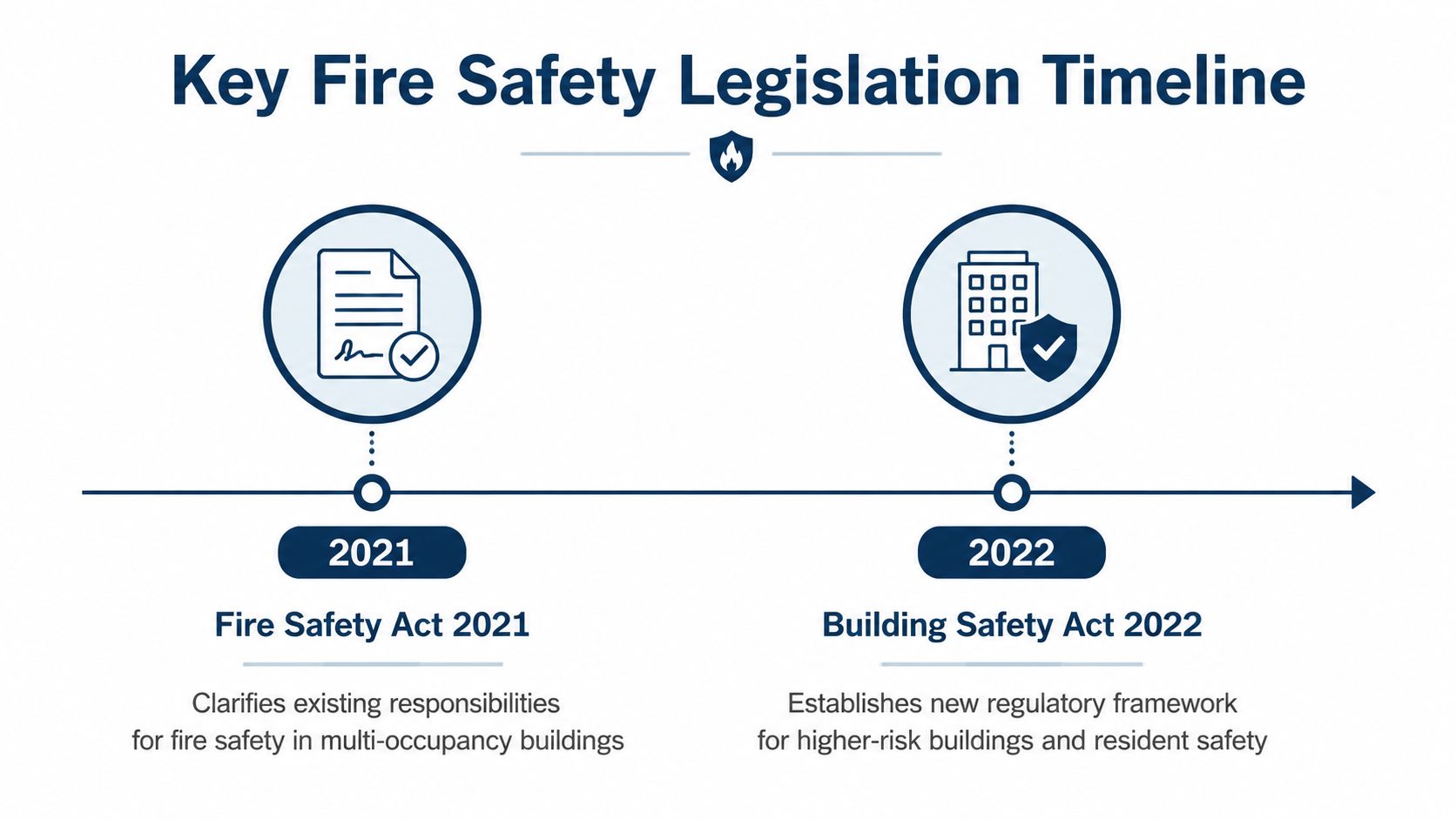
The two laws that changed the conversation are the Fire Safety Act 2021 and the Building Safety Act 2022. Most buyers hear the names but not the practical effect. Here's the short version. They pushed responsibility into the open and made it much harder for serious fire risks in blocks to be brushed aside.
What the Fire Safety Act changed
Before this Act, there was too much room for argument over what parts of a block sat within the fire safety regime. That was a problem. External walls, flat entrance doors and balconies can all play a major part in how fire spreads.
The Act made it clear that these elements are part of the fire safety picture in multi-occupied residential buildings. In plain English, the person responsible for the building can't ignore the façade and pretend only the hallway matters.
That's why lenders and solicitors now ask harder questions about wall systems and doors. They're reacting to a legal environment that no longer lets those issues sit in the background.
If the external wall build-up is unknown, expect delay. Lenders dislike uncertainty more than they dislike bad news.
What the Building Safety Act means in practice
The Building Safety Act 2022 went further. It introduced a stricter framework for higher-risk buildings and clearer accountability for keeping residents safe. It also matters to ordinary leaseholders because it changed the conversation around historic defects and remediation costs.
That doesn't mean every owner is suddenly free of all worry. It means the position on responsibility and protections is more structured than it was. If you own or are buying in a larger block in places like Croydon, Canary Wharf or Nine Elms, this is not abstract law. It affects management, reporting and often the pace of sales.
A lot of confusion comes from people mixing up daily flat safety with wider building obligations. They're linked, but they're not the same thing. A leaseholder might need to keep the inside of their flat sensible and safe. The people controlling the block must deal with broader building risk.
For a non-legal explanation of building safety duties from a surveying perspective, the health and safety guidance here is a useful starting point.
If you want a simple contrast, it helps to compare with other jurisdictions. For example, Brisbane smoke detector requirements show how some rules focus heavily on alarms within homes. In England, flats fire regulations often go wider because the common parts and external wall systems can affect everyone in the block.
| Law | What it changed for flat owners and buyers |
|---|---|
| Fire Safety Act 2021 | Brought external walls, balconies and flat entrance doors firmly into fire risk considerations |
| Building Safety Act 2022 | Created a tougher regime for building accountability and reshaped how historic safety defects are handled |
Who Is Responsible for What A Simple Breakdown
When fire safety trouble appears in a flat block, everyone starts pointing at someone else. That's normal. It's also why deals drag on.
The cleanest way to understand it is this. A block of flats is a shared machine. One party owns or controls the structure. Another may manage it day to day. Individual leaseholders live inside separate parts of it. If one part fails, the whole machine can be affected.
Think of the block like a shared machine
The freeholder or landlord usually carries the main legal burden for the building as a whole. That typically includes common parts, structure and the wider fire safety arrangements. In many buildings they appoint a managing agent to organise inspections, repairs and paperwork, but appointing an agent doesn't make the duty disappear.
The managing agent often becomes the practical point of contact. They arrange fire risk assessments, instruct contractors and chase documents. Some are organised. Some are hopeless. Don't assume their email updates tell the full story.
The leaseholder is usually responsible for the inside of the flat and for not making the building less safe. A common example is replacing the flat entrance door with something that doesn't meet the building's fire strategy. Another is carrying out alterations that damage separation between flats.
Where disputes usually start
These are the flashpoints I see most often:
- Flat entrance doors: Buyers assume the seller owns the problem. The lease may say otherwise.
- Balconies and cladding: Leaseholders often have no direct control, yet the sale still suffers if the block paperwork is poor.
- Service charge demands: Owners want to know what they can be asked to contribute towards.
- Missing records: If no one can produce assessments, certifications or reports, suspicion grows quickly.
Responsibility for the building doesn't always sit with the person who caused the delay in your sale.
That's why independence matters. Advice is more useful when it isn't tied to the managing agent, developer or lender. If you need a broader picture of the sort of residential advice a surveyor can provide, the full range of services listed here gives the right context.
Decoding the EWS1 Form
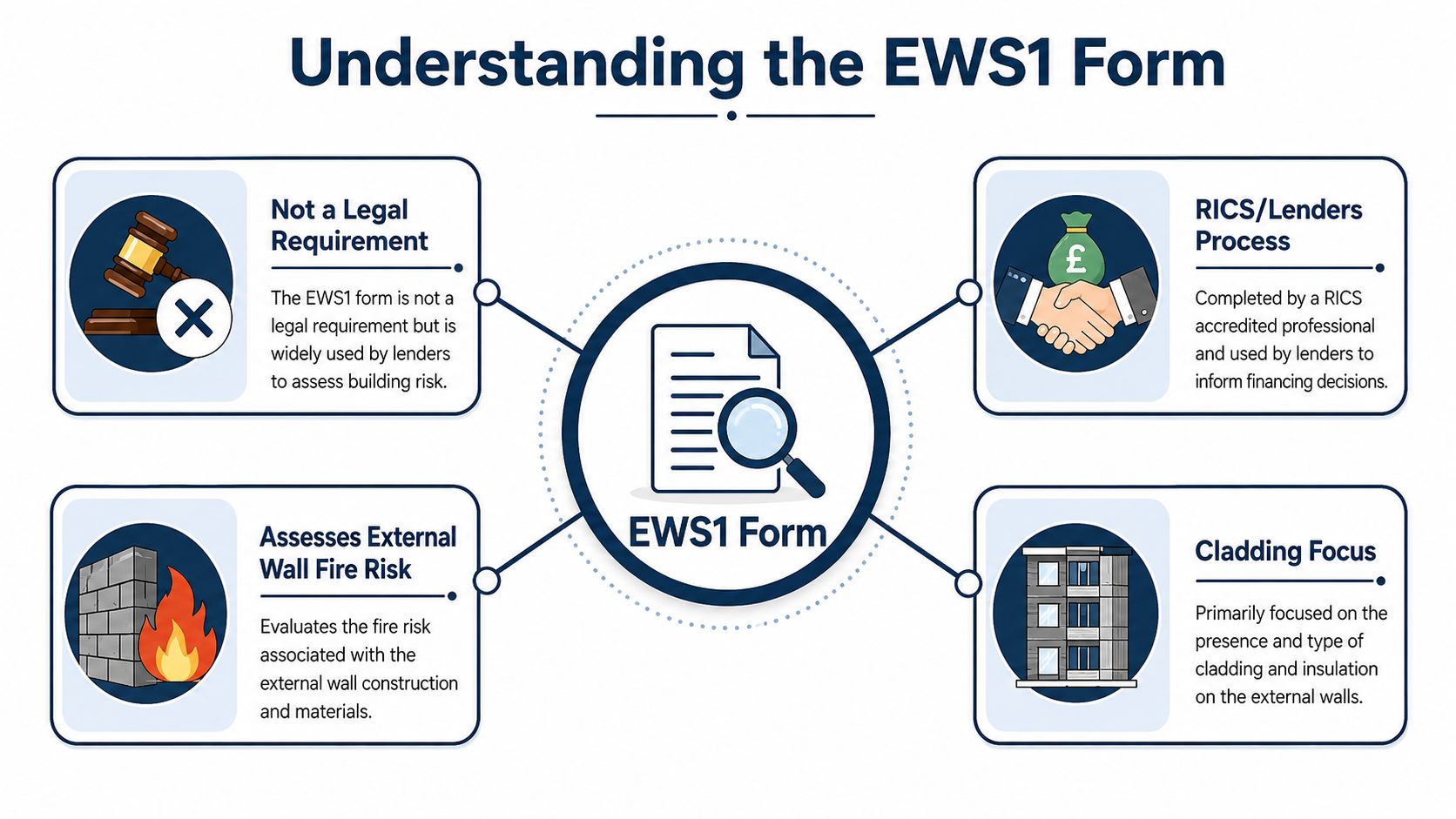
The EWS1 form causes more confusion than it should. Buyers often think it is a legal certificate that every flat must have. It isn't. Sellers often think that because the block looks modern, the form will be easy to get. Not always.
What an EWS1 form is really for
An EWS1 form is a process used in the market to help assess the fire risk of a building's external wall system. It grew out of lender concerns about cladding and similar materials. In practice, it often becomes the document that decides whether a sale moves or stalls.
That's why buyers in places like Greenwich, Tower Hamlets and Croydon hear about it so often. Many of these areas have newer developments, mixed-use blocks and buildings with façade systems that lenders want checked properly.
The form is completed by a suitably qualified professional looking at the external wall build-up and associated fire risk. It is about the building, not just your flat. So if one flat owner says, “I don't have an EWS1”, that usually means the block doesn't have one in place, not that they forgot to fill something in.
A useful side note here is material classification. If you're trying to understand what product fire ratings mean in practical terms, this explanation of achieving A2 fire resistance is worth reading. It helps decode the language people use when discussing façade materials.
Here's a plain-language video overview before we get into the ratings.
What the ratings mean for you
The letters and numbers matter because they influence lending and saleability. The broad picture is straightforward.
| Rating | Practical meaning |
|---|---|
| A1, A2, A3 | External wall materials are considered unlikely to support significant fire spread, and remedial work is not required on the basis of that review |
| B1 | Combustible materials may be present, but the risk is judged low enough that remedial works are not required |
| B2 | The wall system needs remedial work because the fire risk is not acceptable |
A B2 rating is where real pain starts. Sales can collapse. Remortgages become difficult. Buyers pull back because they can't tell how long the remediation will take, who will organise it or what the final financial position will be.
Don't treat an EWS1 form as a box-ticking exercise. Treat it as a clue to the building's wider condition and management.
Just as important, the EWS1 is not the whole story. A block can have wider fire safety issues that sit outside the wording people focus on in the form. That's why sensible buyers look at the building as a whole, not just the headline rating.
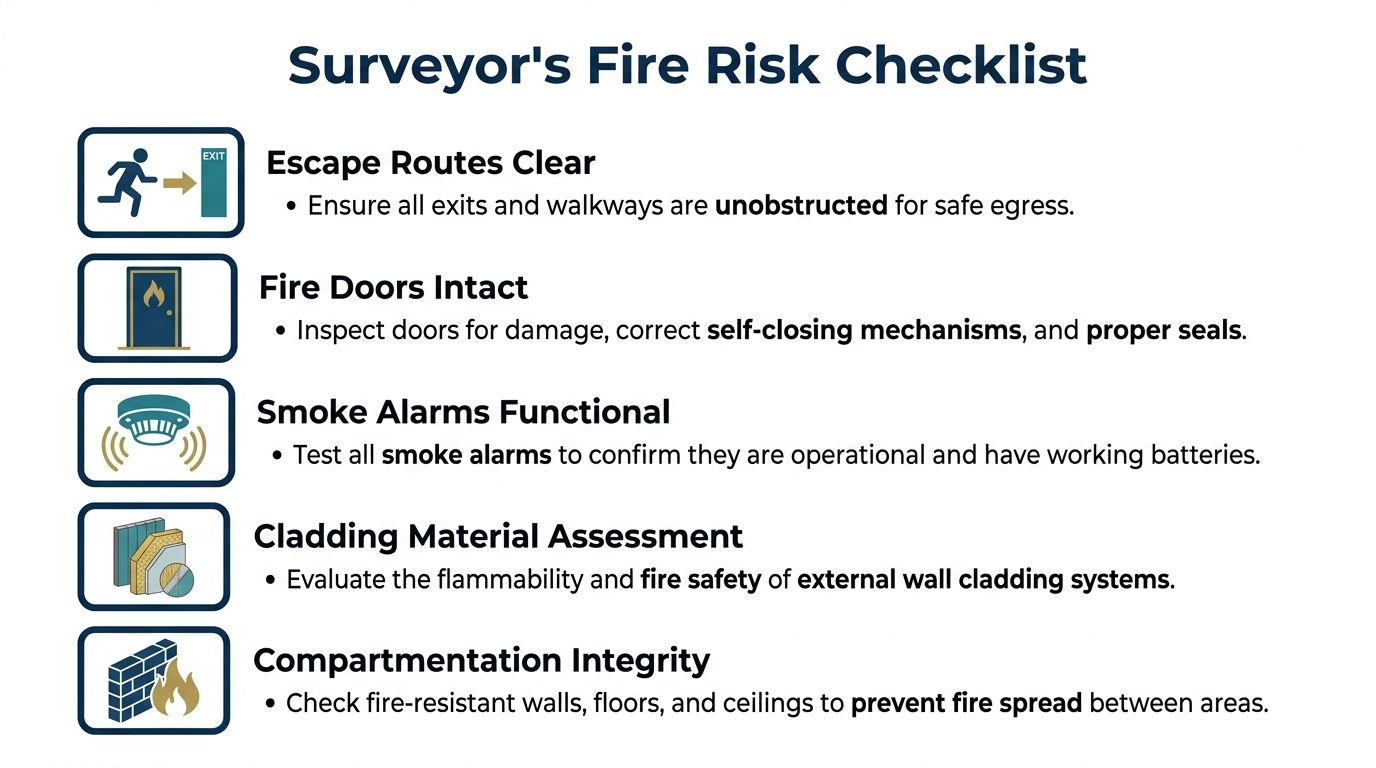
A Surveyor's Checklist for Fire Risk in Flats
When I inspect a flat, especially in an older conversion or a mixed-age block, I don't just stare at the living room ceiling and call it a day. Fire risk in flats sits in the relationship between the flat, the common parts and the building fabric.
That's especially true in London. A Victorian conversion in Southwark or Lambeth can look charming and still have poor compartmentation, suspect doors and awkward escape arrangements. A newer flat in Barking or Stratford may present a different set of questions around external materials, balconies and management records.
What I look at first on site
The first pass is always practical. How would fire spread, and how would people get out?
- Entrance door to the flat: I'm looking for signs it performs like a proper fire door, not a decorative replacement that weakens the strategy.
- Common corridors and stairs: These should be usable escape routes, not storage areas for bikes, prams and cupboards.
- Service penetrations: Gaps around pipes and cables can undermine compartmentation if they are poorly sealed.
- Visible wall construction and balconies: I note what can be seen and what remains uncertain.
- Alarm and lighting arrangements in common parts: Absence, neglect or obvious disrepair all matter.
That doesn't mean a survey replaces a specialist fire engineer's inspection. It doesn't. But it often tells you whether the building raises sensible concern and whether further investigation is needed.
For landlords who also deal with mixed-use premises or office space elsewhere, this article on fire risk assessment compliance for businesses is a useful contrast. It shows how formal compliance thinking works in non-domestic settings, which helps people understand why records and management matter so much in blocks too.
Why converted London flats need closer scrutiny
Converted buildings are where experience really counts. In Forest Hill, Peckham, Camberwell and Brockley, I regularly see flats carved out of houses that were never designed for modern fire separation standards.
Typical issues include:
- Original doors kept in place: Attractive, but not always suitable as flat entrance doors.
- Loft and basement alterations: These can create hidden routes for smoke and fire if the work was poorly detailed.
- Old lath and plaster and timber elements: Character features don't stop fire.
- Unrecorded works: The building may have evolved over years without a clear paper trail.
A standard viewing won't spot those things. Even a lender's valuation won't go into this level of detail. That's one reason a RICS Building Survey report is often the right call for converted flats and older blocks. If the building is straightforward and modern, a lighter survey may suffice. If the building is older, altered or visually inconsistent, you need more than a surface check.
Which survey fits the building
I'd keep it simple:
| Building type | Usual best fit |
|---|---|
| Modern flat in a conventional block | Often a Level 2 survey, depending on age and complexity |
| Victorian or Edwardian conversion | Usually a Level 3 Building Survey |
| Flat with visible alterations, defects or unclear history | Level 3, because the risk sits in what needs proper interpretation |
The more unusual the building, the less sense it makes to rely on the cheapest survey option.
A decent survey for flats fire regulations should leave you with clear next steps. Not waffle. You need to know what appears sound, what looks doubtful and where specialist advice is required.
What to Do If Your Flat Has Fire Safety Problems
If a survey raises fire safety concerns, or an EWS1 comes back with a poor outcome, don't flap. Bad news is still useful if you get it before exchange. It gives you choices.
If you are buying
Start with the paperwork, then test it against the building reality. Ask for the fire risk assessment, any EWS1 documentation, records of planned remedial works and correspondence about who is responsible. If the seller or managing agent can't produce a clear trail, assume the issue may drag on.
Then decide like an investor, not a dreamer.
- Renegotiate if the risk is understood but unresolved
- Pause if key reports are missing
- Walk away if the liability, delay or uncertainty is too great
The right response depends on the seriousness of the defect and the quality of the management. If the building is muddled, your purchase will be muddled too. For advice on next steps around a residential purchase problem, this contact page is the proper route for speaking to a surveyor directly.
If you already own the flat
Push the managing agent or freeholder for clear written information. Ask what investigations have been done, what remedial works are planned and how leaseholder protections may apply. Keep everything in writing.
You may also need a specialist opinion if the existing information is vague or contradictory. A surveyor can help you understand the building context and identify where a fire engineer or legal adviser needs to come in.
If you need a plain-English view from an experienced independent surveyor, call 0800 00 16 422. You need clarity, not another circular email chain.
Frequently Asked Questions About Flats Fire Regulations
Does every flat need an EWS1 form
No. An EWS1 form is not a legal requirement for every flat. It is a market and lending tool used where the external wall system needs review or a lender wants that reassurance.
Can I rely on a mortgage valuation to spot fire safety problems
No. A mortgage valuation is not a proper condition survey. It is brief, limited and prepared for the lender's purpose, not yours.
Who pays for fixing fire safety defects in a block
That depends on the lease, the nature of the defect, the building history and the legal protections that may apply. Never assume the answer from hearsay in a residents' WhatsApp group.
Are older converted flats riskier than purpose-built blocks
Often, yes. Not because they are automatically unsafe, but because alterations, old construction and patchy records create more scope for hidden defects. That is why survey choice matters so much.
If you're buying, selling or holding a flat in London and the fire safety position is muddy, don't guess. Corinthian Surveyors London LTD is an independent firm of RICS Chartered Surveyors and Valuers based in Forest Hill, run by Clive Thompson, who holds RICS and CABE qualifications and has over 30 years in the built environment. The firm is regulated by RICS, has no ties to lenders, estate agents or developers and advises across London, the Home Counties and the South of England. For a sensible view on surveys, defects and what the paperwork really means for your property decision, call 0800 00 16 422.