
Building Survey Reports: Your 2026 Guide to Buying
You've found a place you like. The estate agent is pressing for speed. The lender has done its valuation. On paper, it feels as if the heavy lifting is finished.
It isn't.
In London, the trouble is usually in the bits you don't notice on a viewing. The cracked render on a Victorian terrace in Brockley that points to movement. The damp smell in a Greenwich lower ground floor flat that tells you moisture is getting in somewhere it shouldn't. The loft conversion in Wandsworth that looks neat enough until someone checks the structure and fire separation properly. That's why building survey reports matter. They turn guesswork into evidence.
A 2025 investigation by Survey Merchant found that 87% of UK homebuyers viewed building survey reports as a critical part of their buying process. I'm not surprised. If you're spending serious money on a London property, the survey report is often the only document in the transaction written purely for your protection.
Table of Contents
- Why You Need More Than a Mortgage Valuation
- Choosing the Right Survey for Your London Property
- What to Expect in Your Building Survey Report
- How to Commission a Surveyor in London
- How to Read Your Report and Understand the Findings
- Using Your Survey to Negotiate and Plan Next Steps
- Frequently Asked Questions About Building Surveys
Why You Need More Than a Mortgage Valuation
A mortgage valuation is for the lender. That's the first thing to get straight.
If you're buying a flat conversion in Lewisham or a 1930s semi in Bromley, the bank wants to know whether the property is suitable security for the loan. It does not mean anyone has checked the place in the detail you need. Buyers confuse those two things all the time, and it costs them.
The lender isn't looking after you
The lender's valuation can be brief. It may spot obvious problems, but that isn't its job. Its job is lending risk.
Your survey is different. It's about defects, repair, maintenance and the actual state of your purchase. If the property has roof spread, damp penetration, defective pointing, timber decay or signs of movement, you need that set out plainly before you exchange contracts.
Practical rule: if a defect would matter to you after completion, you need a survey, not just a valuation.
A lot of buyers start by asking the right questions at the viewing stage. That helps. passref's advice on viewings is a sensible checklist because it pushes you to ask about alterations, maintenance and what's been covered up. But viewings only get you so far. Fresh paint hides a lot in London.
London property punishes assumptions
In South East London alone, you can move from a Victorian terrace in Forest Hill to an ex-local authority flat in Peckham to a converted house in Catford within minutes. Each one brings different risks.
Victorian and Edwardian stock often comes with ageing roofs, chimney issues, suspended timber floors and patch repairs done at different times to different standards. Flat conversions can bring complications around sound insulation, fire separation, shared structure and who is responsible for what. A survey report gives you evidence. That matters later if you need to negotiate.
If you want a plain-English explanation of how valuation documents differ from condition reporting, this guide to property valuation reports is worth reading alongside the survey side of the process.
A cheap mistake at survey stage often becomes an expensive problem after completion.
Choosing the Right Survey for Your London Property
You view a smart London flat on Saturday, offer on Monday, and by Wednesday you are trying to save a few hundred pounds on the survey. That is the wrong place to economise.
Choose the survey around the building, its age, and what has been done to it. London punishes lazy assumptions. A tidy finish says very little about the roof structure, hidden damp, altered load paths, poor fire separation in conversions, or patched repairs from three different decades.
The quick rule
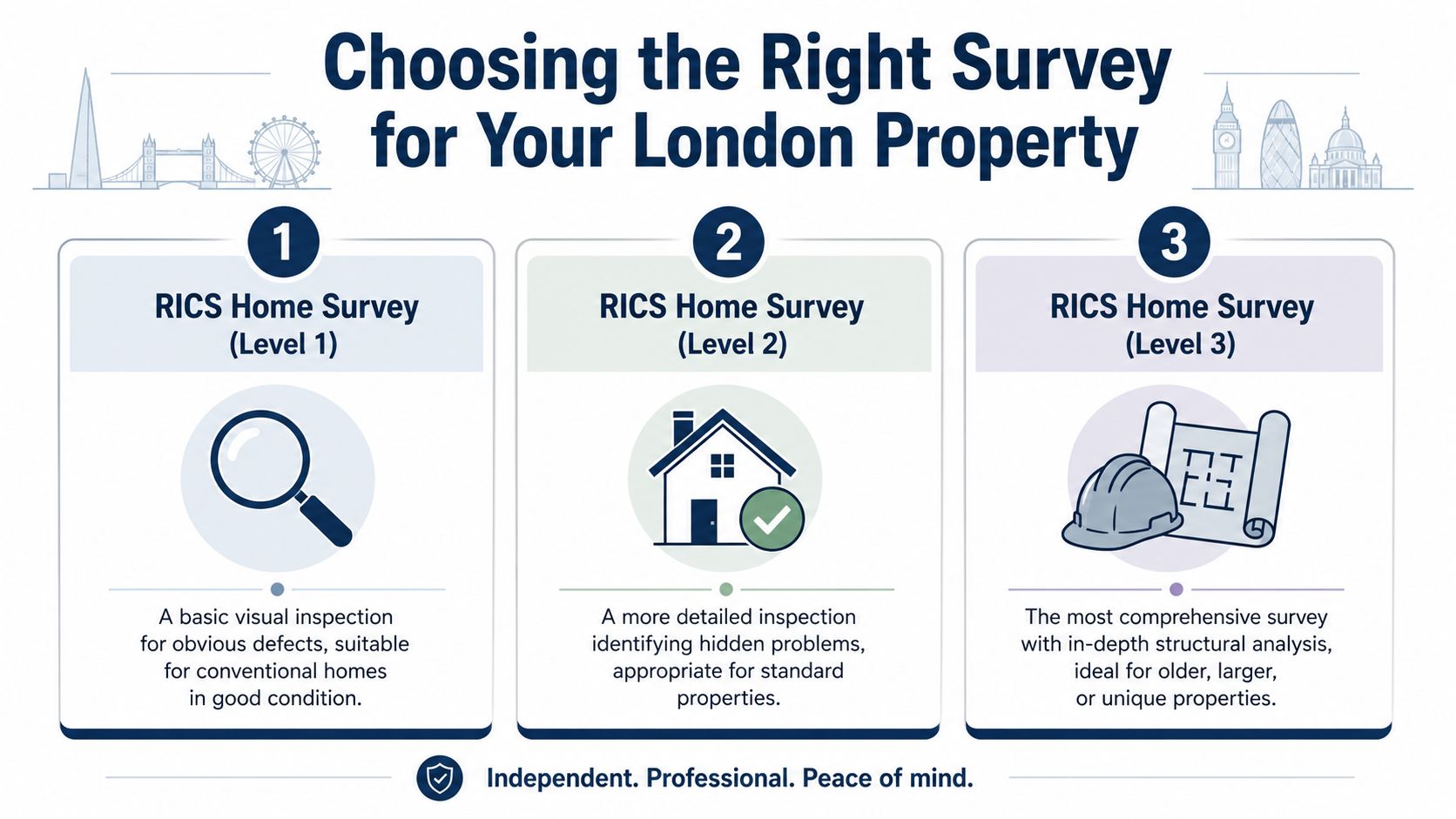
Level 1 suits a simple, modern home in good order where you only want a basic condition snapshot.
Level 2 fits many conventional properties that appear reasonably well maintained. It is still a visual inspection of accessible parts only. If you want a plain-English summary of the survey tiers, this guide on what a RICS survey is covers the basics.
Level 3 is the right call for older homes, converted buildings, heavily altered properties, unusual construction, or anything that already raises questions. In London, that includes a huge slice of the market.
Pay more for the Level 3 when the building justifies it. The extra fee is minor next to the cost of rotten joists, a failing roof covering, defective drainage, or a loft conversion that was done badly and signed off vaguely.
RICS Survey Levels Compared
| Feature | Level 1 (Condition Report) | Level 2 (HomeBuyer Report) | Level 3 (Building Survey) |
|---|---|---|---|
| Best for | Modern conventional homes in good order | Standard homes that appear reasonably sound | Older, altered, larger or unusual properties |
| Inspection style | Basic visual inspection | More detailed visual inspection | Detailed inspection with fuller analysis |
| Invasive testing | No | No | Still visual overall, but with deeper reporting and analysis |
| Repairs explained | Limited | Some condition guidance | Detailed defect analysis and repair advice |
| London examples | A newer flat in a modern block | A 1960s house in Croydon | A Victorian terrace in Nunhead or warehouse conversion in Bermondsey |
Which London properties usually need Level 3
If the place was built before 1900, has been extended more than once, includes a loft conversion, shows cracking or damp staining, or uses non-standard materials, get the Level 3.
That applies to the kind of homes buyers see every day across London. Victorian terraces in Southwark and Blackheath often have a long repair history, with bits renewed at different times and to different standards. Flat conversions in Sydenham or similar areas can look perfectly respectable while hiding issues around structure, fire separation, sound insulation, shared roof liability, or who owns and maintains what.
Here is the blunt version. If the property has character, age, or a complicated layout, it also has more scope for concealed defects. A Level 2 may confirm that something looks poor. A Level 3 is far more likely to explain what the defect is, how serious it is, and what you need to do after the report lands on your desk.
What to Expect in Your Building Survey Report
A lot of buyers open a building survey report, see pages of text and switch off. That's a mistake. The report is there to help you make decisions, not to impress you with jargon.
A proper report should be structured, readable and tied to evidence seen at the property. If it isn't, you should ask questions.
How the report is usually laid out
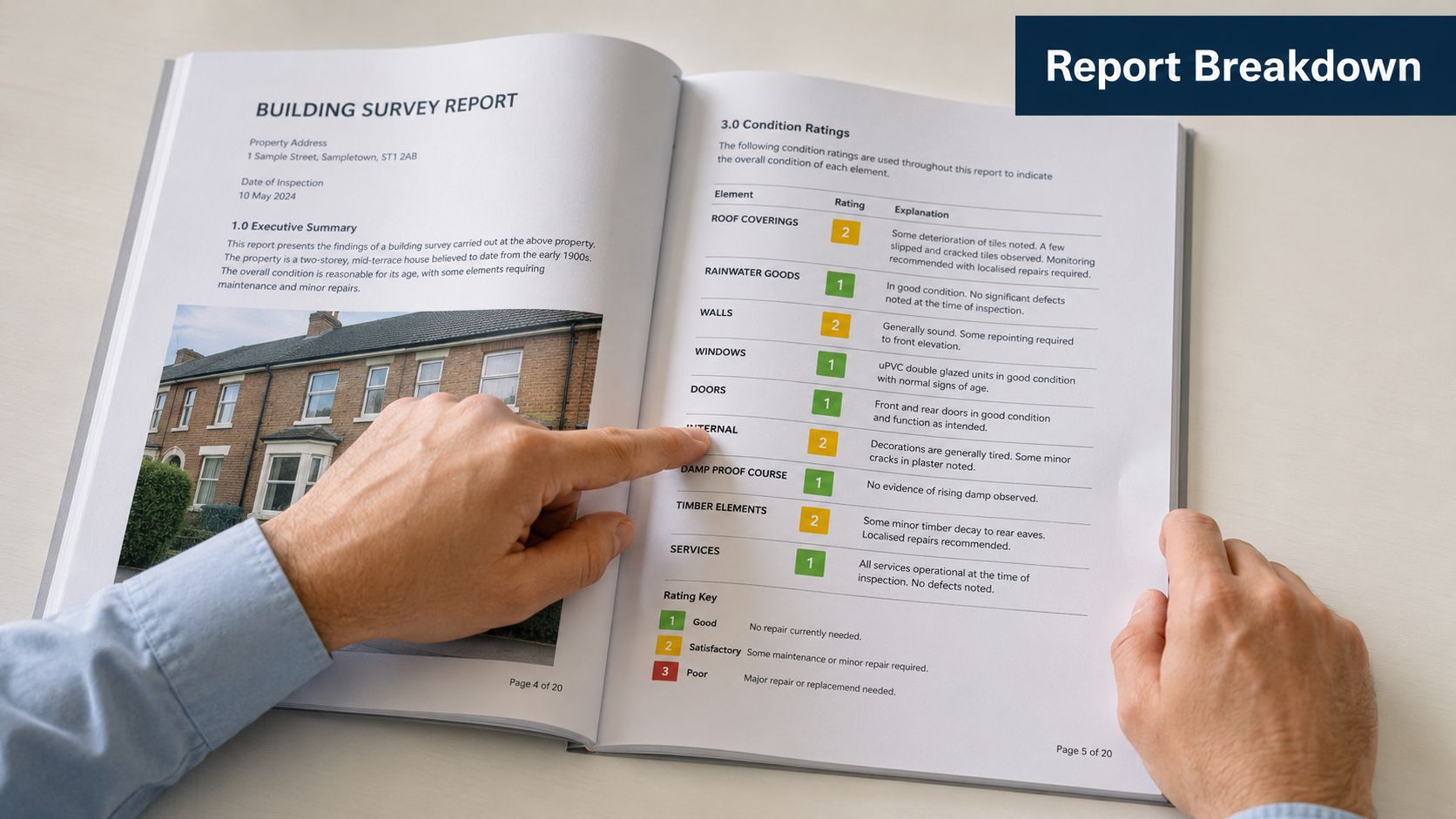
Most building survey reports begin with an overview or executive summary. Read that first. It tells you what matters now.
After that, the report usually works through the property element by element. Roof coverings, chimney stacks, walls, windows, floors, drainage, services and external areas. Each section should say what was seen, why it matters and what ought to happen next.
The best reports also make the limitation clear. Surveyors can't see through walls. They can't inspect areas that are covered, locked, blocked or inaccessible. If a loft hatch is sealed up behind storage or a fuse board is boxed in, no one can comment properly on what they can't reach.
What the ratings actually mean
Many reports use a traffic light system because buyers need to prioritise quickly.
- Red or urgent items: matters needing prompt attention, usually safety concerns or defects likely to worsen quickly
- Amber or serious items: repairs or investigations needed, but not immediate danger in every case
- Green or non-urgent items: normal maintenance or no significant issue noted
Under RICS standards, a Level 3 survey must categorise defects by urgency as urgent, serious or non-urgent, and link each issue to its root cause, as set out by Oakfield Surveyors' explanation of building survey reports. That root cause point matters. “Damp noted” is weak reporting. “Moisture ingress likely due to defective rainwater goods causing local timber decay” is useful.
A report is only valuable if it tells you what the defect is, what may be causing it and what needs doing next.
How to Commission a Surveyor in London
Choosing the surveyor matters almost as much as choosing the survey type.
You want someone independent. Not tied to your lender, not tied to the estate agent and not trying to keep a deal alive for someone else's benefit. In residential work, that independence is worth a lot because it keeps the advice focused on the building.
What to ask before you instruct
Start with qualifications. Ask whether the surveyor is RICS regulated. Ask whether they hold CABE credentials if you want added technical reassurance. Ask who will inspect the property and who will sign the report.
Then ask practical questions:
- Local experience: have they inspected similar stock in the borough you're buying in
- Report style: do they explain defects plainly or hide behind boilerplate wording
- Turnaround: when will you receive the report
- Insurance: do they carry professional indemnity cover
- Scope: are you ordering a Level 2 or a Level 3, and why
Corinthian Surveyors London LTD is one independent option in this market. It's a RICS regulated firm based in Forest Hill, run by Clive Thompson, who holds both RICS and CABE qualifications, with no ties to lenders, estate agents or developers. That matters when you need straight advice on a flat in Camberwell, a terrace in Deptford or a probate house in Bromley.
For a buyer trying to sort the wheat from the chaff, this guide on how to choose a building surveyor in London without wasting time or money is a sensible starting point.
What to send before the inspection
Don't make the surveyor work blind if documents exist. Send paperwork for alterations, damp-proofing, roof works, replacement windows and planning consents where relevant. If the property is tenanted or managed, access arrangements matter too. A practical piece on how landlords maintain tenant relations with inspections is useful because it shows how access and communication can affect what gets seen on inspection day.
If a seller says major works were done, ask for the documents before you rely on the claim.
A final point on cost. Survey fees vary by size, age, complexity and value. Cheap reports are often cheap for a reason. In London, the awkward building with the rushed report is usually where trouble starts.
How to Read Your Report and Understand the Findings
You get the report back on a Friday afternoon. Page one mentions damp, timber decay, movement and further investigation. Estate agent says not to worry. Seller says the house has “always been like that”. None of that helps. Your job is to sort routine old-house issues from defects that will cost real money or cause trouble after completion.
Start with the visual summary below, then read the body of the report slowly.
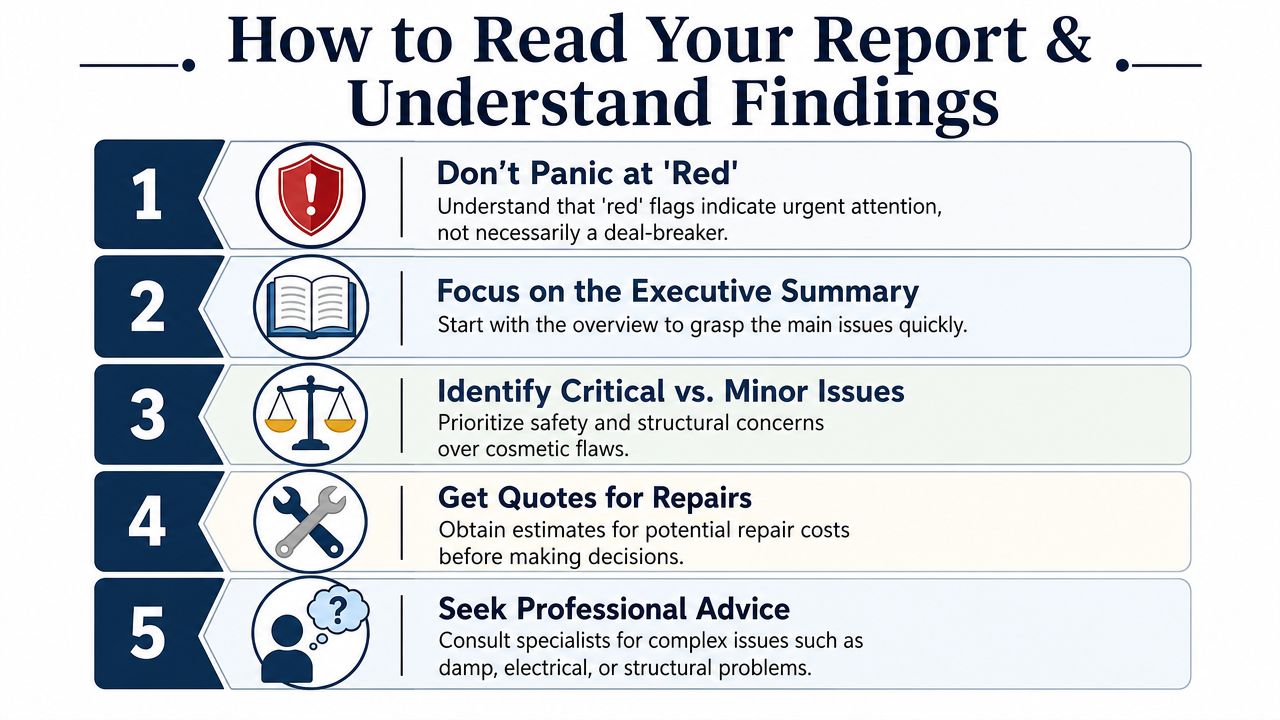
Read in this order. Summary first. Urgent items second. Then anything affecting structure, water ingress, electrics, roof coverings, windows, drainage and legal responsibility. Leave the cosmetic points until the end. Buyers waste time getting upset about dated kitchens while missing failed flashings or damp bridged by raised paths.
Common phrases translated into plain English
Survey language can either overstate or understate the problem. Here is what the wording usually means in practice.
- Structural movement: the building has moved, or may still be moving. Fine age-related cracking is common in London period housing. Stepped cracking, sticking doors, distorted openings and sloping floors need closer attention.
- Rising damp: moisture is showing at low level. Sometimes that is true rising damp. Often in Victorian terraces and garden flats, the cause is high external ground levels, cement render, bridged damp proof courses, poor sub-floor ventilation or leaking rainwater goods.
- Timber decay: timber has stayed damp long enough to deteriorate. The key question is not just how much wood is damaged, but why it got wet in the first place.
- Failed pointing: mortar has broken down or been replaced badly. On older London brickwork, hard cement pointing often does more harm than good because it traps moisture in the brick faces.
- Further investigation recommended: the surveyor has seen enough to justify specialist input, but not enough to give a final answer from a visual inspection.
RICS explains the purpose and limits of surveys in its consumer guide on house surveys. Read that as background, but do not stop at the traffic-light ratings. A red condition rating matters less than the cause, the likely repair, and whether the defect is active or longstanding.
Here's a short video that helps frame the process:
How London housing stock changes the answer
London reports need local reading. The same phrase can mean very different things depending on the building.
In a Victorian terrace in Peckham, Nunhead or Southwark, some uneven floors, patch repairs and hairline cracking may be perfectly normal for a house that has been standing for more than a century. What matters is pattern, location and whether there is fresh movement. Cracks tapering from window corners, bulging rear additions and damp concentrated around chimney breasts tell a different story from old settlement.
Converted flats need even more care. If you are buying in Clapham, Battersea or Wandsworth, do not just ask whether a defect exists. Ask whether it sits within the flat, the structure, the roof, the common parts or an area controlled by the freeholder. A sound survey report identifies the issue. Your solicitor then needs to match that issue to the lease and repair obligations.
Lower ground and basement flats across Greenwich, Blackheath and West London are another trap. “Damp” is too vague. You need to know whether you are dealing with condensation, lateral penetration, defective drainage, tanking failure, raised external levels or poor ventilation. Those are different problems with different costs.
A useful rule is simple. Never ask only, “Is this bad?” Ask three better questions: what is causing it, who pays for it, and what happens if I leave it for 12 months?
If you need help turning findings into action points, some of the negotiation thinking in RealEstateCRM's sales closing strategies is surprisingly relevant. The useful part is the discipline. Get clear on the issue, the evidence and the decision you need from the other side.
Using Your Survey to Negotiate and Plan Next Steps
A survey report isn't the end of the process. It's the point where you stop guessing and start acting.
Too many buyers file it away after one worried read. That misses the value. Good building survey reports give you a working list of risks, priorities and likely spending.
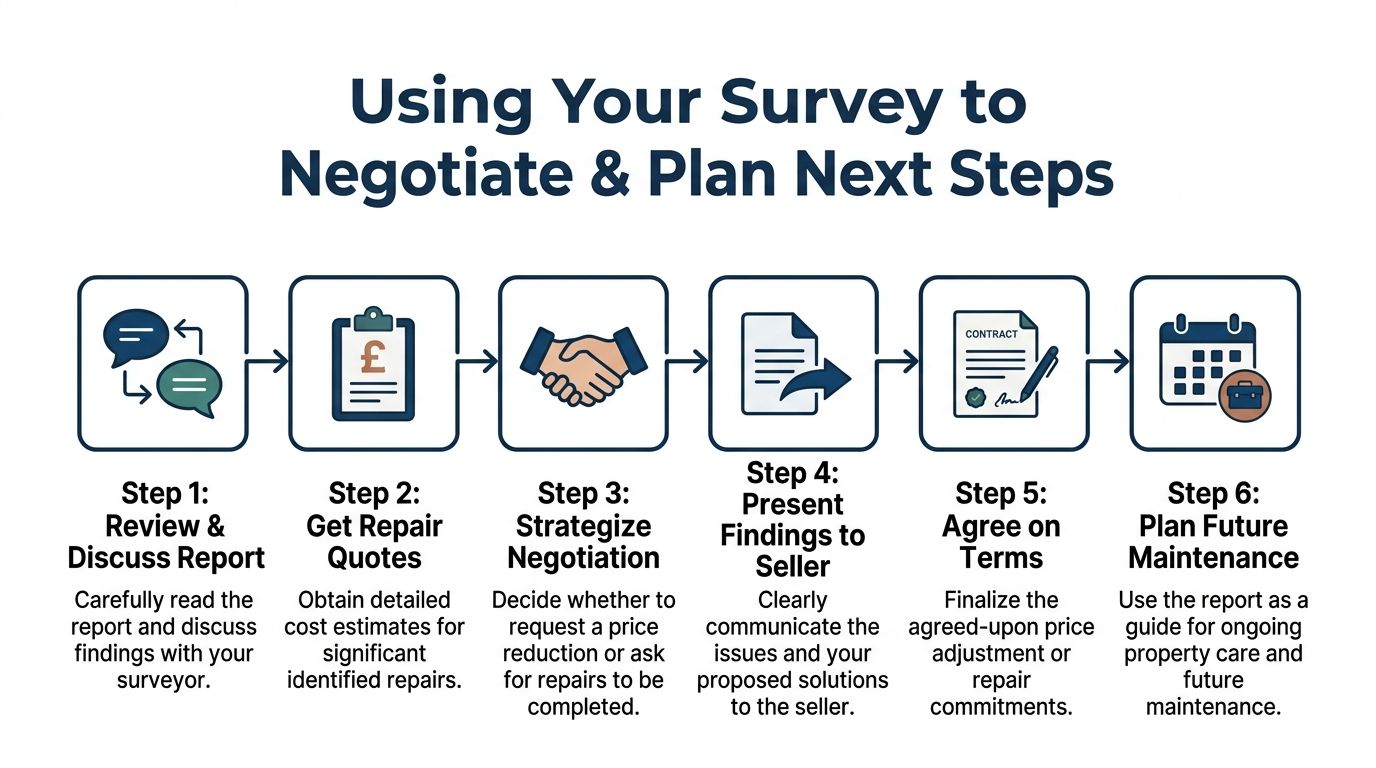
What to do in the first 48 hours
Read the summary again. Then isolate the items that affect safety, structure, weather tightness and legal responsibility.
After that:
- Speak to the surveyor. Clarify what is urgent and what is routine.
- Get targeted quotes. Damp contractor, roofer, structural engineer, electrician or drainage specialist, depending on the defect.
- Keep the list tight. Buyers weaken their position when they throw cosmetic complaints in with serious issues.
- Send evidence, not emotion. The seller is far more likely to respond to a clear schedule of defects and quotes than to a general complaint.
A lot of sales advice online is about momentum and control. Some of the negotiation ideas in RealEstateCRM's sales closing strategies are useful here, not because you're “closing” a deal like an agent, but because structured communication usually gets better results than vague back-and-forth.
When to renegotiate and when to walk away
Renegotiate when the report identifies real defects with defensible cost consequences. That might mean roof repairs, defective windows, damp remediation, movement monitoring or unsafe services. Ask for a price reduction if the works are clear and measurable. Ask for further investigation when the issue is still uncertain.
Walk away when the defects are severe, the seller won't engage and the risk sits beyond your appetite or budget. Some buildings can be repaired. Some become a money pit because the condition, lease structure or ownership history makes resolution messy.
Use the report after completion as well. It becomes your maintenance plan. Sort urgent items first. Then budget for the rest in a sensible order.
If you need help interpreting a report or deciding what to challenge, speak to a surveyor before you let the transaction drift. A short conversation at the right moment can save a poor decision. For that, Corinthian can be reached on 0800 00 16 422.
Frequently Asked Questions About Building Surveys
You get the report back on a London flat conversion. There are red and amber ratings all over it, the roof is shared, the rear addition looks patched together, and the agent says not to worry because “every old place reads like that”. Slow down. The right question is not whether the report looks alarming. It is whether the defects are normal age-related upkeep, a real cost problem, or a warning that the building has been altered badly.
Is a Level 2 survey enough for most London homes
Usually not.
For a modern flat or a fairly standard post-war house in decent order, Level 2 can be fine. For much of London, especially Victorian terraces, Edwardian houses, converted flats and properties that have been extended into the loft or rear, Level 3 is the sensible choice. Older stock hides defects well. Poor alterations, damp trapped by modern finishes, roof spread, tired windows and service issues are common, and a lighter survey will not give you enough context to judge the risk properly.
Can a building survey report tell me the exact repair cost
No. It gives you the defect, the likely cause, the urgency and the sort of specialist you need.
That is enough to make decisions. It is not a contractor's quote. If the report flags roof repairs, movement, decayed joinery or damp investigation, get prices from the right trades before you exchange. In London, repair costs vary sharply by access, conservation constraints, parking, scaffolding and whether the problem sits in a flat under a lease or in a freehold house.
Should I worry if the report has lots of amber or red items
Only if you read them lazily.
A long list of defects is normal in older London property. What matters is the pattern. I would focus first on structure, water ingress, roof coverings, windows, unsafe electrics, outdated plumbing, fire separation in conversions and anything that could trigger a dispute over who pays. A sound Victorian terrace can produce pages of comments and still be a good buy. A converted flat with unresolved roof responsibility or signs of poor fire compartmentation can be a much bigger problem, even if the defect list looks shorter.
Does a surveyor check everything
A surveyor checks what is visible and accessible on the day.
That means no one is seeing through fitted cupboards, sealed floor voids, boxed-in pipework or heavy furniture. Services are not tested in the way a specialist contractor would test them either. If access is poor, expect caveats. If the report recommends further investigation, treat that as a live issue and deal with it before you commit, not after completion when the cost is yours.
If you need a clear reading of a London property before you commit, Corinthian Surveyors London LTD handles residential surveys and valuations across London, the Home Counties and the South of England. The firm is based in Forest Hill, is regulated by RICS, with Clive Thompson holding both RICS and CABE qualifications, and it covers Level 1, Level 2 and Level 3 surveys along with valuations and related residential advice.