
Party Wall Act UK: A Homeowner’s Plain English Guide

A notice lands on your doormat. Or scaffolding appears next door before anyone has explained what's happening. Perhaps you're planning a loft conversion, rear extension or basement dig in Forest Hill, Lewisham, Dulwich or another London terrace, and your shared wall has suddenly become a legal issue.
The Party Wall etc. Act 1996 provides the statutory process for this work in England and Wales. It doesn't replace planning permission or building regulations. It deals with the relationship between the work and neighbouring property, including notice, consent, surveyors, protective conditions and damage.
The practical point is simple. Don't start work because the drawings are approved, and don't assume silence means permission. Get the correct notice and timing right before your builder arrives.
Table of Contents
- What the Party Wall Act Actually Does
- The Three Notices and Their Timeframes
- Rights and Obligations of Each Owner
- Surveyor Appointment and the Party Wall Award
- Typical Costs and Timescales in London
- Common Disputes and How to Avoid Them
- Implications for Property Transactions in London
- Action Checklist and Frequently Asked Questions
What the Party Wall Act Actually Does
The Party Wall etc. Act 1996 governs party walls, boundary walls and certain excavations near neighbouring buildings in England and Wales. It was enacted on 18 July 1996 and came into force on 1 July 1997, creating a national procedure for specified building work. It doesn't apply in Scotland or Northern Ireland. The government's explanatory booklet sets out the framework and the roles of building owners, adjoining owners and surveyors.
A party wall is usually a wall separating buildings owned by different people, such as the wall between two Victorian terraced houses in Brockley or Peckham. The Act can also cover work to a party structure, construction on the boundary line and excavation that could affect a neighbour's foundations. A basement dig in Richmond creates a different technical risk from a loft conversion in Catford, but both can bring the Act into play.
The Act exists because structural building work is too important to leave to an informal conversation between neighbours. It gives the building owner a route to carry out lawful work and gives the adjoining owner a clear opportunity to understand the proposals, record the condition of their property and secure reasonable protective measures.
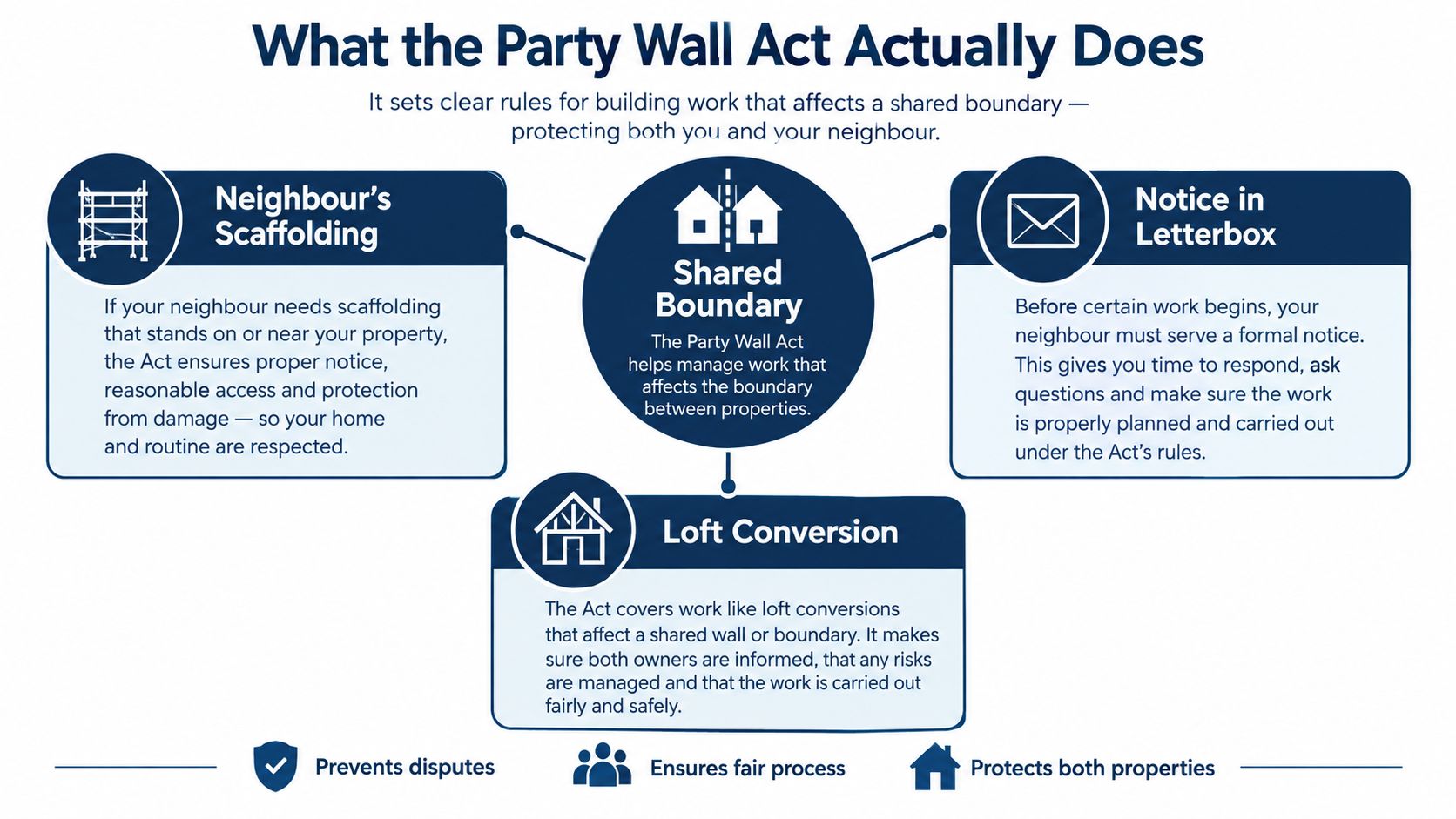
The Act doesn't decide whether your extension should receive planning permission. It addresses a separate question: how will the proposed work affect the neighbouring property, and what process must be followed before work starts?
Practical rule: Treat the Party Wall Act as a construction risk-control process, not as a formality to complete after the builder has started.
The Three Notices and Their Timeframes
The notice depends on the statutory right you're exercising. Using the wrong notice, or serving the right notice too late, can hold up the project.
| Notice type | Work covered | Minimum notice period | Expiry rule |
|---|---|---|---|
| Party structure notice | Work to an existing party wall or party structure, such as cutting in beams or altering a shared wall | At least 2 months before the intended start date | Ceases to have effect if the work hasn't begun within 12 months after service or isn't pursued with due diligence |
| Line of junction notice | Building a new party wall or party fence wall on the line of junction | Generally 1 month before the intended start date | The notice must relate to the proposed work and cannot be treated as an indefinite permission |
| Section 6 excavation notice | Certain excavation work near neighbouring buildings or foundations | At least 1 month before excavation begins | The notice relates to the stated excavation proposals and timing |
The party structure notice must identify the building owner, describe the work and state the intended start date. Where special foundations are proposed, it must include plans, sections, construction details and reasonable information about the loads those foundations will carry. That information lets the adjoining owner assess issues such as vibration, structural movement, waterproofing and temporary works. Section 3 of the legislation sets out these requirements.
An excavation notice must explain the proposals and state whether you intend to underpin, strengthen or otherwise safeguard the adjoining owner's foundations. For a basement project in Bermondsey, Islington or Wandsworth, this detail matters. A general architectural drawing isn't a substitute for a clear description of the excavation and foundation protection.
Read what a party wall notice involves before serving documents yourself. A notice served early can expire if the project stalls. A party structure notice ceases to have effect if the relevant work hasn't started within 12 months after service, or isn't pursued with due diligence. Serving notice before the design is settled can also create confusion if the structural drawings later change.
Rights and Obligations of Each Owner
The building owner is the person proposing the work. That owner must identify the relevant statutory right, serve formal notice on each affected adjoining owner and provide enough information for the proposal to be assessed. The owner must then respect the notice period and any award conditions before construction begins.
The building owner may have a right to carry out the notified work, but that right isn't a licence to ignore the neighbour's property. Reasonable access may be needed for inspection, preparation of a schedule of condition or execution of authorised works. Access should be arranged properly and limited to what the Act and any award permit.
The adjoining owner is the owner affected by the work. They can consent in writing, dissent and appoint a surveyor, or serve a counter-notice where appropriate. They're entitled to understand the proposals and seek conditions that protect their building.
Silence is the point most homeowners misunderstand. After receiving a party structure notice or counter-notice, the adjoining owner has 14 days to serve written consent. If they don't, the Act treats them as having dissented and a dispute is deemed to have arisen. The revised government guidance explains that non-response doesn't amount to permission.
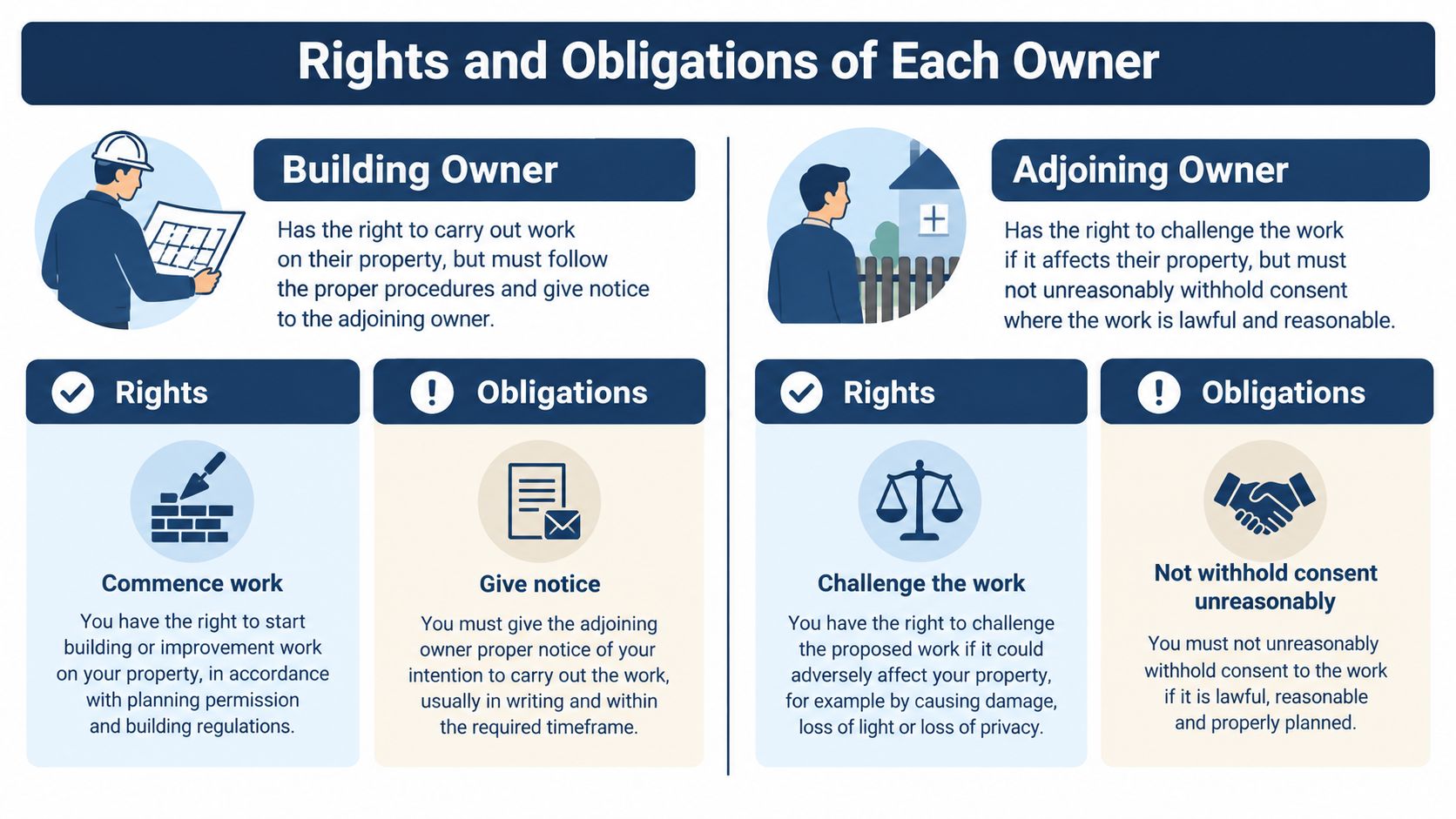
A deemed dissent doesn't mean the neighbour has successfully stopped the work. It moves the matter into the statutory dispute-resolution procedure. A surveyor, or surveyors, can then set conditions for the work, record the adjoining property's existing condition and deal with damage if it occurs.
The sharp distinction is this: the building owner controls the proposal and must follow the process. The adjoining owner can challenge the method and insist on protection, but can't use the procedure merely to demand an unrelated benefit.
Surveyor Appointment and the Party Wall Award
Once an adjoining owner dissents, there are two practical routes.
One agreed surveyor
Both owners can agree to appoint one surveyor. That surveyor acts impartially for both parties. They aren't the building owner's representative, even if the building owner pays the reasonable costs.
Two surveyors
Each owner can appoint their own surveyor. Those surveyors work together to prepare the award. They also select a third surveyor who can decide matters the first two can't agree. The third surveyor is a decision-maker, not another consultant for either side.
A surveyor will review the drawings and structural information, inspect the adjoining property and prepare a schedule of condition where access is available. The schedule records existing cracks, distortion, damp or other defects before work starts. That baseline is particularly useful in older terraces around Sydenham, New Cross and Greenwich, where minor cracking may pre-date the extension.
The result is the Party Wall Award. It normally identifies the permitted work, protective measures, working arrangements, access rights, monitoring or inspection requirements and the procedure for making good damage. It may also include the drawings and technical documents on which the decision is based.
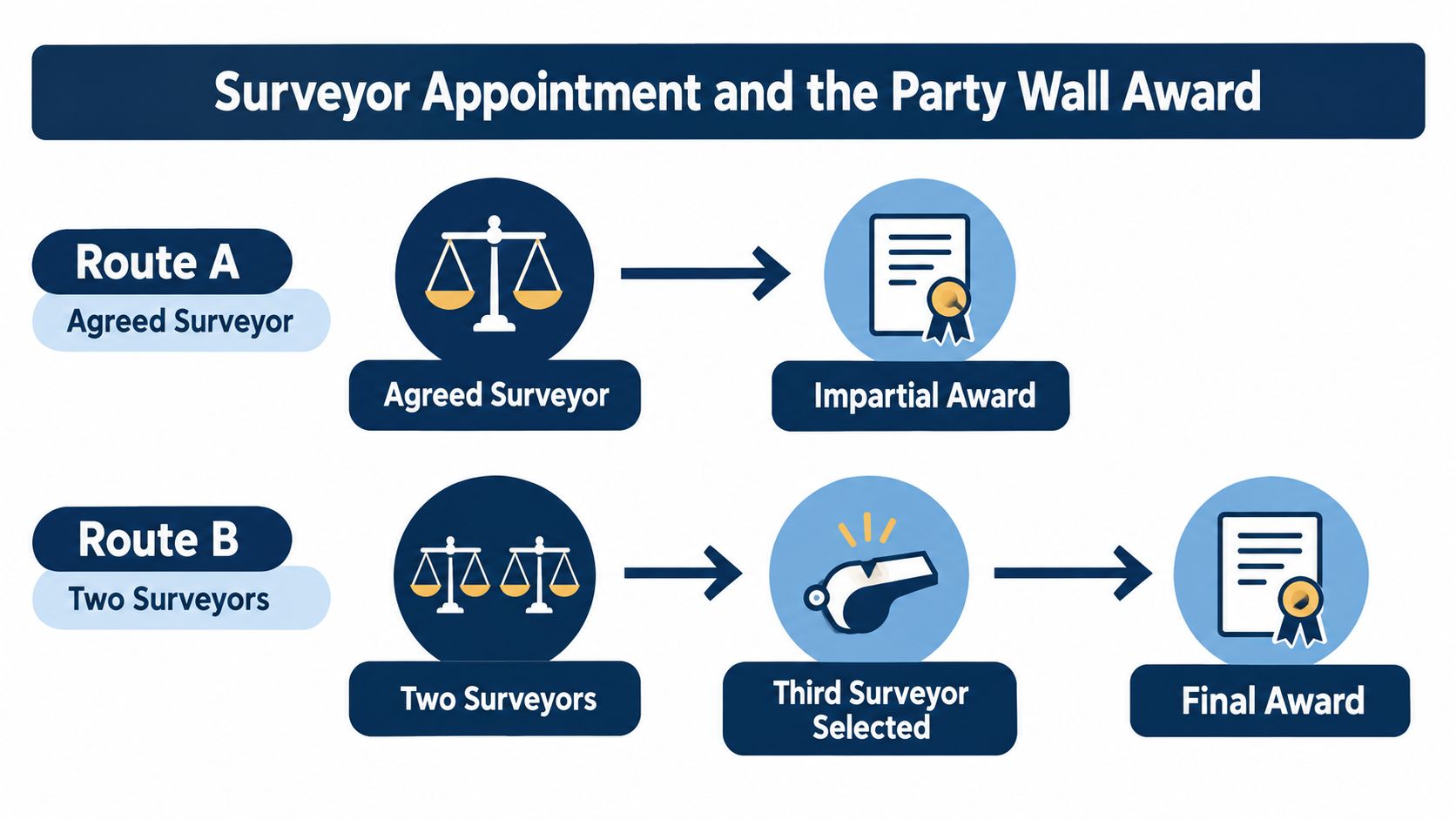
The award is legally binding. Either party can appeal to the county court within 14 days of service. Most matters are dealt with by the surveyors, but that doesn't make the award optional. For a clearer explanation of the role, see whether you need a party wall surveyor.
Typical Costs and Timescales in London
A straightforward rear extension party wall matter in London commonly takes four to eight weeks from instructing the surveyor to a sealed award. That isn't a statutory period. It's a practical working timescale that depends on the quality of the drawings, the number of adjoining owners, access for inspection and whether one or two surveyors are involved.
The statutory notice period still controls the earliest lawful start. Work to an existing party wall needs at least two months' notice. Certain excavation works and construction on the line of junction generally need at least one month. The surveyor's timetable sits alongside those legal deadlines, not instead of them.
Fees depend on the complexity of the work, the number of neighbours, the amount of technical information, access arrangements and whether the dispute requires separate surveyors. Corinthian Surveyors provides property-specific quotations rather than pretending one figure suits every London terrace. The party wall agreement cost guide gives useful context, but your actual fee should follow review of the drawings and adjoining properties.
In most cases, the building owner pays their own surveyor's fee and the adjoining owner's reasonable party wall costs. That commonly includes the schedule of condition. If the adjoining owner appoints a surveyor unnecessarily, or the work is unrelated to the building owner's project, the position can differ.
A single agreed surveyor is often less expensive than two separate surveyors because there's one appointment and one decision-maker. It only works where both sides are comfortable with that arrangement. If there's a genuine conflict, separate surveyors are the sensible choice.
A design change after notice is a common hidden cost. If the change affects the notified work, you may need further notice or a revised award, and the programme can move. Don't serve a vague notice just to start the clock.
The financial risk of skipping proper advice isn't limited to the surveyor's fee. An invalid notice, incomplete drawings or work started too soon can produce delay, additional professional costs and a neighbour who no longer trusts the project.
The statutory process is easier to follow when you understand the sequence. The video below provides another overview of the procedure.
Common Disputes and How to Avoid Them
Most London party wall disputes begin with poor administration. The structural design may be acceptable, but the notice, dates or records don't match what happens on site.
| Common cause | Typical trigger | Practical fix |
|---|---|---|
| Wrong start date | The notice uses a date that doesn't allow the statutory period to run | Check the intended start date against the correct notice period before service |
| Drawings don't match the build | The contractor follows revised structural details that weren't included in the notice or award | Finalise the structural information before notice and notify material changes |
| Work starts too early | The builder treats planning approval or written neighbour contact as permission to start | Give the contractor the notice and award, then make the legal start condition clear |
| No schedule of condition | The parties have no reliable record of pre-existing cracks or damp | Arrange an inspection before demolition, excavation or structural work |
| Access is refused or assumed | One owner expects unrestricted entry, while the other has received no proper request | Put access dates, hours and purpose in writing and follow the award |
| Neighbour ignores the notice | The adjoining owner doesn't reply within the statutory response period | Treat silence as deemed dissent and appoint a surveyor rather than assuming consent |
An adjoining owner who says nothing within 14 days hasn't accepted the work. The statutory consequence is deemed dissent, which starts the dispute-resolution route. The building owner can proceed once the required award is in place and the relevant notice period has run, but must follow the award exactly.
Do not let the builder decide that a small alteration is harmless. Moving a steel beam, deepening a foundation or changing excavation sequencing can alter the risk to the adjoining building. Tell the surveyors before the change reaches site.
Good records also protect the neighbour relationship. A dated schedule, clear drawings and sensible access arrangements give both parties something objective to rely on when a crack appears or a delivery causes disruption.
Implications for Property Transactions in London
Party wall paperwork becomes important when you sell, buy or remortgage. Terraced housing in Lambeth, Southwark, Lewisham and Bromley often sits beside ongoing extensions, loft conversions or basement works. Converted flats in Bermondsey and warehouse-style developments can create additional questions about shared structures and access.
A live notice, unresolved dissent, active scaffolding or incomplete award may lead to enquiries from the buyer's solicitor. The buyer's RICS surveyor may comment on visible works, access restrictions or the absence of supporting documents. A lender may also pause its decision until the position is clear.
Check the file at four points:
- Before contracts: Give your solicitor every notice, consent, award, drawing and schedule of condition.
- During the buyer's survey: Explain what work has taken place and show the surveyor the relevant award.
- Before exchange: Resolve outstanding questions rather than relying on an informal conversation with the neighbour.
- At completion: Leave the buyer a complete record, including any award that still affects obligations or access.
A properly sealed award isn't a defect on title. It's a legal document governing authorised building work. Missing paperwork is the problem. Buyers generally need to know what was proposed, what was permitted and whether the work followed the agreed conditions.
Building records should also be checked alongside planning and building control information. For a practical guide to interpreting building permit records, look for consistency between the permissions, drawings, construction and party wall documents.
If you're buying a property beside a basement project in Kensington, Islington or Wimbledon, ask direct questions. Find out whether the excavation is complete, whether damage was alleged and whether an award or schedule of condition exists. A clean paper trail supports a confident transaction.
Action Checklist and Frequently Asked Questions
Building owner checklist
- Define the work: Confirm whether the proposal affects an existing party wall, the boundary or neighbouring foundations.
- Appoint advice early: Use a party wall surveyor before the programme is fixed, not after the builder has booked demolition.
- Serve the right notice: Allow at least two months for existing party wall work and generally one month for relevant boundary or excavation work.
- Wait properly: Don't treat silence, planning permission or a friendly conversation as consent.
- Record condition: Arrange the schedule of condition before structural work begins.
- Control revisions: Send design changes to the surveyors before they reach site.
Adjoining owner checklist
Read the notice on the day it arrives. Note the proposed work, start date and technical information. If you're unsure, appoint a surveyor promptly rather than allowing the 14-day response period to pass without advice.
Attend the condition inspection where possible. Keep the notice, drawings, award and photographs together, and report suspected damage promptly.
Frequently asked questions
Do I need a party wall agreement for a loft conversion?
You may need to follow the Act if the loft conversion cuts into or alters an existing party wall, uses beams bearing into it or involves other notifiable work. The drawings should be checked before the notice is served.
Can I refuse access?
You can't assume that access is available, and the building owner can't demand unrestricted entry. Access depends on the statutory rights and any terms in the award. Raise practical concerns early and put agreed arrangements in writing.
Is a party wall surveyor the same as my building surveyor?
No. A building surveyor assesses the condition of a property. A party wall surveyor deals with statutory notices, dispute resolution, awards and protections for adjoining buildings. Some professionals hold the experience to do both, but the roles are different.
How long does a party wall award last?
A party structure notice ceases to have effect if the relevant work hasn't begun within 12 months after service or isn't pursued with due diligence. Check the award and notice carefully before delaying a project.
Corinthian Surveyors, based in Forest Hill and serving all London boroughs, provides independent party wall advice for building owners and adjoining owners. The practice is run by Clive Thompson, who holds RICS and CABE qualifications, and has more than 30 years' experience in the built environment. Corinthian has no ties to lenders, estate agents or developers. For advice on a notice, surveyor appointment or award, call 0800 00 16 422.
Corinthian Surveyors London LTD advises residential owners on party wall notices, schedules of condition and awards, alongside RICS surveys, valuations and project-related advice. Visit Corinthian Surveyors London LTD before serving notice or responding to one, so the statutory timetable and technical information are checked properly.