
Do I Need a Party Wall Surveyor? a London Homeowner’s Guide
You only need a party wall surveyor if your neighbour doesn't give written consent to your Party Wall Notice within 14 days. If they consent in writing, you can usually avoid appointing a surveyor and skip an average fee of about £1,000 for a single surveyor.
That's the part commonly missed. They ring me because they're planning a loft conversion in Peckham, an extension in Bromley or a chimney breast removal in a Lewisham terrace, and they assume a surveyor is automatically part of the cost. It isn't. The trigger is your neighbour's response.
If you're asking, do I need a party wall surveyor, the sensible way to look at it is this: first work out whether your job falls under the Act, then serve the right notice, then see whether your neighbour agrees. That sequence decides what happens next, not guesswork and not what a builder says on site.
Table of Contents
- Do You Need a Party Wall Surveyor? The Short Answer
- What the Party Wall Act Actually Does
- Common Works That Fall Under the Act
- Serving Notice and Your Neighbour's Response
- When a Surveyor Becomes Mandatory
- Appointing a Surveyor Process and Costs
- Choosing the Right Surveyor in London
- FAQ
Do You Need a Party Wall Surveyor? The Short Answer
If your neighbour agrees in writing, probably not. If they dissent, or they ignore the notice, then yes, a surveyor becomes part of the legal process.
That's the clean answer. The Act causes confusion because people think the word “dispute” means a blazing row over the garden fence. Under the Party Wall etc. Act 1996, it can mean your neighbour says no, or says nothing at all within the response period.
The practical rule
Here's how I explain it on the phone.
- If the work is notifiable: you serve notice first.
- If your neighbour consents in writing within 14 days: you can usually proceed without a party wall surveyor.
- If your neighbour dissents or stays silent: a surveyor must be appointed to deal with the Award.
Practical rule: You don't appoint a party wall surveyor because the work sounds serious. You appoint one because the notice process has led to a dispute under the Act.
This matters all over London. In a Victorian terrace in Forest Hill or Brockley, shared walls are obvious. In a flat conversion in Camberwell or Southwark, people often forget that party structures can include floors and other shared elements too. The legal issue is not the postcode. It's the combination of the type of work and the neighbour's response.
A lot of owners waste time by asking the wrong question first. They ask, “Who's the best party wall surveyor?” The first question should be, “Do my works need notice at all?” If the answer is no, stop there. If the answer is yes, serve the notice properly and wait for the response before spending money.
What the Party Wall Act Actually Does
The Act isn't there to stop your project. It's there to stop avoidable neighbour problems turning into legal and structural ones.
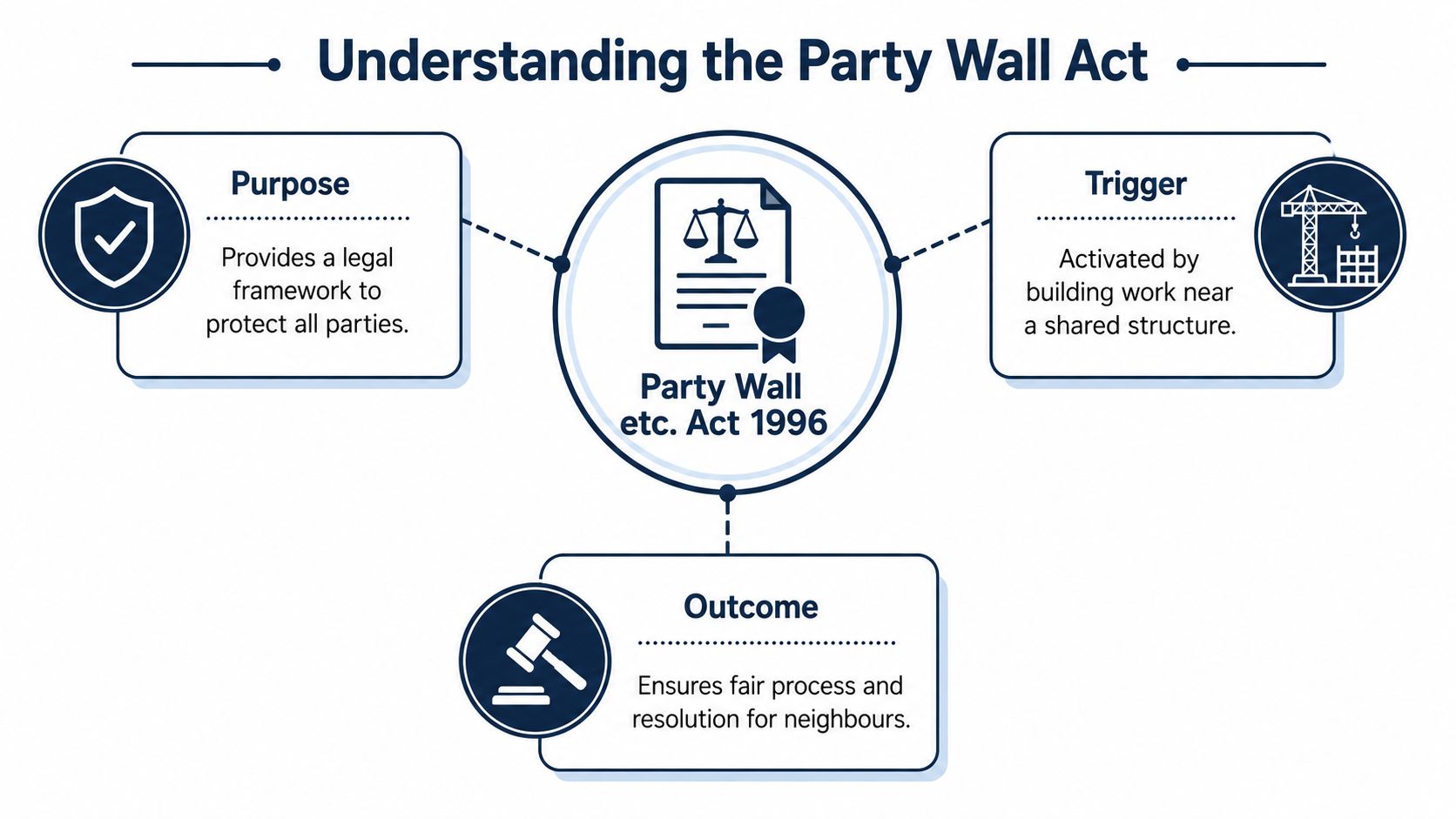
Think of it as a rulebook for building work near shared structures or close to a neighbouring property. You still have the right to improve your home. Your neighbour gets legal protection if your work could affect their wall, floor, foundations or support.
What counts as a party wall or party structure
In plain English:
- A party wall is usually the shared wall between two houses, common in terraces and semis.
- A party structure can include other shared structural elements, which is especially relevant in flats and conversions.
- Excavation near a neighbour's building can also trigger the Act, even if you're not touching the wall itself.
That's why London owners get caught out. In Greenwich and Blackheath, period houses often involve rear additions and structural alterations. In Bermondsey and Rotherhithe, converted buildings can have odd layouts and hidden structural relationships. You might think you're only dealing with your own property, but the law looks at the effect on the adjoining owner as well.
What the Act is trying to achieve
The aim is fairness.
It creates a formal process so that before work starts, everyone knows what's proposed, when it's happening and how damage or access issues will be handled. It also creates a paper trail. That matters if there's later an argument about cracking, movement or who said what before the builder arrived.
The Act is less about permission and more about procedure. Follow the process and the job can move forward lawfully.
Proper advice is invaluable. At Corinthian Surveyors London LTD, the conversation usually starts with drawings, the age of the property and what exactly is being altered. That's the right starting point. Not panic. Not assumptions. Just a clear read of whether the Act is engaged and what step comes next.
If you're also planning wider residential works, it's worth understanding where party wall issues overlap with project management and older building fabric, especially in conservation areas and period stock.
Common Works That Fall Under the Act
Most cosmetic jobs don't involve the Act. Structural jobs often do.
That distinction matters because homeowners regularly overcomplicate minor work and underplay the work that triggers notice. Replastering a wall is one thing. Cutting into that wall to insert steel for a loft conversion is something else entirely.
Work that usually needs notice
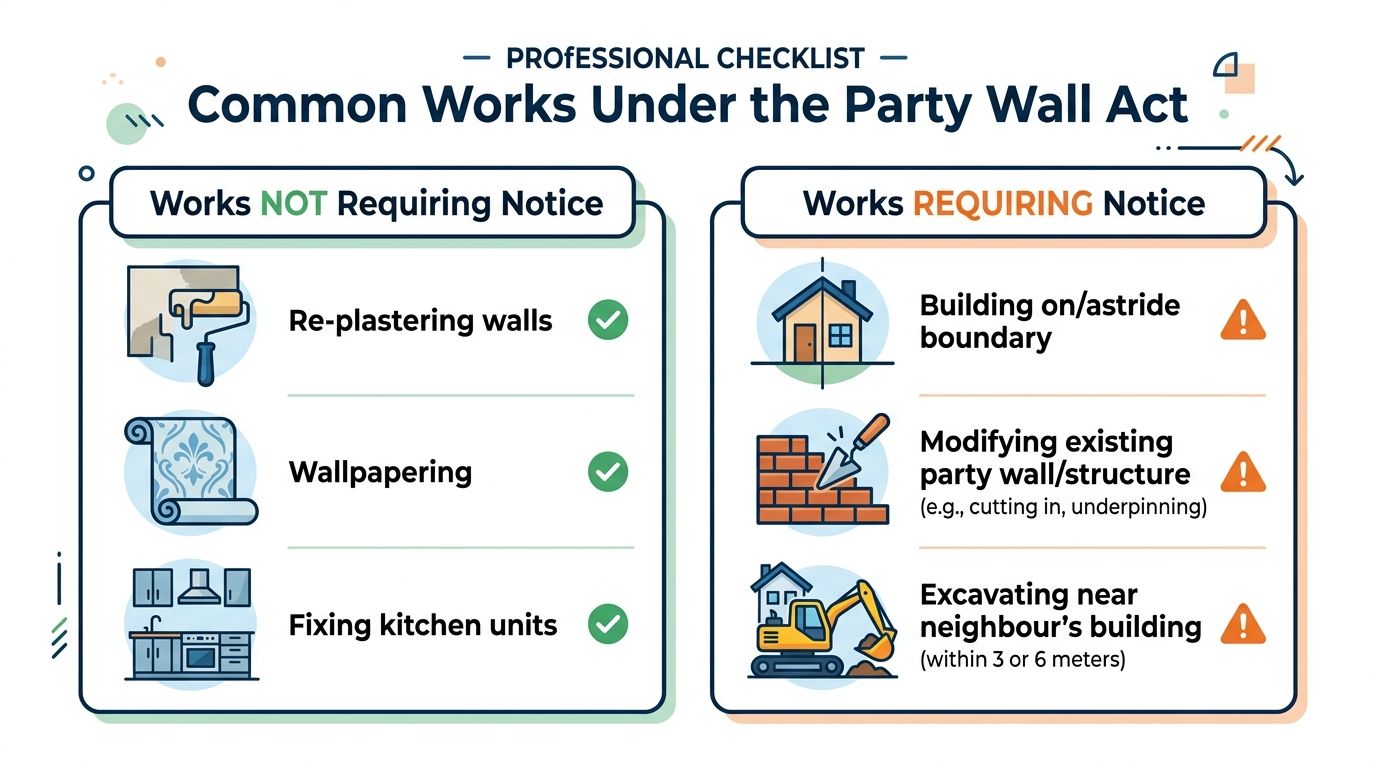
Typical examples include:
- Loft conversions: If you're inserting beams into a shared wall, the Act is usually engaged.
- Chimney breast removal: If the chimney breast is bonded into a party wall, notice is usually required. I've written more on building regulations for chimney breast removal because owners often confuse structural approval with party wall procedure.
- Extensions with excavation: If foundations are close enough to affect a neighbour's building, notice may be needed.
- Underpinning or raising a shared wall: That's squarely within party wall territory.
- Basement works: These often raise the stakes because of depth, sequencing and risk to adjoining structures.
The legal timing matters as well. The law requires a 2 month notice period for works involving alterations to a party structure under Section 2, while new boundary walls or excavations under Sections 1 and 6 need 1 month notice. If the neighbour dissents after 14 days, a surveyor becomes mandatory to create the Award, as set out by Peter Barry's explanation of party wall surveyors.
To see the kind of works that commonly trigger notices, this short video gives a useful overview:
Work that usually doesn't
Now for the jobs that people worry about unnecessarily.
- Replastering: Usually not covered.
- Wallpapering: Not covered.
- Fixing kitchen units or shelves to a party wall: Usually not covered, provided you're not carrying out structural alteration.
That's the broad line. Minor surface work is one thing. Structural interference is another.
For owners doing larger refurbishment projects or looking at rental strategy as part of a renovation plan, it can also help to think through the wider finances before work starts. If you're approaching a refurb from an investor angle, Action Accountants' BRRRR blueprint is a useful overview of how refurbishment decisions fit into a property investment model.
A final London point. In Lewisham, Peckham and Sydenham, small rear additions and loft works on terraced housing are common. In Bromley, Beckenham and Croydon, 1930s semis bring different layouts but the same problem if new foundations go close to the neighbour's side. The house type changes. The legal trigger doesn't.
Serving Notice and Your Neighbour's Response
Once you know the work is notifiable, serve the notice properly. Don't leave it to a vague text message, a chat over the fence or a note pushed through the letterbox.
A Party Wall Notice is a formal legal document. It tells the adjoining owner what you want to do. If the notice is wrong, late or incomplete, you create trouble for yourself before the builders have even priced the scaffolding.
If you're unclear on the document itself, read this guide on what is a party wall notice before you send anything.
The three possible responses
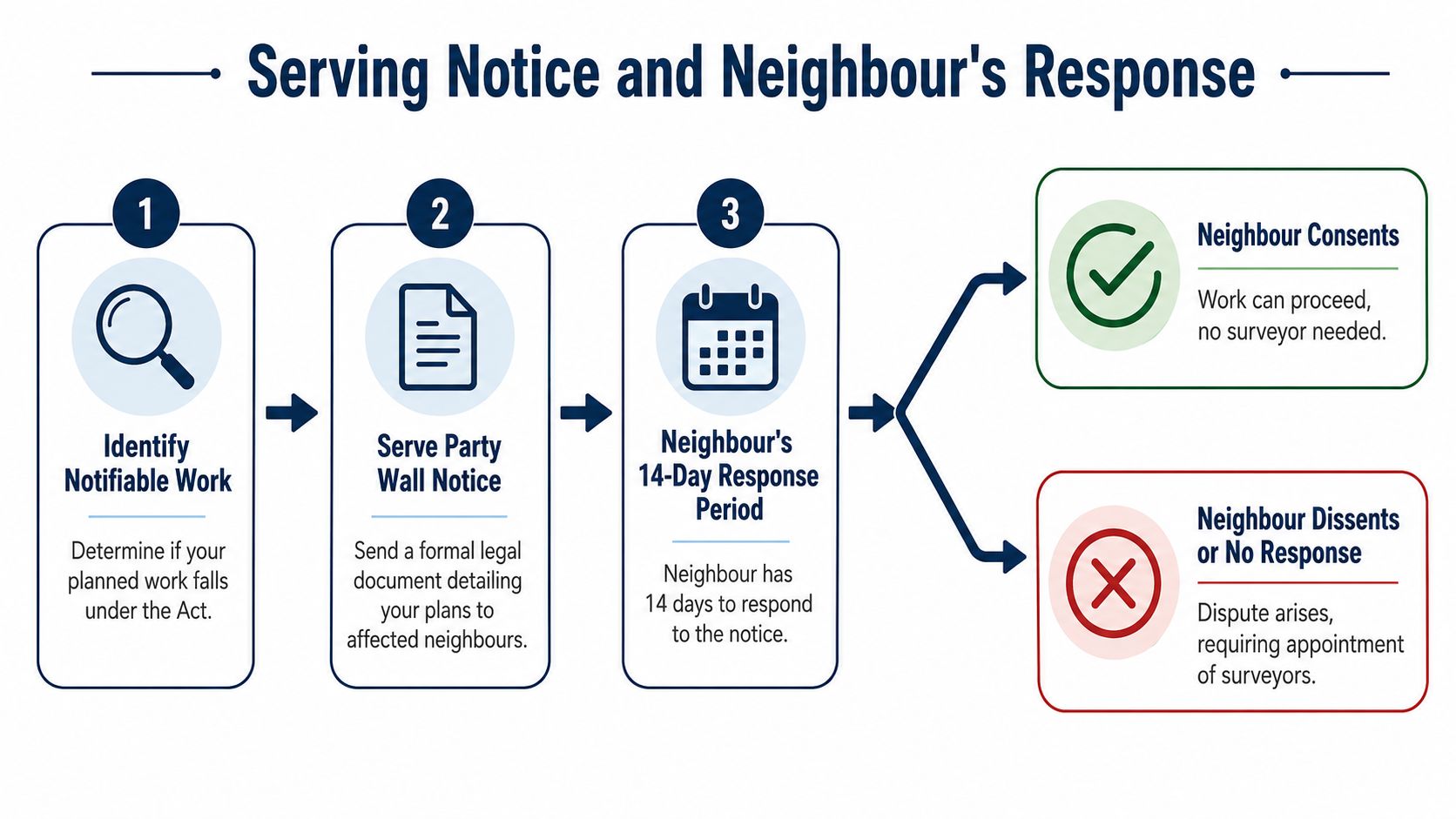
After service, your neighbour has 14 days to respond. From there, there are only three practical outcomes.
| Response | What it means | What happens next |
|---|---|---|
| Consent in writing | They agree to the proposed works | You can usually proceed without appointing a surveyor |
| Dissent | They do not agree | Surveyor appointment process starts |
| No response | Silence is treated as a dispute after the response period | Surveyor appointment process starts |
That last point catches people out. Silence is not neutral. Silence pushes the matter into dispute under the Act.
If your neighbour says nothing, don't treat that as approval. It isn't.
Why the schedule of condition matters
Even where the neighbour consents, I still advise owners to think seriously about a schedule of condition. It records the state of the adjoining property before work starts. That protects both sides.
If a crack appears later, you need a record of what was there beforehand. In construction language, this overlaps with the same basic principle behind a dilapidation report explained by Templeton Built, namely recording a property's condition before works or occupation issues create argument.
In practical terms, the schedule can be the difference between a manageable conversation and a bitter dispute. On London terraces, especially older stock in New Cross, Dulwich and Clapham, small historic cracks are common. If nobody records them before work begins, every mark suddenly becomes your builder's fault in the neighbour's eyes.
So keep it simple. Identify whether notice is needed. Serve it correctly. Wait for the response. If they consent, keep a clear written record and consider a condition schedule. If they dissent or ignore it, stop trying to negotiate the law away and move to the surveyor stage.
When a Surveyor Becomes Mandatory
This is the point where I'll be blunt. A party wall surveyor becomes mandatory when there is a dispute under the Act. In practical terms, that means your neighbour has dissented or failed to respond.
Under the Party Wall etc. Act 1996, a surveyor is strictly mandatory only when neighbours cannot agree on proposed building work. If the neighbour gives written consent within the statutory 14-day response window, the requirement is usually waived. If consent is denied, the law requires a surveyor to be appointed, either jointly or individually, to negotiate the Party Wall Award, as explained in the Federation of Master Builders guide to party wall agreements.
What the Award actually does
The Award is the legal document that lets the process move forward when agreement isn't there. It sets out what work is authorised, how it is to be carried out and what protections apply to the adjoining owner.
In straightforward terms, the surveyor acts like an impartial referee. Not your advocate. Not the neighbour's hired gun. Their duty is to the Act.
A proper Award will usually deal with things like:
- The scope of the works: what is being done
- Timing and access: when works can happen and what access is needed
- Protective measures: steps to reduce risk to the neighbouring property
- Condition recording: so any later damage can be assessed against a proper baseline
- Fees and responsibility: who pays the surveyors under the Award
Once dissent exists, the question is no longer “Can I just crack on?” The question is “How do I proceed lawfully?”
If you start notifiable work without resolving that stage, you invite delay and possible legal trouble. Builders hate that. Neighbours hate it more. Sort the paperwork first.
Appointing a Surveyor Process and Costs
Once a dispute exists, you have two practical routes. You can appoint one surveyor jointly, called the Agreed Surveyor, or each side can appoint their own surveyor.
For simple jobs, one surveyor often makes sense. For more contentious work, separate appointments are common. Basement projects and awkward neighbour relations rarely become simpler by pretending everyone is relaxed when they aren't.
One surveyor or two
Here's the basic comparison:
| Option | How it works | Best suited to |
|---|---|---|
| Agreed Surveyor | One surveyor acts impartially for both parties | Straightforward cases where both sides are sensible |
| Two surveyors | Each owner appoints one, and they agree the Award together | More complex works or strained neighbour relations |
If you're the building owner, you'll usually carry the fees. That's another reason to try for written consent first where the circumstances allow it.
What it tends to cost
The average cost for a single surveyor to arrange a Party Wall Award is about £1,000, with hourly rates typically around £200, varying between £90 and £450 depending on complexity and location, according to the HomeOwners Alliance guide to party wall agreements. The same source states that a loft conversion typically needs a budget of £900 to £1,200 for a single surveyor.
Those figures are exactly why homeowners ask me if they can avoid appointing one. Sometimes you can. If the neighbour consents in writing, you may not need to incur that cost at all.
A few practical recommendations:
- Try consent first: If the relationship is decent, have the conversation early and follow it up formally.
- Don't use the cheapest name on Google blindly: Party wall work done badly can cost more than proper advice.
- Match the surveyor to the job: A loft conversion over a terrace is not the same as deep excavation beside an older property.
- Budget for delay as well as fees: The paperwork process affects your programme even when everyone behaves sensibly.
If your wider works involve structural alteration to an older property, it's also worth understanding where party wall issues overlap with a RICS Building Survey or a lighter RICS HomeBuyer Survey, because those answer very different questions from a Party Wall Award.
Choosing the Right Surveyor in London
Here's the uncomfortable truth. The law does not require someone acting as a party wall surveyor to hold formal qualifications, training or experience. Anyone can lawfully perform that role, which is exactly why you need to be picky, as noted by Anstey Horne on choosing a party wall surveyor.
That should concern you. Party wall disputes involve structural judgement, legal procedure, written notices, schedules of condition and neighbour management. Handing that to someone with no recognised credentials is asking for avoidable trouble.
Why qualifications matter even when the law doesn't require them
In London, housing stock is messy. Victorian terraces in Catford and Brockley have long histories of alteration. Edwardian houses in Greenwich and Blackheath often hide movement, historic chimney work and patch repairs. Converted flats in Lambeth and Southwark can be structurally awkward.
That's why I'd look for someone who is:
- RICS regulated: because standards, complaints procedures and professional rules matter
- Properly insured: because mistakes have consequences
- Experienced with London residential stock: not generic building advice from someone who doesn't understand local property types
- Independent: no ties to lenders, estate agents or developers muddying the advice
If you want a broader checklist, this article on how to choose a building surveyor in London without wasting time or money is worth reading.
What I'd tell you to look for
I'd keep it simple.
Ask what qualifications they hold. Ask whether they're regulated. Ask who they usually act for. Ask whether they deal mainly with London residential property. Ask how they handle schedules of condition and Awards. If the answers are woolly, move on.
Corinthian Surveyors London LTD is an independent firm in Forest Hill run by Clive Thompson, with RICS and CABE qualifications, regulated by RICS and focused on residential property across London and the South East. That sort of background is what you should be looking for in any party wall appointment, whether you instruct Corinthian or someone else.
If you're at the stage where a neighbour has dissented, or you're not even sure whether your works are notifiable, speak to a surveyor before the builder starts. Corinthian Surveyors London LTD deals with residential party wall advice across London, with no ties to lenders, estate agents or developers. If you want to talk it through properly, call 0800 00 16 422 and explain the works, the property type and what response you've had from the neighbour.
FAQ
Do I need a party wall surveyor for a loft conversion?
Not automatically. If the loft conversion involves work to a shared wall, it will often require notice. You only need a surveyor if the neighbour dissents or doesn't reply within the response period.
Can my neighbour stop the work completely?
Not just by refusing consent. What they can do is trigger the formal dispute process, which means surveyors must be appointed and an Award agreed before the work proceeds lawfully.
Do I need a party wall surveyor if my neighbour agrees?
Usually no, provided they give written consent within 14 days. In that situation, many owners proceed without appointing a surveyor, though recording the condition of the neighbour's property beforehand is often sensible.
Should I use any party wall surveyor I can find?
No. The Act doesn't require formal qualifications, which is exactly why you should choose carefully. In London, I'd stick with a properly regulated and insured surveyor with real experience of residential buildings and party wall procedure.