
What Is a Party Wall Notice? Your 2026 Guide

A Party Wall Notice is a formal legal document you must serve on your neighbours before starting certain types of construction work on or near a shared boundary. In practice, that usually means giving two months' notice for works to an existing party structure and one month's notice for excavation or a new wall on the line of junction, with a 14-day window for your neighbour to reply.
If you're planning a loft conversion in Lewisham, a rear extension in Bromley or structural work in a Victorian terrace in Wandsworth, this matters more than most homeowners realise. A party wall notice isn't a polite heads-up. It's a legal step that can decide whether your job moves ahead properly or stalls in a mess of delay, argument and solicitor's letters.
A common oversight is the serious bit. You can't start the work and fix the paperwork later. If you get the notice wrong, or don't serve it at all, you may be left exposed just when builders are booked and scaffolding is up.
Table of Contents
- What Is a Party Wall Notice
- The Law Behind the Notice The Party Wall Act
- Types of Notice and When You Need One
- How to Serve and Respond to a Notice
- What Happens in a Party Wall Dispute
- Costly Mistakes London Homeowners Make
- Frequently Asked Questions About Party Wall Notices
What Is a Party Wall Notice
A Party Wall Notice is the written legal notice that starts the formal process under the Party Wall etc. Act 1996. It tells the adjoining owner what work you want to carry out and gives them the chance to consent or dissent before the work starts.
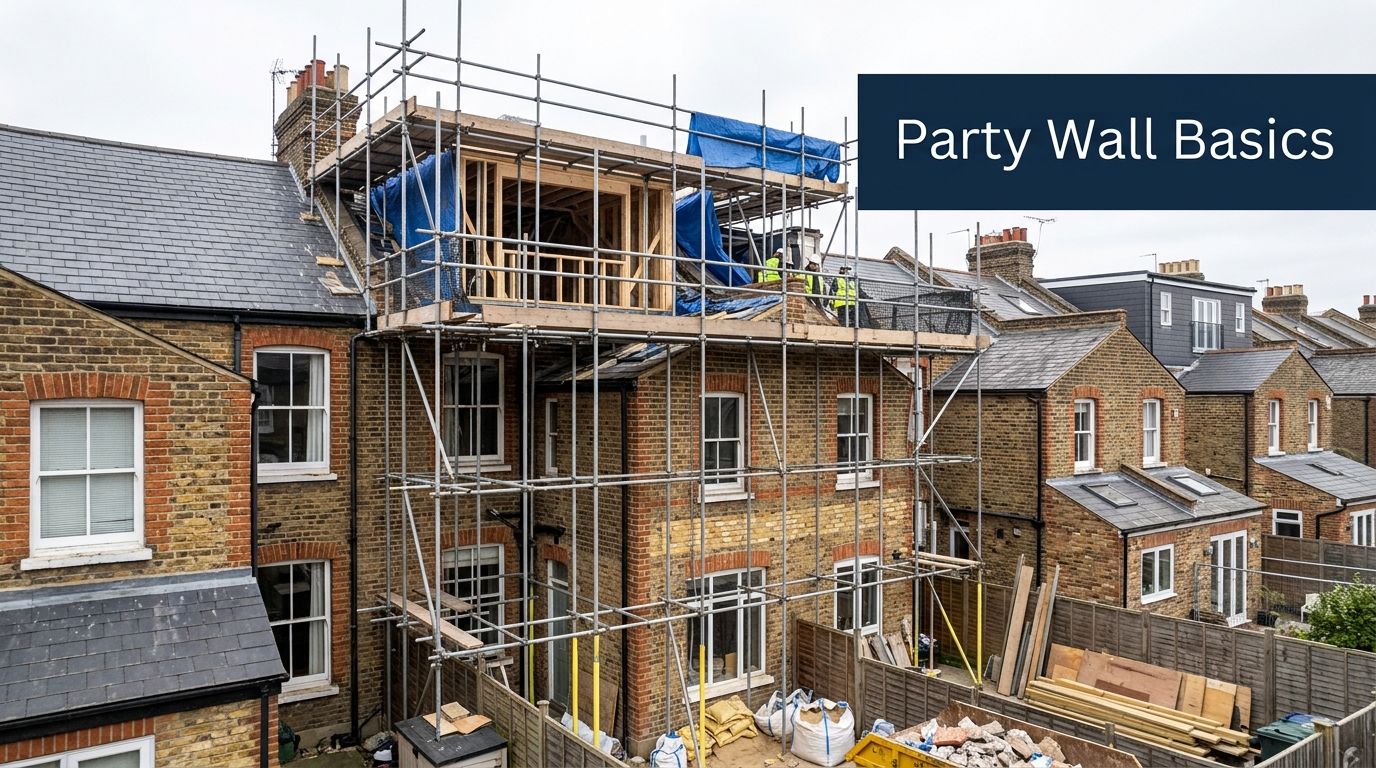
For most London homeowners, the usual trigger is straightforward. You're altering a shared wall, building right on the boundary or digging foundations close enough to affect the next property. In a Bromley semi, that might be cutting into the wall for steels. In a Peckham terrace, it might be a side return extension. In Blackheath or Greenwich, where older housing stock often has shallow foundations, excavation can bring the Act into play very quickly.
This is not optional admin. The notice is the legal trigger for formalising rights on shared boundaries in England and Wales under the Act, and if you don't follow the required procedure the work can become unlawful, with the risk of delay and court action, as explained in the Party Wall Act overview published by FPWS.
Practical rule: If the work touches a shared wall, supports it, cuts into it or digs close to your neighbour's foundations, assume you need advice before a builder starts.
A proper notice also has to say what you're doing in clear terms. That means the nature of the works, not vague wording like "general extension works". If the job involves cutting into a wall, inserting beams or excavating near the neighbour's foundations, those details need to be clear enough for the adjoining owner to understand the risk.
That is the basic answer to what is a party wall notice. It is the legal starting document that protects both sides before work begins.
The Law Behind the Notice The Party Wall Act
You do not get a second chance with a party wall notice. If you start the work first and try to sort the paperwork later, the notice cannot be backdated to clean it up. The Act only works prospectively. Get that wrong, and you hand your neighbour a clear route to injunctive action, delay and extra cost.
The law is the Party Wall etc. Act 1996. It applies in England and Wales and sets the legal process for certain works to shared walls, boundary structures and nearby excavation. In London, where houses sit tightly together and many foundations are older and shallower, that process matters because one owner's job can physically affect the next owner's building.
A lot of homeowners misunderstand what the Act does. It does not decide whether your extension has planning permission. It does not let a neighbour reject lawful works because they dislike the scheme. It gives you statutory rights to carry out specific works, but only if you follow the notice procedure properly.
That point is the one people miss.
Without a valid notice, you are outside the statutory process. That weakens your position immediately. If the neighbour objects to the works or alleges risk, you are then arguing from the back foot instead of relying on the rights the Act would have given you. For a plain-English explanation of how the legislation works in practice, see this Party Wall Act guidance for London homeowners.
What the Act is really trying to prevent
The Act is there to stop avoidable damage, arguments about access, and last-minute rows over responsibility if cracking or movement appears next door. It forces the building owner to put the proposal in writing before work starts, giving the adjoining owner a formal chance to consent or dissent.
Silence is not consent under the Act. That is one of the most important legal consequences to understand. If your neighbour does not reply within the statutory period, the law treats that as a dispute. At that point, surveyors need to be appointed and the matter moves into the award process. Homeowners regularly get this wrong and assume no reply means they can crack on. It does not.
The other hard rule is timing. The notice must be served before the relevant works begin, and the notice period must be allowed to run. You cannot repair a missed notice retrospectively. If your builder is ready on Monday and the notice should have gone in weeks earlier, the correct advice is simple. Delay the start and fix the legal process first.
This legal framework also sits alongside the practical side of the build. Good paperwork with your builder helps avoid a separate mess over scope, timing and responsibility, and a contractor's guide to contracts is a useful starting point for that part of the job.
In short, the Act exists to keep control of risk before the first cut into the wall or the first excavation near the boundary. Serve the right notice, serve it on time, and treat no response as a live dispute, not a green light.
Types of Notice and When You Need One
Pick the wrong notice, and you can stop your own job before it starts. Worse, if you start on the wrong notice or no notice at all, you cannot fix that afterwards by sending one late. The Act does not work retrospectively.
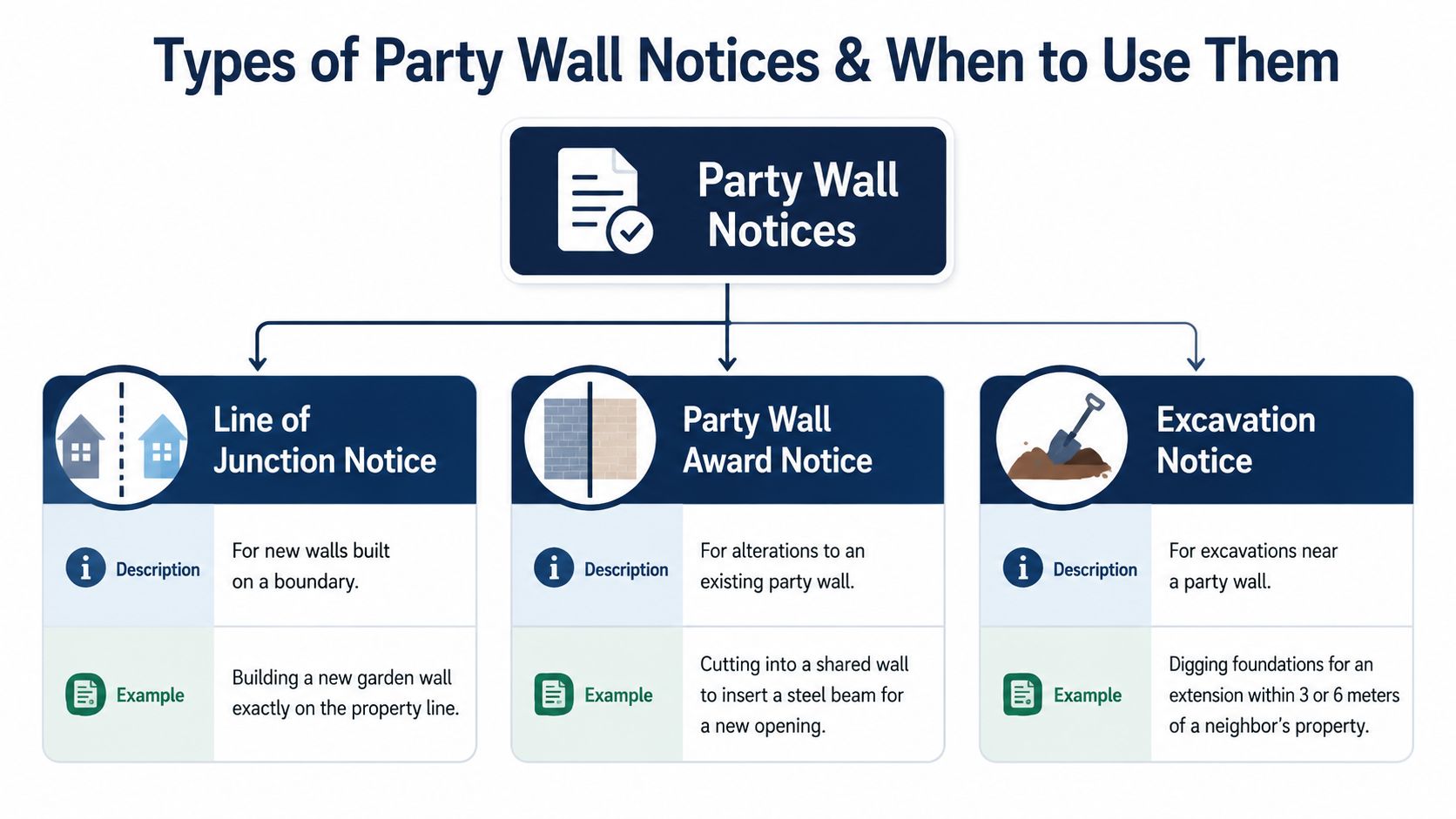
There are three main notice types, and each one matches a different kind of work. The right question is not "am I doing building work?" It is "what exactly am I doing to the boundary, the shared structure, or the ground near my neighbour's foundations?"
Line of junction notices
Use this when you want to build a new wall at the boundary line. A typical example is a garden wall placed right on the line between two properties.
This falls under Section 1 of the Act. The notice period is one month. It often gets missed because homeowners assume the Act only applies once there is already a shared wall. That is wrong. New work on the boundary can trigger it just as easily.
Party structure notices
Use this for work to an existing party wall or party structure. If you are inserting steel beams into the shared wall for a rear extension, forming pockets for padstones, raising the wall for a loft, or cutting away part of it, this is usually the notice you need.
Common examples include:
- Cutting into the wall for steels, bearings or flashings
- Raising, underpinning or thickening the wall
- Removing or altering part of the wall
- Chimney breast work affecting the shared wall, which often ties into wider structural requirements covered in this guide to building regulations for chimney breast removal
The minimum notice period is two months.
Adjacent excavation notices
Rear extensions catch people out here all the time. If you are digging near the neighbour's foundations, the Act may apply even though you are not touching the shared wall at all.
A Section 6 notice is usually needed where you excavate within three metres of the adjoining owner's structure and go deeper than their foundations, or within six metres where the excavation falls within the zone set by the Act's measurement test. The practical point is simple. If foundations are going in near the boundary, check this early with your designer or surveyor. Do not leave it to the builder on site.
The minimum notice period is one month, and the drawings need to be clear enough for the neighbour to understand what is proposed.
Silence still causes trouble here. If you serve the correct notice and the adjoining owner does not reply, that does not give you approval. It pushes the matter into dispute procedures. If you serve the wrong notice for the job, you have created an avoidable problem and wasted time.
If you are also sorting the wider admin for the build, keep your builder's paperwork in order as well. A decent contractor's guide to contracts helps keep scope, responsibility and timing clear alongside the party wall process.
| Notice type | Typical use | Minimum notice period |
|---|---|---|
| Line of Junction | Building a new wall on the boundary line | One month |
| Party Structure | Cutting into or altering a shared wall | Two months |
| Adjacent Excavation | Digging foundations close to a neighbour's structure | One month |
How to Serve and Respond to a Notice
You tell the builder to start on Monday because the neighbour never replied. That is the point projects go off the rails. Under the Act, silence is treated as a dispute. It is not consent, and you cannot fix a bad notice after the works have started.
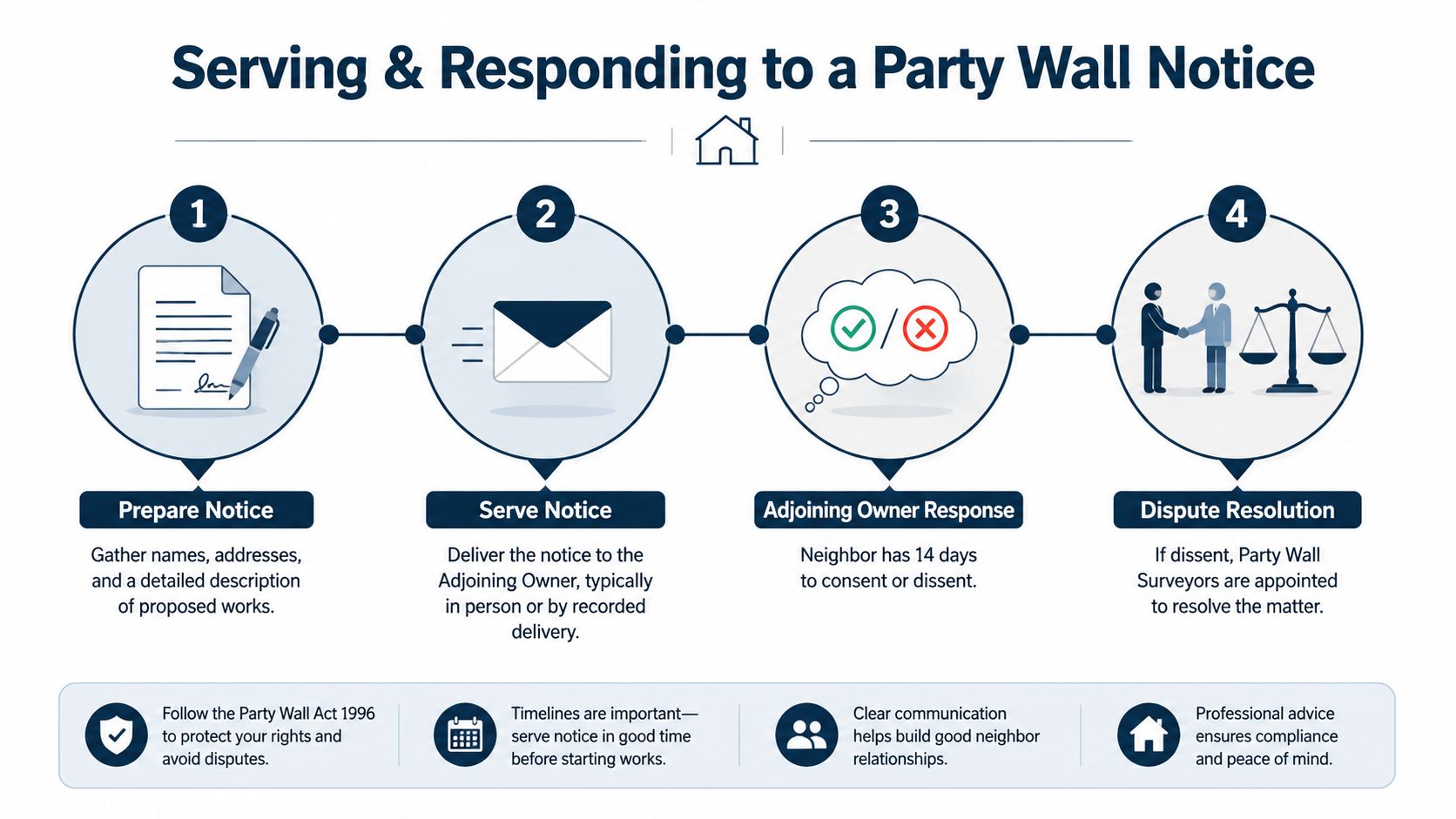
What a valid notice must include
A notice only works if it clearly identifies the building owner, the property, the works proposed and the intended start date. If the job involves excavation or structural work, include drawings and enough technical detail for the adjoining owner to understand what is planned. If special foundations are proposed, spell that out properly.
Get this right before you serve it. Party wall notices are not retrospective. If you start work first and ask questions later, you lose the protection the Act gives you and create a mess that is slower and more expensive to sort out.
A notice also has a shelf life. If the job does not start within the valid period, you serve again and the clock starts again. Do not send notices off half-baked just to feel productive. Serve when the design is settled and the start date is realistic.
Keep every document together from day one. Notices, drawings, proof of service, replies, engineer's details and photos matter if the neighbour later alleges damage such as structural cracks in walls. Good filing prevents bad arguments. If your paperwork is scattered, Vorby's document organization solutions are a sensible place to start.
Best approach: Serve the notice once the drawings are clear, the scope is settled, and you can actually start within the notice period.
What your neighbour can do next
Once the notice has been served, the adjoining owner has 14 days to reply. They can consent in writing, dissent, or say nothing.
The part homeowners get wrong is the silence point. No reply does not let you proceed. The law treats no reply within the 14-day period as a deemed dispute, which means surveyors need to be appointed and the formal process begins.
That video explains the point plainly:
The practical response options are simple:
- Written consent: You can proceed after the notice period, though a schedule of condition is still a sensible precaution.
- Written dissent: A dispute arises and surveyor appointments follow.
- No reply within 14 days: The law treats it as a dispute, not approval.
Act on the legal position, not the mood between neighbours. A friendly chat over the fence is fine, but it does not replace a written response. If you want to stay out of trouble, assume nothing, keep proof of service, and deal with silence as a dispute straight away.
What Happens in a Party Wall Dispute
You serve a notice. Your neighbour says no, or says nothing. At that point, you are in a dispute under the Act, and the job has to go down the surveyor route.
That catches London homeowners out all the time. Silence is not consent. It is a legal trigger.
A party wall dispute is usually an administrative process, not a blazing row. The purpose is simple. Get a binding document in place before work starts, so the works, access, protections and risk of damage are properly controlled. If you get that sequence wrong, you cannot clean it up afterwards with a late notice and hope for the best.
What changes once a dispute arises
Once the dispute exists, surveyors step in and prepare the Party Wall Award. That Award is the legal document that allows the works to proceed under set terms. Until then, you are exposed.
There are two standard appointment routes:
- Agreed surveyor: both owners appoint one surveyor to act impartially
- Two surveyors: each owner appoints their own surveyor, and those surveyors produce the Award
- Third surveyor: available if the appointed surveyors cannot agree on a point
If you want a broader explanation of formal dispute processes, WeUnite's guide to conflict resolution options gives useful background. Party wall procedure is its own statutory system, but the comparison helps explain why a formal process does not automatically mean court.
What the Award actually deals with
The Award is the rulebook for the works. It records what is being built, how the work should be carried out, what protections are required, and who pays the surveyors' fees.
A proper Award will usually cover:
- The works themselves: drawings, structural details and any method information the surveyors need
- Access arrangements: when access is allowed and on what terms
- Protection for the adjoining property: including a schedule of condition before works begin
- Damage procedures: how damage is assessed and made good if it happens
- Timing and working practices: practical restrictions to stop the build becoming a nuisance
Here, owners either protect themselves properly or create a mess.
If the adjoining property already has movement, cracking or signs of age, that needs recording before anyone starts. Otherwise, every old defect risks being argued about later. In older housing stock, that can become expensive very quickly, especially where there are pre-existing issues such as structural cracks in walls.
The point homeowners need to understand
A dispute under the Act is not the problem. An unmanaged dispute is.
The risk is procedural. If a dispute has arisen and no Award is in place, starting work leaves you open to injunction risk, delay, legal cost and a much weaker position if relations with the neighbour turn sour. Friendly neighbours change their tone very quickly once dust, noise or cracking appears.
Get the surveyor appointments sorted promptly. Get the Award in place. Then start work. That is the safe order.
Costly Mistakes London Homeowners Make
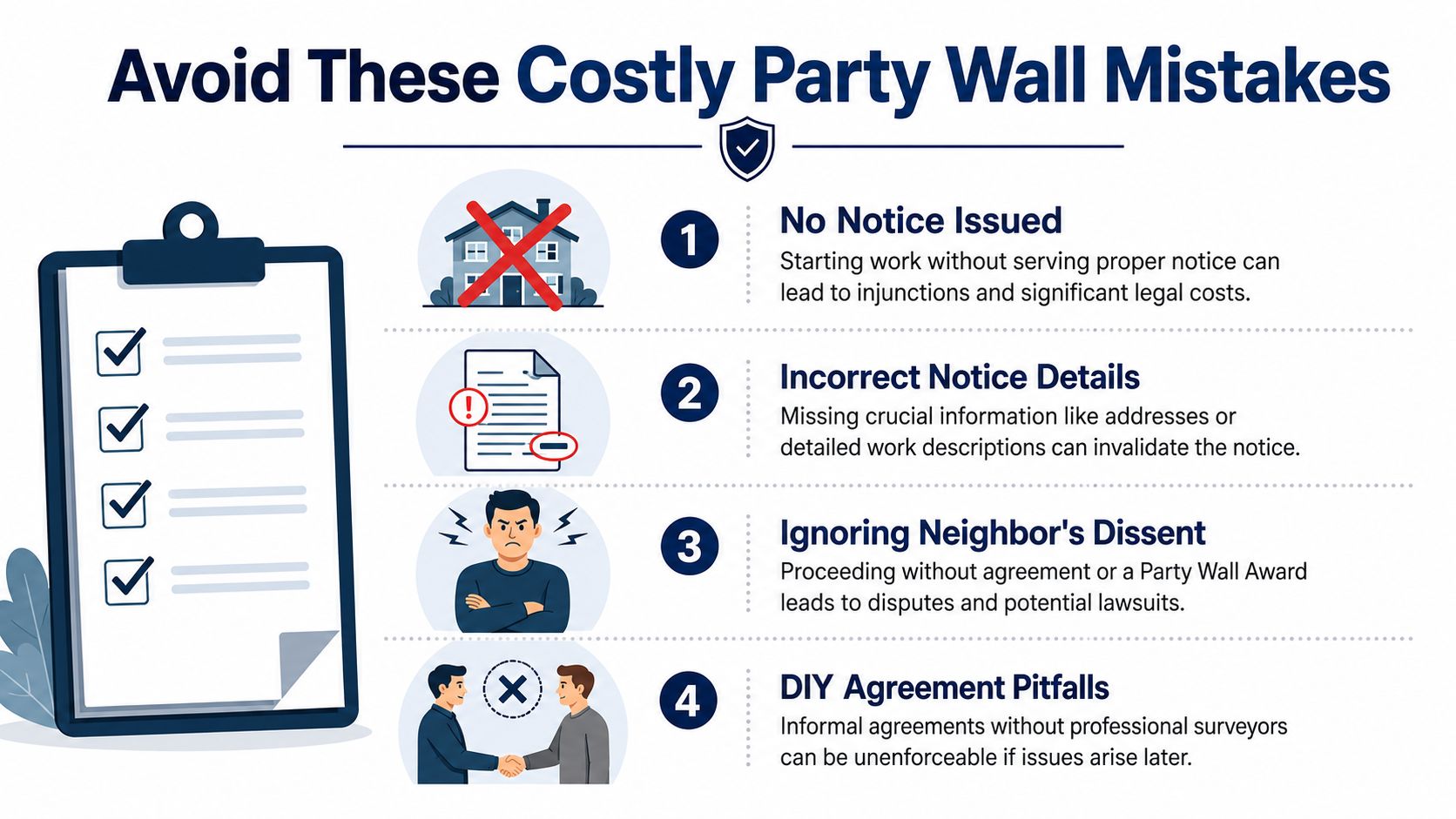
The worst mistake is also the most common. People start the work first and ask about party wall notices after the scaffold is up.
Starting first and asking later
You cannot serve a Party Wall Notice retrospectively. Court rulings confirm that notices and awards cannot be made after work has started, which means work begun without prior notice is a breach of the Act and can leave the homeowner exposed to court injunctions, as explained in Peter Barry's piece on common misunderstandings about the Party Wall Act.
That is the point to take seriously. If you've already started cutting into the wall or digging foundations, the law does not give you a tidy reset button.
Stop and take advice before work starts, not after the builder has opened up the wall.
Other mistakes that derail jobs
Some errors are less dramatic, but they still cause delay and extra cost.
- Using a weak template: If the notice is vague or misses key details, it may not do the job properly.
- Poor drawings: Excavation notices in particular need clear plans and sections.
- Wrong timing: Serving too late can push the whole programme back.
- Assuming neighbour silence means approval: It doesn't.
- Trying to keep it informal: A friendly chat with the neighbour is useful, but it is not the statutory process.
This comes up repeatedly in South East London. Owners in Forest Hill, Sydenham and Brockley often have sensible neighbours and assume that good relations are enough. Good relations help. They don't replace the Act.
If you're unsure whether your rear extension, loft conversion or structural alteration needs a notice, get proper advice before committing to a start date. For straightforward guidance from an independent RICS-regulated practice with CABE-qualified expertise, call Corinthian Surveyors London LTD on 0800 00 16 422.
Frequently Asked Questions About Party Wall Notices
Who pays for the Party Wall Surveyor
In most ordinary cases, the building owner carrying out the works pays the reasonable surveyor fees because they are the one benefiting from the project. That's the usual practical position on residential jobs.
Can I serve the notice myself
Yes, you can. There is no rule saying you need a solicitor to do it. But if the job involves steels, excavation, chimney breast removal or anything more than a very simple boundary matter, getting the notice drafted properly is often the sensible move because mistakes at notice stage can ripple through the whole project.
What if my neighbour ignores the notice
Silence is treated as a dispute after the 14-day response period. You then move to surveyor appointment and the preparation of an Award. You do not treat non-response as permission.
What if my neighbour ignores the Party Wall Award
An Award is a binding legal document. If one side ignores it, the matter may need legal enforcement. At that point you need specific advice based on what has happened, the wording of the Award and the conduct involved.
If you're planning works to a London home and want clear advice before anything goes wrong, Corinthian Surveyors London LTD can help. The practice is independent, based in Forest Hill and regulated by RICS, with Clive Thompson bringing over 30 years of built environment experience and both RICS and CABE qualifications. For residential surveying advice, including party wall matters, building work concerns and related services such as building conservation or project management, you can speak to them on 0800 00 16 422.