
Structural Cracks in Walls: When to Worry and What to Do
You spot a crack while painting the spare room. Or the estate agent has just left and you've noticed a stepped line running through the brickwork by the bay window. Your mind goes straight to subsidence, underpinning and a bill you don't want.
Slow down. Not every crack is serious.
In London housing, especially Victorian and Edwardian terraces, cracks are common. Some are no more than plaster shrinkage, old settlement or seasonal movement. Some are a warning that the building is moving in a way it shouldn't. The trick is knowing the difference, and that means looking at the crack in context, not panicking at the first line in the wall.
Table of Contents
- Spotting a Crack in Your Wall? Here Is What to Check First
- Is It a Surface Crack or a Structural Problem?
- What Causes Wall Cracks and What Do They Look Like?
- A Practical Guide to Assessing and Monitoring Cracks
- What to Expect from a Professional Survey
- Understanding Repairs, Costs and Insurance
- Frequently Asked Questions About Wall Cracks
Spotting a Crack in Your Wall? Here Is What to Check First
You often notice a crack at exactly the wrong moment. You're decorating, getting ready to sell, or waiting for survey results on a place you already love. A thin line on plaster suddenly looks like a structural disaster.
Usually, it isn't. But you do need to look at it properly.
In older London housing stock, small cracks can appear for harmless reasons. Plaster dries and shrinks. Materials expand and contract. Old houses move a little through the seasons. That's normal, particularly in terraces around Forest Hill, Sydenham, Greenwich, Peckham and Dulwich where age, past alterations and mixed repairs all leave their mark.
What matters first is not the drama of finding a crack. It's the shape, width, position and whether it's changing.
Ask yourself four simple questions:
- Where is it? A crack over a door or window means something different from a faint line in ceiling plaster.
- What direction does it run? Diagonal and stepped cracks are usually more significant than random hairlines.
- How wide is it? A crack you can barely catch with a fingernail is a different matter from one you can clearly measure.
- Has anything else changed? Sticking windows, doors that suddenly bind, sloping floors and visible distortion matter more than the crack alone.
First rule: don't fill a crack before you understand it. Once you patch and paint, you've lost evidence.
I've spent years looking at period houses across South East London, and the same point comes up again and again. People either dismiss cracks that need checking, or worry themselves sick over plaster defects that are little more than cosmetic. A calm first inspection sorts most of that out.
Is It a Surface Crack or a Structural Problem?
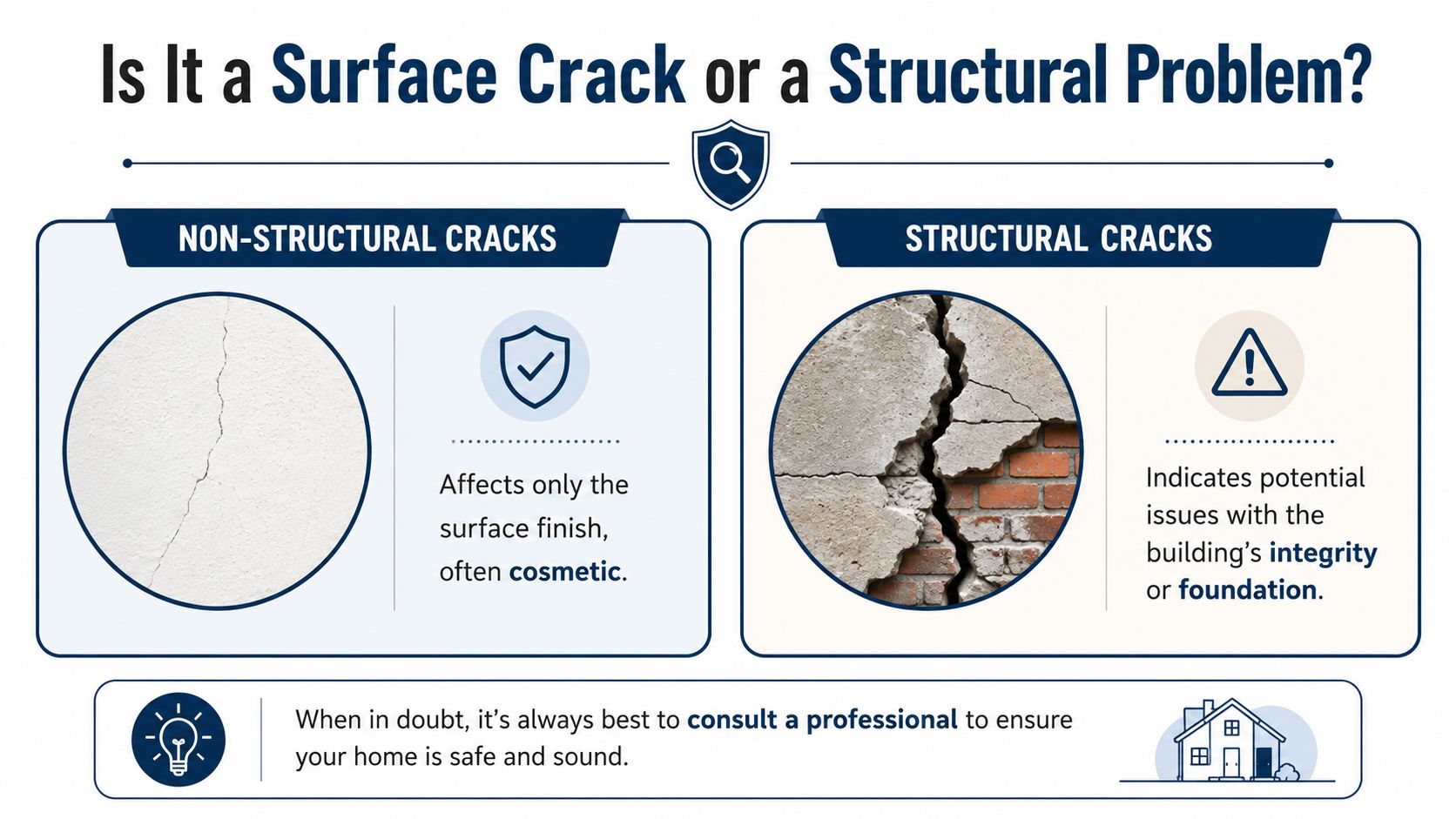
The big distinction is simple. A surface crack affects the finish. A structural crack suggests movement in the building fabric itself.
That sounds technical. It isn't. Think of surface cracking like a split in paintwork on an old car bumper. It may look untidy, but the main structure behind it is still doing its job. Structural cracking is different. That's the shell of the building telling you loads are shifting, support is changing or masonry is under stress.
The quick distinction that matters
A surface crack is often:
- Fine and shallow, usually limited to plaster or decoration
- Random or spider-like, rather than following masonry joints
- Stable, meaning it doesn't keep reopening after redecoration
- Unaccompanied by other symptoms, such as sticking joinery or uneven floors
A structural crack is more often:
- Wider and easier to measure
- Stepped through brick joints, or diagonal from corners of openings
- Repeatedly returning, even after repair
- Linked to movement elsewhere, such as distorted frames or sloping surfaces
The crack itself is only part of the story. You also need to ask what the wall is made of. In a London terrace, a crack in old lime plaster may tell a different story from a crack running through brickwork in a solid masonry wall.
What a surveyor wants to know
Surveyors don't just stare at the crack and make a guess. We place it in the wider building picture. The age of the property, the wall construction, nearby openings, evidence of previous movement and the pattern across the house all matter.
If you want a straightforward explanation of how a survey works, this piece on what a RICS survey involves is a useful starting point.
A practical way to think about it is this short comparison:
| Type of crack | Usually points to | Typical response |
|---|---|---|
| Hairline plaster crazing | Surface finish movement | Redecorate when stable |
| Fine crack that reappears in same spot | Local movement or weak junction | Monitor and inspect in context |
| Diagonal crack from window corner | Stress around opening or movement | Check for progression and related defects |
| Stepped crack through brick joints | Structural movement in masonry | Professional assessment |
A crack in isolation is rarely enough to diagnose anything. The building gives the answer as a whole.
What Causes Wall Cracks and What Do They Look Like?
Different defects leave different signatures. If you learn the common patterns, you stop guessing.
In UK housing, wall cracking is closely linked to subsidence risk because clay soils cover about 40% of England and are especially prone to shrink-swell movement during dry or wet periods. Guidance also treats cracks wider than around 5 mm as an important threshold for concern because they are more likely to reflect structural movement than simple plaster shrinkage, as explained in this guidance on crack widths and subsidence risk.
That matters in London. A lot of the housing stock sits on clay-rich ground. In places such as Lewisham, Bromley, Blackheath, Crystal Palace and parts of Croydon, seasonal ground movement is not some abstract theory. It's part of how the local building fabric behaves.
Patterns that usually mean movement
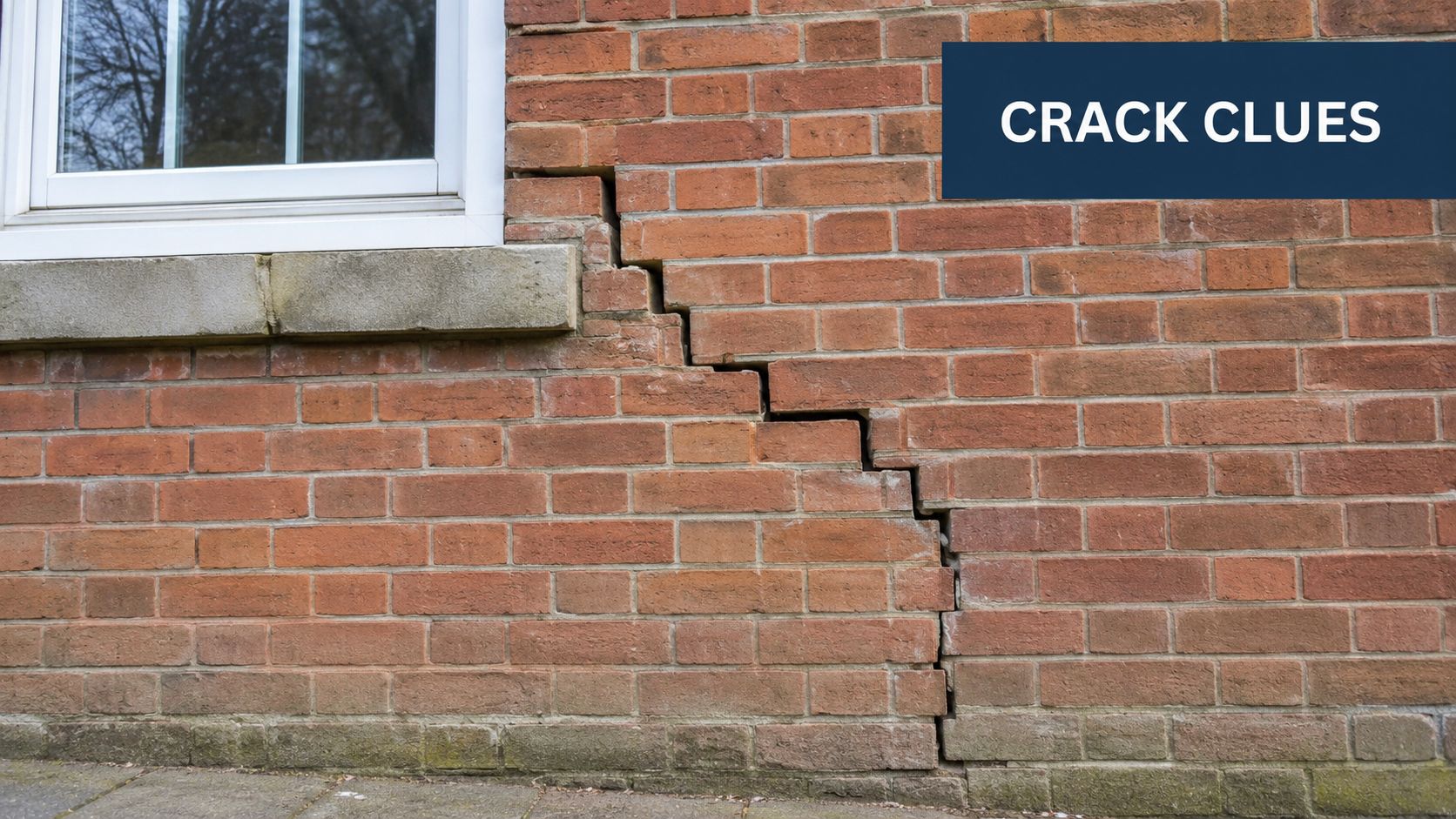
Diagonal cracks often appear when part of the structure is moving at a different rate from the rest. You'll often see them running from the corner of a door or window. Openings are weak points in masonry, so that's where stress tends to show first.
Stepped cracks follow mortar joints in brickwork. These are classic movement cracks in masonry walls. They don't always mean major failure, but they do mean the wall has been under stress.
Horizontal cracks need care. They can point to structural distress, support issues or localised failure, depending on the wall type and location.
Cracks that are wider at one end are worth attention. That taper often suggests movement rather than a simple finish defect.
For readers who want a broader visual primer on external structural warning signs, this essential guide to wall integrity is useful background reading.
Patterns that are often cosmetic
Fine, random hairline cracks in plaster are very common. So are shallow cracks where different materials meet, such as the junction between a wall and ceiling. In Victorian and Edwardian houses, old plaster can also crack because the background has dried, loosened or been patched badly over the years.
Here's the practical distinction:
- Plaster shrinkage tends to be fine, shallow and irregular
- Historic settlement often looks older, dirty-edged and long established
- Structural movement tends to produce cleaner, more directional cracking through masonry or at stress points
Old houses often have old cracks. The question isn't whether a crack exists. It's whether the cause is active.
If you're looking at a period terrace, don't judge the crack without judging the house. A rear extension built decades after the main house may move differently. A chimney breast removal may have altered load paths. A modern hard cement patch in a lime-based wall can also create its own cracking pattern. That's why generic internet advice is often poor. It shows a picture of a crack, but not the building logic behind it.
A Practical Guide to Assessing and Monitoring Cracks
Don't start with filler and paint. Start with a record.

UK survey guidance treats geometry and width as strong indicators of significance. Stepped, diagonal, horizontal or widening cracks are more concerning than fine plaster crazing, and cracks wider than 5 mm are commonly used as a threshold for professional investigation, particularly when they appear with sticking doors or uneven floors, as set out in this practical guide to worrying wall cracks.
What to record straight away
You don't need specialist training to gather useful evidence. You just need to be methodical.
Measure the widest point
Use a ruler or crack gauge. Don't guess.Photograph it properly
Take clear photos straight on, then from a little further back so the location is obvious.Mark the ends lightly in pencil
Add the date. If the crack lengthens, you'll know.Note the exact position
Write down the room, wall, height and nearby feature such as a window, chimney breast or door head.Look for linked symptoms
Check whether windows stick, doors bind or floors feel uneven.
How to monitor a crack properly
If the crack doesn't look immediately urgent, monitor it. That means watching for change, not glancing at it every few months and hoping for the best.
A simple plastic crack monitor can help. So can dated photos taken from the same angle. What matters is consistency. You're trying to establish whether the crack is stable, seasonal or progressive.
Here's a sensible rhythm:
- Check after weather changes if you suspect seasonal movement
- Re-photograph after redecoration if the crack has previously returned
- Compare width and length, not just appearance
- Keep notes in one place, because memory is useless for this
This short video gives a useful visual on checking crack movement before you speak to a professional.
Practical note: if the crack is obviously widening, or the wall looks distorted, skip the monitoring stage and arrange an inspection.
What to Expect from a Professional Survey
Once a crack is clearly significant, or you can't tell what you're looking at, a proper survey is the right move. Not a mortgage valuation. Not a builder's casual opinion. A survey.
Why context matters in London homes
Most general advice misses the point London buyers care about. In a Victorian or Edwardian terrace, the same crack pattern can mean very different things depending on the age of the house, where the crack sits, whether it returns after redecoration, whether there is moisture evidence and whether other symptoms exist. That contextual approach is set out well in this discussion of cracks in older homes.
That's exactly why period housing needs experience, not guesswork. A crack beside a sash window in a Brockley terrace is not judged the same way as a crack in a 1930s semi in Bromley or a converted flat in Bermondsey.
A surveyor will look at:
- Construction type, including solid wall or cavity wall
- Age and alteration history, especially extensions and removed chimney breasts
- Crack location, particularly near openings and junctions
- Moisture and drainage clues, because water often sits somewhere in the background
- Wider movement signs, not just the crack itself
Which survey is usually the right one
If there's a credible concern about structural movement, a RICS Building Survey (Level 3) is usually the right choice. It gives room for detailed inspection and reasoned comment on defects, causes and likely next steps. For a straightforward modern flat with a minor hairline issue, a lower level survey may be enough, but older houses with visible movement need more attention.
For anyone buying a property where cracking is already visible, this guide to a full structural survey for older or more complex homes explains why a deeper inspection is often the sensible option.
Corinthian Surveyors London LTD is one example of the type of independent practice to look for. The key point is independence. You want a surveyor with RICS and CABE qualifications, local knowledge and no ties to lenders, estate agents or developers, because movement defects need a clear head and a straight answer.
A proper survey should also tell you what isn't serious. That matters just as much. Good advice can stop you wasting money on unnecessary engineering when the issue is long-standing and non-progressive.
Understanding Repairs, Costs and Insurance
Repairs come after diagnosis. Not before.
Repair follows diagnosis, not panic
A hairline plaster crack doesn't need underpinning. A stepped masonry crack doesn't get solved with decorator's caulk. The repair has to match the cause.
That might mean:
- Redecoration and local plaster repair if the issue is purely cosmetic
- Lintel repair or replacement if cracking relates to failure over an opening
- Masonry crack stitching where localised wall cracking needs stabilising
- Drainage or moisture correction if leaking services or poor water management are feeding the problem
- Structural engineering input if significant movement is suspected
If your crack is plainly superficial and you want a simple decorating-focused view of patching methods, these Portland drywall repair tips are a decent illustration of cosmetic repair logic. Just don't apply cosmetic repair methods to a structural defect. That's where people go wrong.
Repairing the finish without understanding the movement is like repainting over damp. It hides the symptom and leaves the cause.
Insurance and buying decisions
If you already own the property, check your buildings insurance wording. Subsidence-related issues may be covered, while poor maintenance or bad workmanship usually won't be. Insurers will normally want evidence of cause, which is where a survey or engineering opinion becomes useful.
If you're buying, a crack can change the negotiation completely. Sometimes it justifies further investigation before exchange. Sometimes it supports a price reduction. Sometimes it is historic and low risk, in which case you proceed with clearer eyes.
If you need help choosing someone sensible to inspect the property, this guide on how to choose a building surveyor in London without wasting time or money is worth reading first.
And if the crack worries you enough that you're losing sleep, stop guessing and speak to somebody qualified. A short conversation early on is usually cheaper than a wrong repair later. You can call on 0800 00 16 422 and explain what you're seeing.
Frequently Asked Questions About Wall Cracks
Are cracks in old London houses normal?
Many are. Older houses move differently from modern ones. They've often had extensions, chimney alterations, replastering and decades of seasonal change. A crack can be normal for the age of the building. It can also be the first sign of a live defect. The difference is in the pattern, position and whether it's still moving.
When should I worry about structural cracks in walls?
Worry less about the word “crack” and more about the signs around it. Cracks that are stepped, diagonal, horizontal, widening or linked to sticking doors, sloping floors or distortion deserve attention. Those are not the ones to ignore.
Should I buy a house with wall cracks?
Sometimes yes. Plenty of properties with visible cracking are perfectly mortgageable and repairable. The right question is not “does it have cracks?” but “what is causing them, and is that cause active?” A proper survey answers that before you commit yourself.
Can I just fill the crack and see if it comes back?
You can, but it's a poor way to diagnose movement. If you fill first, you erase evidence. Measure it, photograph it and note the date before doing anything. If the crack already looks serious, don't patch it at all until it has been inspected.
If you've found cracking in a London property and want a plain-English opinion before matters get out of hand, Corinthian Surveyors London LTD offers independent residential advice across London and the South East. That means RICS-regulated surveying, local knowledge of period housing and a sensible view on what's cosmetic, what needs monitoring and what needs urgent investigation.