
Party Wall Agreement Cost: What You’ll Pay in 2026
In a straightforward London project, party wall agreement cost is usually about £1,200 to £3,600 per affected neighbour when the neighbour cooperates. If things turn into a full two-surveyor job, or the work involves a basement or several neighbours, the bill moves up fast because you're paying for process, not a fixed statutory fee.
That's the bit homeowners miss. The Act doesn't hand you one neat price. The final figure depends on notices, a Schedule of Condition, surveyor time and whether the matter turns into a dispute.
Table of Contents
- What a Party Wall Agreement Really Costs in London
- How the Party Wall Act Works in Practice
- Breaking Down the Four Fee Drivers
- London Cost Scenarios for Common Projects
- Factors That Push Costs Up
- Practical Ways to Reduce Your Party Wall Fees
- When to Instruct a RICS Party Wall Surveyor
- Common Party Wall Questions From London Homeowners
What a Party Wall Agreement Really Costs in London
A London homeowner usually gets hit by the bill in four places, and that is the part people miss. First comes the notice work. Then the schedule of condition, which records the neighbour's property before the work starts. After that comes surveyor time, and if the neighbours disagree, the cost jumps again because the dispute has to be dealt with properly.
That is why there is no honest single price for a party wall agreement cost. A simple job with one friendly neighbour can stay modest. A rear extension beside two owners in a tight terrace can move the numbers quickly because every extra property means more letters, more visits and more drafts.
For a straight residential job, the figures usually start around £700 to £2,700 when a surveyor is needed, and a single agreed surveyor often sits around £900 to £2,700 depending on the work. London guidance places each surveyor at £750 to £1,800, so a building owner can end up paying £1,500 to £3,600 per affected neighbour if both sides appoint surveyors. The clean route is cheaper because one surveyor does the job. The moment the neighbour appoints their own surveyor, the bill starts to climb. Party Wall DIY guidance on agreement costs
The sensible way to read those numbers is simple. You are paying for notice drafting, condition recording, surveyor time and, where needed, a formal award. A lot of homeowners fixate on the headline fee and ignore the true driver, which is the amount of professional time needed to get the paper trail right.
What the price usually reflects
Surveyor time is the main cost. More neighbours mean more site visits, more emails, more phone calls and more paperwork. A terrace in Peckham or Brockley often costs more than a semi in Bromley for that reason alone, even if the building work looks similar from the street.
Older figures are still useful because they show how quickly the market has moved. Earlier UK guides often put a loft conversion at around £1,300, an extension at £1,500 and a basement at £1,800, with hourly rates often shown at £150 to £250. More recent 2025 to 2026 guidance has moved upward to £900 to £1,200 for lofts, £1,200 to £1,500 for extensions and £1,800 to £2,700 for basements when one surveyor is involved. HOA surveyor cost guide
The bill is usually driven by how many people are involved, not by the length of the wall.
Notice-only work can be much cheaper. One fee guide says a party wall notice can be served for £167 per side or owner through a professional service, which is a very different number from a full award process. Party Wall DIY guidance on agreement costs
If you want the process itself spelled out, see the party wall agreement process.
How the Party Wall Act Works in Practice
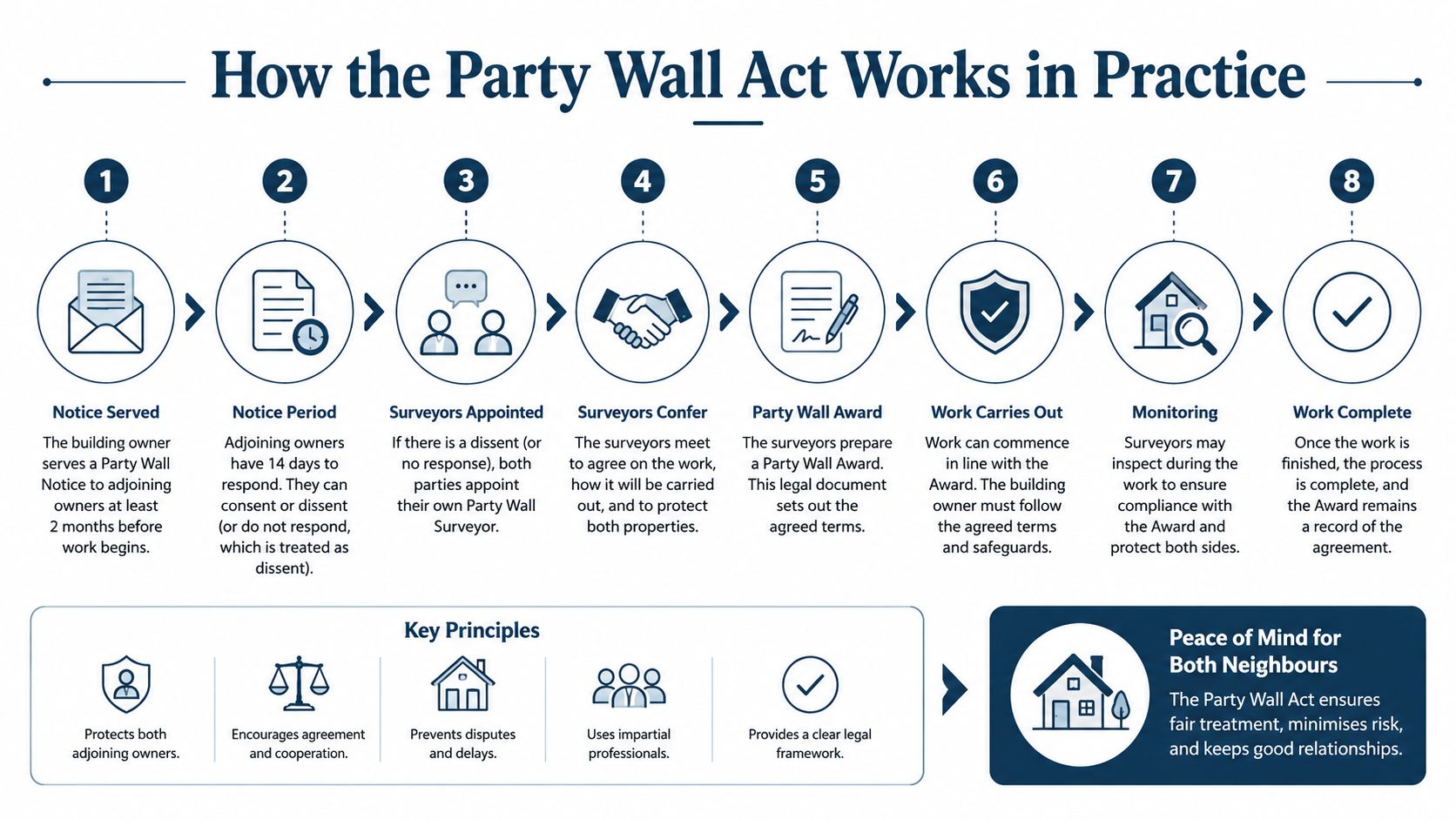
A typical London scenario is a rear extension on a Victorian terrace in Forest Hill. You want to build close to the boundary and maybe cut into a shared wall for steelwork. That's where the Party Wall etc. Act 1996 comes in, it protects the adjoining property and gives both sides a proper process. It does not give a neighbour a blank cheque to block work.
There are three notice routes in plain English. A line of junction notice covers work at the boundary. A party structure notice covers work to the shared wall itself. An excavation notice covers digging near a neighbour's foundations. If the neighbour replies within the notice period and consents, the process is lighter. If they dissent, the formal award route starts.
Who does what
The building owner is the person doing the works. The adjoining owner is the neighbour whose property could be affected. If both sides agree on one person, that person is the agreed surveyor. If not, each side appoints a surveyor and those two surveyors handle the award process.
A surveyor needs independence. That matters when there is friction, because the job is to apply the Act properly, record the condition of both properties and draft the award without favour. That's why an independent residential specialist is better than a lender-style panel mindset. It's a different job entirely.
The notice response window is 14 days. If there's no response, the law treats that as dissent and the process moves on. In practice, most of the stress comes from late notice and poor communication, not from the Act itself. Party wall agreement process explanation
Serve early. That one habit avoids a lot of needless cost and argument.
Breaking Down the Four Fee Drivers
1. Notices
The notice stage is usually the cheapest part of the process, but only if it is done properly the first time. A professionally served notice can cost £167 per side or owner under one UK fee guide, which is a small amount compared with the rest of the bill.
What you are paying for is accuracy. If the notice type is wrong, the dates are wrong, or the project is described badly, the whole process can stall and have to start again. In places like Lewisham or Southwark, where many terraces and conversions share awkward side passages and older walls, that kind of mistake gets expensive quickly.
2. Schedule of Condition
A Schedule of Condition is a dated record of the neighbour's property before work starts. It photographs and describes cracks, movement, finishes, and anything else already there, so nobody ends up arguing later about whether the project caused the damage. The building owner usually pays for this because the Act puts reasonable costs on the person doing the work. RICS procedure guidance on party wall legislation
This is not paper-pushing for the sake of it. A proper schedule can save a lot of trouble later, because it gives both sides a clear record of what was already present before the builder starts cutting, digging, or opening up walls.
3. Surveyor time
The bill starts to climb during the appointment. In London, surveyor fees are commonly in the £150 to £200 hourly range, and a straightforward residential award can sit around £1,000. The less tidy the paperwork, the more time gets spent on calls, site visits, and drafting.
The cost is time spent solving avoidable problems. If the drawings are incomplete, the notice is poor, or the neighbour wants changes, the surveyor has to keep revisiting the same issues. That is how a modest job stops feeling modest.
4. Dispute escalation
Once the neighbour dissents, fees rise because both surveyors have to review drawings, inspect the properties, and prepare the award. In London, guidance often places a single-surveyor route around £800 to £1,500, while two surveyors can take the standard cost up to £1,800 to £3,500 for an extension, with basement or multi-neighbour cases reaching £8,000+. Party Wall Advice complete guide
That is the part homeowners underestimate. Every extra email, every extra visit, and every revised draft adds time, and time is what gets billed. When the matter becomes formal, the cost is driven less by the paperwork itself and more by how much back-and-forth the dispute creates.
London Cost Scenarios for Common Projects
London homeowners should stop looking for one neat party wall agreement cost. That number does not exist. A loft in Clapham, a rear extension in Dulwich, and a basement in Bermondsey all drive different bills because the work triggers different levels of notice, inspection, surveyor time, and dispute risk.
Here is the practical picture for common projects.
| Project | Single agreed surveyor | Two surveyors appointed | Multi-neighbour outcome |
|---|---|---|---|
| Rear extension | £1,200 to £1,500 | £1,500 to £3,600 per affected neighbour | Higher if more than one neighbour is affected |
| Loft conversion | £900 to £1,200 | £1,500 to £3,600 per affected neighbour | Higher if chimney or party structure issues are involved |
| Basement dig | £1,800 to £2,700 | £1,500 to £3,600 per affected neighbour | £4,500 to £12,000+ for several adjoining owners |
Those ranges match current London guidance for straightforward work and the heavier figures that appear once the job turns into a multi-neighbour dispute. Mayfair Studio London 2026 guidance HOA surveyor cost guide
How to read the table
A consented rear extension in Bromley usually stays near the lower end because one surveyor can keep the process tight and the neighbour response is straightforward. A terraced loft in Deptford or Peckham often needs more attention if the party wall is being cut into for steels, because that creates more review and more back-and-forth. A basement in Greenwich, Wandsworth or Southwark can turn into a multi-neighbour exercise very quickly, especially where more than one property is affected.
Do not treat the table as a fixed quote. It is a budgeting guide. Surveyors still need the drawings, the site layout and the neighbour's response before they can price the work properly. Corinthian Surveyors London LTD handles this kind of residential work across London, but the sensible move is still the same, get a written quote for your exact scheme and do not rely on a headline range.
Factors That Push Costs Up

Some jobs look straightforward and still end up expensive. That happens because party wall fees are driven by separate events, and each one adds time to the file.
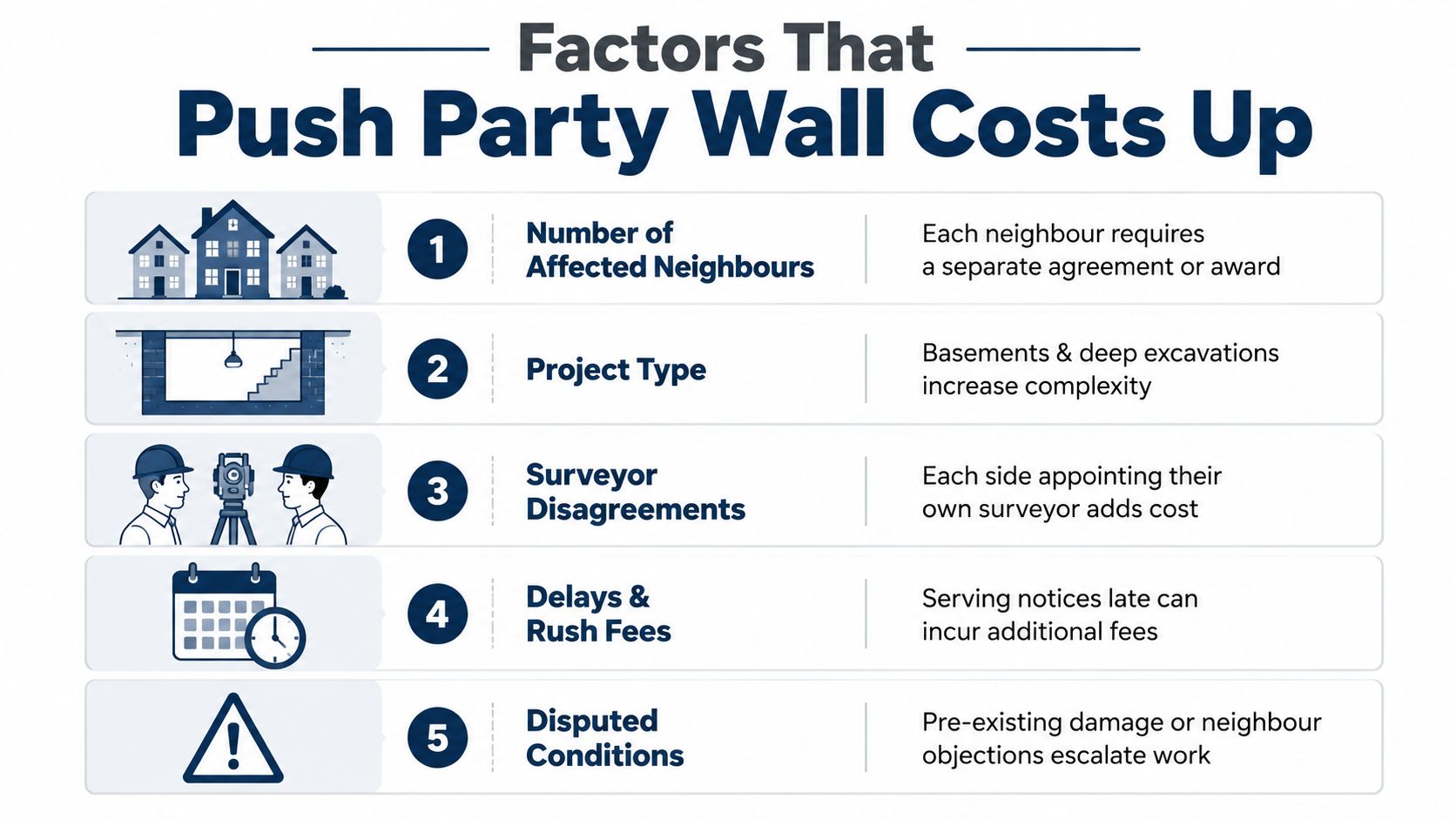
- More affected neighbours. Every extra neighbour means another notice, another response to manage and, in some cases, another surveyor appointment. Terraces in Brixton, Camberwell, Bermondsey and Forest Hill often push the bill up because the work can affect more than one adjoining owner.
- Basement or deep excavation. Deep digs cost more because the risk profile is higher and there is more structure to check. London surveyors price that extra scrutiny into the job, especially where the ground works sit close to neighbouring foundations.
- Multiple Schedule of Condition inspections. If several adjoining owners need recording, the site visits multiply fast. That is billable time before the builder has even broken ground.
- Dissent and drafting. Once a neighbour dissents, the surveyor has to prepare proper award terms, deal with access rights and usually have another round of discussion. If the two surveyors cannot agree, the matter can move towards a third surveyor.
- Old London fabric. Victorian and Edwardian terraces in Lewisham, Forest Hill, Dulwich, Peckham, Brixton, Camberwell and Bermondsey often have shared chimney stacks and party structures that make the detail fiddly and the review longer.
More moving parts mean more fee pressure.
That is why a project in Catford or Blackheath can look cheap at first and still drift upward once the drawings, neighbour responses and structural details are all on the table. The Act does not penalise you for building. It charges for the time needed to protect the neighbour properly.
If you want a calm, plain-English check before you serve anything, read party wall advice for London homeowners.
Practical Ways to Reduce Your Party Wall Fees
If you want the bill down, reduce the time the process consumes. That is the only honest way to do it. Skipping proper advice usually costs more later.
- Serve notices early. Late instruction causes rushed drafting and avoids none of the legal steps.
- Talk to neighbours first. A calm conversation before formal service often prevents the automatic dissent that drives up fees. Party wall advice in London
- Use one agreed surveyor where the relationship is good. It is usually cheaper than running two separate appointments.
- Keep the design routine. The more unusual the excavation or structural alteration, the more inspection time gets added.
- Agree access windows. If a surveyor can get in once and do the condition record properly, you cut return visits.
- Give clean documents. Missing drawings and vague notes waste time. Time is what you're buying.
A decent RICS surveyor should point out these savings early. That includes a residential specialist who knows when an agreed surveyor route is realistic and when it will only create delay. If you want a precise cost control conversation, ask for that before notices go out, not after the neighbour has already replied.
When to Instruct a RICS Party Wall Surveyor
If you are working on a terrace or semi in London, get a surveyor involved before you serve notice if the work touches a shared structure. That includes loft conversions cutting into the party wall, basement excavations near neighbouring foundations, chimney breast removals shared with adjoining owners and any case where the neighbour has already dissented.
A RICS surveyor matters because the job sits inside a published procedure, a complaints route and professional indemnity cover. That gives you a proper framework if something goes wrong. It also keeps the advice independent, which matters in dense areas like Southwark, Lambeth, Greenwich and Hackney where neighbour disputes can flare quickly.
Clear trigger points
- Shared walls in terraces and semis. If the work affects the wall between properties, get advice.
- Excavation near foundations. Basements and deep footings are not DIY territory.
- Chimney breast removal. Shared stacks often create hidden issues.
- Dissent or silence from the neighbour. Once that happens, the surveyor route is no longer optional.
- Complex access or multiple properties. The moment the project stops being simple, professional input pays for itself.
The right surveyor is not there to block the build. The job is to keep it lawful, document the condition properly and stop a small disagreement turning into a delay. Party wall surveyors in London
Common Party Wall Questions From London Homeowners
Is a consented party wall agreement really zero cost in practice?
No. If the neighbour consents, you may avoid a formal award, but you can still face notice preparation, schedule of condition work, and admin time. The paperwork is lighter, not free, and that is where a lot of London homeowners get caught out.
Who pays when the neighbour dissents?
The building owner usually pays the reasonable costs of the process. That is why the bill rises when more neighbours are affected, more drawings have to be checked, or the dispute becomes harder to resolve. RICS procedure guidance on party wall legislation
How long does it usually take?
Allow 2 to 4 months for a straightforward London job, and longer once there is dissent or a third surveyor has to step in. Mayfair Studio London 2026 guidance
Can a building owner recover fees from the neighbour?
Usually no. The building owner pays the reasonable costs unless the award or a tribunal decision says otherwise in a specific dispute.
When is a third surveyor appointed?
A third surveyor is brought in when the two appointed surveyors cannot agree on a point in the award process. That means more time on the file and more cost, so it is best avoided if the issues can be settled earlier.
If you want the figures pinned down properly, get the notice strategy and neighbour response assessed early. A local, impartial surveyor keeps the process proportionate and stops avoidable fee creep.