
Party Wall Agreement Process: A Step-by-Step Guide
You've probably got plans drawn up already. Maybe it's a rear extension on a Victorian terrace in Lewisham, a loft conversion in Forest Hill, or a basement dig in Southwark. The design may look straightforward on paper, but if your work touches a shared wall, the party wall agreement process is what decides whether you can start on time or whether the job stalls before the first skip arrives.
The mistake I see most often is treating this as a polite neighbour chat. It isn't. Under the Party Wall etc. Act 1996, notice, response, surveyor appointment and award are all part of a formal legal process in England and Wales, and the timing matters just as much as the drawings. Miss the sequence and you can delay a perfectly workable project.
Table of Contents
- What the Party Wall Agreement Process Actually Covers
- When You Need a Party Wall Notice
- What a Valid Party Wall Notice Must Contain
- How the Neighbour Responds and What Happens Next
- Choosing a Party Wall Surveyor and the Agreed Surveyor Option
- Preparing the Party Wall Award
- Disputes, Appeals and What to Do If a Neighbour Refuses
- Frequently Asked Questions
What the Party Wall Agreement Process Actually Covers
A lot of homeowners think the party wall issue starts when the neighbour complains. It doesn't. It starts much earlier, as soon as the proposed works touch a shared wall, shared structure or boundary in a way that brings the Act into play. On a London terrace, that often means a rear extension, a chimney breast removal or steelwork going into a party wall.
The Act sits alongside planning permission and building control. It does not replace either of them. Planning asks whether the scheme is acceptable to the local authority. Building control looks at technical compliance. The Party Wall etc. Act 1996 deals with how your work affects the adjoining owner's rights and how any disagreement gets managed.
Practical rule: if your work affects a shared wall, a boundary wall or nearby foundations, don't guess. Check the party wall position before you finalise start dates.
The process is formal because it has to be. A notice is served, the neighbour has a set time to respond, and if there's no agreement the matter moves into surveyor appointment and an award. That award is the document that lets the work proceed with conditions attached. If you want a useful plain-English overview of the wider context, Corinthian Surveyors has a good starting point in its guide to what a party wall agreement is.
The three triggers most homeowners need to keep in mind are simple. Work to an existing party wall or structure. A new party wall or structure astride the boundary line. Excavation near a neighbour's structure. Get that wrong and your build programme falls apart before it begins.
When You Need a Party Wall Notice
People lose time. They assume only big schemes need notice. In reality, a modest rear extension in Bromley or a loft conversion in Peckham can trigger it if the work cuts into a party wall or affects foundations near the neighbour's house.
The statutory timing is not flexible. For work to an existing party wall or structure, the notice period is typically 2 months. For a new party wall or structure and for excavation work, 1 month is enough under the Act and the government booklet, which is the legal framework for party wall work in England and Wales. Miss that timing and the job can sit idle even if the architect's drawings are ready.
Do this early: work backwards from your target start date. If the notice window has not run, your builder should not be on site.
| Type of work | Minimum notice period | Example projects |
|---|---|---|
| Work to an existing party wall or structure | 2 months | Cutting into a shared wall, inserting steels, chimney breast removal |
| New party wall or structure on the boundary | 1 month | Building a wall astride the line of junction |
| Excavation | 1 month | Basement digs, foundations near a neighbour's structure |
A useful way to think about it is this. If your work is touching the structure you share or the ground that supports it, you probably need to serve notice. If you are just redecorating, you probably do not. The line is not decoration, it is structural effect.
The RICS party wall procedure guide is clear that a new wall astride the boundary needs express consent, and if that consent is refused the wall must be built entirely on the building owner's land and at their expense. That is a hard rule, not a negotiation point. For more background on the notice side of the process, Corinthian Surveyors has a separate guide on what a party wall notice is.
What a Valid Party Wall Notice Must Contain
A weak notice causes needless delay. I see this when people try to send a few vague lines and call it done. If the neighbour cannot tell what is proposed, the notice is not doing its job.
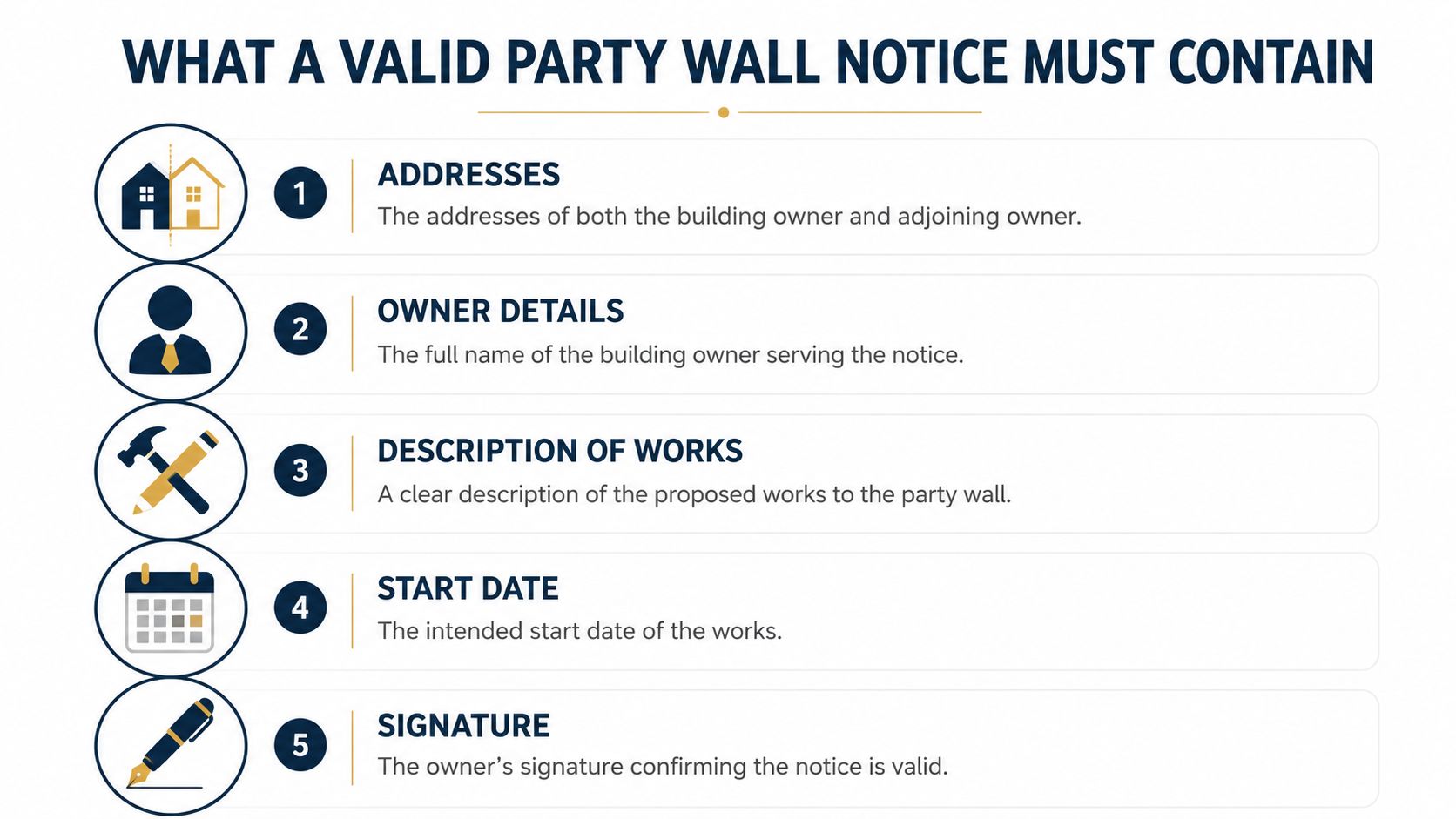
A proper notice should identify the building owner clearly, set out the exact property and works, and give the intended start date. It should also say that the adjoining owner can agree or dissent. For new walls on the boundary, it must deal with whether projecting foundations are proposed on the neighbour's land and whether access is needed.
For excavation cases, the notice needs more detail. Plans and sections are expected, showing the site, the depth of excavation and the underpinning or foundation details. That is not paperwork for its own sake. It lets the adjoining owner and surveyor understand the risk properly.
A good notice usually includes:
- Owner details: the building owner's full name and address.
- Work details: the exact location and extent of the proposed works.
- Start date: the intended commencement date.
- Response rights: a clear statement that the neighbour can agree or dissent.
- Technical drawings: plans and sections where excavation is involved.
Corinthian Surveyors, like any decent independent RICS practice, will check the notice before it goes out because an invalid notice puts the project back by a full notice period. The same point is made in the Act's practical guidance, and it is why vague DIY notices are such a false economy.
How the Neighbour Responds and What Happens Next
Once the notice is served, the clock starts. The adjoining owner has 14 days to respond in writing. If they consent, the work can proceed once the notice period has run. If they dissent or say nothing, the law treats that as a dispute and the surveyor route begins.
A counter-notice is another piece people overlook. Where the notice relates to work to an existing wall, the neighbour can serve a counter-notice within 1 month if they want additional work done at the same time, such as raising their side or carrying out related work on their flank. That keeps the process tidy when both sides need something done to the same wall.
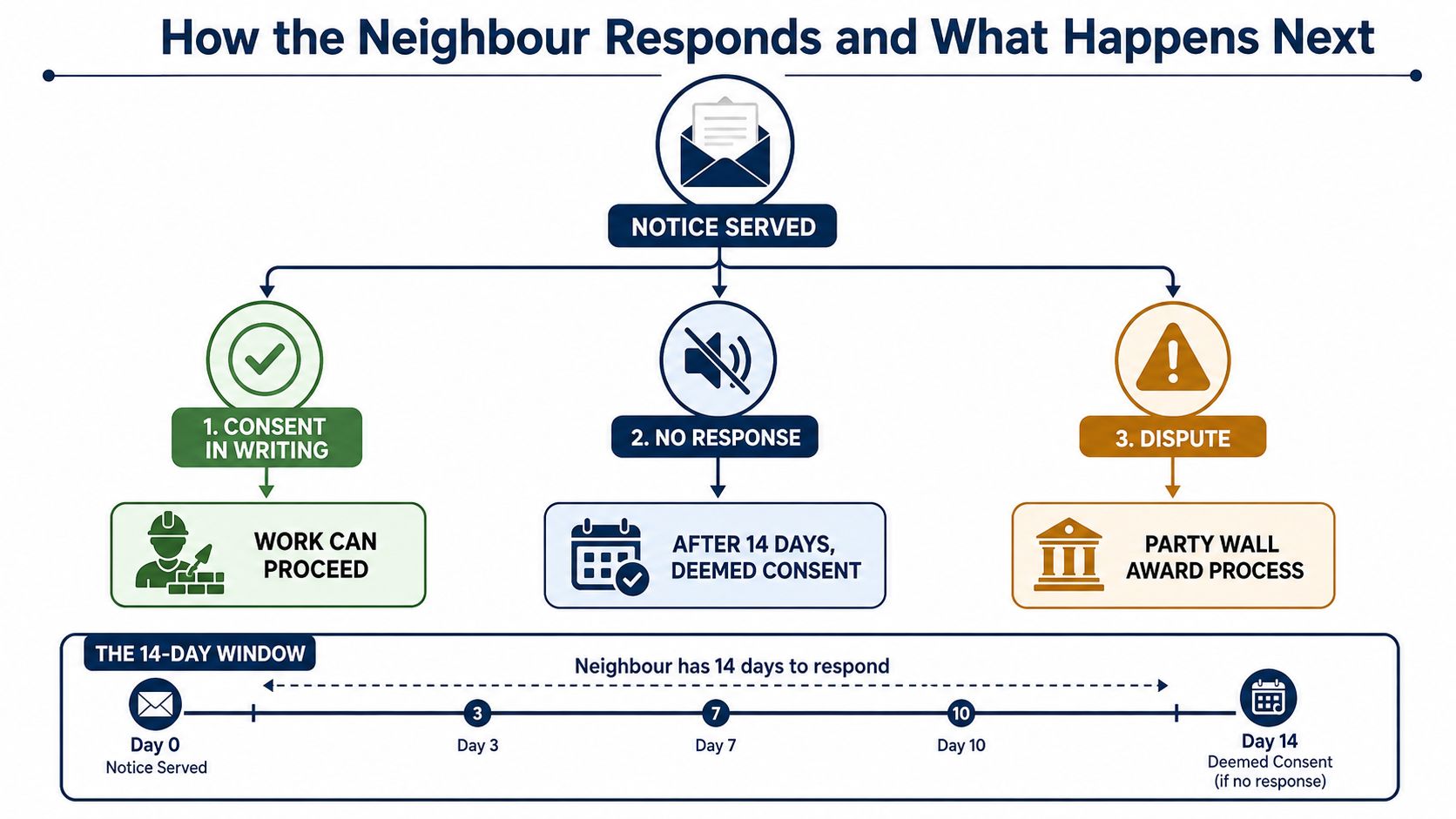
A terraced-house extension in Southwark often follows the same pattern. The building owner serves notice. The neighbour either signs, dissents, or ignores it. If there is dissent, each side appoints a surveyor or both agree on one surveyor, and the award is prepared from there. Silence is not a shield. It does not block the scheme, it moves it into the formal dispute route.
The government's impact assessment gives one of the few official snapshots of how widely this process is used, estimating roughly 2,800 practising surveyors doing party-wall work and about 226,800 total notices per year in England and Wales, with 1% assumed to be served in person. That tells you something important. This is not a niche process for rare projects. It is routine in the residential market.
Choosing a Party Wall Surveyor and the Agreed Surveyor Option
There are two sensible routes. The first is the agreed surveyor, where one RICS chartered surveyor acts for both owners. The second is two separate surveyors, one appointed by each side, with a third surveyor nominated in case the first two cannot agree.
The agreed surveyor route is usually quicker and simpler. It suits straightforward work and a neighbour relationship that is still workable. Two surveyors are better when the scheme is more complex, the neighbour is worried about access or damage, or you already know the conversation will be difficult. In a Brixton conversion or a basement job in Blackheath, I would often expect a more formal appointment route than on a simple garden wall job.
The main thing is independence. You want a RICS chartered surveyor with party wall experience, proper insurance and no tie to the builder, developer or lender. A practice like Corinthian Surveyors London LTD is a useful example of the independent route because the advice comes from the surveyor's duty under the Act, not from anyone else's commercial interest.
The government does not keep a statutory register of party wall cases, so you should choose the person, not just the label. Ask whether they regularly deal with London terraces, Victorian semis and flat conversions. That local knowledge matters when the details are about old walls, patched mortar and awkward access down a shared side return.
Preparing the Party Wall Award
The award is the document that matters when people stop agreeing. It is not a design document. It does not approve planning, and it does not rewrite your architect's scheme. What it does is set the conditions for how the notifiable works can proceed.
A proper award records the works, sets out the timing, deals with access, and says how damage will be handled if it happens. It should also include the schedule of condition, which is the baseline record of the adjoining property before work starts. On London terraces and semis, that baseline matters because cracking, vibration and pre-existing defects are often argued about later. If the surveyor has photographed the wall, ceilings and vulnerable finishes before a hammer swings, there is a clear comparison point.
The schedule of condition is boring when everything goes right and invaluable when something goes wrong.
The award also deals with fees and responsibility. The building owner pays their own surveyor. If one agreed surveyor is used, that fee is split between the two owners. Each owner pays their own solicitor if they choose to involve one. Where the adjoining owner has caused unnecessary work, the award can shift reasonable costs, but that is the exception, not the default.
For homeowners who want a sense of how a formal construction dispute document is framed in adjacent legislation, the passref landlord compliance guide is a useful broader reference point. It is not a party wall document, but it shows the same principle, written process first, argument later.
A sensible award should usually include:
- Describe works clearly so there is no dispute about what is allowed.
- Set the schedule so the timing and sequence are clear.
- Define conditions for access, protection and making good.
- Include rights so both owners know where they stand.
Corinthian Surveyors quotes on a per-property basis, which is the right approach. Fixed pricing looks neat, but party wall work in Forest Hill is not the same as a detached house in Sutton or a warehouse conversion in Bermondsey. The fee depends on the property, the complexity and whether one surveyor or two are needed.
Disputes, Appeals and What to Do If a Neighbour Refuses
A neighbour refusing to sign does not kill the project. It moves it into the dispute process. The Act is built for that. The surveyors then decide the terms of the award, and if they cannot agree, the third surveyor is there to break the deadlock.
Any owner served with an award has 14 days to appeal it. That is a short window, and it is one reason people should read the document properly when it lands. The appeal route is narrow. It is there for errors of law or jurisdiction, not for a simple dislike of the surveyor's judgement.
If damage is suspected during the works, act fast and keep it factual. Tell the surveyor in writing. Photograph the area. Ask for a joint inspection. Then compare the damage with the schedule of condition. That is how these issues are resolved on the ground, not by ranting at the builder or the neighbour.
Starting notifiable work without serving notice can lead to an injunction and a claim for damages. Sorting it out afterwards is harder than serving the notice properly in the first place.
The costs side is often where people get emotional. Don't. The building owner normally pays their own surveyor. An agreed surveyor's fee is split. If the matter becomes more complex, two surveyors may be needed, and the award can deal with those costs too. The point is not to “win” on fees. The point is to keep the job lawful and controlled.
For a broader view of dispute handling in construction, the dispute resolution in construction NSW guide is a useful comparison. Different jurisdiction, same basic lesson, keep the process documented and don't improvise once a dispute exists.
If you are planning works in Lewisham, Greenwich, Southwark, Bromley or the surrounding boroughs, Corinthian Surveyors London LTD can check whether notice is needed, prepare the paperwork and handle the award process as an independent RICS and CABE-qualified practice based in Forest Hill. Call 0800 00 16 422 if you want the process handled properly before a builder starts digging, cutting or opening up a shared wall.
Frequently Asked Questions
How long does the party wall agreement process take
The minimum timing is set by the notice period, then the neighbour has 14 days to respond. After that, if surveyors are appointed, the award still has to be prepared and served. In practice, the full process often runs across the notice window plus the time needed to produce the award.
Can a neighbour refuse a party wall agreement
They can refuse consent, but that does not give them a veto over the works. It triggers the formal surveyor process instead. Silence has the same legal effect as dissent.
Who pays for the party wall surveyor
The building owner usually pays for their own surveyor. If one agreed surveyor is used, the fee is split between the two owners. Solicitor costs are separate if either side chooses to use one.
What happens if I start work before serving notice
That is a bad move. You risk an injunction and a claim for damages, and you make the whole thing harder to regularise later. Serve the notice first, then build in the right order.