
Property Condition Assessment Checklist: 8 Areas to Check
A dry-looking home can still have a damp problem. In England, 6% of homes had surveyor-identified damp, while 31% of households reported condensation, damp or mould problems, according to the English Housing Survey 2024–25. Those measures aren't interchangeable, but they make a practical point: what you see during a viewing isn't necessarily what happens through winter.
A useful property condition assessment checklist records more than whether something looks tidy. It identifies the defect, its location, the evidence behind the diagnosis and what needs checking before you commit to the purchase.
You can spot warning signs yourself. A stain beside a chimney breast, a sticking bedroom door or a musty cupboard deserves a question. None proves a serious defect on its own.
For each area, keep a simple record:
- What you can see: Photograph the defect with the seller's permission and identify the room or elevation.
- What you need explained: Ask about previous repairs, recurring problems and available paperwork.
- What happens next: Separate routine maintenance from matters needing a survey or specialist investigation.
If you're an executor dealing with an unfamiliar property, record what isn't known rather than guessing. Missing history is a reason to investigate, not evidence that the building is sound.
Table of Contents
- 1. Roof coverings, flashings and chimneys
- 2. Damp and moisture
- 3. Subsidence and structural movement
- 4. Timber decay and infestation
- 5. Drainage and external works
- 6. Electrics, gas and heating (visual inspection)
- 7. Windows, doors and joinery
- 8. Plumbing, lead pipework and hot water
- What Each Area Shows and Where Specialist Input Is Needed
- Using the Checklist to Decide Your Next Step
1. Roof coverings, flashings and chimneys
Start outside and look up from a safe position. Missing slates, uneven ridges, leaning chimney pots and overflowing gutters can all justify closer inspection. Don't climb onto a roof or lean out of an upstairs window.
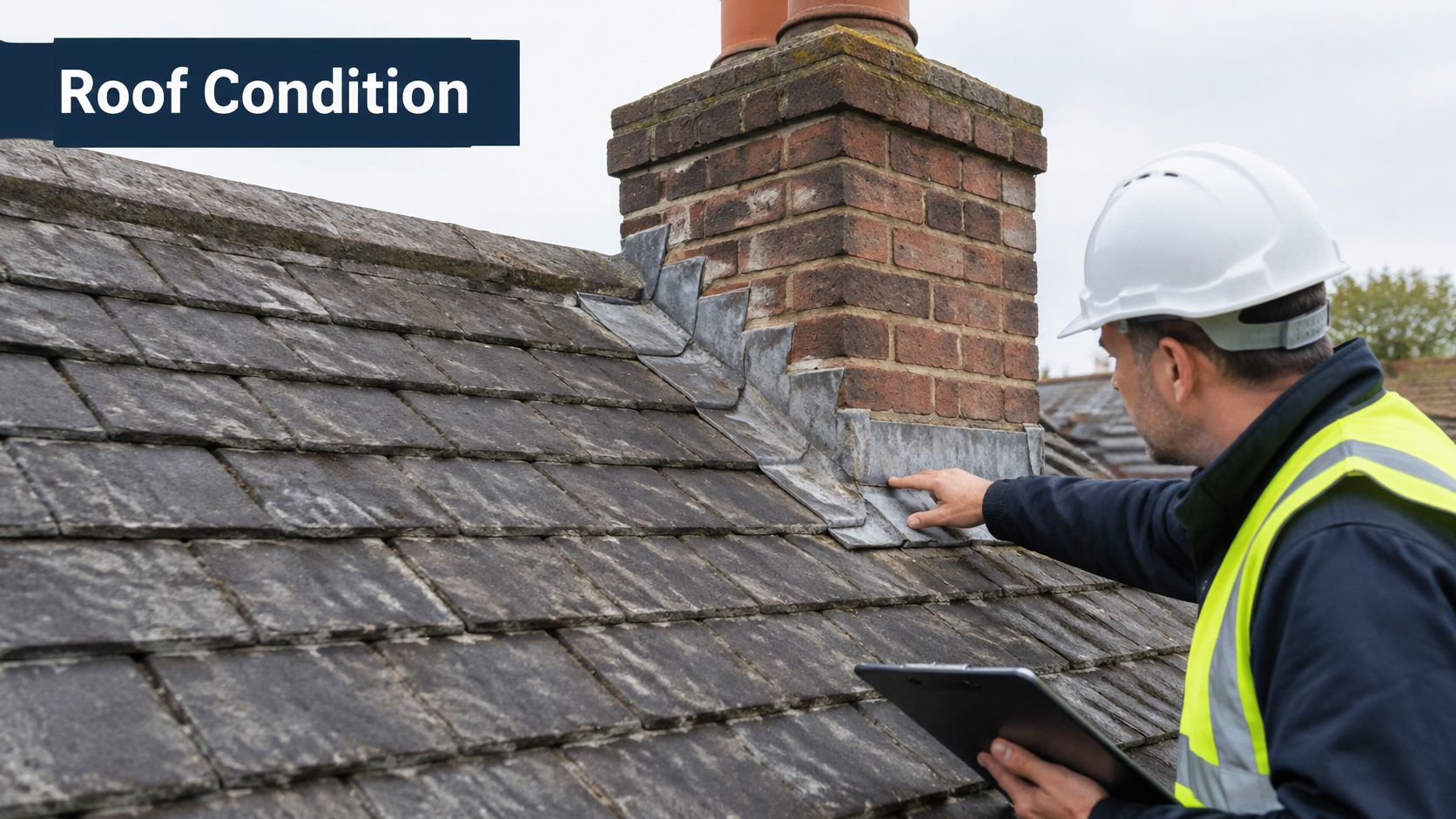
On a Victorian terrace in Lewisham, a slipped slate might look like a small maintenance job. If water has reached the rafters or ceiling beneath it, replacing the slate won't address all the damage. Staining below a chimney can also indicate failed flashings, the weatherproof junctions between the stack and roof.
The surveyor should record the covering, ridge and hip details, valleys, flashings, rainwater goods and chimney condition. The RICS Home Survey Standard requires records of construction, condition, inspection circumstances, limitations and findings. An inaccessible roof slope mustn't be treated as inspected and satisfactory.
When a roof concern needs more investigation
A straightforward house in reasonable condition may suit a Level 2 Homebuyer Survey. A complicated roof, extensive deterioration or substantial alterations may justify a Level 3 Building Survey.
- Ask about loft access: Establish whether the surveyor entered the roof space or inspected only from the hatch.
- Clarify concealed areas: Don't assume insulation was lifted or timbers beneath boarding were examined.
- Request supporting evidence: Roof invoices can help establish age. Appearance alone won't reliably date a covering.
Where leaks, sagging or concealed decay remain unresolved, arrange a suitable roofing or structural inspection before exchange. A quotation based only on pavement-level photographs may miss the underlying repair.
2. Damp and moisture
Damp is a symptom, not a diagnosis. Condensation, rain penetration, plumbing leaks and moisture rising through masonry need different responses. A high moisture-meter reading doesn't establish the cause by itself.
In England, 5% of dwellings had a significant damp problem in 2023, according to the English Housing Survey. During a viewing, look beyond fresh paint for mould behind curtains, swollen skirting, stained chimney breasts and musty smells inside cupboards.
Practical rule: Don't buy a damp treatment until someone has explained where the water comes from and why the proposed work will stop it.
Consider a ground-floor flat in a converted Bermondsey warehouse. Mould behind a wardrobe could result from condensation on a cold external wall rather than rising moisture. Injecting a damp-proof course wouldn't correct poor ventilation or restricted air circulation.
What the surveyor should distinguish
The report should identify the affected area, extent, likely cause and limitations of the inspection. Meter readings need interpretation alongside wall construction, external ground levels, ventilation and visible staining. Our explanation of what causes rising damp helps separate that diagnosis from other moisture problems.
- Ask about recurrence: Does the staining return after rain or during colder weather?
- Inspect outside: Look for leaking gutters, damaged pointing and soil or paving against the wall.
- Request repair records: Previous treatment paperwork matters, particularly where the same patch has returned.
The relationship between symptoms and causes is worth understanding before authorising treatment.
Persistent moisture, suspected concealed decay or conflicting diagnoses warrant independent investigation. A Level 3 survey is worth considering where solid walls, incompatible repairs and extensive damp need assessing together.
3. Subsidence and structural movement
A crack above a bay window isn't automatically subsidence. It might relate to a failed lintel, local movement or a problem with the bay itself. The crack's position and surrounding distortion matter more than a quick judgement about its width.
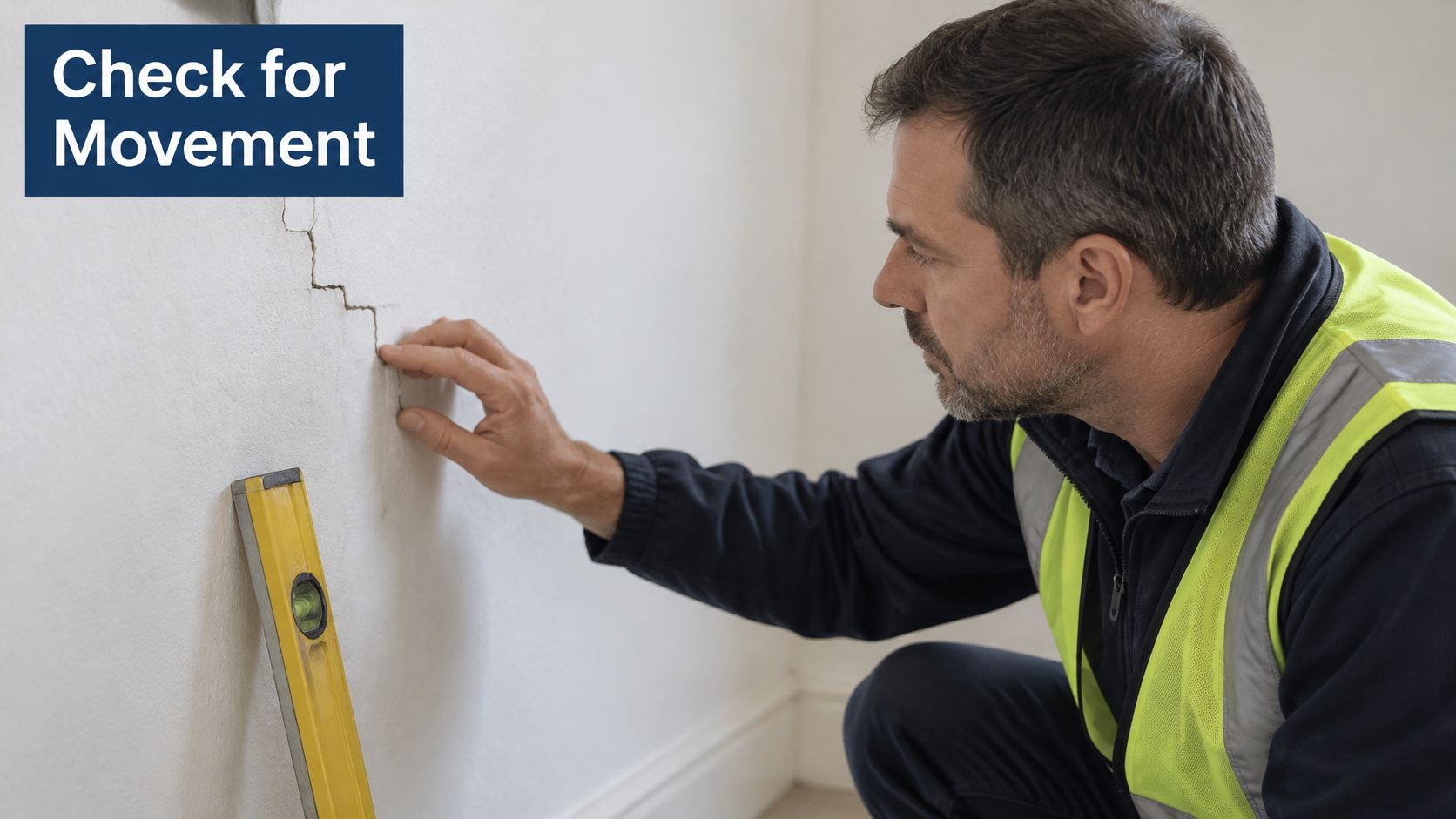
At the viewing, look for diagonal cracking around openings, doors that catch and floors that slope noticeably. Check whether the same area looks distorted outside. Don't force a sticking door or assume new filler proves a repair was successful.
In a Bromley semi, cracking near a bay may prompt questions about trees, drains and foundation movement. Where foundations bear on shrinkable clay, changes in soil moisture can matter. In a Croydon terrace, cracking where an extension meets the original house may instead require investigation of their different foundations.
What turns a crack into a specialist referral
The surveyor should describe the pattern, location and associated movement. They should explain whether the evidence suggests longstanding distortion or a concern needing further investigation. A single visit cannot always establish whether movement is continuing.
- Photograph the context: Include the whole wall as well as the crack.
- Ask for history: Request previous engineering reports, monitoring records and details of insurance claims.
- Check alterations: Removed walls and chimney breasts may be relevant to the movement.
Our guide to signs of subsidence inside a house explains the warning signs worth recording. Suspected structural movement generally supports choosing a Level 3 Building Survey, with a structural engineer or drain investigation where the findings justify it.
Don't remove a nearby tree as a precaution. Establish the cause of movement before changing conditions around the foundations.
4. Timber decay and infestation
Check the moisture source before discussing timber treatment. Repairing a rotten window cill without correcting the route by which water enters leaves the replacement exposed to the same problem.
In an Edwardian house in Forest Hill, a springy suspended floor might prompt concern about joists beneath the room. Those joists may be concealed by carpets and floorboards. The surveyor must distinguish an observed symptom from confirmed decay.

Your viewing checks should stay non-destructive. Look for crumbling skirting, distorted joinery, fungal growth and small holes in exposed timber. Don't prod decorative finishes or lift boards without permission.
Old holes don't prove active infestation
Insect holes can remain long after activity has stopped. Similarly, dark timber isn't necessarily rotten. The surveyor should assess accessible wood, moisture conditions and evidence of deterioration rather than diagnose treatment needs from appearance alone.
- Record access: Ask which roof timbers, floor areas and other structural wood were visible.
- Check ventilation: Look for blocked air bricks serving suspended floors.
- Request paperwork: Obtain previous timber reports, treatment details and any guarantees.
A Level 2 survey can identify visible concerns in a conventional house. More extensive decay, altered floors or complicated concealed construction may make a Level 3 survey more appropriate.
Where the strength of a joist or roof member is uncertain, specialist inspection may require agreed opening-up. Use a suitably qualified timber specialist for diagnosis and any treatment report. If structural timber has lost strength, an engineer may also be needed.
Spraying timber isn't a substitute for stopping water entry, improving ventilation and repairing damaged sections. Agree the cause and repair scope before accepting a treatment proposal.
5. Drainage and external works
Walk the whole plot rather than stopping at the back door. Look at gullies, paths, steps, retaining walls and the ground beside external walls. In a flat, relevant communal grounds and shared drainage can be just as important as the rooms you're buying.
The government's HHSRS tenant guide describes an inspection extending to accessible parts of the dwelling, relevant common parts, surrounding grounds and outbuildings. That's a useful principle for a viewing: don't assess an isolated room while ignoring the conditions around it.
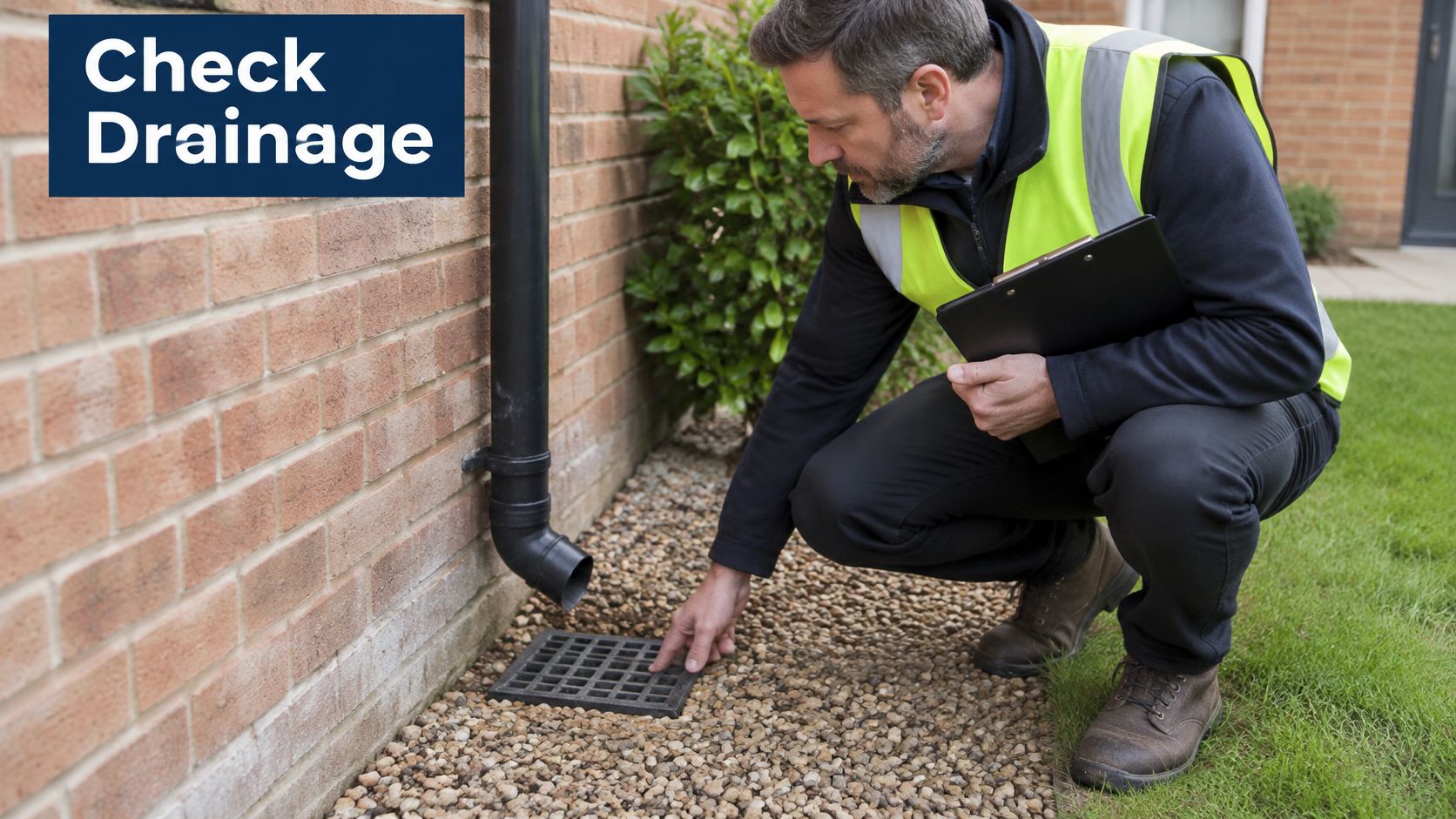
Look for consequences you can recognise: standing water, overflowing gullies, sewage smells, sunken paving and damp at the base of walls. Don't lift heavy chamber covers yourself.
When a camera survey is justified
The surveyor should record accessible drainage arrangements and visible defects. Access to inspection chambers depends on the survey scope, safe lifting and the condition of the covers. A visual inspection doesn't confirm the condition of buried pipes.
In a Brockley terrace, a drain may pass beneath neighbouring gardens. Establish its route and ask your conveyancer to clarify responsibility rather than assuming every pipe within the boundary belongs solely to the owner.
- Repeated blockages: Ask for clearance invoices and previous camera reports.
- Movement near drains: Consider a camera inspection where leakage could be relevant.
- Raised paving: Check whether external ground levels may be contributing to internal damp.
A drain camera survey is a separate specialist investigation. Resolve material concerns before exchange, particularly where the likely repair route crosses neighbouring land.
6. Electrics, gas and heating (visual inspection)
A working boiler isn't proof of a safe boiler. Nor does a light switching on establish that the wiring is satisfactory. A residential survey records visible services, but it doesn't replace electrical testing or a gas inspection.
During the viewing, ask about the boiler's age and servicing history. Look for visible leaks, damaged sockets, loose fittings and improvised wiring. Don't remove covers, touch exposed conductors or attempt to inspect a flue yourself.
In a converted Victorian flat in Peckham, an old rewirable fuse board should prompt a qualified electrician's assessment. It doesn't prove that every cable needs replacement, but it's not something to dismiss because the sockets work.
Separate appearance from test evidence
The surveyor should identify the visible installation type, apparent condition and inspection limitations. An electrician should investigate electrical concerns. A Gas Safe registered engineer should assess gas appliances and associated safety issues.
Our guide to home electrical testing explains why a visual survey and a dedicated electrical assessment serve different purposes.
- Electrical paperwork: Request installation certificates and any electrical condition report.
- Heating records: Ask for boiler service documents and relevant gas safety records.
- Immediate danger: Stop using suspect equipment and obtain qualified advice rather than waiting for a routine report.
For landlords, record the EPC alongside the physical heating checks. The government's domestic energy-efficiency guidance states that covered private rented properties generally cannot be let below EPC band E unless a valid exemption applies.
Neither a Level 2 nor a Level 3 survey substitutes for specialist safety testing. Choose the survey for the building, then commission the tests its findings or missing records justify.
7. Windows, doors and joinery
Open accessible windows and doors with permission. A painted-shut sash, misted glazing or a door that catches gives you something specific to ask about. Don't force stiff fittings, particularly where glass or decayed timber could fail.
Original sash windows in a Greenwich period house may need repairs to cills, cords and draught seals rather than wholesale replacement. Conversely, a modern window with moisture trapped between the panes may have a failed sealed glazing unit. These are different repairs.
The surveyor should record frame condition, glazing defects, operation where checked and deterioration around openings. They should also consider whether sticking joinery relates to poor maintenance, moisture swelling or movement in the surrounding wall.
- Check lower sections: Look for failed paint and soft-looking timber at cills and bottom rails.
- Inspect above openings: Cracks or distortion around a lintel need more than a joinery quotation.
- Request documents: Ask about installation records, guarantees and whether guarantees transfer.
Repair first, replacement where justified
For a house in a Blackheath conservation area, check planning constraints before pricing replacement windows. Listed status may also affect what work can proceed. Don't assume that matching the existing colour makes a replacement acceptable.
Repair judgement: Sound original joinery with local decay deserves a repair assessment before you commit to replacing the whole window.
A Level 2 survey may be suitable for routine window defects in a conventional property. A Level 3 survey is more useful where historic fabric, extensive decay or structural distortion complicates the repair.
If a bay window has cracking above it and a distorted frame below, establish the structural cause first. Fitting new windows without addressing movement can leave the underlying defect unresolved.
8. Plumbing, lead pipework and hot water
Open the cupboard beneath the kitchen sink. Look around the cylinder, toilet connections and accessible pipe joints for staining, corrosion or makeshift containers catching drips. These checks are simple, but concealed pipework still needs a clear limitation in the report.
With permission, run taps and flush toilets. Note weak flow, slow drainage and unusual noises. These observations help identify questions, but they don't establish the condition of hidden pipes or prove that water quality is satisfactory.
In a pre-war house in Sydenham, an older incoming supply pipe may need its material confirmed. If lead is suspected, ask the water company about identification, testing and replacement arrangements. Don't assume that visible copper beneath the sink proves the entire incoming supply is copper.
What should go in the report
The surveyor should describe visible pipe materials, hot-water storage and evidence of leakage. They should identify inaccessible sections and recommend further checks where there's a material uncertainty.
- Supply pipe: Ask the seller or water company to confirm its material where records exist.
- Cylinder and fittings: Look for corrosion, staining and damp around connections.
- Previous leaks: Request invoices and establish whether damaged floors or ceilings were repaired.
Say an older cylinder in an Edwardian house has staining around its fittings. A plumber needs to establish whether there's an active leak and assess the installation. Repainting the cupboard isn't an adequate response.
A Level 2 survey can flag visible plumbing defects. A Level 3 survey may provide more useful building context where repeated leaks could have affected floors or other concealed construction. Neither replaces pressure testing, water sampling or specialist inspection of an unvented hot-water system.
What Each Area Shows and Where Specialist Input Is Needed
| Item | Common warning signs | Checked by | Specialist next step |
|---|---|---|---|
| Roof coverings, flashings and chimneys | Missing or slipped tiles, damaged flashings, staining, defective gutters | Surveyor, from accessible vantage points and in the loft where possible | Roofer assessment if access is limited or materials need specialist review |
| Damp and moisture | Tide marks, mould, staining, salt deposits, blown plaster or decayed skirting | Surveyor, using visual evidence and indicative moisture readings | Confirm the cause before arranging damp treatment |
| Subsidence and structural movement | Diagonal or stepped cracks, sticking doors, sloping floors, walls out of plumb | Surveyor assesses signs of movement and possible causes | Level 3 Building Survey and structural engineer assessment if movement is suspected |
| Timber decay and infestation | Soft or crumbling timber, flight holes, frass, damp or decayed joists | Surveyor checks accessible timbers for decay and infestation | Qualified timber treatment firm; invasive investigation may be needed |
| Drainage and external works | Blocked or damaged gullies, pooling water, cracked walls, patched drains | Surveyor checks visible drainage and external areas | Drain camera survey if concerns arise; legal advice may be needed for shared drains |
| Electrics, gas and heating (visual inspection) | Old fuse board, visibly poor wiring, ageing boiler, leaks or corrosion | RICS surveyor carries out a visual inspection only | Qualified electrician or Gas Safe registered engineer testing |
| Windows, doors and joinery | Misted glazing, sticking openings, rot, cracked lintels | Surveyor checks accessible frames, glazing, hardware and lintels | Specialist repair or structural check if defects warrant it; check consent requirements |
| Plumbing, lead pipework and hot water | Visible lead pipes, leaks, corrosion, staining or poor water flow | Surveyor records visible plumbing and hot water systems | Confirm supply pipe material with the water company or seller; arrange further checks if needed |
Using the Checklist to Decide Your Next Step
Your notes from a viewing are a starting point. They help you ask sharper questions, but they cannot confirm what sits behind plaster, prove concealed timber is sound or show that movement has stopped. What happens next depends on the age, construction and uncertainty around the building, not on how many ticks you made.
Condition covers more than decoration. In England, 15% of dwellings failed the Decent Homes Standard in 2023, according to the English Housing Survey's assessment of housing quality. Weigh repair needs against safety, heating, damp risk and whether the accommodation suits the occupants.
Match the survey level to that risk:
- Level 1 Home Condition Survey: Suits a conventional property in apparently good condition when a basic condition overview meets your needs.
- Level 2 Homebuyer Survey: Suits many conventional homes in reasonable condition where you need advice on defects, repairs and maintenance.
- Level 3 Building Survey: Is generally the better choice for older, altered, unusual or neglected buildings where construction and defects need fuller assessment.
A higher level still has limits. No RICS survey lifts every floorboard or includes every specialist test. Plan for a drain camera inspection where drainage concerns stay unresolved, an engineer where significant structural uncertainty remains and an independent damp investigation where the moisture source is unclear.
Put safety hazards first. The Housing Health and Safety Rating System operating guidance assesses deficiencies by the risk they create for occupants. A loose stair guard or unsafe installation needs action before a more visible cosmetic defect. My recommendation is to sort your list into safety items, defects that change value or budget, and maintenance to programme over time.
At Corinthian Surveyors London LTD, we provide residential condition surveys and advice on appropriate further investigation. We are an independent RICS-regulated firm based in Forest Hill, led by surveyor Clive, the firm has over 30 years' experience in the built environment.
Can I use this checklist instead of a survey?
No. Use it to record concerns and prepare questions. A professional survey adds interpretation, condition assessment and advice on what to do next.
Does a mortgage valuation check the property's condition?
Not for your purposes as a buyer. A lender's valuation is not a substitute for your own condition survey, even if someone visits the property.
Should specialist checks happen before exchange?
Where an unresolved defect could affect your decision or repair budget, establish its significance before you commit. Discuss the findings with your surveyor and conveyancer rather than relying on an informal reassurance from the seller.
Corinthian Surveyors London LTD offers RICS residential surveys to assess the defects on your checklist and explain which need further investigation. Contact Corinthian Surveyors London LTD with the property address, its approximate age and your main concerns to arrange a RICS residential survey before exchange.