
Signs of Subsidence Inside House: Expert Guide 2026
You've spotted a crack in the wall. It wasn't there before, or at least you're sure you'd never noticed it. Then the back door starts catching on the frame, the wallpaper near the ceiling looks slightly rippled and suddenly you're online reading horror stories about foundations collapsing.
That reaction is normal. I see it all the time. People go from “it's probably nothing” to “the house is falling down” in about ten minutes.
Here's the straight answer. Not every crack means subsidence. Old houses move. London houses especially move. Victorian terraces in Lewisham, Edwardian homes in Dulwich and 1930s semis in Bromley all develop marks and quirks as they age. Some of that is harmless. Some of it isn't.
The problem is that cosmetic cracking and genuine structural movement can look similar to an untrained eye. That's where people either panic too early or ignore something they shouldn't. Neither helps.
If you're worried about signs of subsidence inside house walls, floors or openings, the sensible approach is simple. Look at the pattern. Look at where the defect is. Look at whether it's recent. Then decide whether the issue needs monitoring or proper investigation.
This guide strips the noise out of the subject. No scare tactics. No vague advice. Just the signs that matter, what they usually mean in London property and what your next step should be.
Table of Contents
- Introduction
- What Is Subsidence and Why Does It Happen in London
- The Key Signs of Subsidence Inside Your House
- Assessing the Severity When to Actually Worry
- Your Next Step Commissioning a Surveyor
- The Surveyor's Findings and Common Repair Solutions
- How to Get Professional Help in London
- Frequently Asked Questions About Subsidence
Introduction
You usually notice subsidence indirectly. A crack appears above the lounge door. The kitchen window suddenly needs a shove to close. The wallpaper near the ceiling line starts to crease for no obvious reason. On their own, each of those can sound minor. Together, they deserve attention.
What matters is pattern, not drama. A single hairline crack in plaster after redecoration is one thing. A new diagonal crack near a window corner, combined with a sticking sash or a door that no longer sits square, is different.
London homeowners get mixed messages online. One website tells you every crack is a disaster. Another shrugs it off as normal settlement. Neither is good enough. Older housing stock across Southwark, Greenwich, Lambeth and Bromley needs a more grounded view because the buildings are varied and the ground conditions are often awkward.
Practical rule: Don't try to diagnose subsidence from one symptom in isolation. Look for a cluster of signs that all point in the same direction.
The sensible approach is to separate three things. First, ordinary ageing and minor movement. Second, distortion that may be historic and no longer changing. Third, active ground movement that needs proper assessment.
That distinction matters because the remedy depends on the cause. Some houses need nothing more than monitoring. Some need drains checked. Some need tree management. A few need structural repair. Jumping straight to the worst-case scenario is how people lose sleep and make poor decisions.
What Is Subsidence and Why Does It Happen in London
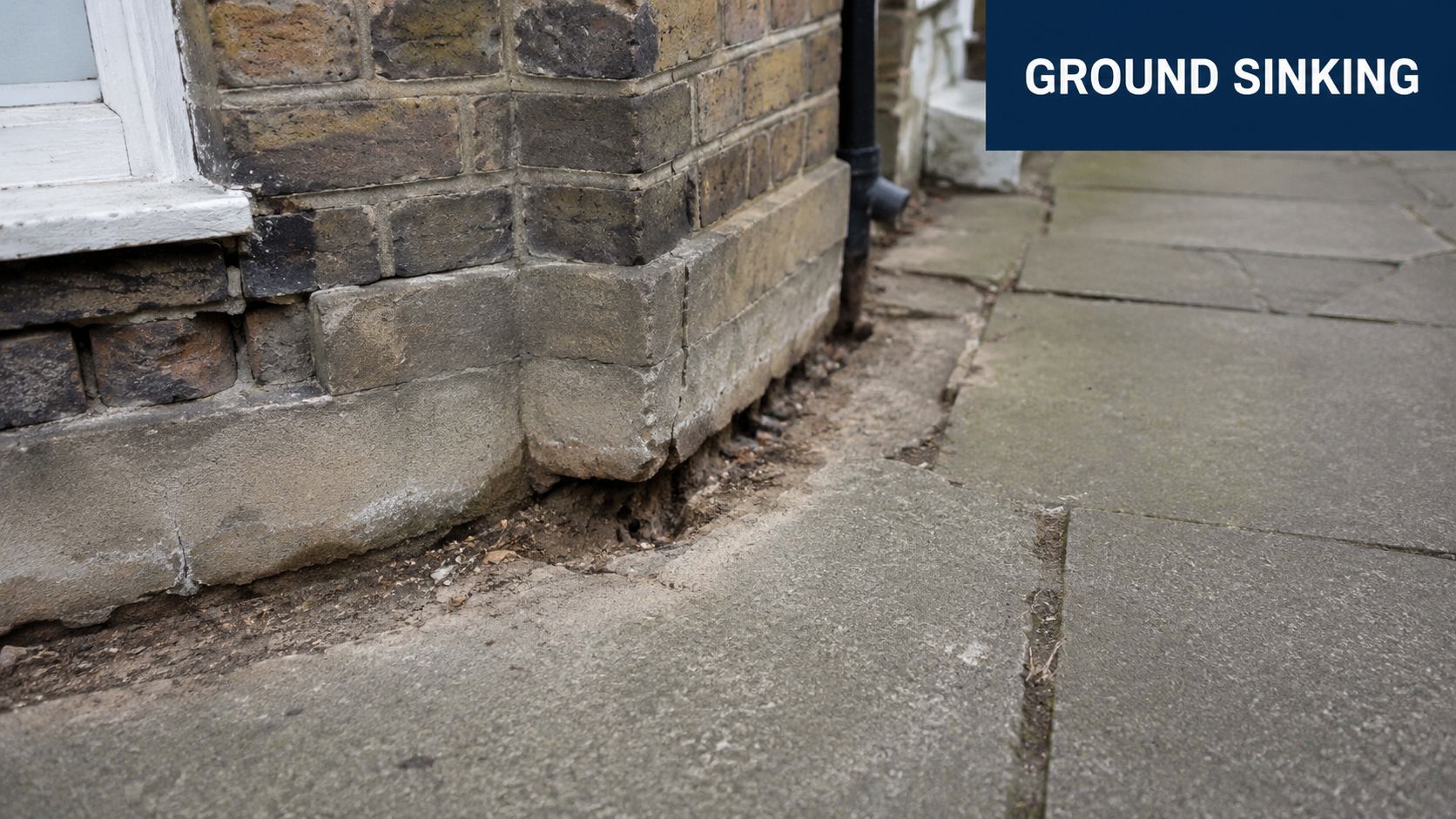
Subsidence means the ground beneath part of a building moves downward and the foundations lose support. When that happens, the structure above starts to distort. The key word is unevenly. If one area drops more than another, the walls, floors and openings take the strain.
In plain English, think of a table standing on firm ground. If one leg starts sinking into soft soil, the table twists. Houses behave in much the same way, just more slowly and with more expensive consequences.
Why London homes are exposed
A large part of London and the South of England sits on clay soil. Clay expands when wet and contracts when it dries. That shrink and swell behaviour is one reason internal distortion is particularly common in southern England, especially during hot dry spells, as noted in this overview of signs of subsidence.
That matters in places like Lambeth, Southwark, Bromley and Croydon where you'll often find period houses and shallower foundations than you'd see in newer construction. Victorian terraces were built well in many respects, but they were not designed with modern foundation standards in mind.
The common triggers
Three causes turn up again and again in London work:
- Clay drying out: In prolonged dry weather, clay can shrink and pull away from foundations.
- Trees drawing moisture: Large trees close to the house can remove moisture from the soil and worsen shrinkage.
- Leaking drains or pipework: Escaping water can soften or wash out supporting ground.
Rainwater management also matters more than many owners realise. Overflowing or blocked gutters don't automatically mean subsidence, but persistent water where it shouldn't be can aggravate ground and drainage problems. If you want a practical maintenance checklist, these expert tips for gutter care are worth reading.
Houses don't usually move for no reason. There is normally a trigger, and finding that trigger is half the job.
Extensions are another weak point. Where an extension joins the original building, different foundations and different movement rates can expose trouble quickly. If that joint starts cracking, pay attention.
The Key Signs of Subsidence Inside Your House
Those searching for signs of subsidence inside house spaces often want a simple checklist. Fair enough. These are the internal warning signs that deserve proper attention.
Right near the start, it helps to see the pattern plainly.
Diagonal cracks that matter
The biggest warning sign is not just “a crack”. It's a very specific type of crack.
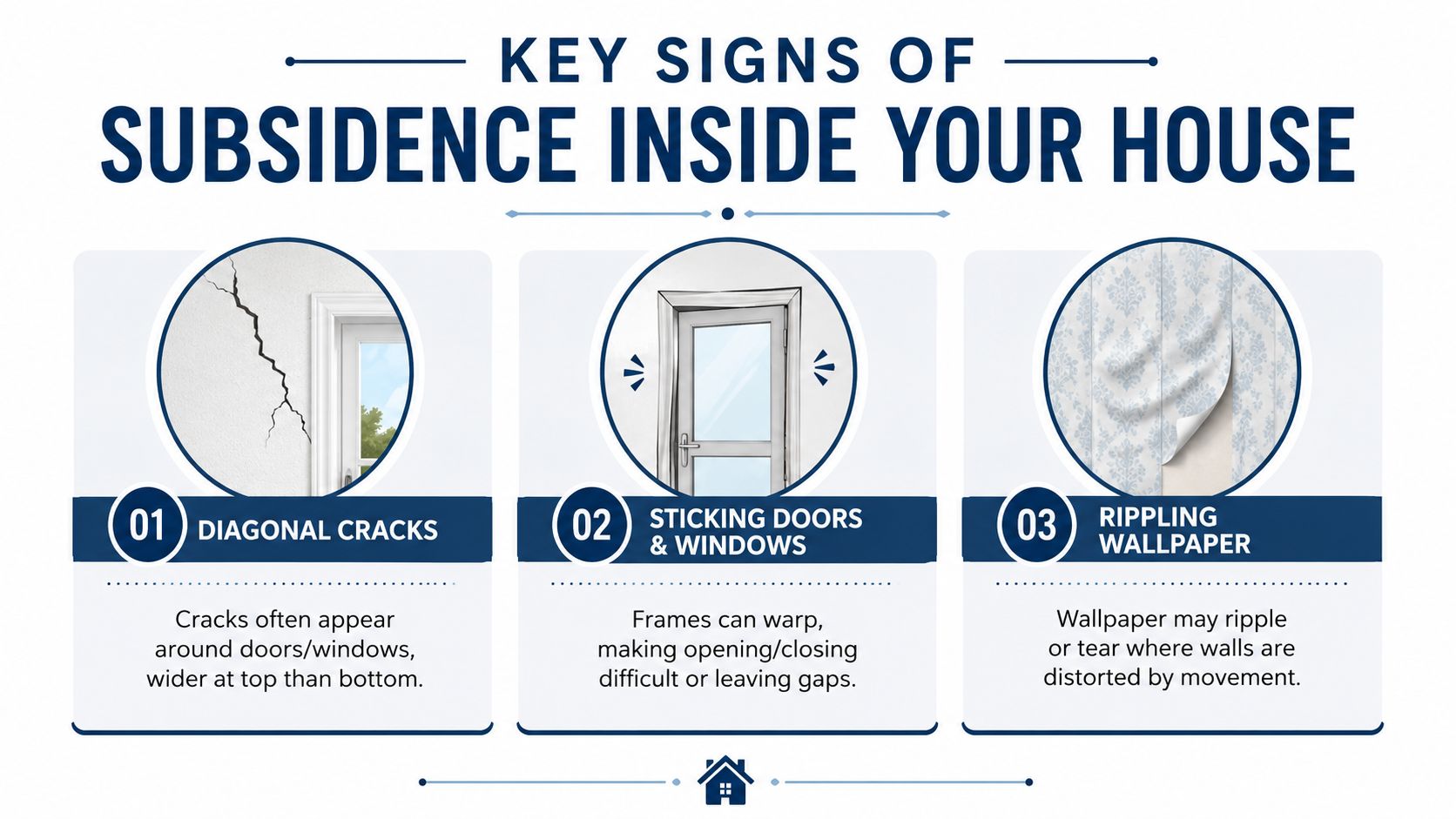
In the UK, the clearest indicator is a diagonal crack wider than 3mm, roughly the width of a 10 pence coin, which is wider at the top than the bottom and appears suddenly after prolonged dry weather, particularly around weak points such as doors and windows, according to AXA's guidance on spotting the signs of subsidence.
That description matters because it separates real concern from everyday plaster shrinkage.
Look for this:
- Diagonal direction: The crack often runs from the corner of a door or window.
- Uneven width: It's wider at one end, commonly the top.
- Depth: It may pass through plaster and continue into the wall behind.
- Inside and outside match: The same movement can often be seen externally in brickwork.
- Step pattern in masonry: Brick joints may crack in a stair-step shape.
If a crack is at the point where an extension meets the main house, I take that seriously. That can point to differential movement between two parts of the building.
For a broader look at crack patterns, this guide on cracks in walls of a house is useful.
Doors and windows that start fighting you
A sticking window isn't always a joinery problem. Sometimes the frame is being pulled out of square because the supporting wall has moved.
When subsidence affects one area of the house, the opening distorts. That's when sash windows jam, casements catch and doors scrape or refuse to latch properly. If the issue arrives without obvious wear, swelling from damp or poor decoration work, treat it as part of a bigger picture.
Here's the difference:
| Sign | More likely cosmetic or minor | More likely structural movement |
|---|---|---|
| One internal door catches in humid weather | Yes | Less likely |
| Several openings on one side distort together | Less likely | Yes |
| Window won't close and a new diagonal crack appears nearby | Less likely | Yes |
A single sticky door in an old house doesn't prove anything. A group of distorted openings in the same area is far more telling.
A short visual explanation can help if you want to compare what you're seeing at home.
Wallpaper creases gaps and sloping floors
Wallpaper often tells the truth before plaster does. If you see rippling or creasing where the wall meets the ceiling, and there's no sign of damp, that can indicate the wall has shifted relative to the ceiling.
The same goes for gaps opening beneath skirting boards. Those gaps can appear when the wall support changes and the floor no longer sits as it once did. Some owners also notice a floor beginning to slope or dip.
If wallpaper is creasing at wall to ceiling joints and doors are sticking at the same time, don't dismiss it as decoration trouble.
The internal signs that often travel together are:
- Rippling wallpaper: Especially at wall and ceiling junctions.
- Gaps at skirtings: Small separations can indicate movement.
- Sloping floors: Sometimes subtle, sometimes obvious.
- Localised distortion: One room or one corner may show more evidence than the rest of the house.
None of this means the building is about to fall down. It means the house may be telling you something structural is happening. Listen to the pattern, not just the loudest symptom.
Assessing the Severity When to Actually Worry
The question isn't “is there a crack”. The question is is the movement active.
That's the line between mild concern and genuine action. Plenty of older London homes have historic cracking that has been there for years and hasn't changed. It may look untidy, but stable old movement is a different matter from a crack that is widening now.
Historic movement or active movement
A defect becomes more concerning when it shows three things together: width, shape and progression.
According to this summary of RICS guidance on how to spot signs of subsidence, a crack points more strongly to subsidence when it exceeds 3mm in width, extends through plaster into masonry and is wider at the top than the bottom, often running diagonally from door or window corners. That level of concern can justify specialist monitoring for up to 12 months to confirm whether movement is continuing.
That last point is the one many owners dislike. Monitoring takes time. But time is often exactly what gives you the answer.
Here's a sensible way to judge urgency:
- Less urgent: Old repaired cracks with no recent change.
- More urgent: New diagonal cracks near openings.
- More urgent still: Cracks plus distorted doors, windows or floor levels.
- Immediate professional input: Clear recent movement after a dry spell, especially if inside and outside signs align.
What a surveyor does next
Surveyors don't guess. We inspect, compare and monitor. If the evidence isn't conclusive on day one, we use tell-tales or crack monitors and revisit the issue over time.
That sounds less dramatic than internet advice, but it's the correct method. Subsidence is about movement. If you want to know whether movement is active, you measure it.
Don't panic because a crack looks ugly. Worry if it's changing.
Also, don't repaint and fill everything too quickly. Fresh cosmetic repairs can hide useful evidence. If you suspect something structural, photograph it first, date the images and keep notes of when doors or windows started sticking.
Your Next Step Commissioning a Surveyor
If you suspect subsidence, stop trying to solve it from social media posts and builder opinions. You need an independent inspection with a proper written assessment.
Why guesswork is a bad idea
A builder may be very good at building work and still be the wrong person to diagnose structural movement. An estate agent is not a surveyor. A mortgage valuation is not a condition report. It's there for the lender's lending decision, not to protect you from hidden defects.
RICS also treats distorted openings seriously. This explanation of subsidence and how to identify it notes that sticking or jamming doors and windows, where there's no damp or wear issue, is a key sign because the structural opening can be shifting as the wall moves.
If that's happening in your house, you need someone who can assess the building as a whole. Not just the crack. Not just the joinery. The building.
Which survey is usually right
For suspected subsidence, the right starting point is usually a RICS Building Survey Level 3. That's the most detailed standard residential survey. It suits older properties, altered properties and homes with visible defects.
A Level 2 survey can flag obvious movement in a straightforward home, but where structural concern already exists, Level 3 is usually the better call. If you're unsure about the difference, this explanation of what a RICS survey is sets out the basics clearly.
A proper inspection should consider:
- Crack pattern and location
- Internal and external alignment
- Age and construction of the property
- Nearby trees and vegetation
- Drainage history and possible leaks
- The relationship between the original house and any extension
Ask for independence. That matters. A surveyor with no ties to the lender, estate agent or developer is in a better position to tell you the truth plainly.
If the evidence points that way, the surveyor may also recommend a structural engineer, a drainage contractor for a CCTV survey or a period of formal monitoring before any repair decision is made.
The Surveyor's Findings and Common Repair Solutions
People hear the word subsidence and jump straight to underpinning. That's a mistake. Underpinning exists, but it is not the automatic outcome.
What happens after inspection depends on the cause. A decent survey doesn't just describe symptoms. It links the symptoms to the most likely source of movement and sets out practical next steps.
What the report usually points to
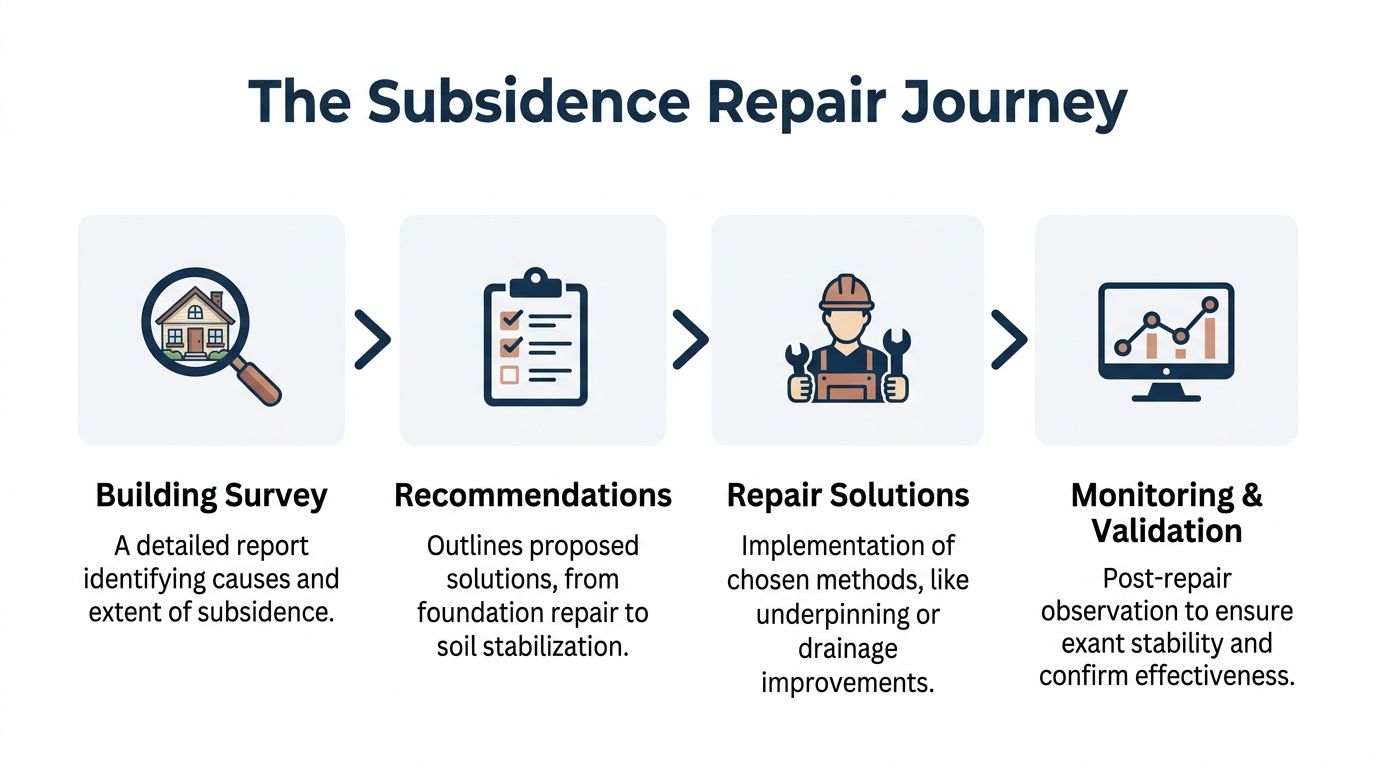
A Building Survey report dealing with suspected movement should explain what was seen, where it was seen and how serious it appears. It should also say what needs checking next.
Common recommendations include:
- Monitoring: If movement is suspected but not yet proven to be ongoing.
- Drain investigation: Especially where leaking drains may have softened or washed out ground.
- Tree management advice: Where nearby vegetation may be drying shrinkable clay.
- Further structural input: If the pattern is advanced or unusual.
If you want a sense of how reporting is structured, this article on building survey reports gives a useful overview.
Repairs are often simpler than people expect
A lot of cases come down to addressing the cause rather than rebuilding the house.
That may mean repairing a drain. It may mean managing a large tree carefully. It may mean a period of monitoring followed by local repairs once the building has stabilised. Only some cases progress to major structural work.
For homeowners trying to understand the repair options more broadly, it can help to look at examples of solutions for residential concrete problems, particularly where foundations, slabs or masonry need targeted remedial work. The exact remedy in a London house still depends on diagnosis first.
Underpinning is a last resort, not the opening move.
Insurance may become part of the process if there is an active subsidence claim. Timescales can be slow because monitoring, drain checks and cause analysis take time. That's frustrating, but rushing to the wrong repair is worse than waiting for the right one.
You also need to be realistic about cosmetic work. Redecoration usually comes after stability is confirmed. Filling and painting over active cracks before that point is money wasted.
How to Get Professional Help in London
London property needs local judgement. A Victorian terrace in Peckham or Camberwell behaves differently from a 1930s semi in Bromley or Sidcup. A converted flat in Islington has different red flags from a bay-fronted house in Catford. The age, construction and ground conditions all change the reading.
South London is full of housing stock where movement can be misread. In Lewisham, Forest Hill, Sydenham and Brockley you often see period homes with old plaster, later extensions and long histories of patch repair. In outer boroughs such as Croydon, Bexley and Bromley, the issue may show up differently because plot sizes, tree cover and extension work are different.

The right response is still the same. Don't panic. Don't ignore it. Get a proper independent assessment.
If you want a clear view of what you're dealing with in a London property, a report from an independent RICS Chartered Surveyor is the sensible route. Corinthian Surveyors London LTD is based in Forest Hill and works across London, the Home Counties and the South of England. The practice is independent, regulated by RICS and led by Clive Thompson, who holds both RICS and CABE qualifications. If you need that sort of measured assessment, call 0800 00 16 422.
Frequently Asked Questions About Subsidence
Are all cracks inside a house signs of subsidence
No. Many are cosmetic. Old plaster cracks, minor settlement and movement from normal ageing are common. The concern rises when the crack is diagonal, wider than a 10p coin, near an opening and part of a wider pattern of distortion.
Can I sell a house that has had subsidence
Yes, but you need to handle it properly. Buyers will want clarity. A documented history, evidence of investigation and records of any repair or monitoring are far better than vague reassurance.
Should I claim on insurance straight away
Not always. First establish what you're looking at. If there are strong signs of active movement, speak to your insurer and follow their process. If the issue is unclear, an independent survey can help you avoid starting the wrong process too early.
How long do subsidence investigations take
Often longer than owners expect. If monitoring is needed, the process can run over many months because the point is to establish whether the movement is continuing, stabilising or seasonal. Fast answers are nice, but reliable answers matter more.
Is underpinning usually required
No. It is one possible remedy, not the standard answer. Many cases are addressed through drainage repairs, tree management or monitoring followed by local repairs once movement stops.
If you need a calm, independent opinion on suspected structural movement in a London home, Corinthian Surveyors London LTD offers RICS residential surveys and valuations across London from its Forest Hill base. For suspected subsidence, the sensible starting point is usually a RICS Building Survey, and if you need to discuss the right survey type you can also review their wider residential surveying services.