
Party Wall Agreement Dispute: What to Do Next
Your neighbour has objected to your extension. The builder wants a start date, the drawings are ready and you're being told you need a party wall agreement. But the objection might be about damage, access or who owns the wall, and those aren't all the same dispute.
A party wall agreement dispute needs the right route before it needs more correspondence. Start by identifying what your neighbour wants resolved. Appointing surveyors won't settle every disagreement between adjoining owners.
Table of Contents
- Check Whether the Party Wall Act Applies
- Dispute Stages and How Long Each Takes
- Serve Notices and Appoint an Independent Surveyor
- Negotiating Terms and Reading the Party Wall Award
- What to Do When the Process Goes Wrong
- Frequently Asked Questions
Check Whether the Party Wall Act Applies
The first question is whether the disagreement concerns building work covered by the Party Wall etc. Act 1996. The framework applies across England and Wales. It covers specified work affecting party walls, boundary walls and excavation near adjoining buildings.
A neighbour saying the wall belongs entirely to them raises a different issue from a neighbour asking how their kitchen will be protected during construction. Use these routes to separate the questions.
Which dispute issues the Party Wall etc. Act 1996 covers
| Issue | Covered by the Act? | Route |
|---|---|---|
| Cutting into or building on a shared wall | Yes | Party structure notice and party wall award |
| Excavating near an adjoining building | Yes, where within the Act's distance limits | Excavation notice and party wall award |
| Where the true boundary line sits | No | Boundary agreement, mediation or court |
| Ownership of a disputed strip of land | No | HM Land Registry cannot decide, mediate or resolve it |
| Noise, dust and vibration during works | Partly, through award conditions | Award protections and civil routes |
The notice-and-award entries describe the route where a dispute arises. Written consent to valid notices can avoid the need for an award.
Separate construction from ownership
A party wall award regulates construction. It doesn't settle who owns a disputed wall or the land beneath it. HM Land Registry's boundary guidance explains that title plans generally show only general boundaries and that the organisation cannot decide, mediate or resolve boundary disputes.
This matters with Victorian terraces in Lewisham and Southwark, where historic walls and later alterations can complicate the picture. Rear extensions in Bromley and Croydon, and basement digs in Lambeth, also need careful comparison of title plans with physical occupation. Don't assume a fence or old wall proves the legal boundary.
Use the guide to when a party wall agreement is required to help identify notifiable work. Before serving anything, establish which issue your neighbour disputes: consent to construction, responsibility for damage or ownership and boundary position.
Dispute Stages and How Long Each Takes
Party wall notice and dispute timescales
| Stage | Typical timescale | Notes |
|---|---|---|
| Party structure notice served | At least 2 months before work starts | Statutory minimum notice for work on a shared wall |
| Excavation notice served | At least 1 month before work starts | Applies to digging near adjoining foundations |
| Neighbour's response to a notice | 14 days | Consent, dissent or no response, which is treated as dissent |
| Mediation | 4 to 6 weeks | Runs alongside surveyor appointment but does not replace the award |
| Formal party wall award | 8 to 12 weeks | Assumes prompt engagement and can take longer with a third-surveyor referral |
The Party Wall etc. Act 1996 provides the statutory notice framework, including the two-month party structure notice, one-month excavation notice and 14-day response period. In its 2025 guidance, SurvDesign states that formal awards typically require 8–12 weeks, while mediation generally takes 4–6 weeks.
Understand which clocks overlap
Serve the valid notice first. The response determines whether the parties can proceed by consent or need the statutory dispute process. If the neighbour dissents, appointing surveyors doesn't mean construction can begin immediately.
The notice period and award preparation can overlap. They aren't separate blocks to add together, but neither does the expiry of the notice period guarantee a lawful start. The drawings must be adequate and any required award must be in place and complied with.
Mediation can help owners agree access arrangements or resolve hostility while surveyors address the technical issues. It doesn't replace a required award. Don't suspend the statutory process merely because discussions seem promising.
Programme rule: Book builders around the date the award permits work, not the date you posted the notice.
Plan for the difficult parts
The award estimate assumes both owners engage promptly and the design is sufficiently developed. Missing foundation details, disputed service and unanswered correspondence can extend the programme. A referral to the third surveyor introduces another decision-making stage.
Ask your surveyor what information is still missing. A drawing showing an extension's footprint isn't enough to assess excavation risk if it omits foundation depth and neighbouring structures.
Use the explanation of how long a party wall agreement takes when discussing the programme with your contractor. Agree when updated structural drawings will be available and avoid changing the design while the award is being prepared.
Surveyors' fees usually fall to the building owner. A prolonged dispute increases professional time and can leave either owner exposed to additional expenditure, particularly if legal advice becomes necessary.
London surveyors can be busier during peak building months. Ask for realistic inspection and drafting dates at instruction, rather than accepting a vague promise that everything should be ready before the builder arrives.
Serve Notices and Appoint an Independent Surveyor
Correct paperwork matters more than an impressive-looking notice template. Establish the work, the legal owners and the proposed appointment before sending documents.
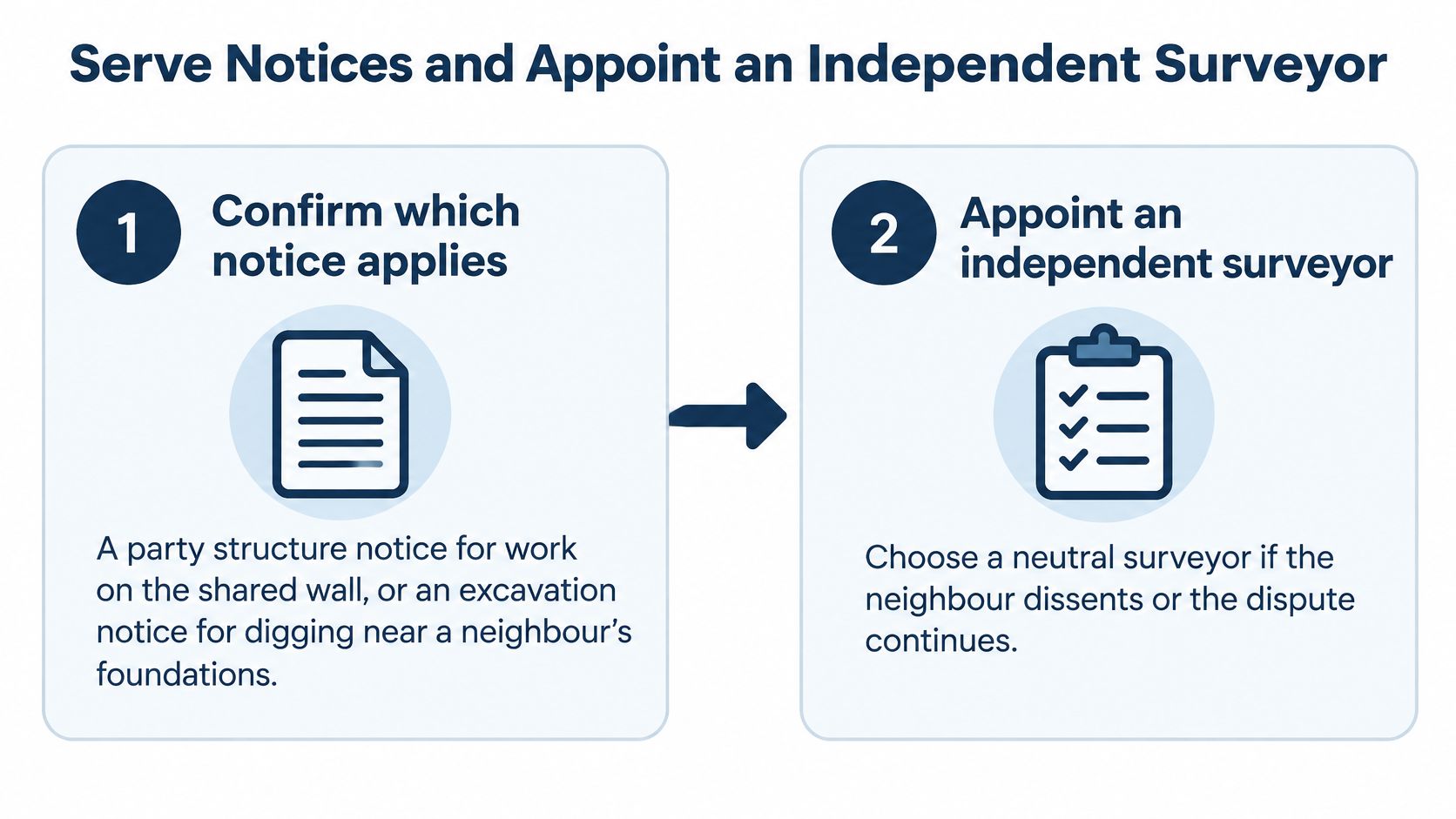
The flow below shows the initial decisions. The detailed checks are what make those decisions reliable.
Prepare the notice properly
Confirm which notice applies. A party structure notice addresses relevant work on the shared wall. An excavation notice addresses qualifying digging near adjoining foundations. Check whether boundary-wall work requires a different notice rather than forcing every project into those categories.
Choose an independent surveyor before naming anyone. Speak to a RICS-qualified surveyor with party wall experience. Check their qualifications and actual experience with the proposed construction, not just whether their website mentions extensions.
RICS and CABE qualifications are useful professional signals. Valuers Registration Scheme status matters for valuation work, but it isn't a substitute for party wall competence. Ask about ties to either owner, a lender, estate agent or developer.
Gather a usable information pack. Obtain architectural and structural drawings, title information and photographs of the wall. Keep a dated correspondence log. For a loft conversion, the surveyor needs to understand beam bearings and chimney alterations, not just the proposed room layout.
Identify every adjoining owner and serve the notice correctly. Check freeholders and relevant leaseholders rather than addressing the document only to whoever lives next door. Consider mortgagees where legally relevant, but don't assume every lender is automatically an adjoining owner.
Put the notice in writing. Include the required description, proposed start date and drawings where required. Keep evidence of the service method and date for each recipient.
Make the appointment work
Allow the correct notice period. A party structure notice requires at least two months before work starts and an excavation notice at least one month. A builder's availability doesn't shorten the statutory programme. Any lawful agreement to an earlier start needs proper advice and clear documentation.
Record the response. The neighbour has 14 days to respond to the relevant notice. Silence is not consent. Where it creates a deemed dispute, follow the statutory appointment procedure rather than treating an unanswered email as permission.
Use the right surveyor arrangement. The owners can jointly appoint an agreed surveyor or appoint separate surveyors. Separate surveyors select a third surveyor at the outset, available to determine matters when necessary. An agreed surveyor must act impartially for both owners.
Deal formally with an unavailable agreed surveyor. Under section 10(3) of the Act, proceedings begin again if the agreed surveyor refuses to act, dies, becomes incapable of acting or neglects to act for 10 days after either party serves a request.
For neglect, serve a dated written request and retain proof of service. If proceedings restart, use the statutory appointment process again rather than assuming the original appointment continues.
An agreed surveyor can reduce duplicated work and correspondence. Separate appointments can be more suitable where owners need distinct representation within the statutory process. Neither arrangement excuses delay or permits a surveyor to act as an owner's partisan advocate.
This video provides further context for the notice and appointment process.
Negotiating Terms and Reading the Party Wall Award
Access, protection and making good deserve attention before construction begins. A vague promise that the contractor will be careful won't tell anyone what to do when water enters the neighbour's bedroom or a crack appears beside a window.
A useful award describes the authorised work and the safeguards attached to it. It shouldn't read like a general permission slip for whatever the builder later decides to construct.
Agree practical protections
Discuss working hours, access dates and how the contractor will protect occupied rooms. Temporary weatherproofing matters when opening a roof. Dust containment and safe access matter when work affects a shared passage.
- Working hours and access. Set clear arrangements for inspections, scaffolding and any justified entry onto adjoining property. Don't treat access provisions as permission to use the neighbour's garden indefinitely.
- Temporary works. Identify propping, sequencing and support requirements. These should align with the structural design and the contractor's method.
- Dust, noise and water. Specify relevant containment and protection measures. Identify who responds if a covering fails or a leak develops.
- Insurance and making good. Check appropriate insurance arrangements and describe how damage will be assessed and repaired. Insurance doesn't remove the need to prevent damage.
A schedule of condition records the adjoining property before work starts. It should combine written descriptions with clear photographs. Record existing cracking, damaged plaster, staining and distorted openings, including their locations.
Photograph the whole wall and the close-up defect. A detailed picture is much less useful if nobody can establish where it was taken.
Check the technical scope and fees
The award should use coordinated architectural and structural drawings. Check drawing references and revisions. For excavation, the documents need to establish depth and proximity to adjoining buildings.
Monitoring should specify what is measured and who records it. Crack gauges may suit identified cracks, while movement monitoring requires appropriate reference points and specialist interpretation. Agree inspection frequency, reporting arrangements and what happens if movement warrants stopping work.
RICS party wall guidance explains that the building owner generally pays for the works and reasonable party wall costs, although costs may be apportioned where repairs or shared benefits justify it. Ask for the fee basis and what additional work could generate further charges.
In 2025, SurvDesign's dispute-cost guidance put legal and surveyor costs for party wall disputes between £1,000 and £10,000. That's a broad guidance range, not a quote for your property or a ceiling on exposure.
Surveyors decide matters within the Act. An award isn't a substitute for planning permission, building control approval or a contractor's workmanship obligations. Wider nuisance and ownership demands need separate consideration.
Before the award is finalised, ask for the pre-works inspection, written monitoring arrangements and access dates. Resolving those practical questions early is more useful than arguing over wording that doesn't change how the work will proceed.
What to Do When the Process Goes Wrong
An award you dislike isn't an award you can ignore. Government guidance on party wall disagreements says either owner normally has 14 days from service to appeal to the county court, which may rescind or modify the award and make an order on costs.
Problems after a notice or award and the action to take
| Problem | Likely cause | Action |
|---|---|---|
| Award served and you disagree | Surveyor's reasoning or costs seem wrong | Appeal to the county court within 14 days of service |
| Work started before the award was complied with | Owner treated silence as consent | Stop the work and take legal advice on compliance |
| Neighbour disputes where the wall sits | Title plans show only general boundaries | Use a boundary agreement, mediation or court, since the award will not decide it |
| Neighbour starts work without notice | No notice served or accepted | Seek legal advice on urgent court relief |
Challenge the award through the proper route
The appeal is a formal court process. A complaint to the surveyor, their firm or a professional body doesn't replace it. Nor does asking the surveyor to reconsider stop the deadline.
An appeal isn't an automatic fresh hearing of every issue. Identify the actual concern: jurisdiction, the authorised work, protection measures or costs. A party wall solicitor can assess which parts need challenging and how to frame the case.
Don't assume a late challenge will be rescued. Jurisdiction arguments can raise separate questions, but they aren't a dependable escape from missing the appeal deadline.
Keep the award, covering correspondence and evidence of delivery. If service is disputed, the starting date may become contested. Send the full documents to your solicitor rather than just a photograph of the page you disagree with.
A complaint can address professional conduct. It doesn't preserve your right to appeal an award.
Respond to construction problems
If you're the building owner and required protections haven't been implemented, stop the affected work and obtain advice. Check what the award required before restarting. Continuing because the contractor has already opened the wall can increase both physical risk and legal exposure.
If the neighbour challenges the wall's position, establish whether the design assumes a right over disputed land. Don't ask surveyors to solve title ownership by adding a sentence to the award. A property solicitor may need to review the documents and advise on agreement or proceedings.
Where neighbouring work starts without notice, record what is happening safely. Take dated photographs from your own property and keep messages. A solicitor can assess whether urgent court relief, including an injunction, is appropriate.
A party wall schedule of condition can help establish the property's earlier state, but it isn't retrospective permission for unauthorised construction. Preserve any existing inspection records and ask for advice about documenting current damage.
A stalled agreed surveyor may require proceedings to restart under the ten-day request rule described in the notice section. Mediation, independent-expert determination and arbitration can assist suitable disputes, but they don't replace the statutory appeal deadline.
Once an award has arrived and a challenge is being considered, consult a party wall solicitor quickly. Waiting for another reassuring email can leave too little time to act.
Frequently Asked Questions
Do I need a party wall notice for a loft conversion?
The work determines the answer, not the label “loft conversion.” Cutting beam pockets into a party wall, altering a shared chimney or making structural changes to the wall can require notice. Work contained within your property may follow a different route.
Have an independent surveyor check the architectural and structural drawings before serving notice. In a terrace, confirm how the new floor and roof structure will bear on the existing building. Planning approval does not settle that question.
Does a party wall award protect me if my neighbour's works cause damage?
An award can require a schedule of condition, monitoring and protective measures. These help record the property's earlier condition and set out how the work should be managed, but they cannot guarantee that damage will not occur.
If damage appears, photograph it and notify the building owner and surveyors promptly. Keep dated records and repair quotations. The statutory process may address relevant damage, but an award does not rule on ownership of the wall or land, or replace a separate civil claim where one is needed.
Getting the documents checked
Corinthian Surveyors London LTD is an independent firm of RICS Chartered Surveyors and Valuers based in Forest Hill, serving homeowners and property professionals across London. The practice has over 30 years' experience in the built environment and is led by surveyor Clive.
Have your notice, drawings and correspondence ready, then contact the firm through corinthiansurveyorslondon.co.uk. If an award has already been served, say so when you get in touch.