
How Long Does a Party Wall Agreement Take
A party wall agreement typically takes 4 to 8 weeks from notice to a signed award. The absolute minimum is around one month plus response handling, while a dispute can push the process to 8 to 12 weeks or more, depending on the work and the level of cooperation.
That answer surprises many London homeowners because the process isn't one fixed queue. The legal notice period creates the hard starting point, but your neighbour's response determines which route follows. A cooperative adjoining owner can keep matters straightforward. Silence or dissent moves the job into the surveyor process.
Table of Contents
- Understanding the Party Wall Timeline
- Statutory Notice Periods and Response Windows
- The Consent Pathway When Your Neighbour Agrees
- The Surveyor Appointment and Award Process
- Common Causes of Delay and How to Avoid Them
- Your Party Wall Agreement Checklist and Final Notes
- Frequently Asked Questions
Understanding the Party Wall Timeline
The phrase “party wall agreement” covers two different practical situations. Your neighbour may consent to the proposed work, in which case the formal surveyor process may not be needed. Alternatively, they may dissent or fail to reply, creating a deemed dispute and requiring surveyors to prepare an award.
UK practitioner guidance confirms that a straightforward agreed-surveyor route can sometimes be completed in a day or a week, but only where the drawings are complete and everyone cooperates. More typically, allow 3 to 5 weeks from notice to award, plus the statutory notice period. If the matter becomes disputed, the overall period can reach 8 to 12 weeks or more (Collier Stevens guidance on fast party wall awards).
The practical fork looks like this:
- Neighbour consents: the matter may remain at notice stage, subject to the required notice period and sensible records of the adjoining property.
- Neighbour dissents: surveyors are appointed and an award is prepared.
- Neighbour doesn't respond: after the statutory response window, a dispute is deemed to have arisen and the surveyor route begins.
Practical rule: Don't work backwards from the date your builder wants to start. Work forwards from correctly served notice.
For a loft conversion in Forest Hill, a rear extension in Catford or basement excavation in Dulwich, the drawings need to show the work clearly enough for the adjoining owner and surveyor to understand the likely effect. A construction industry AI support bot can help with general construction terminology and preparation questions, but it can't replace a properly served notice or professional party wall advice.
Statutory Notice Periods and Response Windows
The notice date sets the earliest lawful start, but your neighbour's response determines which route follows. Under the Party Wall etc. Act 1996, work to an existing party wall normally requires at least two months' notice. Line-of-junction work and excavation generally require one month's notice (GOV.UK guidance on when and how to tell neighbours).
The category of work therefore affects the initial lead-in:
- Existing party wall works: at least two months' notice.
- Line-of-junction or boundary work: usually at least one month.
- Excavation: usually at least one month.
After valid notice is served, the adjoining owner has 14 days to give consent. That is a statutory response window, not a courtesy period. A clear written consent keeps the matter on the consent route. Silence or an invalid response means the matter is treated as disputed, and surveyor appointments may follow under the Act (Party Wall etc. Act 1996).
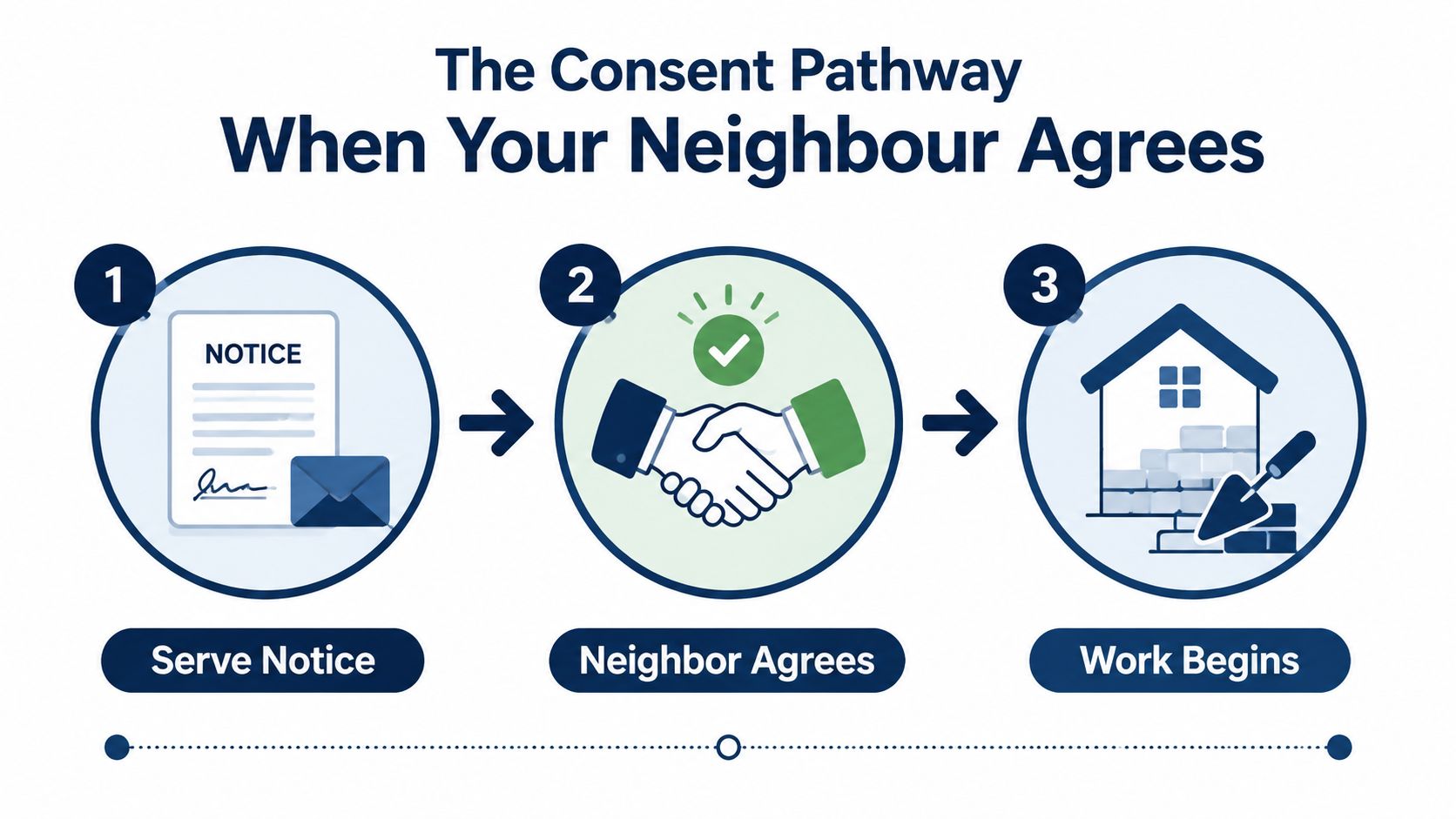
Consent does not automatically permit an immediate start. The notice period still applies unless the Act allows an earlier start or the neighbour agrees to one. In practical terms, the shortest route is roughly one month plus response handling, while many residential projects need a two-month lead-in.
The notice itself remains valid for 12 months, so the relevant work will generally need to begin within that period or the notice will lapse. For a plain-English explanation of this formal document, read what a party wall notice is and when it is used. The GOV.UK explanatory booklet on the Party Wall etc. Act 1996 provides further guidance on the statutory process.
The Consent Pathway When Your Neighbour Agrees
The smoothest route starts before the notice is served. The building owner has clear drawings, identifies the correct adjoining owner and explains the proposed work without making promises about matters outside the Party Wall Act.
Take a typical South East London example. A homeowner in Brockley proposes a rear extension involving excavation near the adjoining property's foundations. The plans identify the excavation and boundary relationship clearly. The neighbour receives the notice, understands the proposal and gives written consent.
In that situation, there may be no award to prepare. However, consent isn't a reason to ignore the condition of the adjoining property. A schedule of condition records existing cracks, damp marks, movement or damaged finishes before construction. It gives both owners a fair reference point if an allegation of damage arises later.
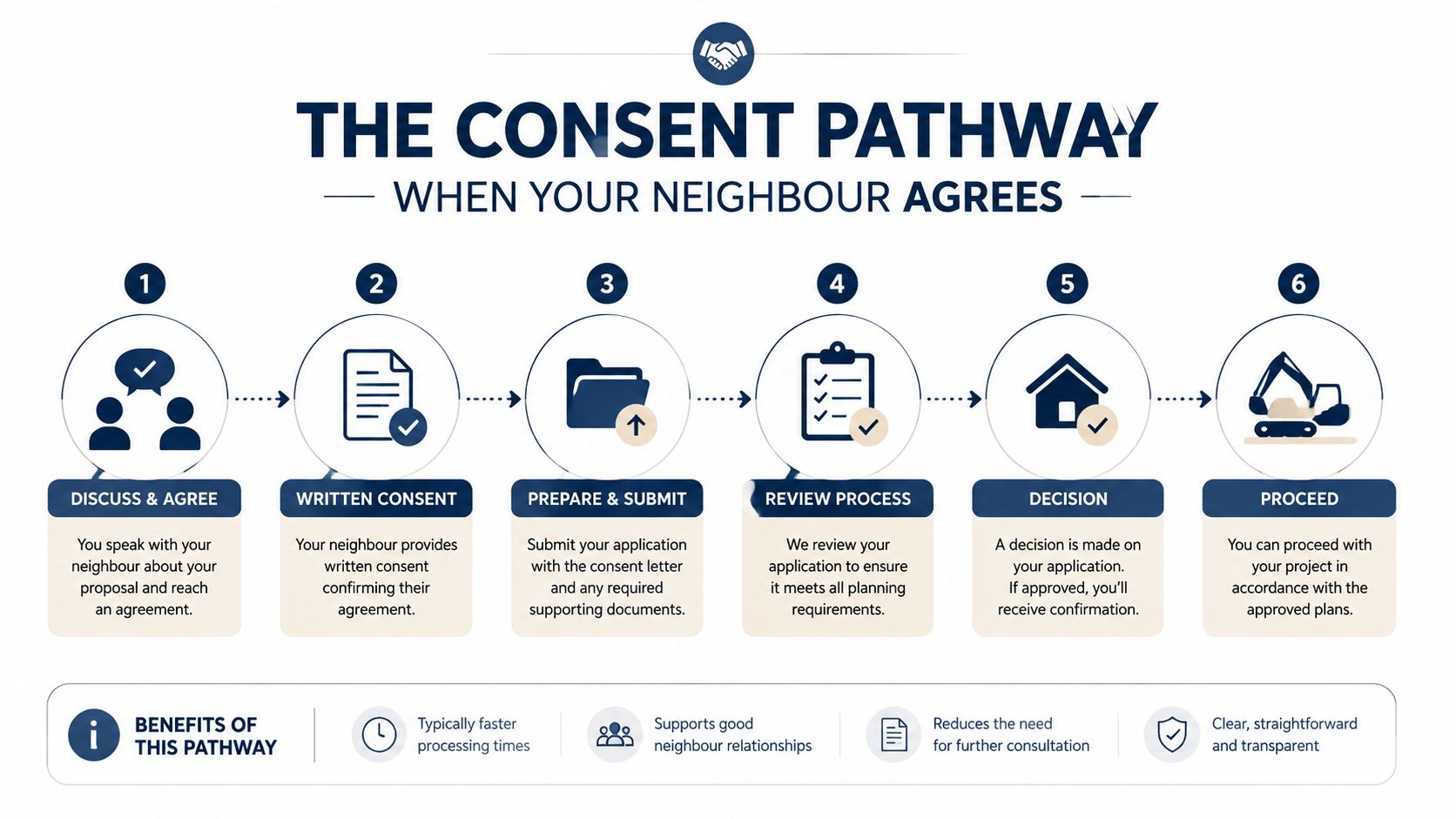
The usual smooth route is:
- Prepare the drawings and identify the relevant works.
- Serve the correct notice with the required information.
- Receive written consent from the adjoining owner.
- Arrange a schedule of condition where appropriate.
- Observe the statutory notice period unless an earlier start is properly agreed.
- Begin work in accordance with the plans and any agreed safeguards.
The legal timetable alone can take one to two months before work starts. Section 3 notices for work such as a new party wall require at least two months' notice, while section 6 excavation notices require at least one month's notice. If the adjoining owner doesn't consent, a dispute arises after 14 days and the matter moves to the surveyor and award stage under section 10 (Party Wall etc. Act 1996).
A consenting neighbour can therefore make the process administratively lighter, but they can't erase the statutory requirements. The common mistake is treating a friendly conversation as legal consent. Keep the response in writing and keep the project information consistent.
The Surveyor Appointment and Award Process
Once the adjoining owner dissents or does not respond within the statutory window, the matter becomes a formal dispute under the Act. The neighbour has not gained a veto over the extension, loft conversion or basement. The statutory protection procedure has been triggered.
The owners can appoint one agreed surveyor if both are comfortable with that arrangement. If they prefer, each owner appoints their own surveyor. The surveyors then handle the technical and procedural issues needed to prepare a binding party wall award.
What the surveyors examine
Surveyors review the drawings and assess how the proposed works relate to the adjoining property. They may need details of foundation depth, temporary works, structural openings, access requirements and the methods proposed to protect the neighbour's building.
They also consider a schedule of condition, usually based on an inspection of the adjoining property where access is available. This record does not predict damage. It establishes the property's condition before work starts, giving both owners a reference point if damage is alleged later.
An award normally defines the permitted works, protective measures, access arrangements and other project-specific conditions. It gives the owners and contractor a clear framework, rather than leaving important decisions to informal assumptions.
Why an award does not cancel the notice period
Section 10 permits surveyors to make a binding award where the parties cannot agree. The award cannot shorten the minimum notice period. Any period stated in the award for carrying out the work only begins after the statutory notice period has expired or the relevant dispute has arisen (section 10 of the Party Wall etc. Act 1996).
Once the 14-day window expires without consent, the dispute route begins automatically. The surveyor process then deals with protection and conditions, not permission to ignore the notice requirements.
That distinction matters when a builder says the paperwork can be “sorted later”. Starting first can leave the building owner exposed and make practical resolution harder. For guidance on choosing and appointing a suitable professional, see party wall surveyors in London.
Straightforward matters commonly move from dissent to signed award within 2 to 6 weeks, although the Act sets no fixed deadline for the final award. More involved projects take longer when drawings change, access is delayed or the surveyors must resolve technical differences. The timetable therefore depends heavily on cooperation, the quality of the information supplied and the complexity of the works.
Common Causes of Delay and How to Avoid Them
The biggest delays are usually created before the notice is served. Incomplete drawings, incorrect adjoining-owner details and an unrealistic construction programme can send a straightforward matter back to the beginning.
GOV.UK guidance on reaching agreement with neighbours explains that the practical process can take 2 to 4 months or longer once notices, schedules of condition and award preparation are included. That is a planning range, not a guaranteed timetable. A well-prepared file may progress smoothly, while missing information can lead to repeated questions and avoidable pauses.
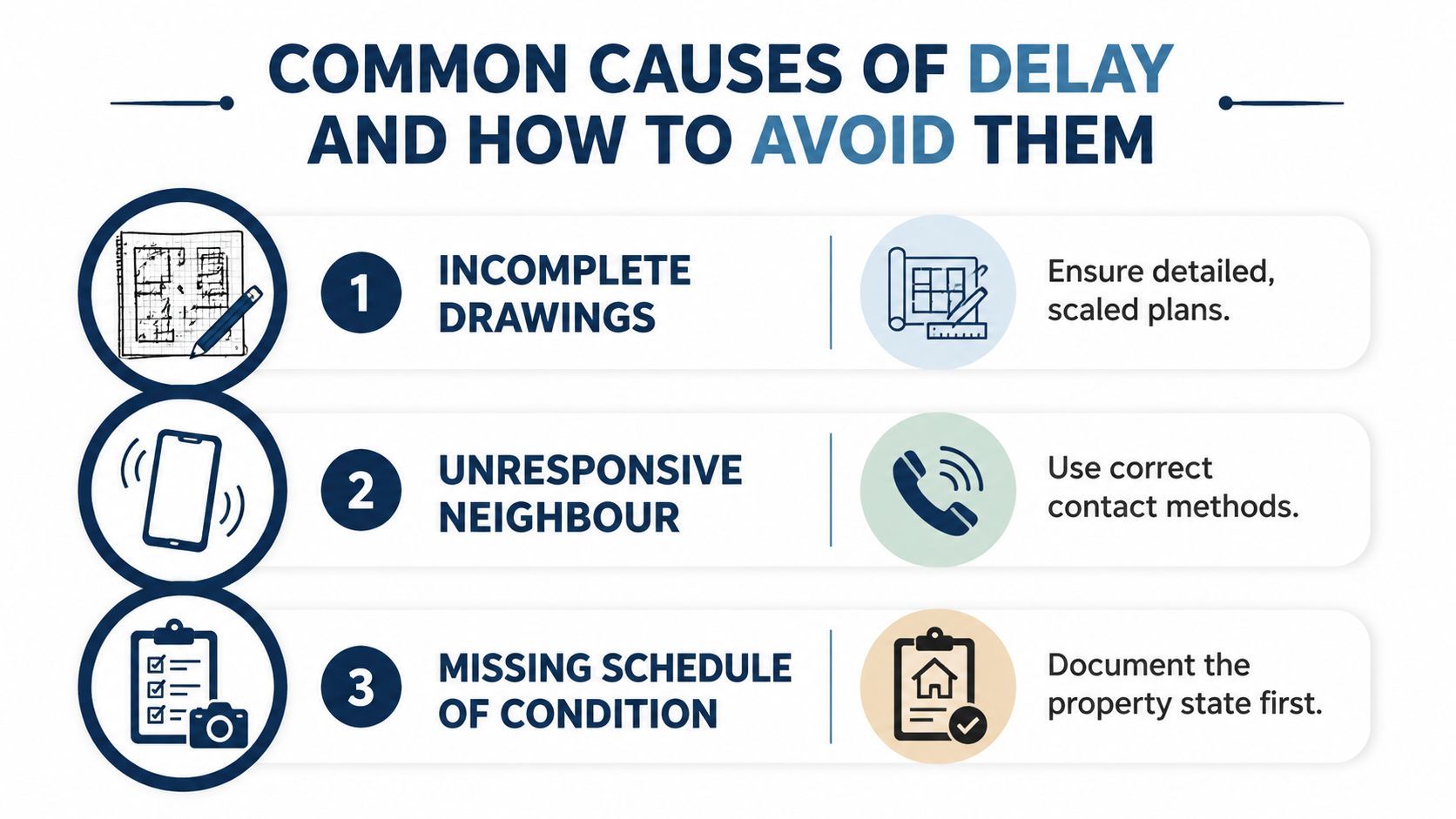
Where projects lose time
- Incomplete drawings: Provide properly scaled plans, sections and structural information. A vague sketch leaves the surveyor unable to assess the proposed work without further queries.
- Incorrect notice details: Check names, addresses, ownership and the description of the works. An error can undermine the notice and require the process to be revisited.
- Unresponsive neighbours: Where relations allow, speak to the adjoining owner before serving notice. After service, use reliable contact details and keep a written record of reasonable attempts to progress matters.
- No schedule of condition: Arrange access early. If the adjoining owner cannot provide access, tell the surveyor promptly rather than allowing the inspection to remain an unspoken dependency.
- Changing the design: A revised foundation, new steelwork or altered wall position may require the surveyor to reconsider the documents. Freeze the relevant design before serving notice where possible.
The type of project also affects the practical timetable. A London terrace in Peckham or Camberwell may have restricted access and closely connected structures. A basement proposal in Bermondsey raises different technical questions from a loft conversion in Sydenham. The surveyor needs information about the actual building, not a generic project description.
The sensible route is to obtain party wall advice early, prepare accurate drawings and speak to the neighbour before formal papers arrive. Rushing the notice rarely saves time if an incomplete or defective process has to be restarted.
Do not ask a contractor to promise a start date before the notice strategy is settled. The construction programme should allow for the legal lead-in, possible surveyor involvement and time to resolve access or drawing queries.
Your Party Wall Agreement Checklist and Final Notes
The party wall timetable depends on the neighbour's response, not only on your preferred construction date. A cooperative adjoining owner may allow the matter to move through written consent. A dissent, silence or disagreement over access can shift it into the surveyor and award route, with different costs and practical delays.
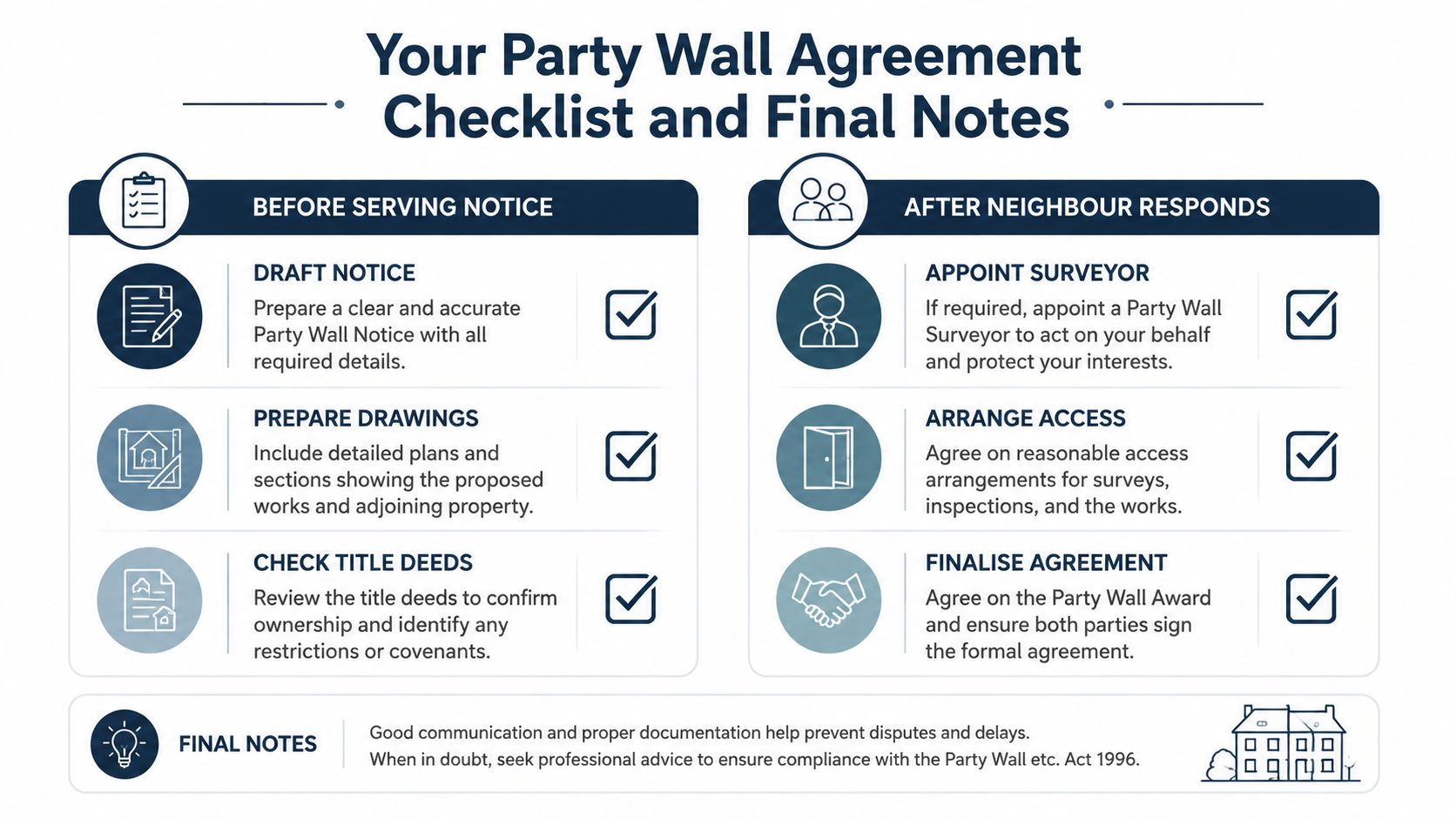
Use the right checklist for the route
| Neighbour's position | Practical next step | Effect on the programme |
|---|---|---|
| Written consent | Keep the consent with the project records and confirm the agreed works | The formal award route may be avoided |
| Dissent | Appoint an agreed surveyor or separate surveyors | The award must be prepared and served before covered work starts |
| No response | Treat the dispute as having arisen after the statutory response period | Surveyor appointments can proceed despite silence |
A common London trap is assuming that a narrow terrace project is straightforward. Basement works, shared structures and restricted access can create inspection or damage concerns that are not obvious from the drawings. Those issues may lead to further questions, revised documents or conditions in the award.
Keep the construction programme separate from the party wall process until the route is clear. The contractor should receive the relevant award conditions, and any material design change should go back to the surveyor before work proceeds.
Costs also vary with the route. Written consent can avoid surveyor fees, while dissent or non-response may involve one or two surveyors and additional work. For a practical explanation of the factors affecting fees, see this guide to party wall agreement cost.
Corinthian Surveyors London LTD is an independent firm of RICS Chartered Surveyors and Valuers based in Forest Hill. Led by Clive Thompson, who holds RICS and CABE qualifications and has over 30 years' experience in the built environment, the firm provides residential party wall advice across London, the Home Counties and the South of England. It has no ties to lenders, estate agents or developers, which supports independent advice.
Frequently Asked Questions
Can I start work before the party wall award is signed?
You shouldn't start work covered by the Act before the required notice period has expired and, where a dispute exists, the award has been served. An award can't be used to bypass the statutory timetable.
What happens if my neighbour never replies?
After 14 days, a dispute is deemed to have arisen. The surveyor appointment process can then begin, so silence doesn't provide a shortcut or leave the matter permanently suspended.
Does the notice validity period matter?
Yes. A served notice normally remains valid for 12 months. If the work doesn't start within that period, the notice will usually lapse and the process may need to be addressed again.
Do I always need a surveyor?
Not necessarily. A neighbour who gives valid written consent may avoid the formal award route. If the neighbour dissents or doesn't respond within the statutory period, surveyors are required to deal with the dispute under the Act.
Corinthian Surveyors London LTD provides independent party wall advice, notice support, schedules of condition and surveyor services for residential projects across Forest Hill, Lewisham, Greenwich, Southwark and the wider London area. Call 0800 00 16 422 to discuss your proposed extension, loft conversion, basement or boundary work, then visit Corinthian Surveyors London LTD for further information.