
What Does a Party Wall Surveyor Do: Role and Process
A party wall surveyor is an independent professional who manages the Party Wall etc. Act 1996 process and sets the terms of building work affecting a shared wall, shared structure or neighbouring excavation through a written award.
Perhaps your neighbour has handed you drawings for an extension. Or your builder is ready to start and the neighbour hasn't replied to your notice. The important question isn't whether someone needs to inspect the wall. It's whether the statutory procedure has been followed and what must happen before the work can proceed.
Table of Contents
- What a Party Wall Surveyor Actually Does
- When the Party Wall Act Applies to Your Project
- How a Notice Becomes a Party Wall Award
- Responsibilities of Building and Adjoining Owners
- What the Award Covers and Why It Is Final
- What Shapes Party Wall Surveyor Fees and Timelines
- Confirm Whether You Need a Surveyor Before Work Starts
What a Party Wall Surveyor Actually Does
A party wall surveyor resolves disputes about work covered by the Act. Inspection supports that task, but it isn't the whole job. The surveyor examines the proposals, considers the neighbouring property and determines the conditions under which the relevant work can proceed.
The central document is the party wall award. It sets out the authorised work, its timing and method, protective requirements and responsibility for reasonable professional costs. The Government's party wall explanatory booklet explains this statutory role and the appointment arrangements.
An appointment by one owner doesn't make the surveyor that owner's advocate. The surveyor must act impartially, rather than secure whatever outcome the person paying would prefer. That distinction matters when a proposed construction method needs changing to protect the adjoining building.
The inspection is focused on the proposed work and the structures it could affect.

Who does what on a party wall matter
| Professional | What they decide or produce | Who appoints them |
|---|---|---|
| Party wall surveyor | Party wall award setting the works, timing and protections | Building owner and adjoining owner, jointly or separately |
| Architect or structural engineer | Design, calculations and detailing of the works | Building owner |
| Building control inspector | Assessment of compliance with Building Regulations | Through the building control arrangements for the project |
| Planning officer | Planning permission and conditions | Local authority decides, no appointment by owners |
| Solicitor | Legal advice on rights, title and the wider dispute | Either owner |
| Building contractor | Carries out the works in accordance with the award and project documents | Building owner |
These roles aren't interchangeable. A structural drawing doesn't resolve a party wall dispute. Equally, an award isn't a substitute for design calculations, planning permission or building control.
A sensible appointment starts with checking whether the Act applies. The surveyor then reviews the drawings, inspects relevant areas where access is available and assesses foreseeable risks. The useful output is an enforceable set of conditions, not merely a description of the wall.
Corinthian Surveyors offers party wall advice from Forest Hill. The practice is independent, with no ties to lenders, estate agents or developers.
When the Party Wall Act Applies to Your Project
A neighbour's silence can change what happens next. If they do not consent in writing within 14 days of receiving a relevant notice, a dispute is treated as having arisen. The building owner must then follow the Act's dispute procedure before the affected work proceeds.
The notice period depends on the work, not the project label. The Act's provisions for boundary walls, party structures and adjacent excavation set separate requirements for work to an existing party structure, a new wall on the line of junction and qualifying excavation.
Notice requirements by type of work
| Type of work | Notice needed | Minimum notice | Section of the Act |
|---|---|---|---|
| Works to an existing party wall or party structure | Party structure notice | Two months | Section 3 |
| New wall on the line of junction or party fence wall | Line of junction notice | One month | Section 1 |
| Excavation within 3 metres of a neighbouring structure, deeper than its foundations | Excavation notice | Two months | Section 6 |
| Work wholly inside your land with no relevant effect on shared structures or neighbouring foundations | None under the Act | Not applicable | Outside the relevant categories |
Excavation within 6 metres can also require notice if it crosses the relevant 45-degree line drawn down from the neighbouring foundations. The distances and notice periods come from the linked legislation. Allow the correct period before starting; an excavation notice served only one month ahead does not meet the section 6 minimum.
The boundary line alone does not determine whether the Act applies. Excavation on your land may affect a neighbour's building, depending on the depth of your proposed foundations and the position of theirs.
Practical rule: Describe the physical work, not just the project. “Rear extension” and “loft conversion” are not notice categories.
Cutting into an existing shared wall may require a party structure notice. An extension near a boundary does not, by itself, mean that notice is required. A garden shed well away from neighbouring buildings and shared structures will usually be a different case.
For a Victorian terrace in Lewisham, Brockley or Peckham, check each part of the proposal separately. Basement excavation and changes to a shared chimney breast may fall under different provisions in the same project.
Serving the wrong notice, or serving it too late, can delay the work while the procedure is corrected. See when a party wall agreement is required to distinguish a project description from the work that triggers the Act.
How a Notice Becomes a Party Wall Award
A neighbour who does not reply can change what happens next. The building owner cannot treat silence as consent. Once the response period expires without written consent, a dispute is deemed to have arisen and the statutory appointment procedure begins.
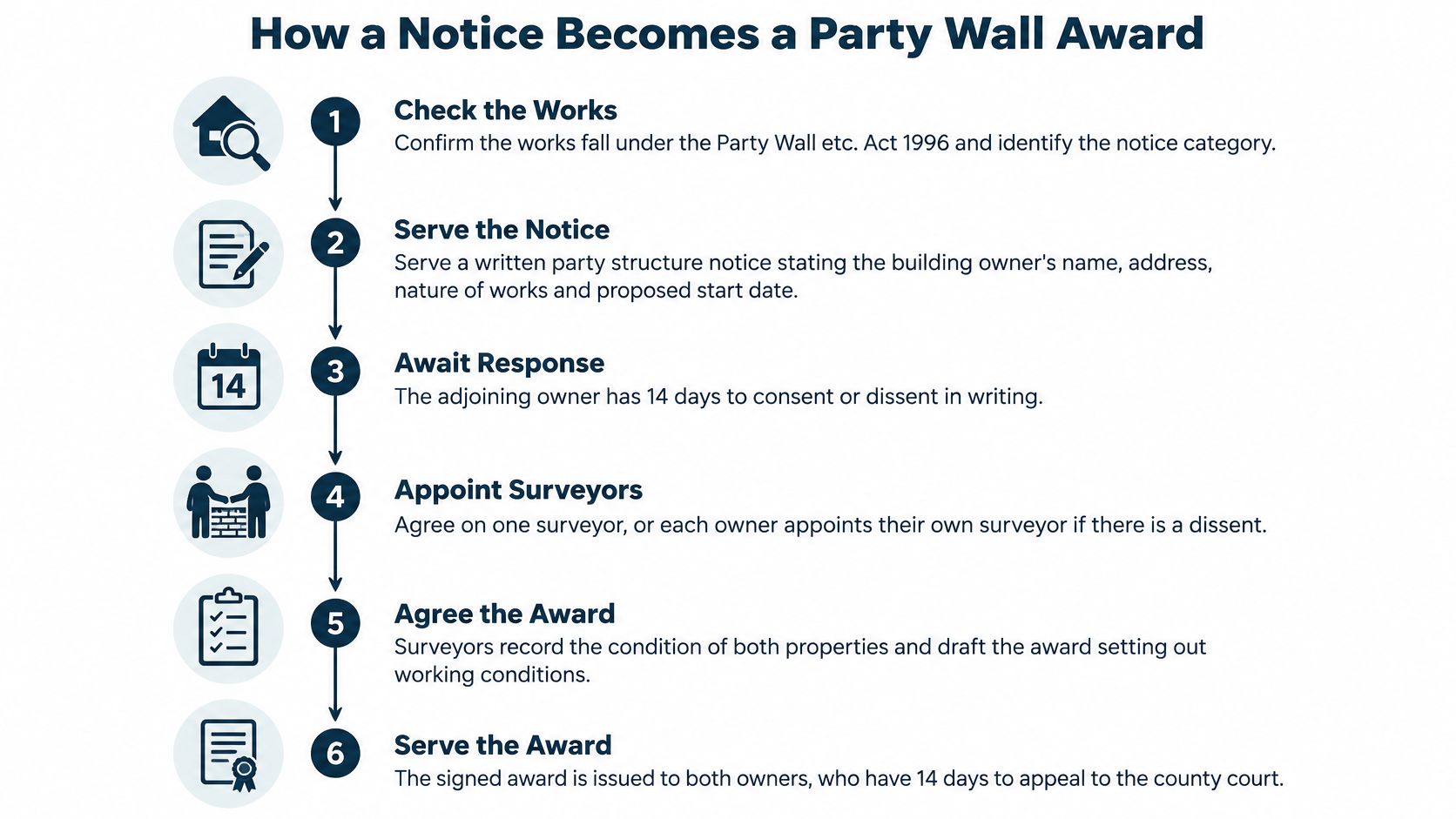
Check the works and notice category. Compare the drawings with the Act before preparing the paperwork. A general letter about planned building work is not a substitute for the correct statutory notice.
Prepare and serve the written notice. A party structure notice must name and give the address of the building owner, describe the proposed work and state its intended start date. For special foundations, include plans, sections, construction details and reasonable particulars of their loads, as required by section 3's notice requirements.
Allow the response period. For a party structure notice, the adjoining owner has 14 days to consent in writing. If consent is not given within that period, a dispute is deemed to have arisen. The Government's revised party wall guidance explains the statutory procedure.
Arrange the surveyor appointments. The owners can agree to appoint one surveyor jointly, or each appoint a surveyor. If they appoint separately, those surveyors select a third surveyor at the outset, so one is available if they cannot agree on a matter.
Inspect and record the condition. Surveyors arrange access and document the parts of the properties that could be affected, usually with descriptions and photographs. Record any areas that could not be inspected, so the record does not imply they were checked.
Settle the disputed matters. The surveyors review the technical information and determine conditions for the proposed work. Conditions should deal with identifiable risks and give the owners and contractor clear requirements.
Serve the award. Both owners receive the formal award governing the relevant work. The contractor needs the applicable conditions before reaching the stage of work they address.
When the neighbour doesn't cooperate
Silence is not consent. If the adjoining owner does not respond within 14 days, the deemed dispute triggers the appointment process. The adjoining owner then has 10 days to appoint a surveyor. If they fail to do so, the building owner may appoint one on their behalf. The building owner should follow that procedure rather than keep waiting or treat the notice as permission to start.
Check that the appointment is in writing and clearly identifies the surveyor and the owner they represent. Confirm whether the owners appointed a single agreed surveyor or separate surveyors. If separate, confirm the third surveyor has been selected. Do this before relying on the appointment to make decisions.
Refused access does not end the statutory process. It creates an evidential and procedural issue for the surveyor to address. Keep requests, replies and refusals in writing. An appointment does not give anyone the right to force entry.
A missing reply changes the procedure. It does not give the builder a free hand.
Check the notice's description of the work and intended start date before serving it. Under section 3, a party structure notice ceases to have effect if the work has not begun within 12 months of service or is not pursued with due diligence.
For a spoken explanation of the process, the following video follows the stages.
Responsibilities of Building and Adjoining Owners
The building owner is the owner proposing the work. The adjoining owner is the neighbouring owner whose property interests are affected by the statutory proposals.
Both need to engage with the paperwork. A surveyor can manage the procedure, but clear instructions and workable access arrangements still depend on the owners.
Building owner responsibilities
- Serve the correct notice. Include the required information and allow the applicable notice period before the relevant work starts.
- Arrange inspection access. Make relevant parts of your property available and help coordinate the information the surveyors need.
- Address professional costs. Budget for the reasonable costs allocated through the process, not just your initial advice.
- Follow the award. Give the contractor its conditions and check that the construction programme reflects them.
- Don't start prematurely. A booked contractor or hired equipment doesn't remove the statutory requirements.
Adjoining owner responsibilities
- Reply in writing. Make your position clear within the response period rather than rely on a conversation over the fence.
- Discuss reasonable inspection access. A condition record is more useful when relevant areas can be examined.
- Consider the appointment options. You can agree a joint surveyor or appoint separately, but either route requires impartial decision-making.
- Read the protections. Check what the award says about your property and raise uncertainties promptly.
The building owner normally pays their own surveyor and the reasonable costs associated with the proposed work. The award determines responsibility, so neither owner should assume every fee presented will automatically be accepted. The statutory framework for costs and disputed matters appears in the Party Wall etc. Act.
A separate surveyor isn't a hired opponent. The purpose is to determine the relevant dispute properly, not prolong correspondence until one neighbour gives up.
There are limits to that jurisdiction. A party wall surveyor doesn't settle unrelated ownership questions, general boundary disputes or every disagreement about a building project. Those matters may require a solicitor and, where necessary, a court.
What the Award Covers and Why It Is Final
If an award arrives, check its terms before the work starts. It sets out what the building owner may do, the safeguards that apply and how costs are allocated. The surveyors' decision is binding unless an owner appeals to the county court within the statutory period. The Act's award and service provisions provide for awards to be served on the owners.
What to look for in the document
- Authorised work. Check that the description and referenced drawings match the proposed work.
- Timing and sequence. Note when work may begin, any required sequence and restrictions on particular operations.
- Protective measures. Check requirements for temporary support, movement monitoring and how sensitive work must be carried out.
- Condition evidence. Confirm that the record identifies the inspected rooms or areas and notes visible cracks, stains, damage and other relevant defects, with their locations and photographs where available.
- Access arrangements. Check why access is permitted, where it applies and any limits or conditions.
- Costs and damage. Read who must pay reasonable professional costs and how damage claims are to be addressed.
A schedule of condition in a party wall matter should make later comparisons possible. A photograph of an entire room may miss a fine crack beside a window. Record the affected surface, the crack's position and appearance, and any other visible signs of damage. The record establishes the condition before work; by itself, it does not prove that later damage was caused by the work.
Challenging an award
Either owner may appeal to the county court within 14 days beginning on the date the award is served, under section 10's appointment, award and appeal rules. If you believe a term is wrong, seek legal advice promptly. An informal complaint does not count as an appeal.
For example, if an adjoining owner considers the movement-monitoring requirement inadequate, they should raise the concern and get advice about an appeal before excavation begins. Waiting until the work is underway may leave less time to act.
Section 10 also requires surveyor appointments to be made in writing. If an appointed surveyor refuses to act or fails to act for 10 days after a request, the Act sets out how the appointment can proceed. The award states how the relevant costs are allocated.
On receipt: Save the award, note when it was served, and check its dates, access terms, monitoring requirements and cost allocation.
What Shapes Party Wall Surveyor Fees and Timelines
Party wall fees should reflect the property and the work involved. There isn't a useful fixed figure that covers both a straightforward proposal and a technically demanding excavation beside several properties.
The following factors indicate where additional work may arise. They aren't automatic charges or guaranteed delays.
Factors that change fee and timeline
| Factor | Usual effect on fee | Usual effect on timeline |
|---|---|---|
| Number of adjoining owners | More notices, property records and reviews may increase work | More responses and inspections to coordinate |
| Type of work | Basements and special foundations can require more technical assessment than straightforward loft work | Complex design and protective measures take longer to settle |
| Written consent from neighbour | May avoid the statutory award appointment and associated costs | Avoids the dispute-resolution stage where valid consent resolves matters |
| Separate surveyors and third-surveyor involvement | Additional professional work can increase costs | Coordination takes time, with further work if referral becomes necessary |
| Condition of neighbouring properties | Existing defects may require more detailed recording | Access and inspection arrangements affect progress |
| Access refused | Repeat requests, visits and procedural work may increase costs | Unresolved access can delay evidence gathering |
A loft conversion with clear drawings and written consent may have a relatively straightforward route. A basement proposal near several neighbouring buildings can require substantially more assessment and carefully defined protective conditions.
The surveyor still needs to examine the actual work. “Loft” doesn't automatically mean simple, and selecting a third surveyor doesn't mean that surveyor will necessarily undertake chargeable dispute work.
Compare the scope, not just the headline quote
Ask whether the quotation includes:
- Inspection and recording. Which properties and areas will be inspected?
- Award preparation. Are drafting, agreement and service included?
- Work-stage attendance. What inspections or monitoring reviews are allowed for?
- Additional work. How are revised drawings, access problems or further disputes charged?
A quote excluding work-stage attendance isn't directly comparable with one that includes it. Nor should a consent-only instruction be mistaken for the full cost of an award if a dispute later arises.
Our guide to party wall agreement costs explains the scope questions worth asking. Corinthian quotes per property after discussing the proposed work, adjoining owners and available drawings.
Confirm Whether You Need a Surveyor Before Work Starts
A neighbour who stays silent after receiving a notice can change what happens next. If they do not respond within 14 days, the matter is treated as a dispute under the Act, and the building owner must follow the dispute procedure before starting the work.
Get advice before work begins if you plan to build on or alter a shared structure, carry out relevant boundary work, or excavate near a neighbouring building. Ask for help if you have received a notice you do not understand, the consent period has passed without written agreement, or your neighbour disputes access for an inspection.
Choose a surveyor who explains the procedure and what happens if your neighbour does not consent or reply. Ask about relevant experience, RICS regulation, written appointments and what the quotation covers. The surveyor's role is to resolve the statutory dispute impartially, not to decide whether the building work itself should go ahead.
Clive Thompson runs Corinthian from Forest Hill. The firm provides party wall advice across London and the South East. Send your drawings and any notices through the Corinthian Surveyors London contact page to ask which procedure applies. The firm's residential services overview covers related surveying needs.
Do I need a surveyor if my neighbour agrees?
Written consent may avoid the award process. Check that it covers the work described in the notice and that the required notice procedure has been followed.
Can one surveyor deal with both owners?
Yes. Both owners can appoint an agreed surveyor, who must act impartially.
Can my builder deal with the paperwork?
A builder's programme does not determine whether the Act's procedure has been followed. Confirm the notice category and next steps before relying on a proposed start date.
Keep dated records of notices, replies and visits before work starts.