
Negotiation Price for Property: How to Use Survey Findings
Only 39% of UK homeowners who bought a property negotiated a price below the asking figure, and the most common reduction was up to 5%. That's the sensible starting point for a negotiation price: ask for a reduction the evidence can support, not one chosen because it sounds ambitious.
A survey can give you a proper reason to revisit an offer. The useful question isn't, “How much can I knock off?” It's, “What does this defect mean for the cost, condition and value of the property, and what concession would protect me without putting the purchase at unnecessary risk?”
Table of Contents
- What Negotiation Price Looks Like in the UK Right Now
- Building Your Evidence File Before You Speak to the Agent
- How to Read the Survey for Negotiation-Grade Defects
- Scripts for the Estate Agent and the Seller
- Choosing the Right Concession Instead of Always Asking for Money Off
- Protecting Transaction Certainty During the Negotiation
- Putting the Plan into Practice with an Independent Surveyor
What Negotiation Price Looks Like in the UK Right Now
The UK benchmark is clear: buyers don't routinely secure large discounts. An Opinium survey of 2,000 UK adults, including 1,269 homeowners, conducted from 1–5 April 2025 found that 39% of homeowners negotiated and bought below asking. The most common result was a reduction of up to 5%, achieved by 20% of respondents. A further 14% secured between 5% and 10% off, while only 6% got more than 10% off, according to the Opinium survey results.
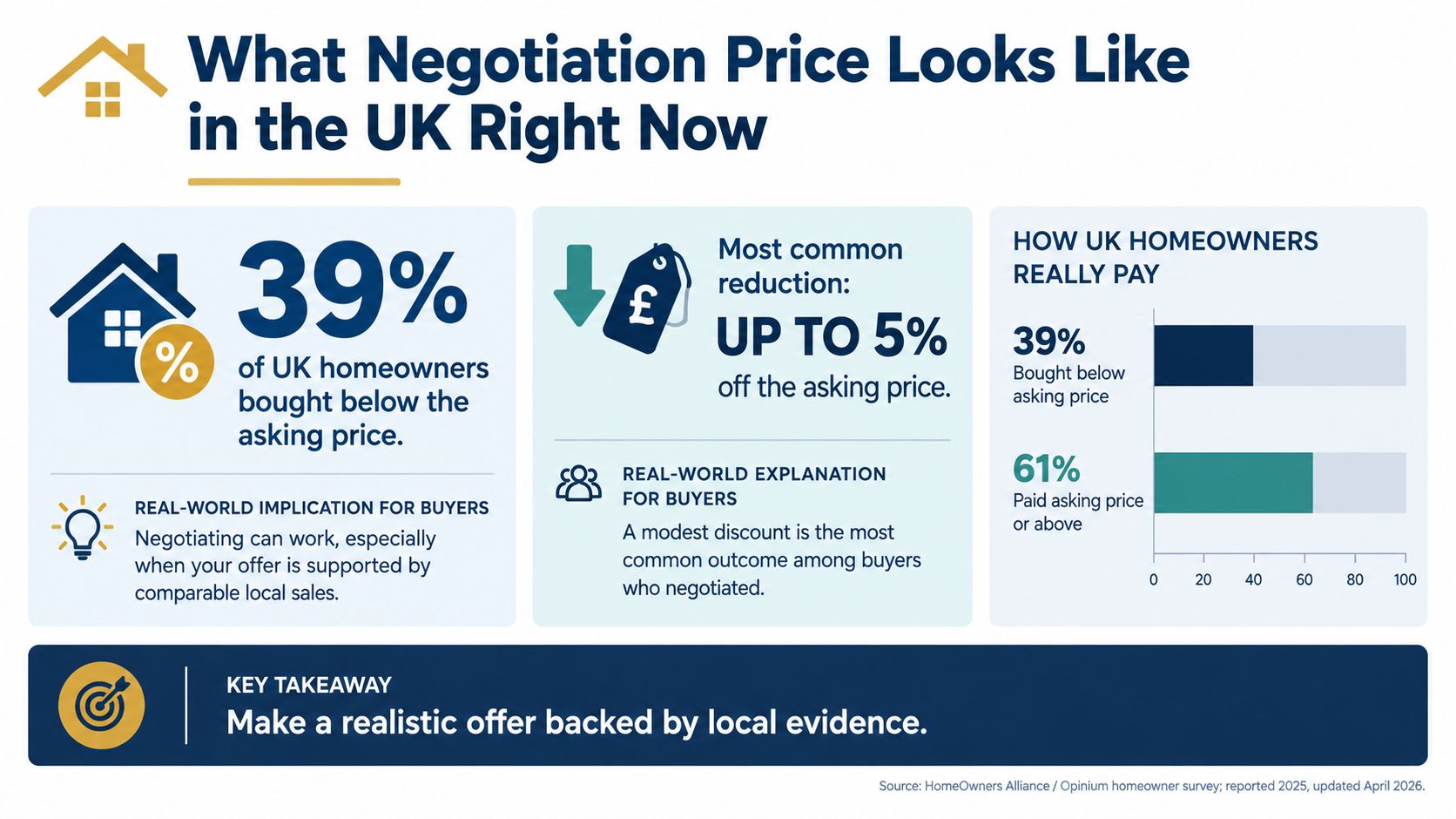
The same survey found that 39% paid the full asking price and 10% paid above it. Competing buyers can lead to best-and-final offers or sealed bids, so a buyer's negotiating position depends on more than the survey. First-time buyers were less likely to have bought below asking than previous homeowners, at 35% compared with 42%.
Those figures are a benchmark, not a rule for every purchase. Historical market conditions matter too. In England and Wales, Nationwide figures reported for 2023 showed that 55% of sellers achieved less than asking, while 24% sold above it. Buyers who negotiated achieved an average discount of 3.5%, compared with 5.1% in 2009, when prices were falling more sharply. The 2023 market comparison shows why there's no fixed negotiation percentage. Local demand, comparable sales, the seller's urgency and the defect's cost all affect what's credible.
Your offer is still negotiable before exchange
In England, an offer isn't binding until contracts are exchanged. GOV.UK says buyers can renegotiate a verbal offer before exchange, and an offer made subject to contract remains open to negotiation. A survey identifying significant problems can justify a price reduction. You can also ask the seller to do the work or withdraw if the findings change your decision, as explained in the GOV.UK home-buying guidance.
Don't confuse a mortgage valuation with a survey. A mortgage valuation is for the lender's purposes. An RICS HomeBuyer Report, now commonly referred to as an RICS Level 2 survey, assesses condition and flags issues that may need attention. A Level 3 Building Survey is generally the more suitable choice for an older, altered or visibly defective property. For a period terrace in Forest Hill or a converted flat in Peckham, choose the survey that fits the building, not the cheapest option by default.
Practical rule: Arrange the right survey as soon as your offer is accepted, while there's still time to act on the findings before exchange.
For another perspective on the conversation itself, see Marilynn Wolfe's advice on price negotiation. For your own purchase, start with the property, the survey evidence and local market facts, then decide what a fair revised offer looks like.
Building Your Evidence File Before You Speak to the Agent
Don't call the agent as soon as you see a worrying phrase in the survey. First, assemble the evidence and decide what you're asking the seller to do.
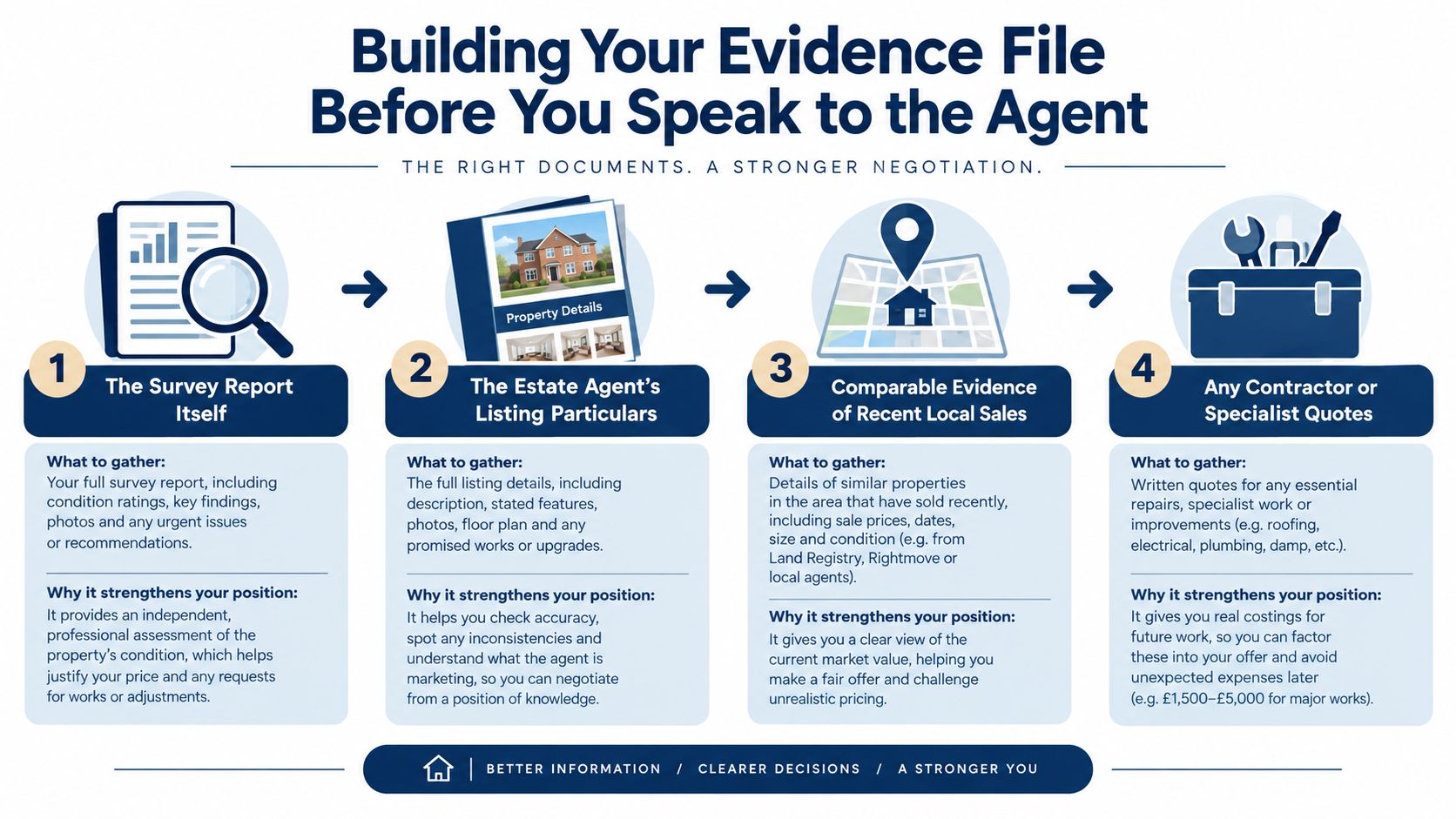
Start with the report. Then gather the estate agent's listing particulars, comparable evidence from recent completed sales and any contractor or specialist quotes obtained after the survey. The listing matters because a defect may already have been mentioned or reflected in the asking price. Check the seller's property information as well, so you're not presenting a known or previously disclosed issue as new evidence.
Put the findings into a one-page defect schedule:
- Defect: Name the issue, such as roof deterioration or damp.
- Severity: Record what the survey says about its effect on condition, safety or future repair liability.
- Remedy: Note the recommended work or further investigation.
- Cost: Separate confirmed quotations from provisional allowances.
- Timing: State whether the work needs doing before occupation or can wait.
- Other requirements: Flag specialist investigation, lender consent or other dependencies.
Buyers often weaken their own case here. Don't count the same underlying problem twice. Don't treat a rough estimate as a confirmed bill. And don't request a reduction for something that the asking price already accounts for.
Barclays research found that 30% of homeowners believed they'd missed potential savings by not negotiating, while 22% didn't know how to haggle and 17% feared losing the property. The average hoped-for reduction was 18%, but that was an expectation, not a typical achieved discount, as reported in the Barclays research coverage. A structured file is more useful than copying that hoped-for figure. If you're checking the asking price against local evidence, Corinthian's guide on how to value your house gives you a starting point. For a different market's practical negotiating perspective, you can also read Maple Ridge home price negotiation tips.
How to Read the Survey for Negotiation-Grade Defects
Not every survey comment belongs in your revised offer. Focus on defects that materially affect condition, safety, repair liability or value. A scuffed floor, tired decoration or dated kitchen is usually a weak reason to renegotiate unless the report identifies a more serious underlying problem.
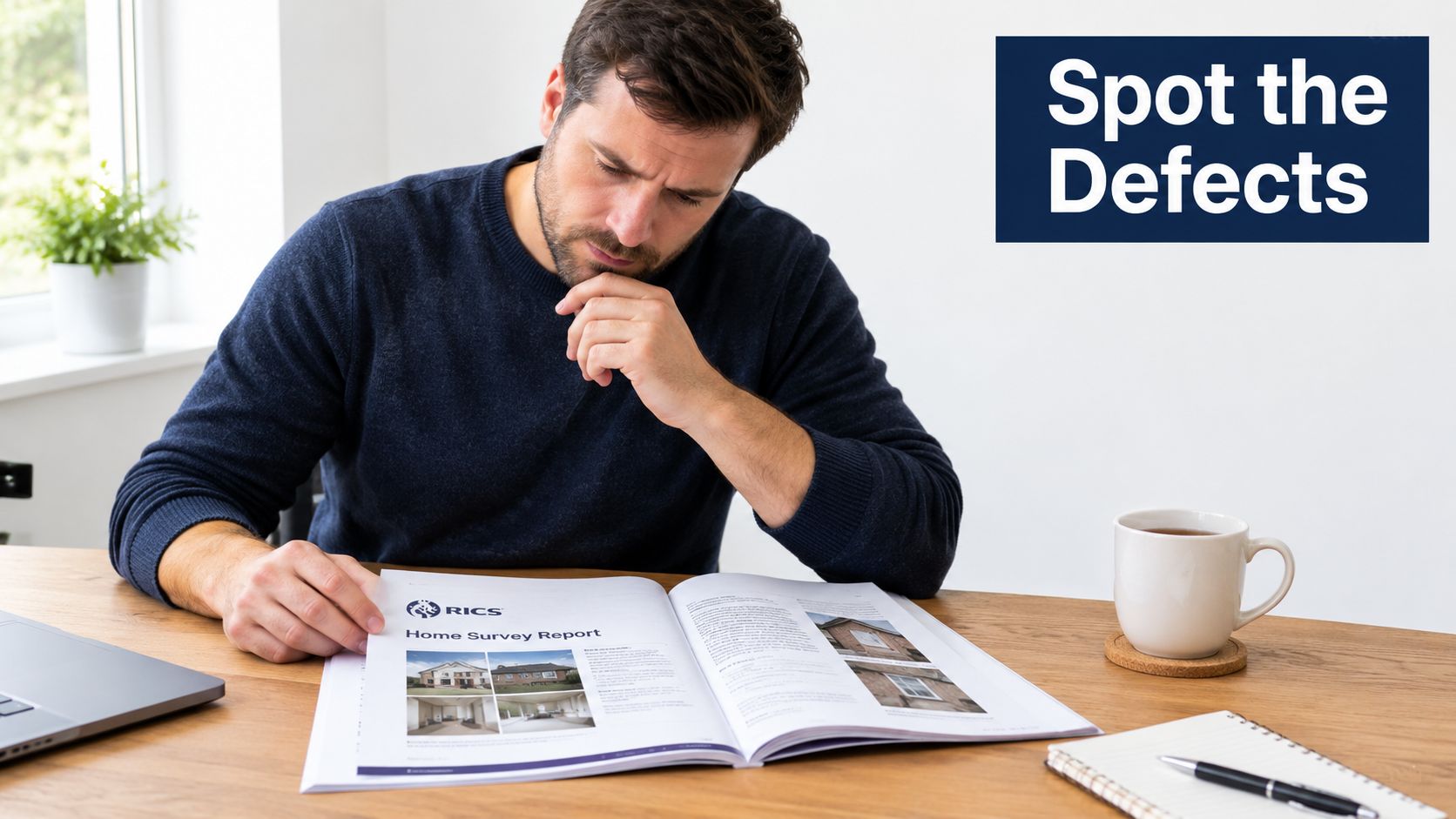
An RICS Level 2 report uses condition ratings to help you see which issues need attention. In practical terms, a serious finding that requires urgent repair or further investigation deserves priority over routine maintenance. Read the report's explanation, not just the rating. A rating identifies concern; it doesn't automatically tell you the price reduction to request.
For example, a note about a loose roof tile isn't the same as evidence of widespread roof failure. A damp patch might need investigation before anyone can say whether the cause is a plumbing leak, poor ventilation or a more extensive defect. In a Victorian house in Lewisham, pay attention to what the survey establishes about the roof, drainage, timber or movement. Don't turn an unconfirmed possibility into a claimed repair bill.
Connect the defect to a defensible figure
For each material finding, record the likely remedy and a realistic cost range. If the surveyor recommends a specialist inspection, get that advice before treating a possible cost as confirmed. Keep confirmed work separate from contingencies, and explain the difference to the seller.
RICS valuation guidance says a valuation should be supported by comparable evidence from recently completed sales of identical or similar properties, with full, accurate and verifiable information analysed and recorded. That's the right discipline for negotiation too: combine the defect, a realistic repair allowance and relevant completed-sale comparables. Don't base your figure on the asking price alone or apply an unsupported percentage. See the RICS valuation guidance for the importance of reliable comparable evidence.
A Level 2 survey may suit a conventional home in reasonable condition. For an older property, major alterations or visible defects, a Level 3 report gives a more detailed inspection. Corinthian's pages explain what to expect from an RICS HomeBuyer Survey and an RICS Building Survey. If you need help making sense of the findings, this guide to building survey reports explains how to work through them.
Scripts for the Estate Agent and the Seller
Keep the first call short. Tell the agent you've received the survey, identify the material findings and say you're preparing a documented revised offer. Don't accuse the seller of hiding anything or open with an arbitrary demand.
You could say:
“The survey has identified defects affecting the roof and damp. I'm getting the recommended costs checked and will send you a revised offer with the relevant report extracts and a defect schedule. I'm still keen to proceed, provided we can agree a fair way to deal with these findings.”
Once you have the supporting information, give the agent the revised figure and the reason for it. Attach the relevant pages of the survey, the defect schedule and any supporting quotation. You don't need to send the whole report if only specific findings are relevant.
A short covering note
“Following the survey, I'm revising my offer to [your proposed figure]. The survey identifies [specific defect], and the attached information sets out the recommended remedy and supporting cost evidence. I remain ready to proceed, and would appreciate a response by [date] so both sides can decide how to move forward.”
Use a clear response date that gives the seller a reasonable opportunity to consider the evidence. Keep the tone firm, not threatening. GOV.UK confirms that a significant survey finding can justify renegotiation before exchange, but the request should relate to the problem identified, not to a general desire to pay less. If the seller rejects the request, decide whether to accept the risk, propose another concession or withdraw. Don't bluff about walking away if you're not prepared to do it.
Choosing the Right Concession Instead of Always Asking for Money Off
A lower price is only one way to deal with a survey finding. Choose the concession that addresses the defect with the least uncertainty and the least disruption to the purchase.
| Concession | Best used when | Main risk to buyer |
|---|---|---|
| Price reduction | The defect and likely repair cost are well documented | The final repair bill may exceed the allowance |
| Seller completes the work | The work is clearly defined and the seller can arrange it before exchange | Quality or scope may be disputed |
| Indemnity insurance | A specific legal or historic issue can be addressed by an appropriate policy | It won't repair a physical defect or guarantee that the issue is harmless |
| Retention from the price | The defect needs monitoring or its cost can't yet be confirmed | The release terms and timing must be agreed clearly |
Ask for a price reduction when you can show what work is needed and why the cost is reasonable. If the seller already has a suitable contractor, having the work completed may be simpler, but agree the scope and evidence of completion before relying on it. A vague promise to “sort it out” isn't enough.
An indemnity policy may be relevant to a particular legal or historic issue, but it isn't a substitute for repairing a roof, investigating damp or checking structural movement. A retention may suit an unresolved cost, but the parties need clear written terms about the amount, who holds it and when it's released. Get your solicitor's advice on legal arrangements.
GOV.UK's selling guidance distinguishes significant findings from minor defects and confirms that a seller may agree to carry out work instead of reducing the price. It also recognises that a buyer may withdraw if a survey finding changes the decision to purchase. Read the GOV.UK guidance for sellers, then choose a remedy that deals with the actual problem. The right concession is the one you can verify and live with, not automatically the largest one.
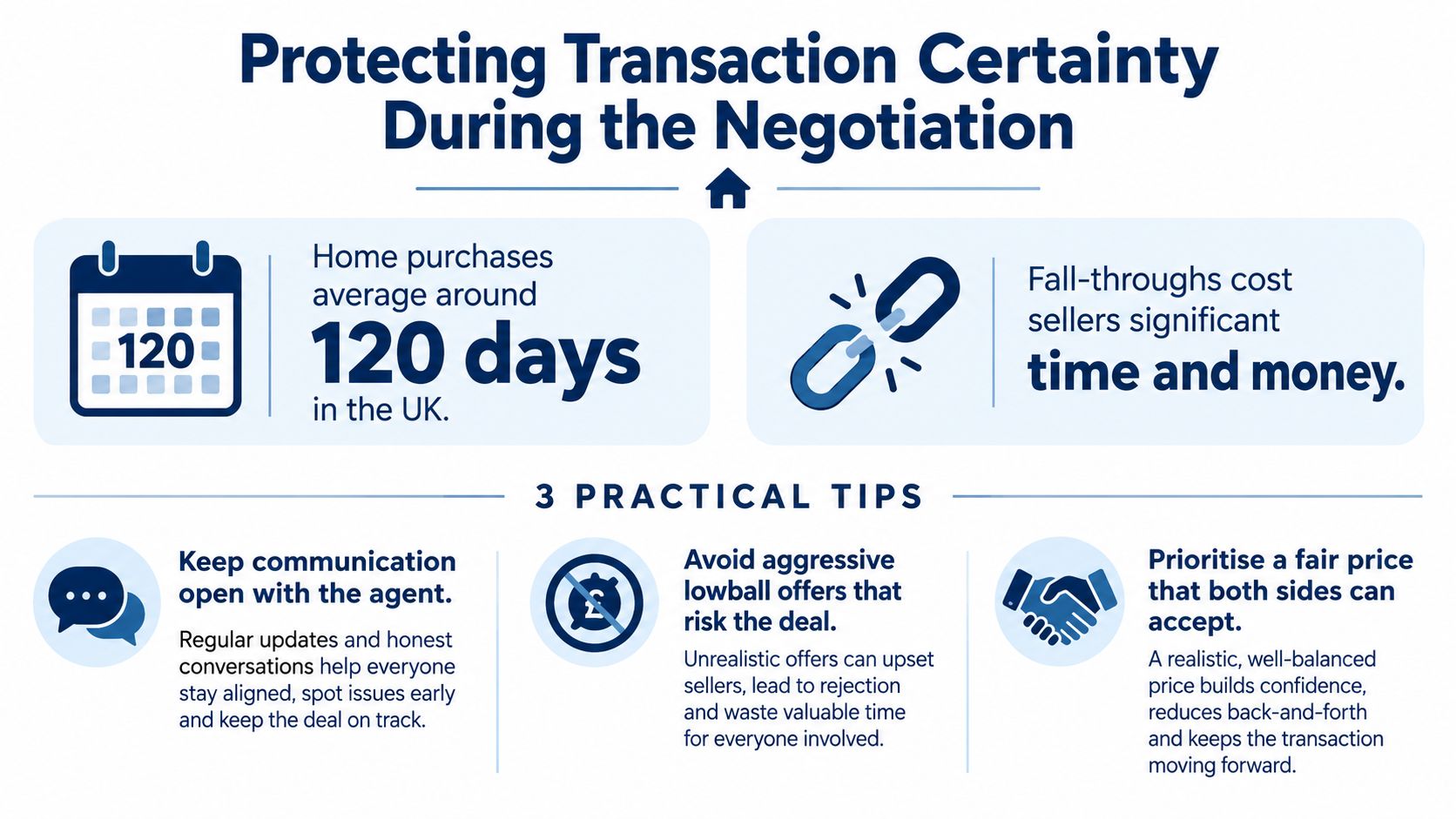
Protecting Transaction Certainty During the Negotiation
The largest possible discount isn't always the best result. A negotiation that delays or collapses the purchase can cost more than the repair allowance you were trying to secure.
UK government material says a home purchase can take around 120 days. It also reports that fall-throughs cost sellers about £400 million annually across England and Wales, while wider failed transactions may cost the economy up to £1.5 billion each year. The government's homebuying announcement gives the scale of the problem. For you, the point is practical: every extra round of negotiation can add delay and uncertainty.
Before you make a revised offer, compare the requested reduction with the likely repair cost and the consequences of losing time. Include temporary accommodation if relevant, mortgage and legal expenses, and the practical cost of finding another property. Don't assume that pressing harder is always worth it.
Market conditions also change. In March 2026, 68% of homes sold below their original asking price, with an average discount of 4.7%, narrower than 5.6% late in 2025. Those figures come from the market evidence described in the verified data, but they aren't a target for your purchase. Your local competition and the specific property still matter.
Decide what the evidence supports, then make one clear proposal. Keep communication open, explain the defect and cost, and show the seller you're still ready to proceed if you can reach a fair agreement.
Putting the Plan into Practice with an Independent Surveyor
Start by matching the survey to the building. A Level 2 survey may fit a conventional property in reasonable condition. Consider a Level 3 Building Survey for an older home, a property needing repair or a building you plan to alter. GOV.UK's Right to Buy guidance gives an independent survey cost range of £400 to £1,500 and describes a Building Survey as suitable for older homes, properties needing repair and buyers considering alterations. The guidance also says a standardised RICS Home Buyers' Survey and Valuation identifies significant defects and provides a guide to value. See the GOV.UK Right to Buy survey guidance.
Arrange the inspection as soon as your offer is accepted. That gives you time to understand the findings, obtain specialist advice where needed and make a reasoned proposal before exchange. Don't wait until the transaction is nearly complete to ask what a material defect might cost to put right.
An independent surveyor can help you distinguish a confirmed defect from a possibility, and explain what evidence would support a revised offer. Corinthian Surveyors London LTD is an independent firm of RICS Chartered Surveyors and Valuers based in Forest Hill, serving London and the Home Counties. Clive Thompson holds RICS and CABE qualifications and has over 30 years' experience in the built environment. To understand what to check before appointing a professional, read this guide to choosing a building surveyor.
If a survey has raised concerns, Corinthian Surveyors London LTD provides RICS HomeBuyer Surveys and Building Surveys to help you understand the findings and build an evidence-led negotiation. Call 0800 00 16 422 or visit Corinthian Surveyors London LTD to discuss the right survey for your property.