
How to Value Your House in London
You've checked your Ealing house on three property websites and received three different figures. That's normal. It doesn't mean the tools are useless, but it does mean one click isn't enough to establish what your home is worth.
A house has a market value at a particular date. It isn't a permanent fact or the seller's preferred asking price. London values depend on the property type, the street, the condition, the tenure and the evidence from comparable sales. The UK House Price Index measures completed transactions rather than asking prices, and its official data reaches back to 1968, with open-data downloads available from January 1995. The UK HPI methodology and data make it a useful long-run reference, but it won't inspect your roof or identify an unauthorised loft conversion.
This guide shows how to value your house using online estimates, sold-price evidence and sensible adjustments. It also explains when you need a formal RICS valuation that another party can rely on. If you're preparing a sale, a clear visual record of the rooms and features can help, and these walkthroughs for property listings are useful for organising that information.
Table of Contents
- What Valuing a House Actually Means
- The Three Main Ways a House Gets Valued
- Building a Comparables List That Holds Up
- Where Online Valuation Tools Help and Where They Fail
- Property, Legal and Tenure Factors That Move the Figure
- When to Commission a RICS Valuation or Survey
- A Practical Pre-Valuation Checklist for London Homeowners
What Valuing a House Actually Means
A valuation is a reasoned opinion of the price a property should achieve on a stated date, assuming a willing buyer and willing seller, proper marketing and no pressure on either party. That is the RICS market value basis, not a distressed-sale figure and not an estate agent's optimistic opening price. The RICS valuation framework sets out that definition and is the standard professional valuers work to.
The date matters. A valuation prepared for a sale in Forest Hill answers a different question from one prepared for probate in Lewisham, where the relevant date may be the date of death. A capital gains tax valuation may also require a historic date. You can't just take today's online estimate and apply it to an earlier event.
Four figures that people often confuse
- An online estimate uses recorded sales and property details such as bedrooms. Zoopla confirms that its estimates draw on HM Land Registry and Registers of Scotland data. It can provide a useful starting point, but it doesn't inspect the property.
- An estate agent appraisal is an opinion about likely saleability and pricing. It may reflect local buyer demand, the agent's instructions and the need to win your listing.
- A mortgage valuation protects the lender. MoneyHelper explains that it checks whether the property is worth roughly what the buyer plans to pay before mortgage approval. It isn't a building survey.
- A RICS Red Book valuation is a formal, purpose-specific opinion prepared by a regulated valuer. It may be required for probate, tax, matrimonial work, shared ownership or other situations where the figure must be defensible.
A mortgage valuation can therefore be lower than the agreed price. That doesn't automatically mean the building is defective. It means the lender's appointed valuer hasn't supported the price for lending purposes.
Practical rule: use an online estimate to start your research, sold comparables to test it and a formal RICS valuation when another person or organisation needs to rely on the figure.
The Three Main Ways a House Gets Valued
There are three recognised valuation approaches. For an ordinary London house, comparable evidence usually carries most of the weight. The other approaches matter when the property is unusual or produces income.
Comparable evidence
The comparable-sales approach asks a straightforward question: what have similar properties sold for? A valuer looks for transactions that are recent, verifiable, similar and consistent with local market practice. RICS guidance says the evidence should be thorough and supported by active-market demand. RICS guidance on valuation methods explains why a single loosely similar sale isn't enough.
For a Victorian terrace in Catford, that means comparing it with similar terraces nearby, not an average for the whole borough. A three-bedroom house on a quiet road in Brockley may not compare well with a similar-sized property beside a busy route. A period conversion in Dulwich needs different treatment from a purpose-built flat in Greenwich.
Replacement cost
The cost approach considers what it would cost to provide a similar property, allowing for age, condition and depreciation. It has less force where many comparable homes trade regularly, but it can help with a newly built home, an architect-designed property or a non-standard building.
A converted warehouse flat in Bermondsey, a house with unusual construction in Wandsworth or a property with very limited local sales evidence may need more than a simple price-per-bedroom comparison. The cost approach can provide a reasonableness check, although land value and buyer demand still matter.
Income evidence
The income approach looks at the value of the income a property can produce. It is rarely the main method for an owner-occupied house. It becomes more relevant where there is a self-contained annexe, a house in multiple occupation or another income-producing element.
| Method | How it works | Best for London houses when |
|---|---|---|
| Comparable sales | Compares the property with verified completed sales | Similar houses or flats have sold nearby |
| Replacement cost | Considers the cost of providing an equivalent property | The building is new, unusual or difficult to compare |
| Income approach | Relates value to sustainable rental income | The property has an annexe, HMO use or another income element |
A good valuation doesn't force one method onto every property. It starts with the strongest available evidence and uses the other approaches to test the conclusion. For a plain Victorian terrace in Lewisham, comparable sales should dominate. For a converted building in a conservation area, the valuer may need to apply more judgement. You can also see how agent appraisals differ from formal opinions in this guide to estate agent valuations.
Building a Comparables List That Holds Up
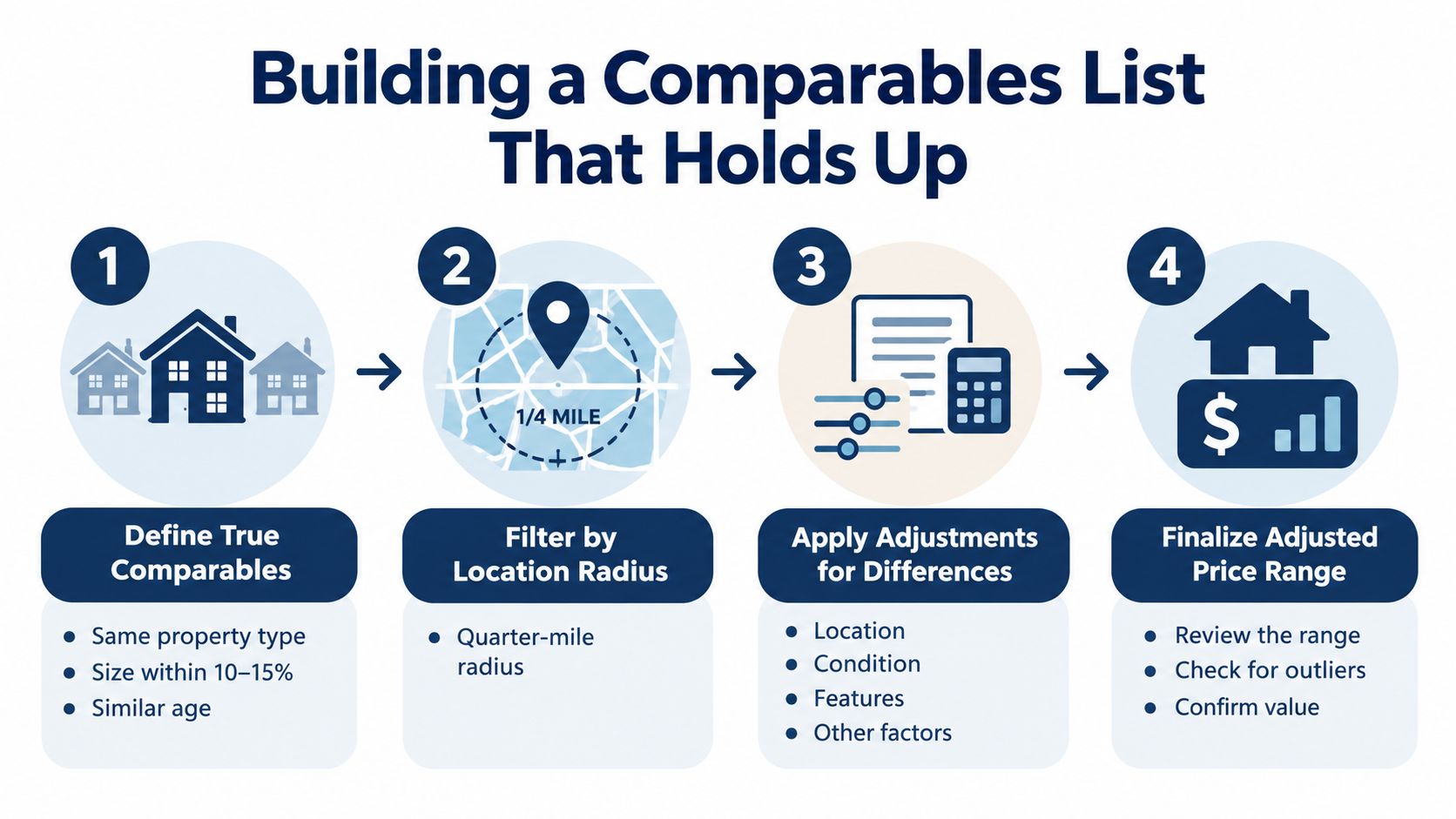
A Muswell Hill homeowner can get a misleading figure by comparing a three-bedroom terrace with every nearby three-bedroom sale. Start with the property itself. Record the tenure, property type, approximate floor area, bedrooms, outside space, parking, condition and unusual features. A useful comparable matches as many of these points as possible.
For a terrace or semi-detached house in Muswell Hill, search first on the same street or an adjoining street. Prefer completed sales that are recent, verifiable and properly exposed to the market. Exclude transactions between connected parties or sales completed without genuine market exposure. RICS valuation practice gives greater weight to evidence that is recent and sufficiently similar.
Four checks before you use a sale
- Check the address and property type. Confirm whether the sale involved a terrace, flat or semi-detached house. A broad postcode label is not enough.
- Check the size and layout. Floor area matters, but so does the arrangement of the rooms. A narrow three-bedroom house is not automatically comparable with a wider house containing the same number of bedrooms.
- Check the condition. A refurbished kitchen, sound roof and modern services can create a material difference between apparently similar homes.
- Check the transaction. Use Land Registry evidence and property-history details from Rightmove or Zoopla. Local agents can sometimes clarify sales that public listings describe poorly.
Suppose your Muswell Hill house is a three-bedroom terrace. One nearby sale has a smaller garden, while another has a poorer EPC and needs work. Do not average the three prices. Adjust each comparable for garden size, condition, floor area, parking, freehold or leasehold status and sale timing. Then identify where the adjusted indications overlap.
Garden size and EPC differences attract adjustments, but London has no fixed allowance. A smaller garden might justify £10,000 in one Muswell Hill sale and £25,000 in another. Derive the adjustment from local evidence and the specific properties. A standard rate will produce false precision.
The golden rule: build your conclusion from at least three solid comparables. One sale is an anecdote. Three or more properly checked sales form an argument.
For a second explanation of the evidence-gathering process, read this guide on checking a property's value in the UK.
This walkthrough shows the order for collecting title details, sold-price evidence and condition notes before comparing sales.
Where Online Valuation Tools Help and Where They Fail
Online valuation tools are useful because they give you a quick benchmark. They combine recorded sales with property characteristics such as bedrooms and location. Zoopla states that its estimate data comes from HM Land Registry and Registers of Scotland records, including previously sold prices and bedroom information.
That makes an online figure helpful for spotting an obvious outlier. If an agent suggests a price far above the broad evidence, the estimate gives you a reason to ask questions. It can also help when you're deciding whether a formal valuation is proportionate.
It cannot see what a surveyor sees. An automated model won't know that your top-floor flat has a short lease, that the roof leaks, that the kitchen was rebuilt last year or that the garden backs onto a busy road. It may also struggle with ex-local-authority flats, period conversions, properties in conservation areas and homes with unusual extensions.
London creates small-area problems
A street in Crystal Palace may trade differently from the next street because of slope, parking, views or noise. A converted flat in Camberwell may differ sharply from a purpose-built flat with similar floor area. In Bermondsey, a warehouse-style conversion cannot be judged only by postcode averages.
The same problem affects rent-based analysis. A map of economic rent data can provide useful context for local patterns, but it isn't a substitute for checking the actual property, tenure and legal restrictions.
| Tool | Strengths | Weaknesses in London |
|---|---|---|
| Zoopla estimate | Uses recorded sales and property details | Misses condition, alterations and micro-location issues |
| Rightmove history | Helps compare listing and sale history | Asking prices aren't completed transactions |
| Land Registry data | Provides official sold-price evidence | Doesn't describe condition or improvements |
| Halifax estimate | Gives a broad market benchmark | National or regional modelling can miss a specific street |
Treat an AVM as a broad range rather than a precise answer. The exact range depends on the tool and the property, so don't attach an invented tolerance to it. Compare the figure with verified sales, then decide whether the remaining uncertainty matters enough to commission a valuer.
Property, Legal and Tenure Factors That Move the Figure
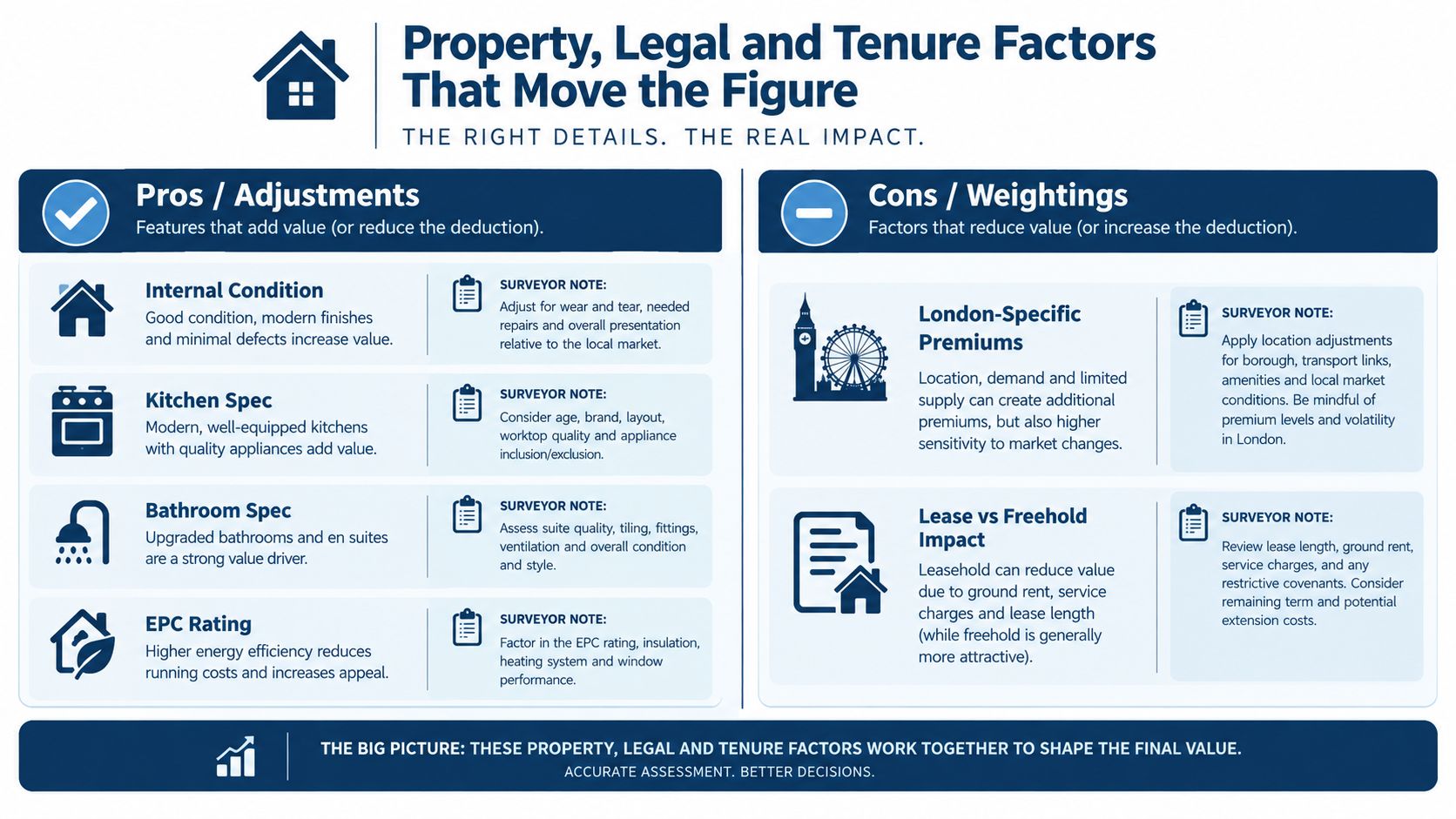
Two houses can sell for different sums even when they share a postcode, bedroom count and approximate size. A valuer adjusts the comparable evidence for the things buyers can see, the things solicitors must verify and the obligations attached to the property.
Physical condition
Condition affects both price and buyer confidence. A damp basement in a Victorian terrace in Forest Hill, timber decay around a bay window in Lewisham or movement cracking in a property near clay soils needs proper investigation. A clean coat of paint won't cure defective pointing, roof spread or an overloaded rear extension.
Look at:
- Internal quality: kitchens, bathrooms, flooring, decoration and visible maintenance.
- Structure and envelope: roof coverings, gutters, chimneys, pointing, windows and signs of subsidence or structural movement.
- Useable space: floor area, layout, ceiling height, natural light, garden, balcony, garage and parking.
- Energy performance: EPC rating, insulation, heating system and evidence of energy improvements.
Don't apply a standard percentage adjustment to these items. The effect depends on the cost, urgency and buyer reaction. A modest cosmetic issue is not equivalent to a roof replacement or a serious defect.
Legal and planning matters
Planning permission and building regulation approvals matter where an owner has built a loft conversion, side return or basement. Check conservation area controls and Article 4 directions, particularly in areas such as Blackheath, Dulwich and parts of Greenwich. Listed status can restrict alterations and increase maintenance requirements.
For flats, examine service charge accounts, planned major works and any Section 20 consultation. Cladding or EWS1 concerns can affect mortgageability and buyer demand. Japanese knotweed, access restrictions, rights of way and restrictive covenants must also be considered where relevant.
Tenure
Freehold and leasehold properties aren't interchangeable. For a leasehold flat, check the unexpired term, ground rent, service charge, repair obligations and whether there is a share of freehold. Lease length can affect value and lending, particularly as it approaches important thresholds. A valuer must consider the actual lease, not just label the property a “flat”.
Online tools fail most visibly here. They may recognise the address and bedroom count while missing a short lease, escalating ground rent or a large planned works bill. Those details need documentary evidence and professional judgement.
When to Commission a RICS Valuation or Survey
Pay for a professional valuation when the figure has a legal, tax, lending or negotiation consequence. An online estimate is not suitable for probate, inheritance tax, matrimonial separation or capital gains tax work. It also isn't the right document for shared ownership staircasing or a formal dispute.
A RICS Red Book valuation is prepared for a stated purpose and valuation date by a regulated surveyor. A survey is different. A Level 2 Homebuyer Survey or Level 3 Building Survey examines condition for a buyer. It may discuss defects that affect value, but it isn't automatically a formal market valuation for tax or probate.
Match the report to the decision
| Report type | Best for | Indicative cost in London | Typical turnaround |
|---|---|---|---|
| RICS Homebuyer Survey, Level 2 | Conventional flats and houses being purchased | Depends on property and scope | Depends on access and instruction |
| RICS Building Survey, Level 3 | Older, altered, listed or unusual homes | Depends on property and scope | Depends on access and instruction |
| RICS valuation report | Probate, tax, matrimonial, lending or formal negotiation | Depends on purpose and property | Depends on documents and inspection |
The brief fee ranges sometimes quoted for London are £350 to £700 for a Level 2 survey, £500 to £1,200 for a Level 3 survey and £400 to £900 for a standalone valuation. These figures aren't verified in the available official data, so treat them only as market examples, not promises or published Corinthian prices. A responsible firm quotes after considering the property, purpose and required report.
Lenders usually arrange their own valuation after an offer is accepted. MoneyHelper says the lender valuation may cost £150 to £800, depending on property value, although the lender often pays it. That inspection protects the loan and doesn't replace your own survey.
Prepare the title, lease, planning approvals, building regulation certificates, EPC, guarantees and details of alterations before instruction. Tell the surveyor the purpose and valuation date at the outset. Corinthian Surveyors London LTD is an independent RICS Chartered Surveyors and Valuers practice, with Clive Thompson holding RICS and CABE qualifications and more than 30 years of built-environment experience. The practice has no ties to lenders, estate agents or developers, which matters when you need an impartial opinion. Its guide to RICS property valuations sets out the distinction in practical terms.
A Practical Pre-Valuation Checklist for London Homeowners
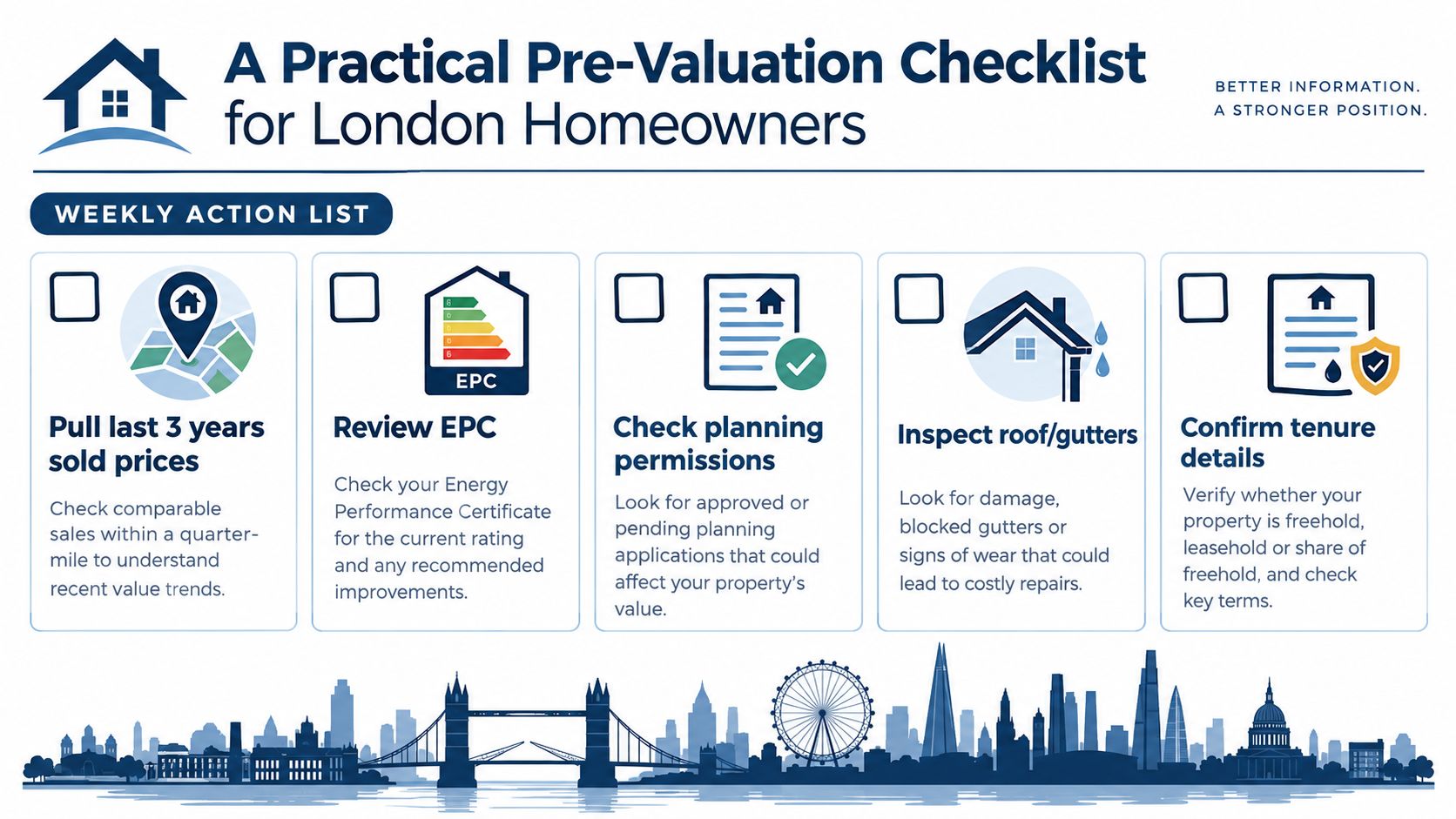
You can improve the quality of your valuation evidence in a weekend. You can't manufacture market demand, but you can remove avoidable uncertainty and give the valuer the documents needed to reach a conclusion efficiently.
Paperwork
Create one folder, digital or printed, containing:
- Title and tenure: title information, lease, share-of-freehold documents and any restrictions.
- Alterations: planning permissions, lawful development certificates, building regulation approvals and completion certificates.
- Flat information: service charge statements, ground rent demands, major works notices and managing-agent correspondence.
- Property records: EPC, guarantees, damp-treatment paperwork, roof invoices and structural engineer reports.
If you can't prove an extension was approved, don't assume the buyer or valuer will ignore it. Missing paperwork can delay a sale and make a property harder to compare with properly documented homes.
Property
Walk through the building as if you were buying it. Check the roof from ground level, clear blocked gutters, repair minor leaks and deal with obvious defective sealant. Don't conceal damp, movement cracks or timber decay. Record them and arrange proper advice.
Inside, remove clutter so rooms and storage areas can be understood. Touch up scuffed decoration, clean windows and make the garden presentable. If you claim off-street parking, make the access and title position clear. A tidy presentation helps buyers, but it doesn't replace a condition inspection.
Pricing
Pull recent sold-price evidence from the Land Registry and property-history services. Focus on closely matching homes in the immediate area rather than averaging all sales in a borough. The HM Land Registry browser shows that even an all-property-type national index moved from 103.7 in August 2025 to 104.3 in May 2026, so timing should never be ignored. The official UK HPI data browser is useful for understanding the wider direction, not for replacing local comparables.
Ask at least three estate agents for an in-home appraisal. Give each the same information and ask them to explain which completed sales support the figure. If the valuations differ, compare the evidence rather than choosing the highest number.
People and purpose
Decide whether you need an informal sale price, a lender figure, a condition survey or a formal valuation. Confirm the valuation date in writing. For probate, tax and matrimonial work, the date and purpose are not administrative details. They define the assignment.
A professional valuer may also need access to the loft, cellar, garden, communal areas and plant rooms. Arrange that before the appointment. If the property is in a conservation area, listed or affected by planned works, disclose it early.
Questions homeowners usually ask
How often should a London house be revalued?
Revalue it when the purpose changes, the market has moved materially or you're making a major financial decision. The UK average was £273,000 in July 2026, with annual growth of 1.4%, while England's average was £293,000 and the UK monthly rise was 0.7%, according to the June 2026 UK House Price Index release. Those national figures don't establish the value of a house in Bromley, Peckham or Ealing. Use fresh local evidence for a sale and a formal date-specific valuation for legal or tax work.
Why can two estate agents value the same property ten per cent apart?
They may select different comparables, make different assumptions about condition or use different pricing strategies. One may quote a figure intended to win the instruction, while another may recommend a price based on quicker saleability. Ask both agents for recent completed sales and challenge unsupported adjustments.
Can a low survey valuation help a buyer renegotiate?
Yes, it can provide evidence for a price discussion, particularly where the lender also reduces the amount it will advance. The buyer should check the valuation basis, identify any factual errors and present stronger comparable evidence if available. The seller doesn't have to accept the reduction, but ignoring a credible shortfall can jeopardise the transaction.
What does a full RICS Level 2 or Level 3 survey cost in Greater London?
There is no reliable single fee. It depends on property size, age, construction, location, access and the report required. A Level 2 survey suits a conventional home in reasonable condition. A Level 3 Building Survey is more appropriate for an older, altered, listed or unusual property. Ask for a written scope and quote rather than choosing on a headline price.
Corinthian Surveyors London LTD provides independent market valuations, probate, matrimonial separation, capital gains tax and shared ownership valuations, alongside RICS Level 2 and Level 3 surveys across London and the South East. For a clear view of what your property is worth and why, call 0800 00 16 422 or visit Corinthian Surveyors London LTD with the property address, valuation purpose and required date.