
How to Choose a Building Surveyor in London
You've found a London property you like, the lender has arranged a valuation and the estate agent is pressing for an answer. Then someone mentions a survey. The question isn't whether you should spend money inspecting a property before committing to it. The question is how to choose a building surveyor who will identify the risks, explain them plainly and stand behind the work.
Treat the appointment as a procurement decision, not a quick price comparison. Ask for qualifications, regulation, insurance, written terms and a clear route for complaints before you pay. That approach matters in Forest Hill, Bermondsey, Bromley and every other part of London because a survey is only useful when the person delivering it has the right competence and accountability.
Table of Contents
- Why Your Lender Valuation Is Not Enough
- Match the Survey Level to the Property
- Questions to Ask Before You Instruct
- How to Compare Quotes the Right Way
- Insurance, Independence and Local Experience
- Red Flags and Common Traps
- FAQs on Choosing a Building Surveyor
Why Your Lender Valuation Is Not Enough
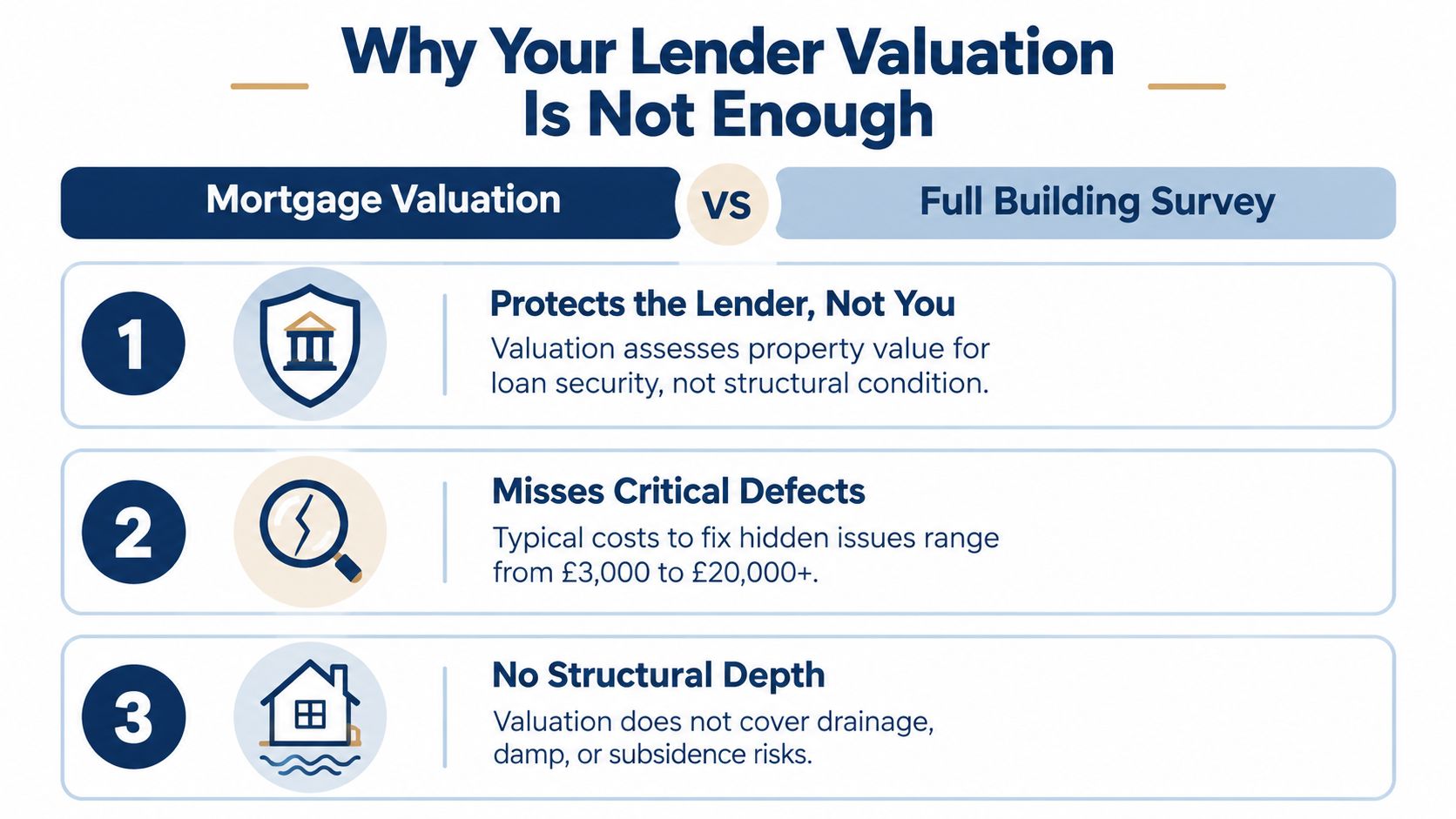
A buyer often discovers the difference too late. The mortgage lender's valuation has come back, the purchase proceeds and a damp patch appears behind a cupboard. Then the buyer learns that the lender wanted confirmation that the property provided suitable security for the loan. The valuation wasn't a detailed inspection for the buyer's benefit.
A buyer-commissioned survey has a different job. It should help you decide whether to proceed, renegotiate the price or walk away before exchange. It should identify visible defects, explain their likely significance and point out where specialist investigation is needed. A valuation and a survey aren't interchangeable.
The distinction matters in a Victorian terrace in Lewisham just as much as it does in a converted flat in Lambeth. The surveyor may need to consider damp, timber decay, roof defects, cracking, drainage, alterations and signs of movement. A lender's valuation does not provide that level of technical scrutiny.
Check the person and the firm
The first check is the individual surveyor. Look for AssocRICS, MRICS or FRICS membership, then verify the membership on the RICS public register. These designations show the surveyor's professional standing, but they don't automatically prove that the firm itself is regulated.
Ask whether the company is RICS-regulated, not merely whether it employs an RICS member. RICS-regulated firms must operate a complaints-handling procedure, provide access to an alternative-dispute-resolution provider and maintain professional indemnity insurance that meets RICS minimum standards. Those protections give you a documented route if the service falls short.
RICS introduced the RICS Home Survey Standard on 1 March 2021. It created a more consistent framework for residential reports and established mandatory requirements for RICS members and regulated firms delivering home surveys in the UK. That means you should ask which exact RICS service is being provided, rather than accepting a vague promise of a “full survey”. RICS' building surveying standards set out the framework behind those services.
CABE qualifications can add useful technical depth, particularly where a property involves conservation, unusual construction or building work. For a listed house in Greenwich or a period property in Blackheath, ask about experience with lime mortar, lath and plaster, original roof structures and conservation constraints.
Practical rule: a logo on a website proves very little. Ask for the individual's qualification, the firm's regulation status and the insurance position in writing.
Look for accountability, not just a polished report
RICS guidance requires the surveyor delivering a Home Survey to have the skills, knowledge and experience appropriate to the property. It also requires the purpose, outcome and limitations of the survey to be documented. A good appointment therefore starts with a written scope, not a casual promise that the surveyor will “have a look around”.
Ask who will physically inspect the property. Confirm which areas will be inaccessible. Establish whether services, roofs, drainage, communal areas and outbuildings are included or excluded. If the property is a flat, clarify how the surveyor will deal with the wider building and any visible defects affecting shared parts.
The English Housing Survey for 2023–24 estimated that bringing a non-decent dwelling up to the Decent Homes Standard cost an average of £10,975, with a median cost of £5,397. The difference shows how a smaller group of properties with expensive defects can push the average upwards, which is why early identification matters to a buyer. The RICS home surveys consumer guide explains the practical relevance of condition, defects and repair decisions.
If you're organising your wider purchase, keep a separate checklist for the legal and practical tasks involved in buying. The essential steps for first-time buyers can help you keep those tasks separate from the technical survey decision. For the specific gap between a lender's valuation and a buyer's survey, see this explanation of mortgage surveyors and valuation.
Match the Survey Level to the Property
Choose the survey level from the building, not from the buyer's budget. RICS provides three principal levels, and each has a defined purpose.
A modern, conventional flat in Bermondsey that appears to be in reasonable condition may suit Level 2. A Victorian terrace in Forest Hill with an altered rear extension, cracking or visible damp deserves closer consideration. A converted warehouse in Peckham, a listed house in Dulwich or a 1930s semi in Bromley may need Level 3 because construction, alterations and defects require more detailed analysis.
| RICS Level | Best Suited To | Report Focus |
|---|---|---|
| Level 1 | A property needing a basic overview | Basic description of condition, risks and urgent defects |
| Level 2 | Conventional properties in reasonable condition with a simple form and layout | A defined physical inspection and structured report, with valuation where selected |
| Level 3 | Older, extended, listed, unusual or visibly defective properties | Detailed analysis of defects, repairs and maintenance |
Level 1 is a starting point. It gives a basic description of condition, risks and urgent defects, but it isn't the right choice where you need detailed advice about repair strategy or concealed risks.
Level 2, formerly associated with the Homebuyer Report, is generally suitable for conventional properties in reasonable condition. It's also split into “survey only” and “survey and valuation” options, so confirm which version you're buying.
Level 3, formerly known as the RICS Building Survey, is the most detailed option. It's the sensible choice for older London homes, substantial alterations, unusual construction and properties showing signs of disrepair. This comparison of a Homebuyer Report and Building Survey explains why the label alone doesn't establish the scope.
Questions to Ask Before You Instruct
Use the first phone call to test the surveyor's process. Don't ask only, “How much is it?” Ask who will inspect the property, what the report will cover and what happens when the inspection reveals a problem outside the agreed scope.

Ask these questions before authorising the work:
- Who will inspect the property? Get the person's name, qualifications and relevant experience.
- Which RICS level is being provided? Confirm the exact service, not just “a building survey”.
- What's included? Ask about roof coverings, accessible loft areas, damp, timber, movement, drainage, services, boundaries and alterations.
- What's excluded? Inaccessible spaces, concealed defects and specialist tests must be identified clearly.
- Is valuation included? Level 2 may be offered as survey only or survey and valuation.
- Is reinstatement cost included? This figure is intended to inform buildings insurance and is a separate report output where provided.
- What happens if a defect needs specialist testing? Ask when the surveyor will recommend a structural, damp, drainage, electrical or asbestos specialist.
- When will the report arrive? Get the turnaround in writing, especially if exchange or renegotiation deadlines are approaching.
- How do complaints work? Request the complaints procedure and redress arrangements before paying.
RICS guidance expects terms of engagement to record the survey's purpose, outcome and limitations. The document should also state the inspection scope, report format, fee, turnaround, liability provisions and any agreed specialist investigations.
A useful comparison is the process of reviewing how to compare legal fees. The same principle applies here. Compare what you receive for the fee, not just the headline figure.
The questions to ask before instructing a surveyor give you a practical script for that conversation.
Watch for whether the surveyor distinguishes between an observed defect and an assumption. A non-invasive inspection can't prove that concealed defects don't exist. It should explain restricted access and recommend next action where visibility is limited.
How to Compare Quotes the Right Way
Two survey quotes can look similar while describing very different services. Put them side by side and compare the actual deliverables.
Start with the RICS level. A Level 1 report and a Level 3 Building Survey aren't equivalent products, so a lower fee may reflect a narrower inspection. Then check the property details used for the quote, including its age, size, construction, alterations and location.
Look for these line items:
- Inspection level: Confirm whether the quote is for Level 1, Level 2 or Level 3.
- Valuation: Establish whether a market valuation is included or excluded.
- Reinstatement cost: Check whether the report includes an opinion intended to inform buildings insurance.
- Specialist follow-up: Ask whether arranging tests or investigations is included, agreed separately or outside the appointment.
- Report timing: Compare promised delivery dates, not vague references to a “quick turnaround”.
- Liability and exclusions: Read the terms for access restrictions, services and concealed areas.
A quote should tell you what the surveyor will do and what they won't do. A report with fewer pages isn't necessarily poor, and a long report isn't automatically useful. The test is whether it gives you a decision-ready schedule of material defects, likely consequences, urgency, limitations and recommended referrals.
Estate agent recommendations deserve a careful look. The agent may be helpful, but you should still confirm that the surveyor is independent and has no conflict connected with the sale. You're commissioning the report to protect your decision, not to keep the transaction moving.
Insurance, Independence and Local Experience
Professional indemnity insurance matters because surveying involves professional judgement. Ask what protection applies to the work and whether the firm can confirm its cover. RICS-regulated firms must maintain professional indemnity insurance meeting RICS minimum standards.
Valuation work has an additional check. If you're commissioning a market valuation, probate valuation or another formal valuation, confirm that the surveyor and firm meet the requirements of the RICS Valuer Registration scheme. A building condition report and a formal valuation are related services, but they aren't the same assignment.
Independence matters just as much. A surveyor with no ties to a lender, estate agent or developer can report the property's condition without having to protect another party's commercial process. That doesn't make every independent surveyor suitable, but it removes an obvious conflict and leaves the buyer with a clearer line of accountability.
Local experience changes the quality of the conversation. A surveyor who regularly inspects Victorian terraces in Lewisham will recognise common issues such as failed pointing, damp bridging, roof spread, chimney defects and poorly executed rear alterations. A surveyor working around Lambeth and Southwark may see recurring problems in converted flats, including unclear maintenance responsibilities, altered layouts and defects affecting shared structures.
The same principle applies in Bromley and Beckenham, where 1930s semis can present different issues from Forest Hill terraces. Ask for relevant experience in the borough and with the construction type, not just a general statement that the firm covers London.
Red Flags and Common Traps
Some warning signs look reassuring because they make the buying process feel easy. A lender panel, an estate agent referral and a discounted report can all save time. None of them removes your responsibility to check who is inspecting the property and what protection you have if the report is wrong.
The panel recommendation
A mortgage broker or estate agent may suggest a panel surveyor. You can consider the recommendation, but don't treat it as an independent endorsement. Ask whether the surveyor has any relationship with the lender, agent or developer, then compare the appointment terms with an independent firm.
A report offered without a named surveyor is a serious concern. You need to know who will attend the property, what qualifications they hold and whether they have experience with a Victorian conversion in Peckham, a warehouse flat in Bermondsey or a listed house in Greenwich.
The vague promise
“Report shortly after inspection” isn't a deadline. If the report arrives after you've exchanged contracts, it has lost much of its negotiating value. Agree the expected delivery date in writing and confirm what happens if access problems or specialist referrals delay the work.
A missing scope is just as problematic. If the terms don't say whether the roof, drainage, services, communal areas or reinstatement cost are included, you can't compare the fee with another quote properly.
The clean report
A clean-looking report doesn't always mean a risk-free property. Read a redacted sample before instructing. Look for clear distinctions between:
- Observed condition: What the surveyor saw.
- Assumed condition: What couldn't be verified because access or visibility was restricted.
- Urgency: What needs attention immediately, soon or as routine maintenance.
- Consequence: What the defect may affect, such as structure, weather-tightness, safety or future cost.
- Next action: Whether you need a specialist inspection, documents or further testing.
RICS building-surveyor service guidance contemplates arranging specialist investigations and tests where agreed, then reporting recommendations for rectification. A surveyor who escalates intelligently is more useful than one who just fills in boxes.
The English Housing Survey figures make the point. For 2023–24, the estimated average cost of bringing a non-decent dwelling up to the Decent Homes Standard was £10,975, while the median was £5,397. Those figures come from the RICS consumer guide on home surveys, and they show why the financial consequence of missed defects can vary sharply.
Save this pre-instruction checklist
- Verify membership: Confirm AssocRICS, MRICS or FRICS status on the RICS register.
- Verify regulation: Check that the firm, not merely an employee, is RICS-regulated.
- Check specialist credentials: Ask about CABE or other relevant qualifications for conservation or unusual construction.
- Match the level: Agree Level 1, Level 2 or Level 3 against the property's age, construction and condition.
- Secure the scope: Get inclusions, exclusions and access limitations in writing.
- Confirm outputs: Record the position on valuation and reinstatement cost.
- Agree timing: Obtain the report deadline in writing.
- Read a sample: Request a redacted report or a written explanation of defect escalation.
- Check protection: Confirm professional indemnity insurance and the complaints route.
- Check experience: Ask about comparable London properties and the relevant borough.
The cheapest meaningful differentiator isn't a low fee. It's a clear written route for correcting errors. Corinthian Surveyors London LTD is an independent Forest Hill practice led by Clive Thompson, who holds RICS and CABE qualifications and has over 30 years of experience in the built environment. The firm is RICS-regulated, belongs to the RICS Valuers Registration Scheme and is insured by Royal Sun Alliance. For a property-specific discussion, call 0800 00 16 422.
FAQs on Choosing a Building Surveyor
Do I still need a survey if I'm getting a mortgage valuation?
Yes. The mortgage valuation protects the lender's lending decision. It doesn't give you a detailed account of damp, timber decay, roof defects, drainage, cracking, alterations or other condition risks.
Choose the survey level according to the property. A conventional flat in reasonable condition may suit Level 2, while an older, extended, listed or visibly defective property is more likely to justify Level 3.
Can I use the surveyor recommended by my estate agent?
You can, but check independence before instructing. Ask whether the surveyor has ties to the agent, lender or developer, who will inspect the property and what complaints and redress arrangements apply.
A recommendation is not a substitute for checking RICS membership, firm regulation, professional indemnity insurance and experience with the type of London property you're buying.
What happens if the surveyor misses an important defect?
Start with the written terms and complaints procedure. The survey should distinguish what was observed from what was inaccessible or assumed, and it should identify when specialist investigation is needed.
RICS-regulated firms must operate a complaints-handling procedure and provide access to an alternative-dispute-resolution provider. The Financial Ombudsman notes that it usually can't handle complaints about independent surveyors and may direct consumers to RICS instead, so confirm the correct route before commissioning.
Technical competence also matters beyond the report itself. Anyone arranging building work should understand the relevant compliance responsibilities, and resources on construction compliance training can help explain why specialist follow-up shouldn't be treated as an optional extra.
How quickly should a building survey report arrive?
Agree the turnaround before paying and put it in the terms of engagement. The right deadline depends on access, the property and the agreed service, but a vague promise isn't enough when you may need to renegotiate before exchange.
Ask what happens if the surveyor finds a defect requiring structural, damp, drainage, electrical or asbestos investigation. The report should either explain the limitation and recommend the next professional or set out how that additional work will be arranged.
Corinthian Surveyors London LTD provides independent RICS Level 1, Level 2 and Level 3 surveys, valuations and defect advice for residential properties across London and the surrounding areas. Visit Corinthian Surveyors London LTD to discuss the property type, agree the appropriate scope and obtain a quote based on the actual inspection required.