
How Does a Party Wall Agreement Work in London
Most advice about party wall agreements starts in the wrong place. It tells you to speak politely to the neighbour about a shared wall, as though an informal conversation is enough. In London, that can be a costly mistake. How does a party wall agreement work? It works through a statutory notice, a defined response period and, where there is dissent, a formal surveyor process under the Party Wall etc. Act 1996 explanatory booklet.
The main risk often isn't a cracked wall. It's a stopped site, an injunction, arguments over access and financing pressure while builders wait. If you're extending a terrace in Wandsworth, excavating a basement in Clapham or carrying out structural work in a converted house in Islington, treat the Act as a project-control measure, not a piece of neighbourly paperwork.
Table of Contents
- Why the Party Wall Act Matters for London Homeowners
- Which Building Works Trigger the Act
- Serving Notice and the 14-Day Response Window
- Appointing Surveyors and the Party Wall Award
- Real Timelines and Costs for a Typical London Project
- Disputes, Injunctions and How Conflicts Get Resolved
- Practical Advice for Building Owners and Adjoining Owners
Why the Party Wall Act Matters for London Homeowners
The Party Wall etc. Act 1996 is the core legal framework for qualifying party wall work in England and Wales. It received Royal Assent on 18 July 1996 and came into force on 1 July 1997, but it doesn't apply in Scotland or Northern Ireland. The framework has therefore been in force for nearly 29 years since 1997, and it remains highly relevant to the way London building projects are planned. Government guidance confirms the Act's scope and procedure.
The Act covers more than a shared brick wall between two terraced houses. It can apply to party walls, party structures, boundary walls and excavations near neighbouring buildings. A basement dig, a side-return extension or work involving beams in a party wall can all raise different statutory issues.
The real consequence of skipping the process
Suppose a homeowner in Wandsworth starts a rear extension to keep the contractor moving. The drawings look straightforward, the neighbour appears friendly and nobody wants to lose time discussing notices. Then the neighbour's solicitor sends a letter stating that the work falls within the Act and must stop.
The neighbour can seek an injunction where qualifying work starts before the statutory process is resolved. That can halt the build while the notice and surveyor procedure catches up. The project may also face professional fees, contractor claims, redesign discussions and pressure from a lender or bridging arrangement. The UK government explains the injunction risk when work begins before the process is resolved.
Practical rule: A friendly conversation is useful, but it isn't a substitute for written notice and a valid statutory route.
This is why I advise clients to involve a party wall surveyor while the design is still being developed. The surveyor can identify whether the proposed excavation, wall alteration or boundary work is caught by the Act and can help align the notice process with the construction programme. Resources such as homeowner protection services overview can also help homeowners think more broadly about protecting a project, but party wall compliance still needs property-specific surveying advice.
Which Building Works Trigger the Act
Start with the work, not the label given to the project. A “loft conversion” or “extension” doesn't automatically tell you whether the Act applies. The structural details, position of the work and relationship with the adjoining building determine the answer.
Work on the boundary or party wall
Section 1 deals with building a new wall on or astride the line of junction. A common London example is a side-return kitchen extension behind a Victorian terrace in Lewisham, Brockley or Peckham. If the new wall is built on the boundary line, the adjoining owner must receive the appropriate written notice.
Section 2 covers work to an existing party wall or party structure. This can include cutting into the wall for steel beams, raising it, underpinning it or carrying out other structural alterations. Basement work in Clapham, Brixton and Islington often brings this issue into focus because the design may rely on the party wall or its foundations.
Section 6 concerns adjacent excavation. The statutory trigger is measurement-based. It applies where part of the proposed excavation, building or structure is within 3 metres of an adjoining owner's building and extends below the level of that building's foundations. Section 6 of the Act sets out this excavation trigger.
Party fence walls and related boundary structures can also fall within the Act. They are less common in ordinary residential work, but they shouldn't be dismissed when a rear garden wall or shared boundary is being altered.
Work that usually sits outside the Act
Internal-only alterations generally don't trigger the process if they don't affect the party wall or adjoining structure. Plastering, decorating and repairs using like-for-like materials are normally outside it. A Chelsea loft conversion might also avoid the Act if the structural work stays clear of the party wall, doesn't cut into it and doesn't involve qualifying excavation.
That conclusion must come from the actual drawings and method of work. Removing a chimney breast, inserting floor beams or forming pockets in a party wall can change the position quickly.
| Act Section | Type of Work | Typical London Example | Notice Period |
|---|---|---|---|
| Section 1 | Building on or astride the line of junction | Side-return extension to a Victorian terrace | 1 month |
| Section 2 | Work to an existing party wall or structure | Cutting in beams or underpinning during a basement project | 2 months |
| Section 6 | Excavation near an adjoining building | Basement dig or lightwell close to a neighbour's foundations | 1 month |
| Sections 3 and 4 | Party wall, party structure or boundary-related work | Alteration of a shared wall or boundary structure | Depends on the applicable notice |
For wider construction risk planning, homeowners can also review practical guidance on how to reduce risk in construction projects. It won't replace a Party Wall Act assessment, but it reinforces the need to deal with legal, design and programme risks before a contractor starts.
Serving Notice and the 14-Day Response Window
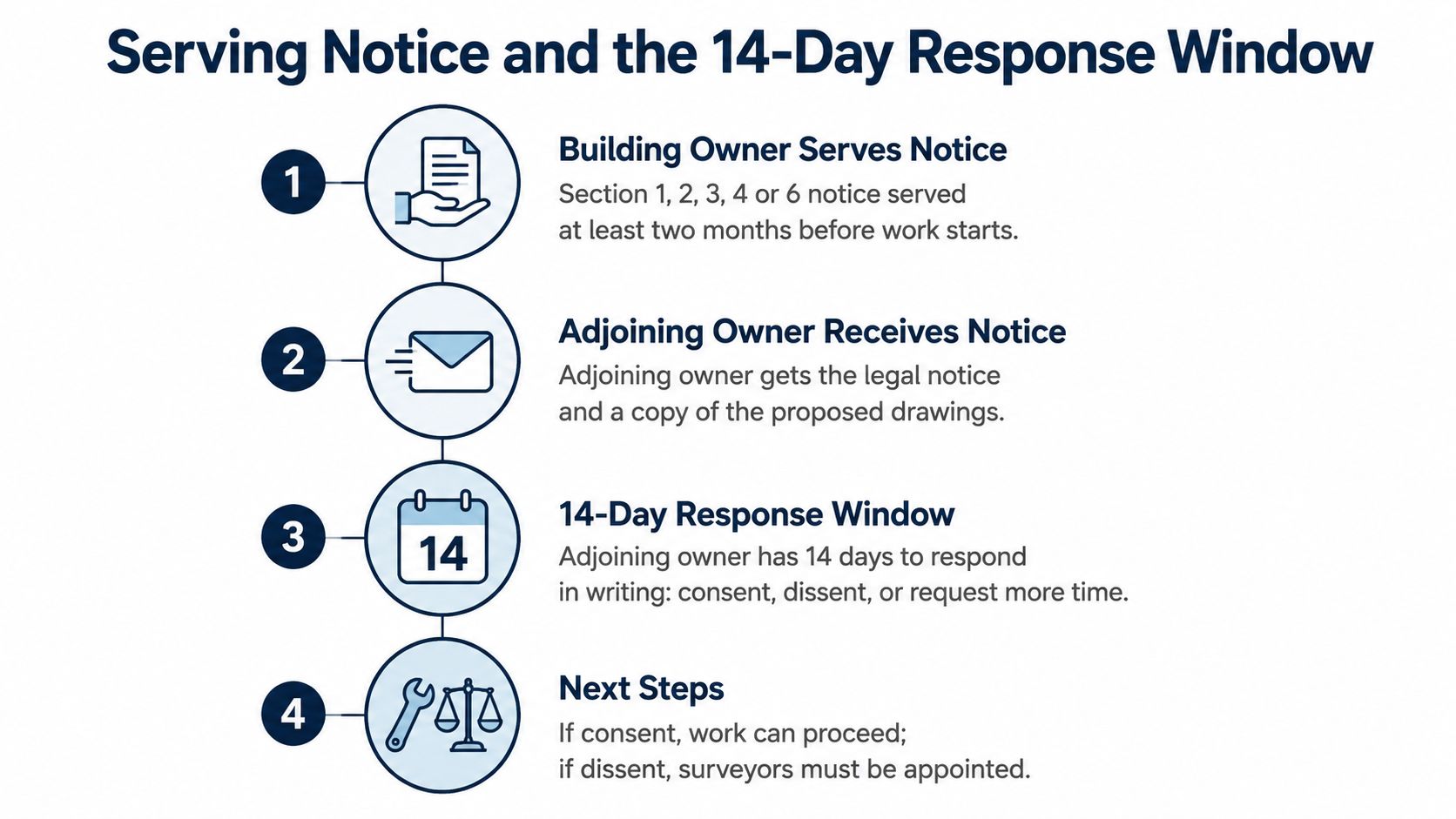
The process begins when the building owner serves written notice on every adjoining owner affected by the qualifying work. For section 2 party wall works, the notice period is generally 2 months before the work starts. For section 1 line-of-junction work and section 6 excavation, the period is generally 1 month. The Act provides the statutory framework for these notice periods and procedures.
The notice should be dated and should identify the building owner, the property, the adjoining property, the proposed works and the intended start date. It must be served in writing. Delivery can be by hand, post or by leaving it at the property in the proper manner. Keep the notice, drawings and proof of service together.
What the adjoining owner can do
The adjoining owner has 14 days to respond. There are three practical outcomes:
- Consent in writing: The adjoining owner agrees to the notified work. The work can proceed under the consent, although a schedule of condition remains sensible where there is any realistic risk of damage.
- Dissent: The adjoining owner doesn't consent and the statutory dispute procedure begins.
- No response: Silence after 14 days is treated as dissent, not consent. The surveyor route then becomes necessary.
Take a Hammersmith side-return extension as an example. If notice is served on 1 March and the planned start date is 1 May, the date fits the general two-month period for work to an existing party wall. The adjoining owner must respond in writing within 14 days of receiving the notice. A written consent allows the project to move forward, while dissent or no response leads to surveyor appointments.
The notice must be accurate. An unclear description, wrong owner or defective service can undermine the timetable. That can mean serving notice again and losing the start date. Corinthian's explanation of what a party wall notice is is useful background, but a surveyor should check the documents against the drawings and ownership information before service.
Appointing Surveyors and the Party Wall Award
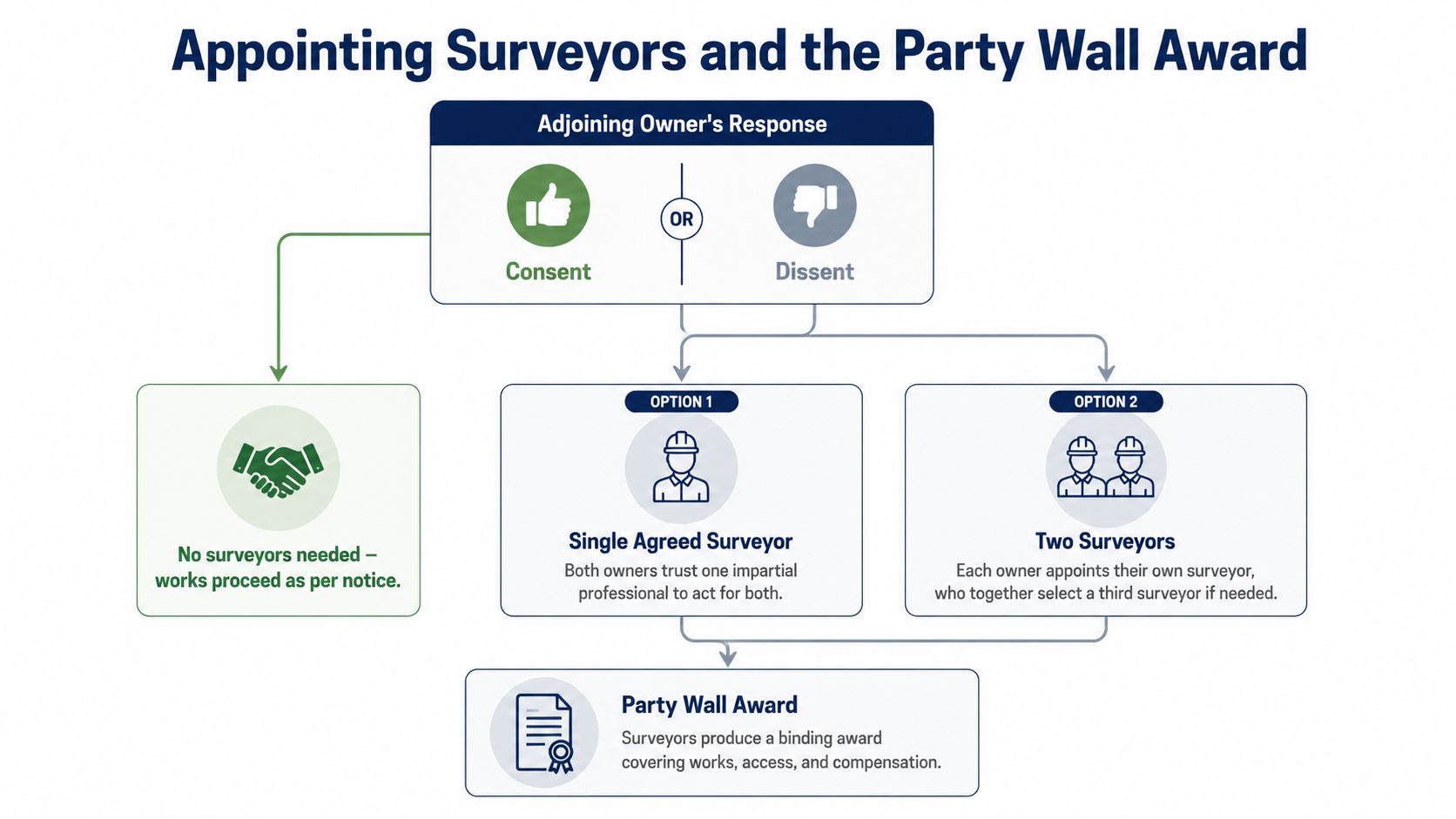
Dissent doesn't give the adjoining owner an automatic veto over lawful building work. It changes the route. Once a dispute is deemed to have arisen, section 10 applies and surveyors must be appointed under the statutory procedure. Section 10 of the Act sets out the appointment mechanism.
The owners can agree to use one agreed surveyor. That person acts impartially for the purposes of the Act and prepares the award. This route can be efficient where both owners understand the work and trust the surveyor's independence.
The alternative is for each owner to appoint their own surveyor. Those surveyors work together and select a third surveyor to decide matters they can't resolve. The adjoining owner has 10 days after a request to appoint a surveyor. If they still don't act, the other party can proceed with an appointment on their behalf under section 10(4).
What the surveyors actually produce
A proper process usually starts with an inspection. The surveyor records existing cracks, movement, damaged finishes and other visible defects in a schedule of condition. This gives both parties a record against which later complaints can be assessed.
The surveyor then considers the building owner's drawings, structural information and proposed method of work. The adjoining owner can raise concerns about excavation, underpinning, access, protection or making good.
The final Party Wall Award is not a casual agreement between neighbours. It is a binding determination that sets out:
- the right to carry out the described works
- the approved timing and working arrangements
- access requirements for inspection or construction
- protective measures and construction safeguards
- responsibility for making good damage
- insurance and compensation provisions
- payment of the relevant costs
The building owner usually pays the reasonable surveying costs because the project creates the need for the statutory process. If the surveyors disagree, the third surveyor can determine the disputed point. Once served, the award is enforceable and must be followed. Corinthian's guide to whether you need a party wall surveyor sets out the decision in homeowner-friendly terms.
Real Timelines and Costs for a Typical London Project
A London side-return extension illustrates the practical effect of getting the order right. The designer develops the drawings, the building owner checks the adjoining ownership details and a surveyor reviews whether section 1 or section 2 notices are needed. Notice should be served early enough for the statutory period to run before the intended start.
If the adjoining owner dissents, the surveyor appointments, inspections and award preparation take their own time. An uncontested matter may move steadily. A project involving basement excavation, complex access or concerns about historic movement can take longer because the surveyors need better drawings, engineering details or further inspections.
Don't build your programme around the most optimistic conversation with the neighbour. Build it around the formal route.
| Item | Agreed surveyor route | Two surveyor route |
|---|---|---|
| Owner response | Written consent or dissent must be established | Written consent or dissent must be established |
| Surveyor appointments | One impartial surveyor agreed by both owners | Each owner appoints a surveyor |
| Inspection | Schedule of condition before affected work | Each surveyor considers the condition and proposals |
| Award | Prepared by the agreed surveyor | Prepared jointly, with a third surveyor available for unresolved points |
| Cost position | Usually simpler for the building owner to administer | Usually more involved because two surveyors are engaged |
| Programme risk | Lower where drawings and access are clear | Greater if appointments or objections take time |
Surveyor fees vary with the property, access, drawings and level of dispute. A straightforward terraced-house extension is not priced in the same way as a basement excavation under a pair of period houses. Ask for a property-specific quotation and confirm what inspection, schedule of condition, award preparation and later attendance are included.
For a clearer explanation of the programme, see how long a party wall agreement takes. The sensible financial decision is to instruct early. Correcting a defective notice or restarting a programme is usually more expensive than allowing proper surveying time at the outset.
Disputes, Injunctions and How Conflicts Get Resolved
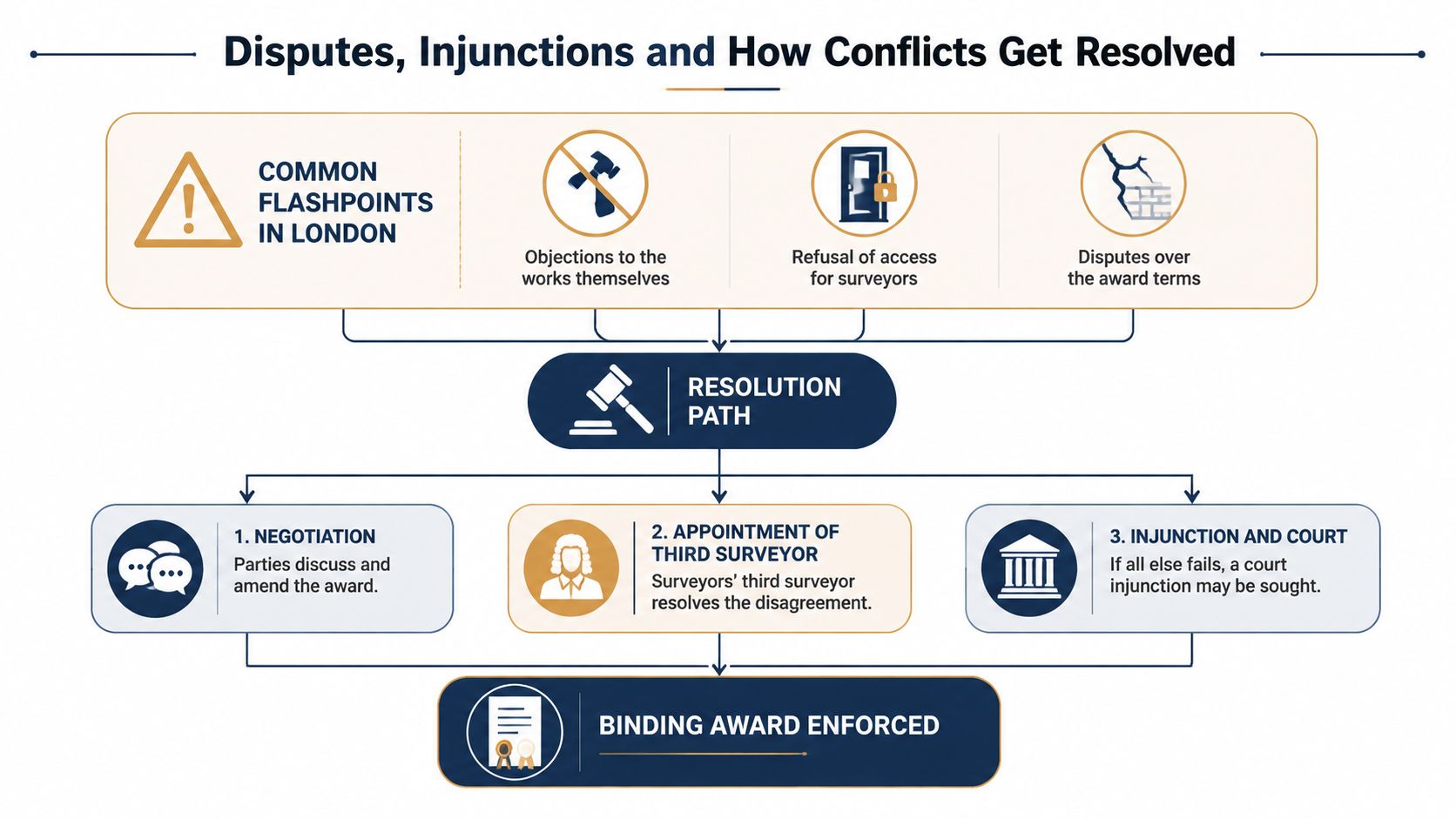
A Party Wall Award isn't a formality that makes every disagreement disappear. London disputes commonly arise because the adjoining owner objects to the proposed method, refuses access for inspection, questions the depth of an excavation or alleges damage after work begins.
The schedule of condition is central to the evidence. If it records a stepped crack above a bay window in a Victorian terrace in Dulwich, the parties can compare that condition with later inspections. If no baseline exists, arguments about when the crack appeared become much harder to resolve.
What happens when the project goes off course
Starting qualifying works without the required process can expose the building owner to an injunction. The adjoining owner can ask the court to stop the work while the statutory position is addressed. That delay can affect contractors, deliveries, temporary works and finance, even where the underlying extension would otherwise be lawful.
Breach of an award creates a separate problem. The contractor may be following a programme that conflicts with access restrictions, hours, protective measures or inspection requirements. The building owner remains responsible for managing the project in accordance with the award.
Keep the evidence moving: Photograph relevant areas, record dates, confirm site discussions in writing and report fresh cracking promptly.
Surveyors should try to resolve disagreements within the award procedure. They can clarify wording, record agreed changes and refer unresolved matters to the third surveyor where the two appointed surveyors cannot agree. Walking off site or arguing by email rarely improves the position.
A surveyor's determination is generally binding, subject to the legal routes available. A challenge to an award can be brought in the county court within 14 days of service, and questions of law may involve the High Court under section 10(17). Enforcement issues can also reach the county court. Those are legal proceedings, not an extension of the ordinary surveyor discussion, so specialist legal advice may be appropriate.
The practical distinction matters. Surveyors decide technical and procedural matters within their statutory role. Courts deal with injunctions, enforcement and challenges. The earlier the parties record concerns and use the surveyor route, the less likely the disagreement is to become a site-stopping event.
Practical Advice for Building Owners and Adjoining Owners
For a building owner, the right time to discuss party wall work is during design, not after planning permission arrives. A basement in Forest Hill, a rear extension in Catford or a loft conversion in Brockley may need revised details once the party wall implications are understood.
Brief the surveyor early enough for notices, ownership checks, structural information and inspections to fit the pre-construction programme. Keep the notice, drawings, proof of service, responses, photographs and award in one project file. Serve every relevant adjoining owner, not just the person who happens to occupy the neighbouring property.
Decisions for the building owner
- Check the drawings: Identify party wall alterations, boundary construction and excavation before appointing the contractor.
- Serve properly: Use a reliable delivery method, retain proof and make sure the notice describes the work accurately.
- Protect the baseline: Arrange a schedule of condition before scaffolding, demolition or excavation starts.
- Brief the contractor: Give the site manager the award and make access, protection and inspection requirements part of the method statement.
- Keep neighbours informed: Tell the adjoining owner about changes that affect access or timing rather than allowing surprises on site.
For the adjoining owner, silence isn't consent. Respond in writing within the statutory period, even if the response is dissent. That keeps the position clear and allows a surveyor to inspect the property before work changes its condition.
Decisions for the adjoining owner
Ask for the proposed drawings and a proper inspection of relevant rooms, elevations and external areas. Raise concerns about excavation depth, underpinning, scaffolding, access and protection early. Keep your own dated photographs and save all communications.
The warning signs are familiar: work starts before notice is resolved, the contractor can't produce the award, drawings change without surveyor review or the building owner refuses access. Those are the moments to act, not after a crack has widened or a contractor has completed the structural stage.
Corinthian Surveyors London LTD is an independent firm of RICS Chartered Surveyors and Valuers based in Forest Hill. Clive Thompson holds RICS and CABE qualifications and has over 30 years' experience in the built environment. The firm provides party wall advice, notices, schedules of condition and awards across London, without ties to lenders, estate agents or developers. That independence matters when the surveyor needs to assess the work rather than just keep a transaction moving.
Quick questions homeowners ask
Can my neighbour refuse the work
They can dissent, but dissent normally moves the matter into the surveyor procedure. It doesn't automatically give them a veto over qualifying work that can lawfully proceed under an award.
Can I start work while waiting for my neighbour
No, not where the Act applies and the statutory process hasn't been resolved. Starting early can lead to an injunction and delay.
Who pays for the party wall surveyor
The building owner usually pays the reasonable costs generated by the works. The final position depends on the circumstances and the terms of the award.
What should I do if work has already started
Stop the affected work, preserve the records and obtain professional advice promptly. Continuing without resolving the statutory position can make the dispute harder and more expensive.
If you're planning an extension, loft conversion or basement excavation in London, Corinthian Surveyors London LTD can review the drawings, advise on the correct notices and prepare the schedule of condition and Party Wall Award where required. Visit Corinthian Surveyors London LTD or call 0800 00 16 422 before the contractor starts, while there is still time to protect the programme.