
Party Wall Advice London: The Homeowner’s Guide
The Party Wall etc. Act 1996 applies to building on the boundary, excavating near a neighbour's building and altering a party structure. In plain English, if you're doing a loft conversion, rear extension or basement work in London, you often need party wall advice before the builders turn up.
Don't confuse it with planning permission or building regulations. Those are separate. This is about protecting you and your neighbour when the work touches a shared wall, a boundary line or nearby foundations.
Table of Contents
- When Party Wall Advice Actually Applies in London
- The Three Types of Work That Trigger the Act
- How to Serve a Party Wall Notice and What It Must Contain
- Appointing a Surveyor Under the Act
- From Notice to Party Wall Award
- Costs, Excavation Triggers and When Professional Advice Pays
- Avoiding Disputes and Getting the Right Help
When Party Wall Advice Actually Applies in London
You've got the architect's drawings. The builder is ready. Then the neighbour asks about a party wall notice and you realise nobody has dealt with it yet. That's the point where many London homeowners lose time, because the Act runs alongside the build programme, not after it.
The simple rule is this. If your work touches a shared wall, a boundary line or nearby foundations, the Party Wall etc. Act 1996 may apply. That's why it comes up so often in terraces, flats and side returns across areas like Lewisham, Forest Hill, Catford, Peckham, Greenwich and Bromley, where homes sit tight together and extensions usually sit close to a neighbour's structure.
Practical rule: if you're cutting into a wall you share, building on the line between plots or digging close to the next property, check the Act before you start.
This is not the same as planning permission. A project can have planning approval and still need party wall notice. It can also pass building control and still need a surveyor if the wall or excavation falls within the Act.
The rule of thumb is straightforward. If your builder needs to work on the boundary, alter a party wall or dig near next door's foundations, get party wall advice early. If the work is fully inside your own property and nowhere near the boundary or shared structure, the Act may not apply.
For London homeowners, early advice is the sensible move. Corinthian Surveyors deals with this kind of residential work across South East London and beyond, and the point is always the same, work out whether the Act bites before you book the start date. That keeps the job moving and avoids a neighbour dispute becoming a delay.
The Three Types of Work That Trigger the Act
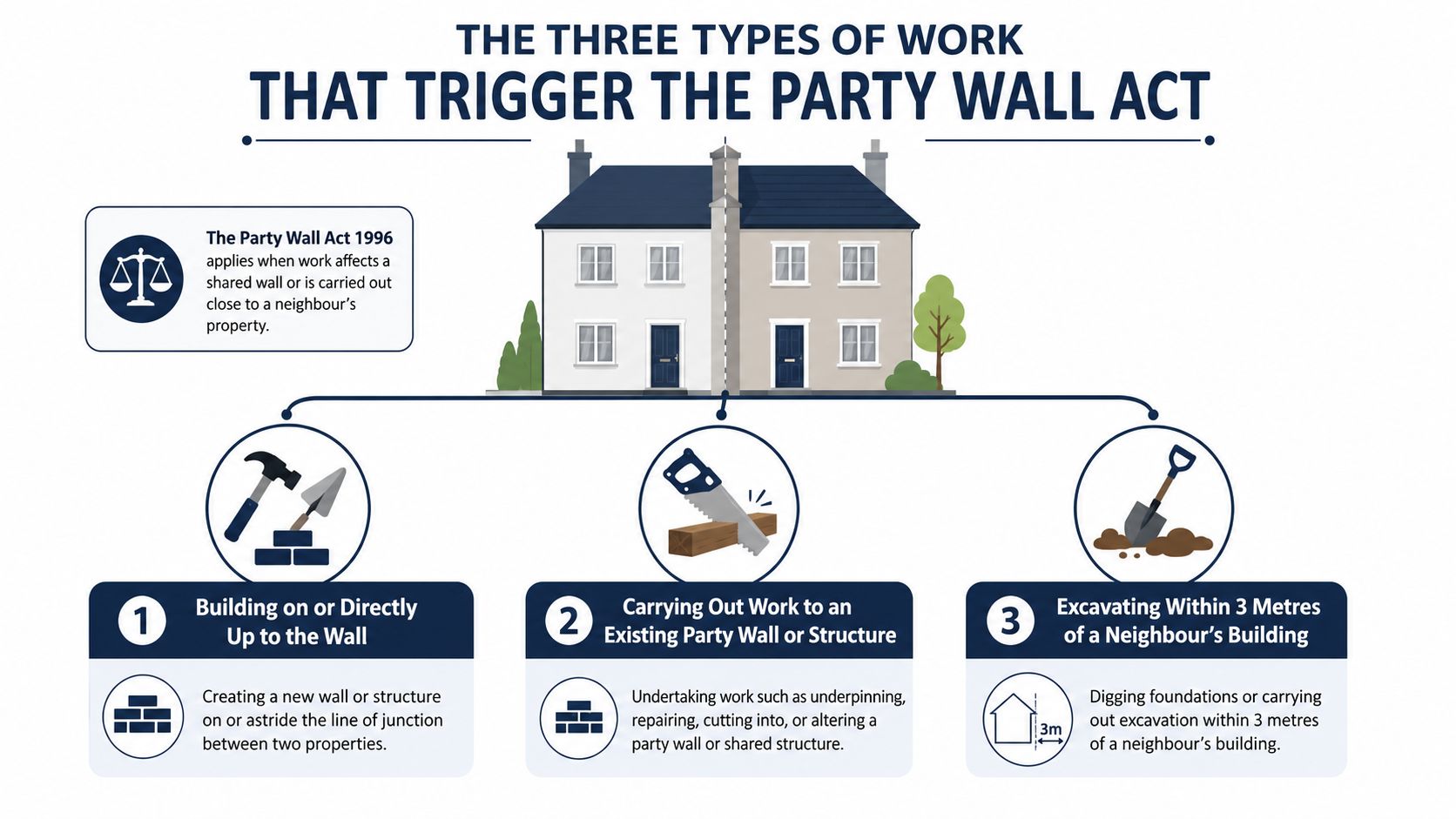
The Act deals with three categories of work, and the project risk is different for each one. Once you know which type you are dealing with, you know whether you need proper surveyor input before you commit to the build.
Work to an existing party structure
This covers cutting into a shared wall, repairing it, underpinning it or otherwise altering it. In a terrace in Brockley or Camberwell, that could mean inserting steelwork for an open-plan kitchen or removing part of a chimney breast.
It also covers work to a shared structure between flats or maisonettes. If the wall carries both properties, treat it as a party wall issue first and a building issue second. That is the point where a small mistake can turn into a neighbour dispute, so get the documents right before the builder starts.
Building on the boundary line
This is the common one for rear extensions, garden walls and small outbuildings. If the new wall sits on the line between your land and the neighbour's, the Act is in play.
In practice, owners run into trouble over layout. A neighbour may expect the wall to sit wholly on your side, or the title plans may be unclear. Accurate drawings and a clear notice matter here, because bad paperwork creates delay and arguments later.
Excavation near a neighbour's building
This is the one that catches out basement jobs and deeper foundation work. The Act applies where the excavation sits within 3 metres of a neighbouring building and goes deeper than its foundations, or within 6 metres where the work intersects a 45° line from the bottom of those foundations. Richmond Council's guidance also notes that this regime covers underpinning or safeguarding the adjoining owner's foundations. See the formal wording in the Richmond Council party wall guidance.
A Victorian terrace in Forest Hill with a rear extension often falls into this category, because the new foundations usually sit close to next door. If your dig is near the flank wall or you are going down for a basement, treat the Act as live until a surveyor checks it properly. For the notice side of that process, see what a party wall notice is and why it matters.
How to Serve a Party Wall Notice and What It Must Contain
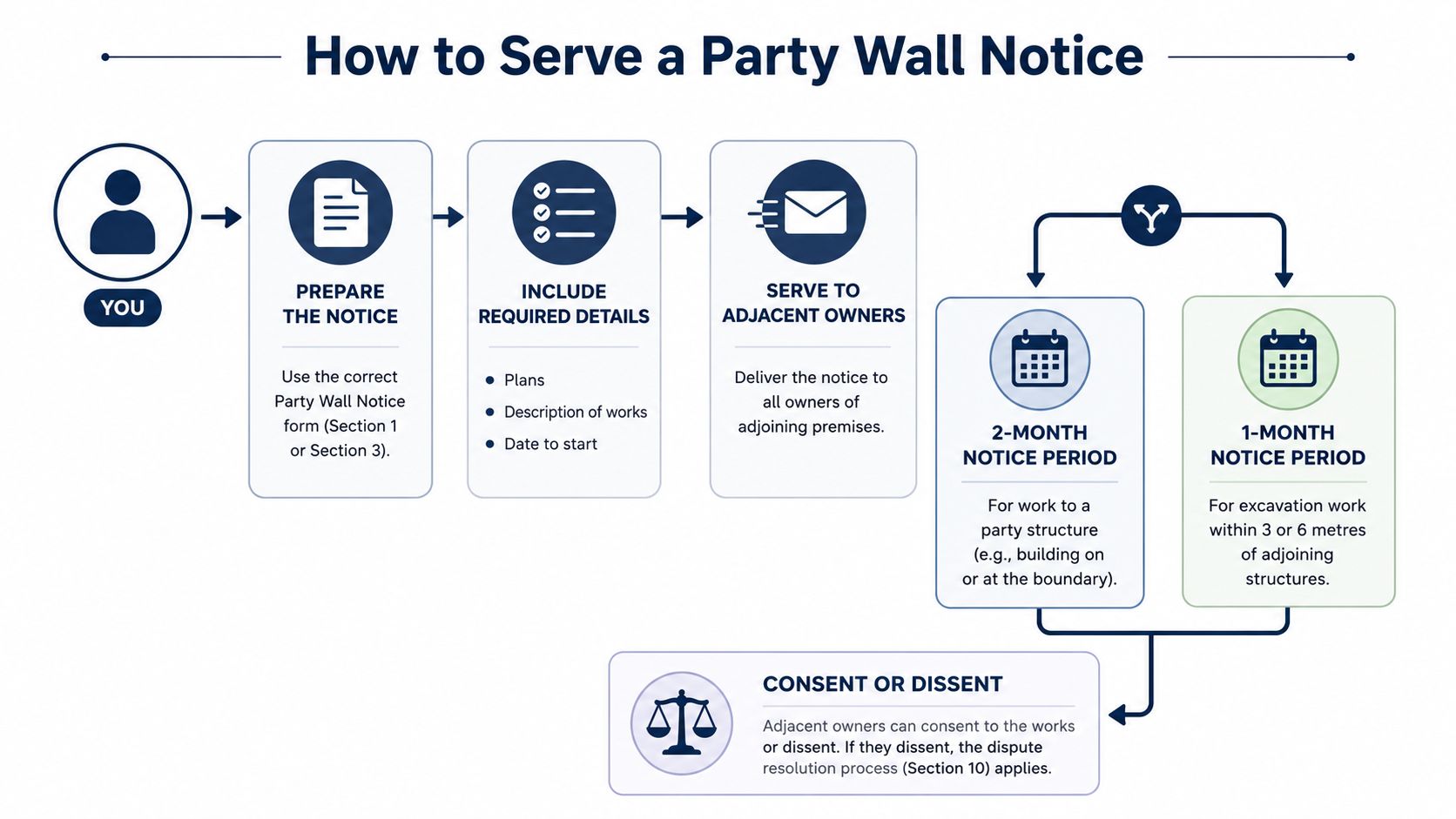
Serve the notice too late and you've already put the project on the back foot. The law is clear, a Party Wall Notice is typically served two months before work starts, but for excavation work or building a new wall on the boundary line the notice period is one month, and once served the notice stays valid for 12 months. That timing matters because design changes and planning delays can easily push a job outside the valid window, forcing you to start again. See the London timing guidance in this party wall agreement guide.
A valid notice needs the basics done properly. It should name the building owner, identify the adjoining owner, describe the works and give the intended start date. For excavation jobs, the plans must be clear enough to show where the foundations go and how deep they are.
If you do not know who owns the neighbouring title, get the address checked properly before serving anything. That is routine work for a surveyor and it avoids the notice landing in the wrong hands or not being served at all.
A Lewisham extension is a good example. Planning consent drags on, the drawings change, and the homeowner is tempted to reissue notice at the last minute. That's where advice pays for itself, because the notice should match the work that will happen, not the version that was on the first set of drawings.
For a plain explanation of what goes into a notice, see What Is a Party Wall Notice. If you want the process handled neatly, hand it to someone who does this every week rather than trying to improvise from a template.
Appointing a Surveyor Under the Act
If your neighbour consents in writing, you may not need a surveyor at all. If they dissent, or if the project is more sensitive, the next choice is between an agreed surveyor or two separate surveyors.
An agreed surveyor is the simpler route. One independent surveyor acts for both owners, keeps the paperwork tight and gets the award moving without a second layer of correspondence. That often suits straightforward residential jobs where the neighbour is calm and the scope is clear.
Two surveyors make more sense when trust is thin or the works are more intrusive. Each side appoints its own surveyor, and if they cannot agree, a third surveyor can be brought in. The government's explanatory booklet says that, when there is a dispute, appointment of an agreed surveyor or two surveyors leads to a legally binding award before work can start. See the government booklet on the Party Wall etc. Act 1996.
An independent surveyor is there to keep the process fair, not to act as a cheerleader for either neighbour.
That independence matters. A firm like Corinthian Surveyors, which is RICS Chartered and CABE-qualified, fits the model you want. It is independent, residential-focused and has no ties to lenders, estate agents or developers, which is exactly what you want when the neighbour relationship is already delicate. If you want a sharper breakdown of when to use a surveyor, the guide at Do I Need a Party Wall Surveyor is a sensible place to start.
Use a surveyor early if the job is close to a boundary, if the neighbour is already uneasy or if the drawings involve excavation. If the matter is simple and the neighbour is cooperative, basic notice support may be enough.
From Notice to Party Wall Award
A party wall notice is not the finish line. It is the point where the project either stays straightforward or starts to carry real risk for the build programme. If the neighbour consents, things usually stay lighter, although a schedule of condition is still a smart move where there is any chance of damage.
If the neighbour dissents, the job enters the formal party wall route. The appointed surveyor or surveyors inspect the affected parts of both properties, record the condition and prepare the award. That award usually deals with the schedule of condition, access, working hours, protections for the adjoining owner and any security for expenses where it is justified.
The award does not block proper works. If the Act allows the work, the award sets out how it is done safely and fairly. Homeowners often get this wrong. The award manages rights and responsibilities, it does not hand the neighbour a veto over lawful works.
In practice, the notice-to-award process often takes several weeks, so you should not leave it until the builder is ready to start. Early instruction keeps the programme realistic and avoids last-minute pressure. If you want a clear walkthrough of the route from notice to agreement, how to get party wall agreement explains the usual steps in plain English.
A proper award is practical. It tells the builder what is allowed, tells the neighbour what protection they have and gives both sides a paper trail if a dispute comes up later. That is why party wall advice in London is really project-risk control, not just paperwork.
Costs, Excavation Triggers and When Professional Advice Pays
The fee question comes up on almost every call. In London, party wall surveyor fees are often in the hundreds to low thousands, depending on complexity, the number of adjoining owners and whether one or two surveyors are involved. The headline figure is not the point. You are paying to reduce project risk before the builder starts cutting or digging.
A typical Victorian terrace in Forest Hill or Catford can look straightforward on paper, then get awkward once the builder proposes deeper foundations, side access or a neighbour who watches every move on the scaffold. A quick conversation with a surveyor at that stage usually costs less than fixing a dispute later.
The excavation issue catches a lot of owners out. The Act is usually engaged where the dig is close to a neighbouring building and goes deeper than the neighbour's foundations, as noted earlier for the 3 metre and 6 metre tests. Richmond Council's guidance on party wall excavation triggers sets out the technical position clearly.
| Project type | Common in | Notice required | Recommended level of support |
|---|---|---|---|
| Rear extension with new foundations | Lewisham, Bromley, Southwark | Often yes | Full surveyor instruction if the dig is near next door |
| Loft conversion touching a shared wall | Terraces and maisonettes | Often yes | Surveyor review before notice is served |
| Garden wall on the boundary | Many London plots | Often yes | Basic notice support may be enough if the neighbour is relaxed |
| Basement or deep excavation | South East London and central boroughs | Often yes | Full surveyor instruction |
| Internal works with no shared structure or excavation | Some flats and newer houses | Sometimes no | Check first, then decide |
For a simple job, basic notice support may be enough. For deeper digs, shared walls or any project where the neighbour is likely to take a close interest, I would bring in a surveyor at the start. That keeps the build moving and avoids having to stop and sort out a problem halfway through.
If you want a plain-English walk-through of the first steps, see How to Get Party Wall Agreement.
Avoiding Disputes and Getting the Right Help
Start with the neighbour, not the paperwork. Show them the drawings, explain the access you need and give them the schedule of condition before the builder arrives on site. Most party wall rows in London start with silence, surprise or a badly explained set of works.
The recurring friction points are predictable. People object to working hours, scaffold oversailing, dust, access and security for expenses. Those issues are usually managed through the award, so the trick is to identify them early rather than pretending they will sort themselves out.
If you want the job handled cleanly, speak to a RICS Chartered surveyor with proper local knowledge and no ties to lenders or developers. That is where Corinthian Surveyors London LTD fits naturally, because it works across all London boroughs and has the RICS and CABE credentials homeowners should look for. The phone number is 0800 00 16 422 if you want a proper conversation about whether your project needs notice support or full surveyor instruction.
The best time to sort a party wall issue is before the builder books the skip.
Corinthian Surveyors London LTD handles residential party wall advice, building surveys and valuations across London with independent, RICS-regulated judgement. If your extension, loft conversion or excavation is about to touch a neighbour's wall or foundations, read the drawings properly and then act early. Visit Corinthian Surveyors London LTD to see how we can help with the notice, surveyor appointment or award process.