
Guide on How to Get Party Wall Agreement: Your 2026 Steps
You're staring at a side return build, a loft conversion or a basement dig, and the neighbour next door has already started asking awkward questions. That's normal. What matters is getting the Party Wall process right before a spade goes in the ground, because once you get it wrong, the delays are expensive and avoidable.
The clean answer is this, if your work affects a shared wall, a boundary wall or excavation near a neighbouring foundation, you need to treat the Party Wall etc. Act 1996 seriously. Serve the right notice, give people time to respond and do not assume silence means consent. That last point catches homeowners out all the time.
Table of Contents
- Does the Party Wall Act Apply to Your Project
- Serving a Party Wall Notice Correctly
- Your Neighbour's Response Consent or Dissent
- The Party Wall Award and Appointing a Surveyor
- Costs Common Pitfalls and How to Avoid Them
- Party Wall Agreement FAQs
Does the Party Wall Act Apply to Your Project
If you're doing a loft conversion in a Victorian terrace in Lewisham, cutting into a wall for steels in Catford, removing a chimney breast in a flat conversion in Peckham or digging a basement in Bromley, stop and check the Act before you commit to dates. Those are exactly the sorts of jobs that tend to trigger the procedure.

The Act matters because it deals with shared walls, boundary walls and excavation near neighbouring buildings. The government's guidance makes the key point plainly, if you do not get a response, you cannot assume consent after serving notice. That is the point where many projects drift into avoidable delay, not because the work is unlawful, but because the paperwork was handled badly. See the practical test in this guide to whether you need a party wall agreement.
The jobs that usually trigger it
A party wall issue usually comes up when the work is structural, not cosmetic.
- Loft conversions: inserting steels, altering the party wall or working at roof level often brings the Act into play.
- Extensions: building up to or close to the boundary can trigger a line of junction notice.
- Basements and deep excavations: digging near a neighbour's foundations is exactly the kind of work the Act is designed to regulate.
- Chimney breast removals: if the chimney is shared or attached to the party wall, you need to look carefully at the notice requirements.
The point is not to panic. The point is to classify the work properly at the outset.
Practical rule: if the work changes the structure, cuts into a shared wall or digs near a neighbour's foundations, assume the Act may apply until a surveyor says otherwise.
What the Act is really doing
The law is not there to stop your project. It is there to create a paper trail, protect the neighbour's property and avoid arguments after the builder has already started. That is why you need written notice and, if the neighbour dissents, a formal route through surveyors.
If you're planning a project in Forest Hill, Greenwich, Southwark or Bromley, local house types matter. A 1930s semi in Beckenham does not behave like a converted warehouse flat in Bermondsey, and the notice strategy should reflect that. The safest approach is to ask early, then plan the programme around the legal process rather than hoping it disappears.
Serving a Party Wall Notice Correctly
A valid notice is not a casual email. It needs the right names, the right work description and the right timing, or you will lose weeks correcting avoidable errors.
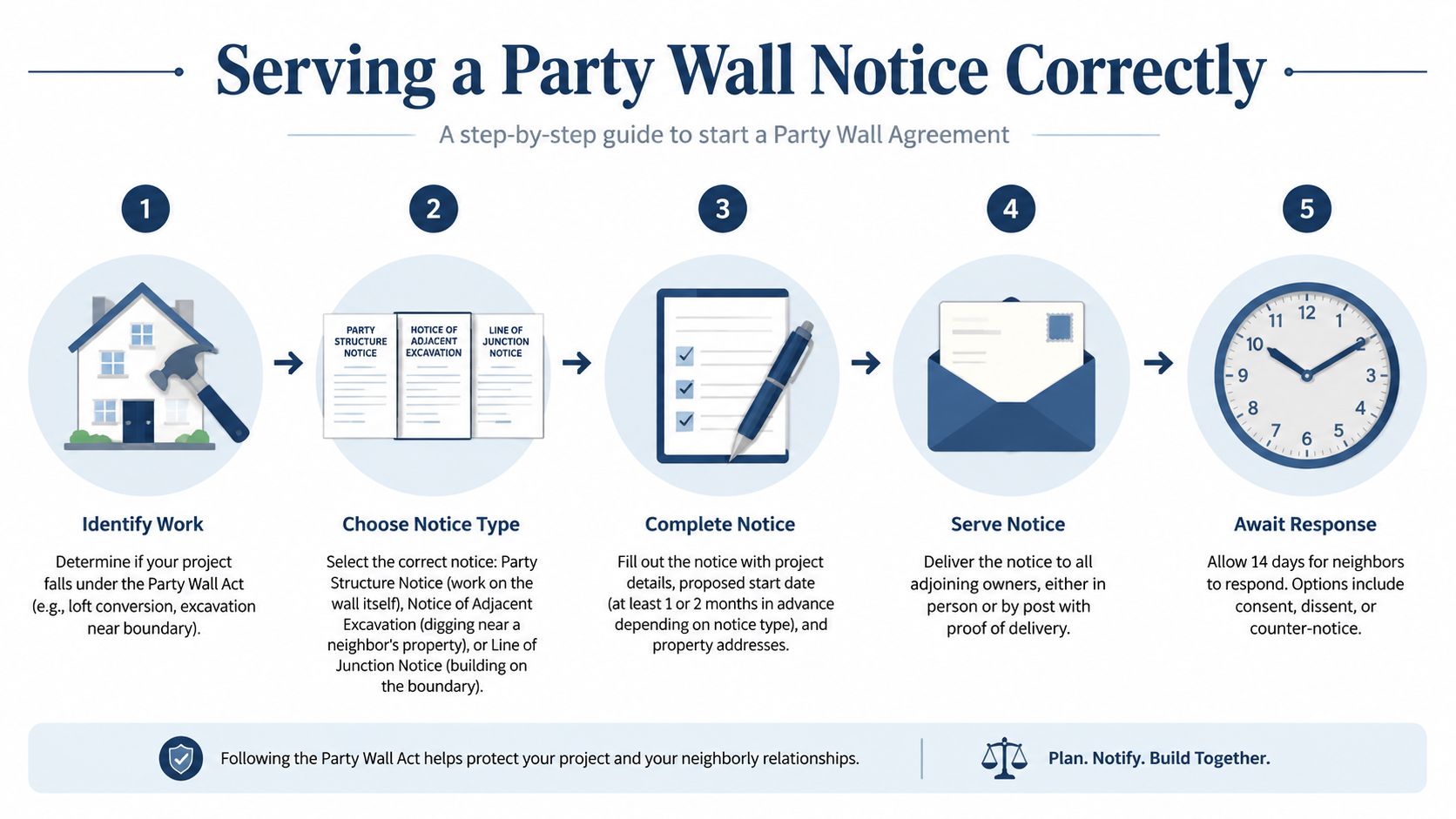
For works to an existing party wall or boundary structure, the notice period is typically 2 months, while excavation notices are commonly 1 month. The notice must include the building owner's name and address, a description of the proposed works and the intended start date. That is the core minimum set out in the professional guidance on what a party wall notice should contain, and it matches the practical requirements used by surveyors.
Start with the right notice type
There are three common routes in practice.
- Party Structure Notice: use this when the work affects the wall itself, such as cutting in for steels or rebuilding part of a party wall.
- Notice of Adjacent Excavation: use this for digging close to a neighbouring building or its foundations.
- Line of Junction Notice: use this when you are building on or up to the boundary line.
Get the category wrong and everything downstream becomes messy. A neighbour who receives the wrong notice is more likely to delay, query or reject it.
Fill in the notice properly
Do not leave owner details vague. If you are dealing with a leasehold flat in Southwark, a block in Woolwich or a converted building in Deptford, check who the adjoining owners are before serving anything. In blocks of flats, there can be more than one party with notice rights, including a freeholder.
The notice should be plain, specific and consistent with the drawings. If the description says “minor internal alterations” but the plans show structural steels and foundation work, expect a challenge. The same applies if you are unsure what a valid notice should include, because that is where many disputes start. This guide to what a party wall notice should contain is the right place to check the basics before anything goes out.
Good practice: match the wording in the notice to the actual drawings and the builder's intended method. Sloppy wording creates doubt, and doubt creates delay.
Serve it in a way you can prove
Deliver it in a way that leaves proof. Personal delivery with a record or tracked post is far safer than hoping a conversation on the pavement counts as service. The legal process turns on dates, so you need evidence of when the notice went out.
The government guidance also says the notice can be served up to a year before work starts, which gives you room to plan properly. That matters in London, where trades, scaffolding and structural work are often lined up tightly. If you want a reliable paper trail, use the same level of discipline a RICS surveyor would expect on a live project.
Your Neighbour's Response Consent or Dissent
Once the notice is served, there are only three real outcomes. They consent in writing, they dissent in writing or they do nothing. The law treats those outcomes very differently.
Under the Party Wall etc. Act 1996, once a valid notice is served, the adjoining owner must respond in writing within 14 days if they consent. If they do not respond in time, the law treats the matter as a dispute and you cannot assume consent. That point is set out clearly in government guidance on reaching agreement with neighbours.
If they consent
Written consent is the simplest route. You still need to respect the notice period, but you avoid the formal surveyor process.
That does not mean you should become casual. Keep the consent with the rest of the project file, because it may matter later if there is damage, a dispute over access or a question about whether the works changed.
If they dissent
Dissent is not a disaster. It just moves the matter into the formal dispute pathway. At that point, the next step is a surveyor or surveyors producing a Party Wall Award.
At this juncture, many homeowners lose momentum. They think dissent means no. It doesn't. It means the legal machinery has started, and you now need to get the paperwork right rather than arguing across the fence.
If they say nothing
Silence is the trap. Homeowners often assume an unreturned notice is harmless, then discover too late that it counts as dissent. The Act is blunt on this point, and the practical effect is simple. No response means you move into the dispute process.
Bottom line: no response is not consent. If the neighbour has not replied within 14 days, plan as if dissent has been triggered.
That matters in places like Brixton, Camberwell and Clapham, where projects are often time-sensitive and neighbours are not always at home to deal with notices quickly. If a response is slow, don't guess. Follow the statutory route.
The Party Wall Award and Appointing a Surveyor
Once a neighbour dissents, the surveyor takes over the process. That is the point where the paperwork has to be handled properly, because arguments over the fence only slow the job down. A good surveyor applies the Act, checks the proposed works and produces a document that lets the project move ahead without turning into a dispute.
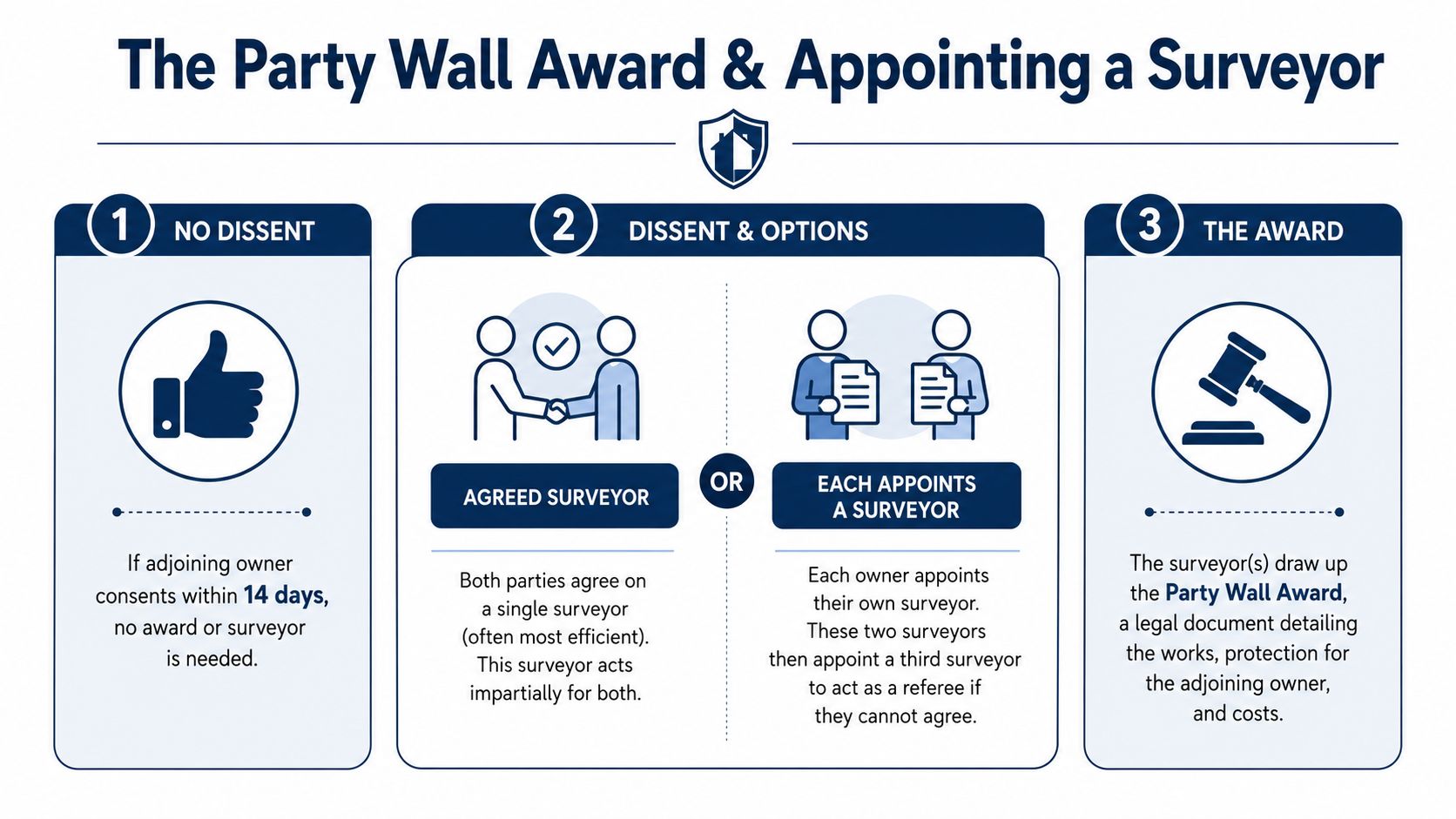
If the owners cannot agree, the dispute has to be handled through surveyors and a party wall award that sets out what work can proceed and on what terms. If an owner wants to challenge the award, the appeal must be filed in the county court within 14 days of service, according to the government's guidance on what happens if you can't agree.
Agreed surveyor or separate surveyors
There are two routes through the dispute.
- Agreed surveyor: one surveyor acts for both owners and stays impartial. This is usually the cleaner option when the works are straightforward and both sides are willing to keep things moving.
- Separate surveyors: each owner appoints their own surveyor. Those surveyors then agree the award between themselves and deal with any points of disagreement in the usual way.
The agreed surveyor route is usually quicker and less clumsy. The separate surveyor route is the better fit where relations have already soured or the works are more involved, such as a basement in Camden or a loft with heavy steelwork in a Victorian terrace in Lewisham.
If you want a practical explanation of how that role works, this guide to party wall surveyors in London is worth keeping to hand.
What the award actually covers
A proper award should be specific, not vague. It normally sets out the permitted works, any limits on how they are carried out, access arrangements if they are needed, the rights and protections for the adjoining owner, and how costs are dealt with. It should also include a Schedule of Condition, which records the neighbour's property before the works begin.
That schedule matters. If a crack claim comes up later, a photo record taken at the start is far more useful than anyone trying to rely on memory.
Why impartiality matters
The surveyor's job is to keep the process factual and controlled, not to win the argument for either side. A surveyor should be looking at the building fabric, the proposed method of work and the legal position, then turning that into a lawful award. That is where proper RICS training matters, and where CABE knowledge can help when the construction details need a careful eye.
If you need to keep signatures and paperwork moving between owners, close real estate deals faster with e-signature tools, but do not confuse that with the legal process. The award still has to be drafted correctly, served properly and tied to the actual works.
Costs Common Pitfalls and How to Avoid Them
The biggest mistake is trying to save a bit of time and ending up paying for it later. Once dissent is triggered, the building owner generally pays all surveyor costs. In London projects, resolving the dispute and getting an award can stretch to 2–4 months minimum, so that delay has to sit in your programme from day one, as practitioner guidance on Party Wall work in London makes clear.
Who pays
If you are the person doing the work, budget for the process properly. That usually means your surveyor, the neighbour's surveyor if they appoint one and any reasonable fees connected to the award.
That is not an optional extra. It is part of the cost of carrying out notifiable work in a lawful way.
The usual mistakes
The first mistake is starting before the award is in place. Builders sometimes talk as if notice is a box-ticking exercise, but if the neighbour has dissented or not replied, you do not have the green light.
The second mistake is serving only one adjoining owner. In blocks of flats in Southwark or converted buildings in Lambeth, the person next door may not be the only party with a legal interest. Miss the freeholder or another entitled owner and the notice can unravel.
The third mistake is underestimating the timeline. A decent contractor programme should absorb the notice period and the dispute process. If it doesn't, the project will feel late before the first hole is drilled.
Avoid this: do not let the builder schedule demolition until the notice path is complete and the award is signed off.
If you are vetting a builder at the same time, it is worth reading a proper homeowner's guide to vetting contractors so you know who is insured, who is organised and who is likely to cooperate with the paperwork. A competent contractor and a disciplined surveyor make the whole process easier. That is exactly why independent RICS advice is worth having before the job starts.
Party Wall Agreement FAQs
What happens if my neighbour ignores the Party Wall Notice?
If your neighbour does nothing within 14 days, the law treats that silence as dissent. In London, that is common, especially where owners are away, letting agents are slow to pass on papers, or the property is in a block with layers of management. Once dissent is deemed, the dispute-resolution process starts and surveyors are appointed to agree a Party Wall Award before work can begin, as set out in government guidance on telling neighbours.
Can my neighbour stop my building work completely?
Usually, no. They can force the Party Wall process to be followed properly, and they can delay you if the notice is wrong or the surveyors are not appointed in time. The Act is there to control the works, not to block sensible development. Once the notice is valid and the award is in place, the builder can proceed within the terms of that award.
Do I need a solicitor for a Party Wall Agreement?
Usually, no. The normal route runs through surveyors under the Act, not a solicitor-led process. If there is a wider property dispute, legal advice may become relevant, but for the notice and the award itself, a competent surveyor is the right person to run it.
How long does a Party Wall Award take to arrange?
It depends on the neighbour's response. Consent keeps things moving, but dissent means you need time for surveyor appointment, inspection, schedule of condition recording, and drafting the award, and London jobs can slow down quickly if people leave notices sitting unanswered. To handle this properly, speak to Corinthian Surveyors London LTD on 0800 00 16 422. A steady, RICS and CABE-qualified surveyor keeps the process moving and stops a simple notice becoming a project-wide delay.