
What Is Property Valuation? a UK Guide for 2026
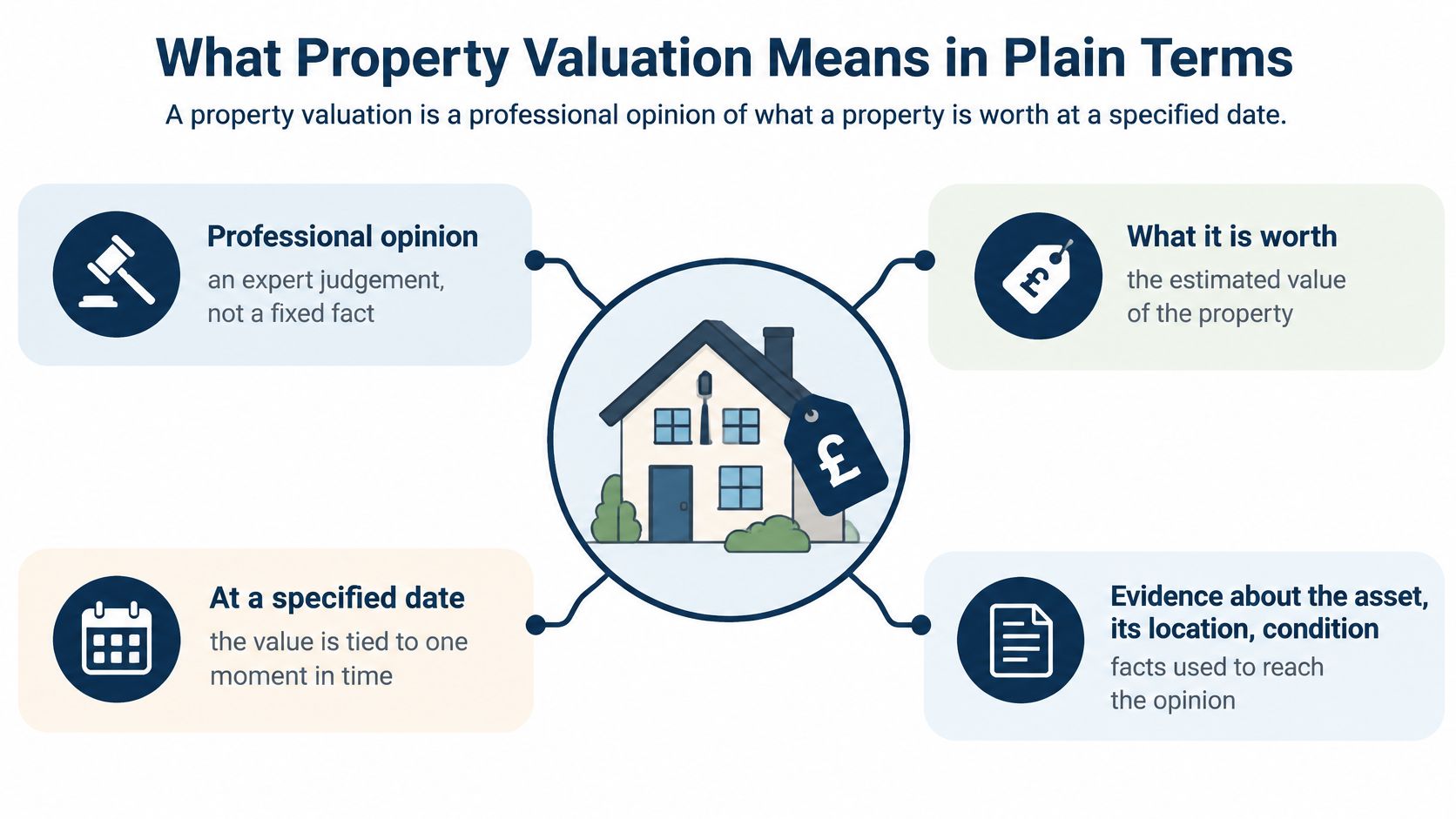
A property valuation is a professional opinion of what a property is worth at a specified date, based on evidence about the asset, its location, condition, legal interests and the market. You may be looking at three different numbers for the same home right now. An agent has suggested an asking price, a website has given an estimate and a lender or solicitor wants something firmer. None of those figures carries the same weight. What matters is who produced the figure, what date it refers to and what evidence sits behind it.
Table of Contents
- What Property Valuation Means in Plain Terms
- Why a Valuation Is Needed and What Each Purpose Asks
- How Valuers Reach a Market Value
- Who Carries Out a Valuation and What the Report Says
- Valuation, Survey and Insurance Figures Are Not Interchangeable
- Why Two Valuations Differ and What to Check First
- Common Questions About Property Valuation
What Property Valuation Means in Plain Terms
Say you're selling a Victorian terrace in Forest Hill or settling an estate in Bromley. You don't need a guess at what a keen buyer might pay on a good day. You need a dated opinion that someone else can test.
That's the difference. A sale price is what one buyer agrees to pay in one transaction. A valuation sets out its basis, assumptions, evidence and limitations in writing. If the reasoning isn't there, you can't rely on the figure.
The work follows a formal framework, not personal preference. Following criticism after the 1972 to 1973 property boom and collapse, RICS marks 50 years of the Red Book by recording that the first edition, Guidance Notes on the Valuation of Assets, was published in 1976. It has developed into RICS Valuation Global Standards, which require ethics, objectivity, competence and transparency from the valuer.
Think of the result as a photograph taken on one day. It's accurate for that valuation date. It isn't a forecast of next month's price and it doesn't stay valid indefinitely if the market or the property changes.
A valuation you can rely on shows its working. A bare number with no evidence is just an estimate with a smarter name.
Two homes with the same floor area can still value very differently. Tenure, condition, defects, extensions, planning history, lease terms and comparable sales all move the figure. A leasehold flat in Lewisham and a freehold house in Bromley use the same definition, but the valuer weighs different evidence for each.
Why a Valuation Is Needed and What Each Purpose Asks
A sale, a mortgage application and an estate return can all require a figure for the same property. Each asks a different question, so the purpose and valuation date should be agreed before the valuer starts. The result is a dated opinion for that specific task, not a price that applies in every situation.
| Purpose | Value measured | Valuation date or point | Typical reason for instructing |
|---|---|---|---|
| Sale | Open-market value | Date of valuation | Pricing or marketing a home |
| Mortgage | Lender's security value | Date of lending decision | Lender requires an assessment before lending |
| Probate and Inheritance Tax | Open-market value | Immediately before death | Estate value form due within 12 months of death |
| Capital Gains Tax | Value as the asset existed | Date of disposal, or 31 March 1982 for land owned then | Sale not at arm's length or transfer to a connected person |
| Matrimonial separation | Basis agreed with solicitors | Date agreed with solicitors or set by the court | Dividing assets between separating partners |
Sale and mortgage
For a sale, open-market value helps set a reasoned asking price. An asking price set too high may deter buyers; set too low, and the seller may receive less than the market could support.
A lender assesses the property as security for a loan. That figure may differ from what an individual buyer would pay, because the lender and buyer are making decisions for different purposes. Ask which basis the lender requires before commissioning a separate valuation.
Probate, tax and separation
For Inheritance Tax, HMRC's Inheritance Tax Manual defines value by reference to the price the property might reasonably be expected to achieve on the open market. For a death estate, the relevant date is immediately before death. A later sale price does not automatically establish the value at that earlier date: the property's condition and market circumstances may have changed.
Timing also affects the estate paperwork. GOV.UK guidance on valuing an estate says the estate-value form must be submitted within 12 months of the person's death and before applying for probate where the form is required. For details on the property valuation itself, see this guide to probate valuation of property.
For Capital Gains Tax, HMRC Helpsheet HS292 on land and leases identifies circumstances where a valuation may be needed, including land owned on 31 March 1982, a disposal that is not an arm's-length bargain, or a transfer to a connected person. The description must reflect the asset as it existed on the valuation date, not its present condition.
For matrimonial separation, the valuation basis and date should be agreed with the solicitors or set by the court. Both parties need a figure supported by evidence and prepared for the same purpose.
Ask first: What is the valuation for, and which date must it reflect?
How Valuers Reach a Market Value
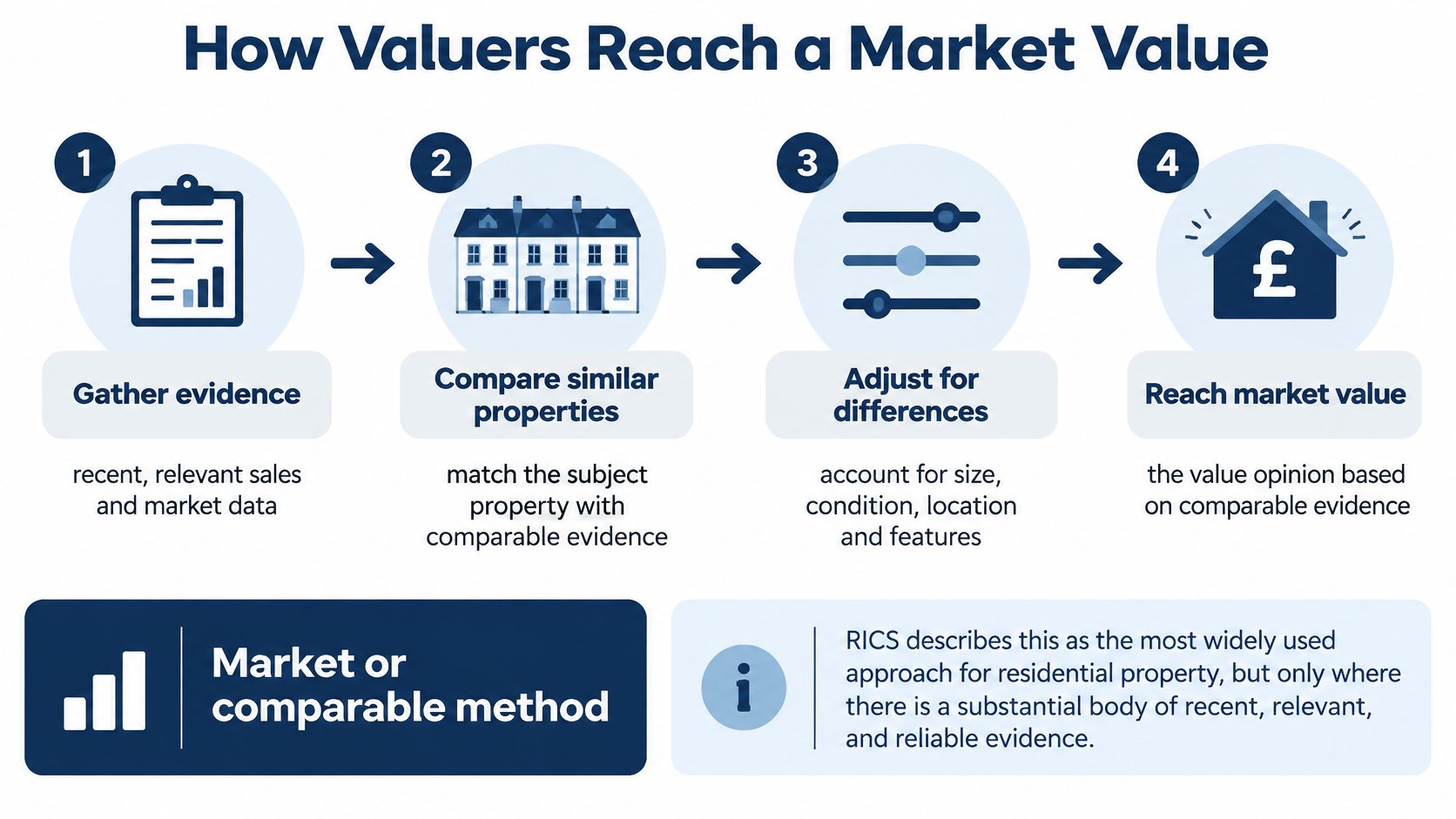
Most residential work uses the market approach, often called the comparable method. It estimates value by analysing sales of similar properties. The short video below walks through that process before the detail that follows.
RICS guidance on valuation methods describes the comparable method as the most widely used approach for residential and commercial property, but its reliability depends on a substantial body of recent, relevant and verified evidence. One apparently similar sale is not enough. Relying on it can produce a material error.
| Method | Used for | Evidence needed | Main limitation |
|---|---|---|---|
| Comparable sales (market approach) | Houses and flats with enough recent sales | Completed, verified sales of similar homes | Thin or poorly verified evidence raises judgement risk |
| Income approach | Let or investment property | Market rent and yield evidence | Depends on reliable rent and yield data |
| Cost approach | Rebuild value for a building | Current construction cost data such as BCIS indices | Ignores land value and what buyers will pay |
The diagram below summarises the comparable route from evidence gathering to the final opinion.
The process step by step
- Set the basis and date: This determines what is being measured and when, so later evidence is not mixed in by mistake.
- Gather completed sales: Asking prices show hope, not value. Completed transactions show what buyers paid.
- Verify each sale: Confirm it was arm's-length and check it with parties involved where possible, because a sale between connected parties may not reflect the open market.
- Adjust for differences: London sub-market, tenure, floor area, condition, age, layout, parking, extensions and transaction timing all need allowance, rather than applying a simple price per square metre.
- Reconcile the evidence: Weigh the adjusted sales and form one opinion, giving most weight to the closest matches.
- Document every adjustment: A lender, solicitor, executor or buyer should be able to follow the reasoning and challenge it.
The cause and effect is straightforward. The closer a sale matches your property in location, physical characteristics, legal interest and date, the smaller the adjustment uncertainty. Thin or poorly verified evidence forces more judgement and widens the risk.
I would always ask which comparables were used and how each adjustment was made. If a valuer can't answer that plainly, don't rely on the figure.
Who Carries Out a Valuation and What the Report Says
A valuation report is a reasoned opinion by a qualified professional, not a guaranteed sale price. In residential work, a RICS Chartered Surveyor and Valuer assesses the evidence and states the assumptions and limits behind the figure. The valuation date matters: the opinion relates to that date, not automatically to a later sale.
Corinthian Surveyors London LTD is an independent firm of RICS Chartered Surveyors and Valuers based in Forest Hill, South East London. Led by surveyor Clive, the firm is a member of the Royal Institution of Chartered Surveyors.
What a sound report contains
- Property address and description: The property being valued, including its type, tenure and accommodation.
- Valuation date: The date to which the opinion applies.
- Purpose and basis: Why the valuation was prepared and the definition of value used.
- Evidence and adjustments: The comparable sales considered and how differences were accounted for.
- Assumptions and limitations: What the valuer has taken as given, and what was not inspected or verified.
- Conclusion and signature: The stated figure and the valuer responsible for the opinion.
The valuation report example shows how these details can be presented. Lenders, solicitors, executors, buyers and sellers may rely on a report for different decisions, so confirm that its purpose matches yours before commissioning it. Ask what assumptions could change the figure and whether any limits affect how you can use the report.
Valuation, Survey and Insurance Figures Are Not Interchangeable
Many homeowners treat four different figures as if they're the same thing. They aren't, and mixing them up leads to bad decisions on price, lending and insurance cover.
| Figure | Who produces it | Main use | What it does not show |
|---|---|---|---|
| Online estimate | Automated model | Rough sense of a price range | Condition, defects, lease terms and the exact comparables |
| Estate agent appraisal | Selling agent | Pricing and marketing a sale | Independence, since the agent earns from the sale |
| Lender valuation | Lender's valuer | Confirming security for a mortgage | The buyer's personal price or the full condition picture |
| Building or homebuyer survey | RICS surveyor | Condition, defects and repair priorities | The market value of the property |
The insurance figure causes the most confusion. A building reinstatement cost assessment estimates what it would cost to rebuild the structure after a major loss. BCIS guidance on reinstatement cost indices states the objective is to capture the current cost of reinstating a completed building, including labour, materials, preliminaries, overheads and profit. BCIS also identifies the ABI/BCIS House Rebuilding Cost Index as the residential index used to update rebuilding cost models between publications.
Market value includes land, location, scarcity and buyer demand. Rebuild cost doesn't. So your purchase price is a poor guide to your insurance sum, especially in high-value parts of London where land carries much of the price. Our note on valuation for insurance explains that gap further.
A survey answers yet another question. It reports condition, defects and repair priorities. A clean survey doesn't confirm the price is right, and a high price doesn't confirm the building is sound.
If the question is what it could sell for, ask for a market valuation. If it's what it would cost to rebuild, ask for a reinstatement assessment. If it's what condition it's in, ask for a survey.
Why Two Valuations Differ and What to Check First
A seller, an agent, a lender and a buyer can arrive at different figures for the same home without anyone being dishonest. A valuation is a dated, reasoned opinion based on evidence and stated assumptions, not a guaranteed sale price. The figure can move when evidence is limited or the property has features that make comparisons difficult.
Unusual layouts, short leases, non-standard alterations and visible defects can all affect the assessment. So can a shortage of comparable sales. A converted flat in Peckham with a short lease, for example, is harder to compare with nearby properties than a standard house on a street with recent sales.
Flood risk and energy efficiency may also affect value, but their impact varies by location and property. Recent English research on flood risk and valuation found an average 2.21% discount for properties in high flood-risk areas. Discounts vary widely according to local risk and circumstances. Ask whether the valuation considers insurance availability, premiums and energy efficiency, and how those factors affect its assumptions.
A national average can show broad market direction, but it cannot settle the value of an individual home. The UK House Price Index summary for May 2026 put the provisional average UK price at £271,000 in May 2026. That figure does not account for a specific property's condition, tenure, location or sale evidence.
Before relying on a valuation, ask for the valuation date, its purpose, the comparable properties used and the adjustments made. Check the assumptions about condition and legal matters, and ask what evidence would change the figure. Record whether a separate survey, legal review or specialist report is needed before exchange or filing a tax return.
Common Questions About Property Valuation
Does a valuation tell me whether a property is a good buy?
No. A valuation is a reasoned opinion of value for a stated date and purpose. Compare it with the asking price, assess the property's condition separately, and consider what you can afford. The figure informs your decision; it does not make it for you.
What if the valuation comes in below the price I agreed?
A lender may base its loan on the lower valuation, leaving you to consider a larger deposit, renegotiating the price or walking away. Before deciding, ask which comparable properties the valuer used and how they adjusted for differences. Check that the valuation date and assumptions match the circumstances you are relying on.
Do I need a valuation to give a property to a family member?
A transfer to a connected person may require a market value for tax purposes because there is no open-market sale price. The relevant value depends on the transfer date and the property's circumstances at that time. Ask your solicitor or accountant what valuation evidence is needed before completing the transfer.
If you are selling and need a market valuation, or buying and want a RICS HomeBuyer survey or building survey, contact Corinthian Surveyors London LTD. The independent firm of RICS Chartered Surveyors and Valuers is based in Forest Hill and serves London. Have the property address and the date you need the figure for ready when you enquire.