
Valuation for Insurance: What You Need to Know

An insurance valuation is not a market value estimate. It calculates what it would cost to demolish and rebuild your property from scratch, including site clearance, professional fees, VAT and compliance work. One 2026 analysis of 46,917 UK properties found that 67% were underinsured, with the average property insured for only 66% of its true rebuild cost according to RebuildCostASSESSMENT.com's analysis.
That distinction matters if your home is damaged by fire, flood or another insured event. A house can sell for one figure but need a very different sum insured to be rebuilt. If the policy is based on the wrong figure, the shortfall can become your problem at the worst possible time.
Table of Contents
- Why Insurance Valuations Differ from Market Prices
- What a Reinstatement Cost Assessment Includes
- Choosing Between a Survey and a Standalone Assessment
- When Generic Online Calculators Fall Short
- How Often to Review Your Insurance Valuation
- Securing Accurate Cover with Independent Surveyors
Why Insurance Valuations Differ from Market Prices
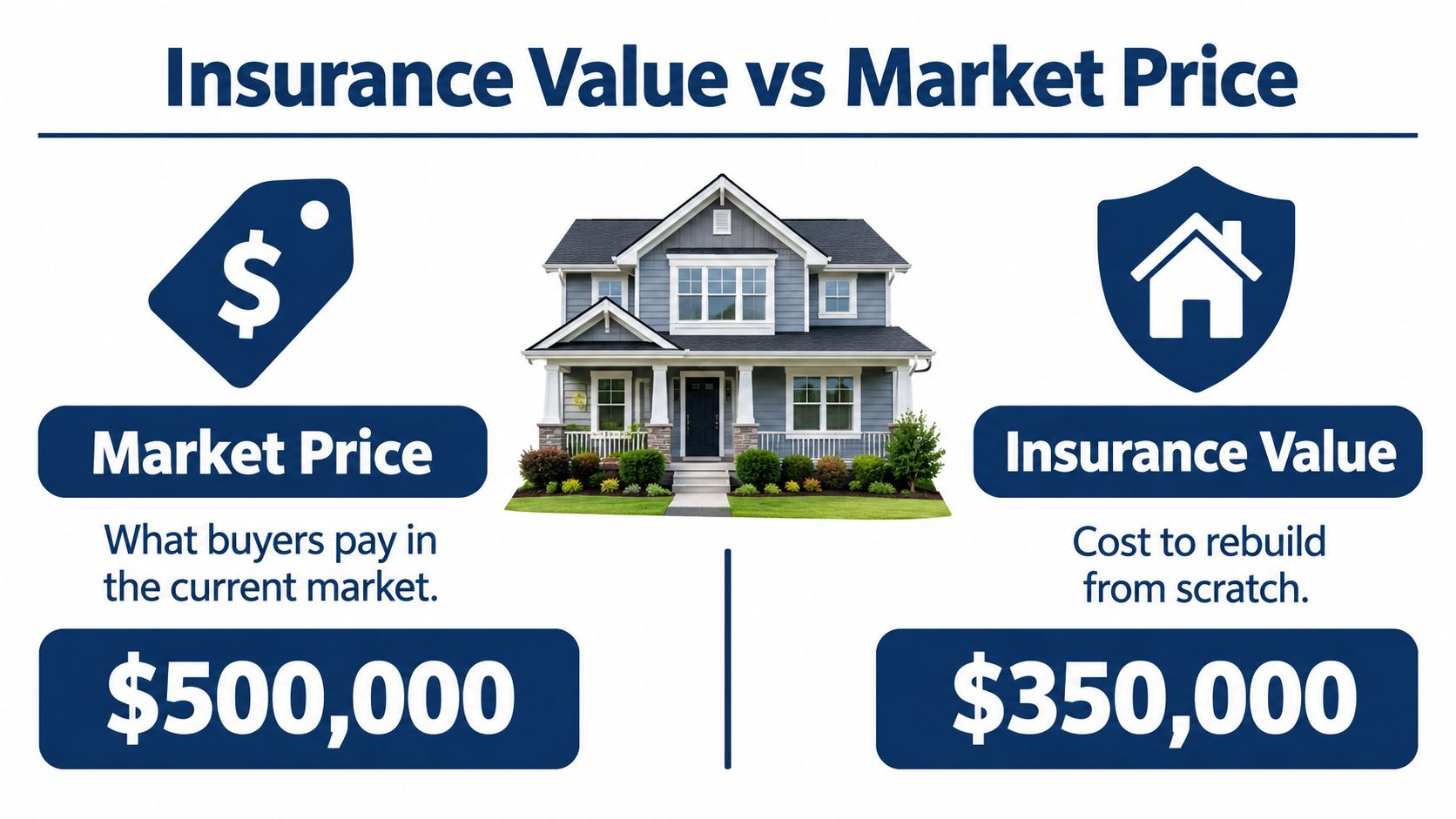
A homeowner buys a Victorian terrace in Forest Hill, checks its market value and enters that figure for buildings insurance. The mistake is understandable, because both figures describe the same property. They answer different questions, though.
The market price includes the land, location, local demand and what a buyer is willing to pay. An insurance valuation focuses on the building and the cost of putting it back after serious damage. The rebuild cost can sit well above or below the price the property would fetch on the open market.
If fire destroys the house, the insurer must account for making the site safe, demolishing the remains, clearing debris, paying professional fees and rebuilding to the required standard. The sale price does not provide a reliable allowance for those works.
This explanation of house valuation shows why the purpose of a valuation matters. A market valuation supports a sale, probate calculation or another financial decision. A reinstatement figure supports buildings insurance.
Practical rule: Never use an estate agent's appraisal or mortgage valuation as the rebuild figure unless the document specifically provides an insurance reinstatement cost.
The Association of British Insurers says the rebuild figure should include demolition and clearance, then reconstruction to the same standard using modern materials, current techniques and current Building Regulations. This guidance on calculating rebuild cost describes a different exercise from estimating what a buyer might pay for a house in Catford, Peckham or Bromley.
Underinsurance can begin with a simple data-entry error. An owner enters the purchase price into an insurance form or relies on a basic floor-area calculation without checking how the area was measured. The figure can look precise while leaving out demolition, professional fees, VAT or unusual construction.
RICS treats insurance estimates as a separate valuation purpose. Its UK supplement reflects the need to select the correct basis of value for the cover arranged. A reinstatement cost assessment measures the cost of rebuilding, not what the property would sell for.
What a Reinstatement Cost Assessment Includes
A reinstatement cost assessment starts with the building itself, not its asking price or sale value. The surveyor considers the construction, size, layout, access, materials and standard required for a full rebuild. This is why an insurance figure can differ sharply from market value, and why relying on the wrong figure can contribute to serious underinsurance. The average property is insured for only 66% of its true rebuild cost.
Consider a straightforward modern house with good access beside a narrow Victorian terrace. The terrace may have a rear extension, complicated roof lines and restricted access through a side passage. A period property in Blackheath or Dulwich may also contain features requiring specialist trades and matching materials.
A properly prepared assessment may include:
- Demolition and clearance: Making the structure safe, demolishing it and removing waste from the site.
- Professional fees: Costs for architects, structural engineers, quantity surveyors and other consultants.
- Statutory costs: Work needed to satisfy current Building Regulations and other applicable requirements.
- Materials and workmanship: Rebuilding to the existing standard, including specialist or non-standard elements.
- VAT: The way VAT applies to the insurance basis.
- Site conditions: Restricted access, party walls, sloping ground and adjoining buildings.
- External features: Garages, outbuildings, walls and other structures requiring separate allowance.
The reinstatement cost assessment guidance explains the figure insurers need. A floor-area calculator is a starting point at best. The later section on generic calculators examines where that approach breaks down.
RICS describes the declared value as equivalent to a fixed-price, lump-sum competitive tender from a competent contractor for work beginning on the first day of the policy period BCIS home rebuilding cost calculator. The surveyor therefore estimates the likely cost at that point. Inflation during the policy term is handled separately through the policy's inflation provision.
That distinction prevents a further misunderstanding. The reinstatement figure is a reasoned estimate of the work required at the relevant valuation date, not an open-ended allowance for every future price increase. Where applicable, the policy's index-linking provision addresses later changes.
The floor area also needs careful checking. Gross internal area and gross external area are not interchangeable, and the measurement method can affect the sum insured. A small error in the recorded area may therefore leave the policy providing less cover than the building needs.
Choosing Between a Survey and a Standalone Assessment
People often use the word “survey” to mean several different services. A home survey investigates condition. A reinstatement cost assessment calculates the likely cost of rebuilding for insurance. Sometimes one appointment can address both needs, but they aren't interchangeable.
A Level 2 Home Survey is intended for conventional properties in reasonable condition. RICS says it can include an insurance reinstatement figure RICS guide to UK home surveys. That can be convenient for a buyer who needs information about defects as well as an indication of the building's insurance basis.
The Level 2 survey may identify visible roof defects, damp, movement or other concerns. It isn't a detailed investigation of every concealed element. It also shouldn't be treated as a substitute for a dedicated RCA when the property is unusual, heavily altered or difficult to measure.
| Your situation | More suitable starting point |
|---|---|
| Conventional house being purchased | Level 2 Home Survey, with the reinstatement figure confirmed |
| Older or substantially altered property | Level 3 Building Survey and a dedicated RCA |
| Listed building or non-standard construction | Standalone RCA from a suitably qualified surveyor |
| Existing home after an extension or loft conversion | Updated reinstatement assessment |
| Insurance review with no purchase taking place | Standalone RCA |
A Level 3 Building Survey examines the property in greater detail and is often appropriate for older homes, listed buildings, period properties and non-standard construction. It can help explain defects and repair priorities, while the RCA focuses on the financial exposure created by rebuilding.
A condition survey tells you what may be wrong with the building. An insurance assessment tells you what it may cost to put the building back.
For a converted flat in Bermondsey, a surveyor may need to consider the relationship between the individual flat and the wider building. The insurance arrangement may be controlled by a freeholder or management company, so the lease and block policy need checking. For a Victorian terrace in Lewisham, extensions, basement works and party wall arrangements may affect the assessment.
Don't order a Level 3 survey just because it sounds more substantial if your only requirement is an insurance figure. Equally, don't rely on a brief insurance number if you also need advice about damp, timber decay, roof movement or structural cracking. The right service depends on the question you're trying to answer.
When Generic Online Calculators Fall Short
An online calculator can be useful for a straightforward property with standard construction and reliable measurements. It becomes less dependable when the building has features that a form can't properly interpret.
Take a Victorian house in Sydenham with a rear addition, high ceilings, ornate plasterwork and a roof that steps around several extensions. The rebuild may require specialist trades, careful temporary works and restricted access. A calculator based mainly on area and property type may not reflect those details.

Listed buildings create a further complication. Matching stone, brick, slate, timber or decorative work may require specialist sourcing and skilled workmanship. Planning and conservation requirements can also shape the reinstatement method. A generic tool doesn't inspect the building or discuss those requirements with the relevant professionals.
A modern extension can cause a similar problem. The owner may remember the original house but forget that the extension changed the roof structure, floor area, drainage or access. A loft conversion may add rooms, stairs and structural alterations that were never included in the old figure.
Homes in expensive London boroughs also need careful treatment. The local labour market, restricted parking, narrow roads and adjoining properties can affect the practical cost of rebuilding. A property in Rotherhithe, for example, may present access issues that don't arise on a detached home in Orpington.
The surveyor's job is to test the assumptions behind the number. That means looking at the construction, measuring where necessary and identifying features that increase complexity.
The following video provides useful background on how insurance valuation fits into the wider property assessment process:
Use an online calculator as an initial sense check, not as automatic proof that the declared value is adequate. A non-standard home deserves a professional assessment because the cost of getting the figure wrong can be much greater than the cost of checking it properly.
How Often to Review Your Insurance Valuation
RICS guidance says reinstatement cost assessments should generally be reviewed every three years, or sooner if the property changes materially RICS guidance discussed by Arthur J. Gallagher. That gives homeowners a useful baseline, but it isn't a reason to ignore the figure between reviews.
Building costs move. BCIS reported that reinstatement costs rose 3.8% in the year to January 2025 and then a further 3.4% after that BCIS insight on underinsurance. Its later update reported an average 4.9% increase in house and flat rebuilding costs against the previous year, based on January 2026 prices BCIS rebuild-cost model update.
Those figures show why a static number can become unsuitable. Domestic buildings insurance policies are generally index-linked and BCIS's House Rebuilding Cost Index is widely used to adjust sums insured between annual policy revisions BCIS insurance products. Index-linking helps, but it doesn't know that you've built an extension or converted the loft.
Review the figure when:
- You alter the property: Extensions, loft conversions, basement works and major refurbishments can change the rebuild requirement.
- You change the specification: New stonework, specialist kitchens, high-quality finishes or altered windows may affect the standard of reinstatement.
- The building changes use or layout: Dividing rooms or creating additional accommodation can affect measurements and construction assumptions.
- You receive a renewal figure that looks unchanged: Ask how it was calculated and whether it reflects the whole property.
- The property is unusual: Listed buildings, flats, conversions and non-standard homes warrant closer professional attention.
Keep records of completed works, plans and measurements. Give them to the surveyor and insurer. If the property is in a conservation area or has unusual construction, mention that before the assessment begins.
Securing Accurate Cover with Independent Surveyors
The central risk is simple. If the declared value is too low, the policy may not provide enough money to restore the building after a major loss. If it's too high, you may pay for cover that doesn't reflect the property's actual rebuilding requirement. Neither problem is solved by confusing market price with rebuild cost.
An independent surveyor can inspect the property and explain the assumptions behind the figure. Local knowledge matters in London, where Victorian terraces in Brockley, 1930s semis in Beckenham, converted flats in Deptford and listed homes in Greenwich can present very different construction and access issues.
Clive Thompson of Corinthian Surveyors London LTD is a RICS and CABE qualified surveyor with over 30 years of experience in the built environment. Corinthian is independent, with no ties to lenders, estate agents or developers. The firm is RICS regulated, belongs to the RICS Valuers Registration Scheme and is insured by Royal Sun Alliance.
A valuation surveyor's role is to apply the correct valuation basis and document the reasoning clearly. That matters for a homeowner arranging cover, a buyer checking a new purchase or an executor dealing with a property after a death.
Review your policy documents, check whether alterations have been included and ask for a professional reinstatement cost assessment if the property is non-standard or the figure is uncertain. Corinthian covers London, the Home Counties and the South of England, including Forest Hill, Lewisham, Southwark, Bromley and surrounding areas.
If you need a building reinstatement cost assessment for buildings insurance, Corinthian Surveyors London LTD can inspect the property and provide a figure based on its construction, access and rebuilding requirements. Call 0800 00 16 422 or visit Corinthian Surveyors London LTD to discuss the property and arrange the appropriate residential valuation service.