
What Is an Asbestos Survey: London Homebuyer’s Guide 2026

You're standing in a Lewisham terrace or a Forest Hill conversion, and you've spotted something awkward, a brown fibrous board in the ceiling, old lagged pipework in the cupboard, or a textured coating that looks untouched since the last century. Don't guess. What is an asbestos survey? It's the proper way to identify what you're dealing with before anyone starts drilling, cutting or stripping anything out.
That matters because asbestos is not a visual judgement call. It's a structured inspection, sampling and reporting exercise, and in older London housing that usually means dealing with uncertainty the right way rather than hoping for the best. If you're buying, inheriting, remortgaging or planning work, you need clear facts, not a shrug and a guess.
Table of Contents
- Introduction to Asbestos Surveys
- Understanding What an Asbestos Survey Is
- Types of Asbestos Surveys
- Legal and Safety Context in the UK
- Survey Process and What to Expect
- Typical Timescales and Costs
- Sample Report Elements and Disclaimers
- FAQs and Next Steps
Introduction to Asbestos Surveys
A buyer in Forest Hill sees old ceiling tiles and pipes wrapped in brittle white lagging during a viewing, then asks the obvious question, do we need to worry? Yes, you do. But worry is the wrong response. A proper asbestos survey gives you facts, and facts let you decide whether to buy, renegotiate, manage or remove.
In London, this crops up all the time in Victorian terraces, 1930s semis, maisonettes and flat conversions. One room may look harmless, while a void, riser cupboard or service chase hides material you can't see from the floor. That is why a survey is the first sensible move, not the last resort.
The point is simple. Suspect material is the starting point, not the conclusion. A qualified survey tells you what it is, where it is, what condition it's in and what happens next.
Understanding What an Asbestos Survey Is
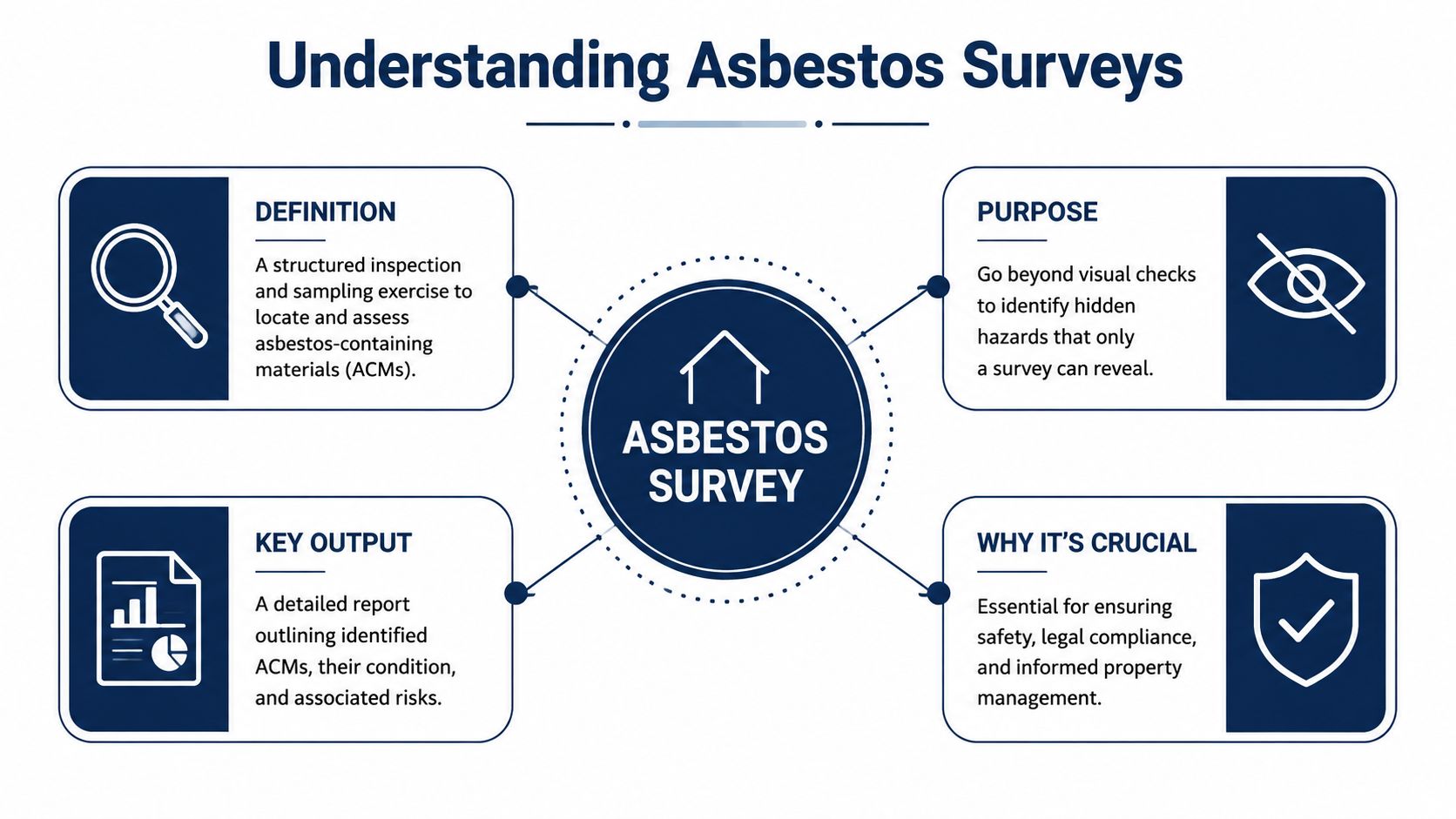
An asbestos survey is a structured inspection and sampling exercise. Its job is to find asbestos-containing materials, usually called ACMs, and assess them so a building can be used or worked on safely. HSE guidance says the survey must give accurate information on the location, amount and condition of ACMs, not just point to a suspicious material and leave the rest to guesswork. That is the standard you should expect from any competent surveyor.
A quick visual check does not do the job. A board can look ordinary, a coating can look harmless, and pipe lagging can be hidden behind services or boxing, but none of that confirms fibre type. Proper practice follows a clear sequence, planning, inspection, sampling, laboratory analysis and condition assessment, with accessible and concealed areas recorded separately. That is the only way to turn a hunch into usable evidence. ASTM E2356
The report is the product. It should tell you what was inspected, what was sampled, what tested positive, where each ACM sits, and how damaged or likely to be disturbed it is. A good surveyor also flags exclusions plainly, so nobody mistakes an uninspected loft void or closed-up service riser for a clean bill of health.
For London buyers and landlords, the issue is not abstract. Older stock in places like Camden, Lewisham, Walthamstow and Acton still turns up with ACMs in floor tiles, textured coatings, soffits, boxing and lagging. That is why borough-specific examples matter. A flat in a converted terrace can look tidy on viewings and still need proper testing before lease work, sale due diligence or a strip-out. If you need a wider property condition context, property condition reports show how asbestos sits inside the full building picture.
Survey reports are also where local decisions get made. A management survey might show low-risk materials that can stay in place with monitoring. A more intrusive report can show areas that need remedial action before work starts. In practice, that difference changes whether a Bermondsey office fit-out stalls, whether a Hammersmith flat purchase goes ahead, or whether a Southwark landlord needs to plan removal before a contractor moves in.
If you need a plain external comparison point, Get asbestos inspected in Austin is a straightforward example of how this issue is handled in another market.
Types of Asbestos Surveys
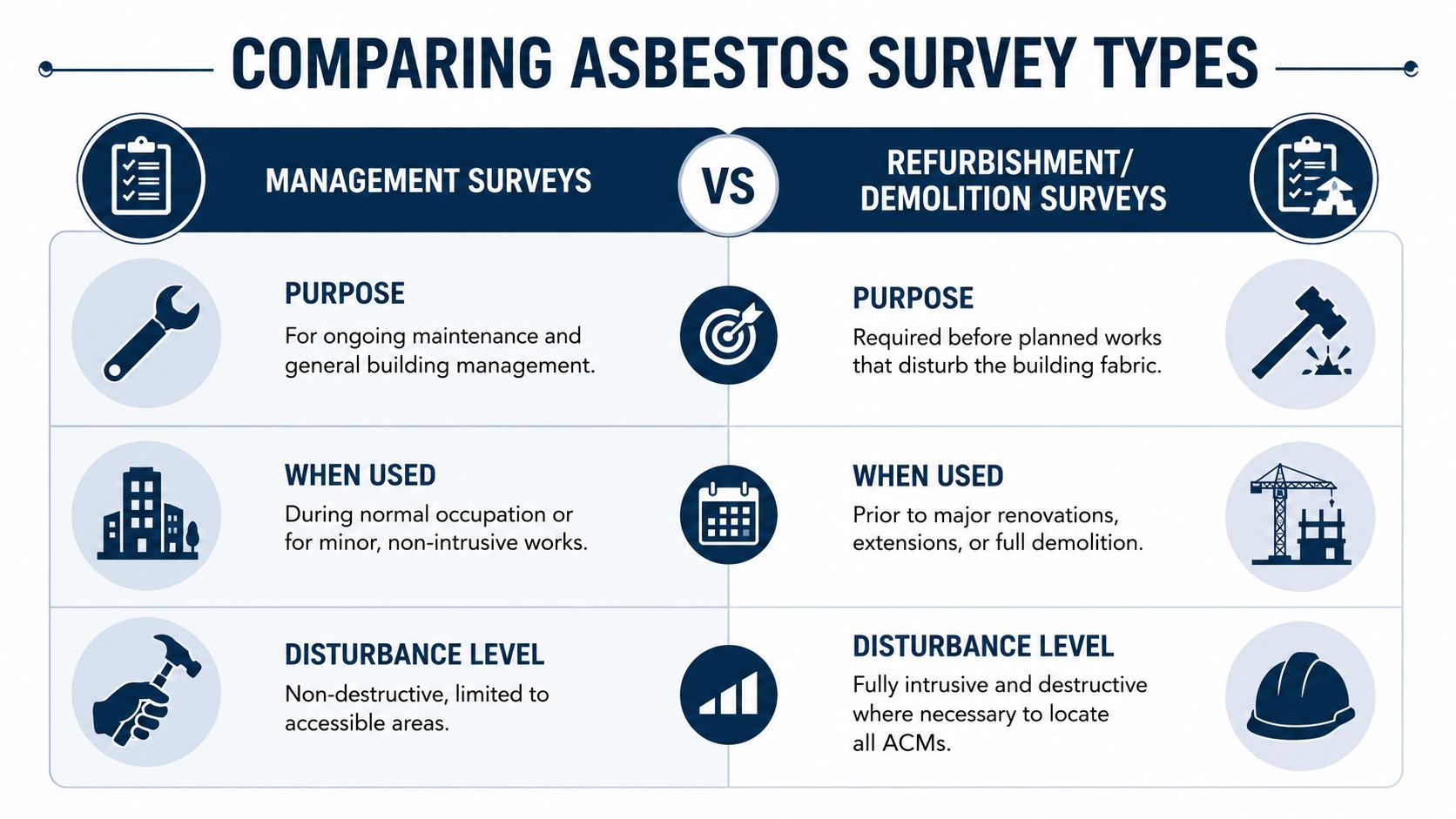
There are two survey types that matter in practice. Management surveys are for normal occupation and day-to-day maintenance. Refurbishment and demolition surveys are for work that will disturb the building fabric, which is where hidden ACMs become a major problem. HSG264 makes that distinction plainly. HSG264 survey guide
A management survey is non-intrusive or lightly intrusive, and it focuses on accessible areas. That suits an occupied flat in Deptford, a rented maisonette in Peckham or a house in Bromley where nobody is opening up walls for major works. It is there to support ongoing management, not to tear the place apart.
A refurbishment or demolition survey is different. It is intrusive by design, because it has to identify ACMs before work starts, including those behind walls, under floors or above ceilings. If you're planning a basement dig in Dulwich or a major reconfiguration in Lambeth, this is the one that matters.
Good rule of thumb: if the work will disturb fabric, don't rely on a management survey. Get the intrusive survey for the exact areas affected.
The wrong survey wastes time and causes delays. An ordinary survey won't reliably find hidden ACMs, and that's where projects get stopped halfway through. Corinthian Surveyors handles residential surveys with that distinction in mind, and if you're comparing survey types, what is a RICS survey is worth reading alongside this.
If you're choosing between the two, ask one question. Will the work disturb walls, floors, ceilings, risers or voids? If the answer is yes, you need the more intrusive route.
Legal and Safety Context in the UK
In the UK, an asbestos survey has to give owners and landlords usable information for the asbestos register and management plan. It should state where suspect material is, how much of it there is, and what condition it is in. That is the basis of duty-to-manage compliance, and weak reports create avoidable problems for anyone responsible for a building.
Qualifications matter in this context. For residential work, you want a RICS-regulated surveyor who can produce a report that stands up in a sale, a probate file, or a pre-works brief. Corinthian Surveyors London LTD operates as an independent firm, with RICS and CABE qualifications, and that independence matters because advice is not being shaped by lender, estate agent, or developer pressure.
People still treat asbestos as a demolition-only issue. That view is wrong. Disturbance is what turns an ACM into a fibre-release risk, so hidden materials need to be identified before refurbishment or demolition starts. The same applies to a kitchen strip-out in Blackheath, a flat conversion in Camberwell, or a full rear extension in Bromley.
For awareness training and the wider safety picture, 11084NAT asbestos awareness is a useful reminder that people working near asbestos need proper basic knowledge, not guesswork.
A report is only useful if it tells you what to do next. If it just says “possible asbestos”, it is not doing its job.
You also need to respect the limits of the evidence. A legally serious survey is not a blanket clearance certificate, and one negative result in a single room does not prove every hidden void is clean. If the surveyor could not sample a concealed area, the report should say so clearly and then explain how that affects risk and next steps.
That is the standard you should expect in Camberwell, Bromley, or anywhere else in South London. Clear scope. Clear findings. Clear actions.
Survey Process and What to Expect
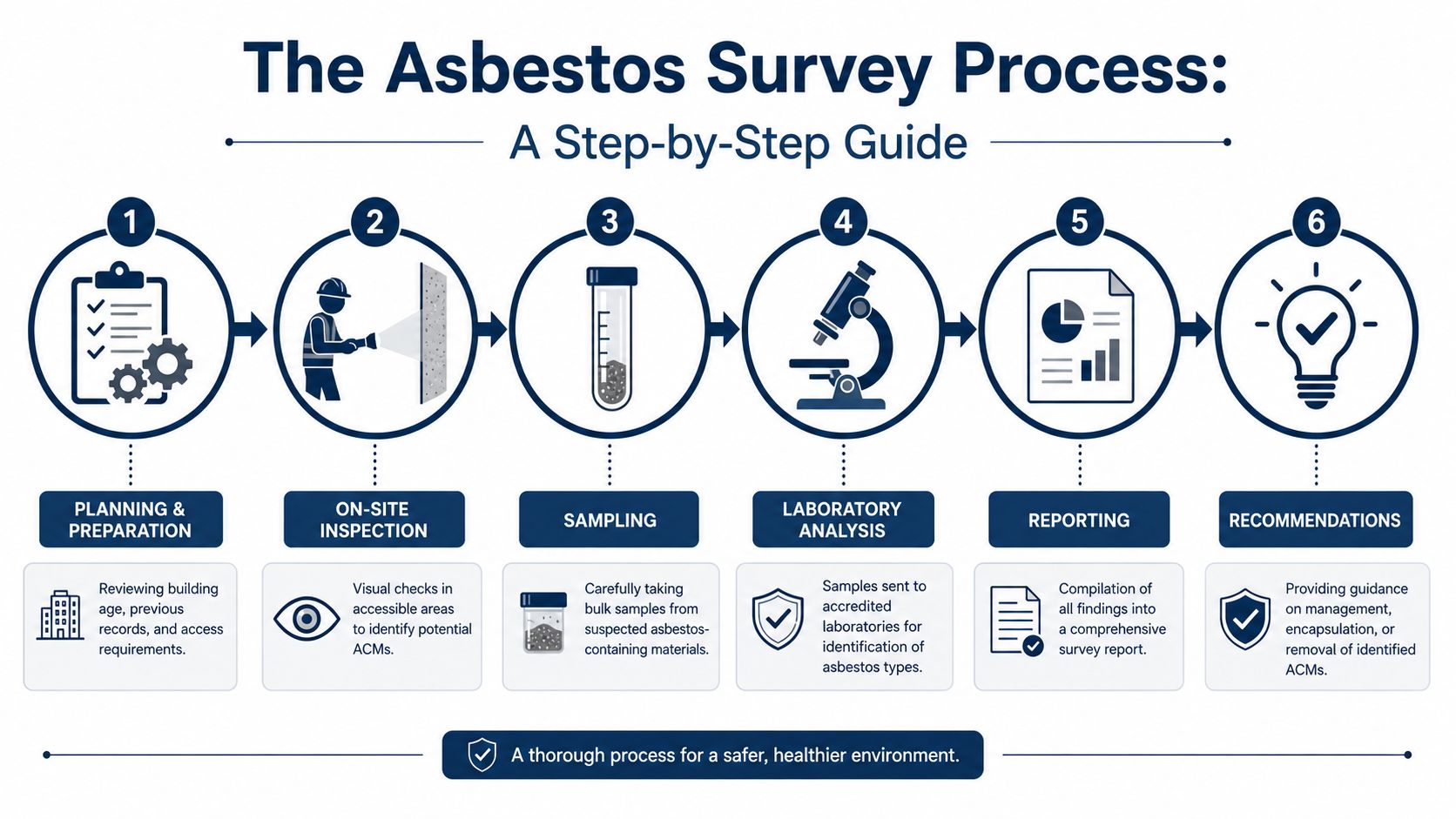
A proper survey starts before anyone steps through the door. The surveyor checks the property age, any previous reports, access problems and the likely construction type. In London, that matters because a 1900s terrace in Lewisham, a post-war flat in Woolwich and a warehouse conversion in Bermondsey do not hide asbestos-containing materials in the same places.
On site, the surveyor inspects the areas that can be reached and records what is visible. Suspect materials may then be sampled for laboratory analysis, but only where access and safety allow it. The workflow is straightforward, locate the suspect material, identify it, record where it is, and note the areas that could not be opened up or fully checked.
A good surveyor does not hide uncertainty. If a void, boxed-in riser or closed-up panel cannot be inspected, the report should say so and explain whether the material is presumed. That matters because the right action depends on whether the material is confirmed, presumed, damaged or likely to be disturbed by future work.
The practical output is a risk-based recommendation. That may be simple management, encapsulation, or removal by the correct class of contractor, depending on the material and condition. The survey is not there to cause panic. It tells you what to do next, safely and in the right order.
A short video walkthrough can help if you want the process in plain language.
What buyers should do: make sure the surveyor explains which areas were inspected, which were not and why. That is where the value is.
For a typical London residential job, expect the surveyor to leave you with a written report, not a vague verbal summary. The report should state what was sampled, what was found and what follows from those findings. If you are buying through Corinthian Surveyors, that is the level of detail you should ask for on any RICS HomeBuyer or Building Survey instruction.
Typical Timescales and Costs
Time depends on access, size and how much sampling is needed. A small flat in Bermondsey with good access moves faster than a larger terraced house in Lewisham with loft, cupboard and service void complications. Lab analysis can also extend the turnaround if multiple samples are taken.
Here's the practical budgeting view for Greater London.
| Survey Type | Turnaround | Cost Range |
|---|---|---|
| Management survey | Usually a short appointment plus report preparation in a few working days | Varies by property size, access and sample count |
| Refurbishment or demolition survey | Usually longer because of more intrusive access and more sampling | Varies by property size, access and sample count |
For a terraced house in Lewisham, expect more time than a flat conversion in Bermondsey if the property has loft spaces, old service routes or awkward access. The main cost drivers are the number of rooms, the level of intrusion, sample analysis and the amount of opening-up needed. If you're under time pressure before exchange or before builders start, book early and leave room for follow-up sampling if needed.
Don't plan a refurbishment start date off the back of a phone call. Wait for the written result, then decide.
Corinthian Surveyors London LTD can quote on a property-by-property basis, which is how this should be done. A quick, accurate quote depends on the actual building, not a guess from a postcode. If you're scheduling a purchase in South East London, build the survey into your timeline before you commit to exchange.
Sample Report Elements and Disclaimers
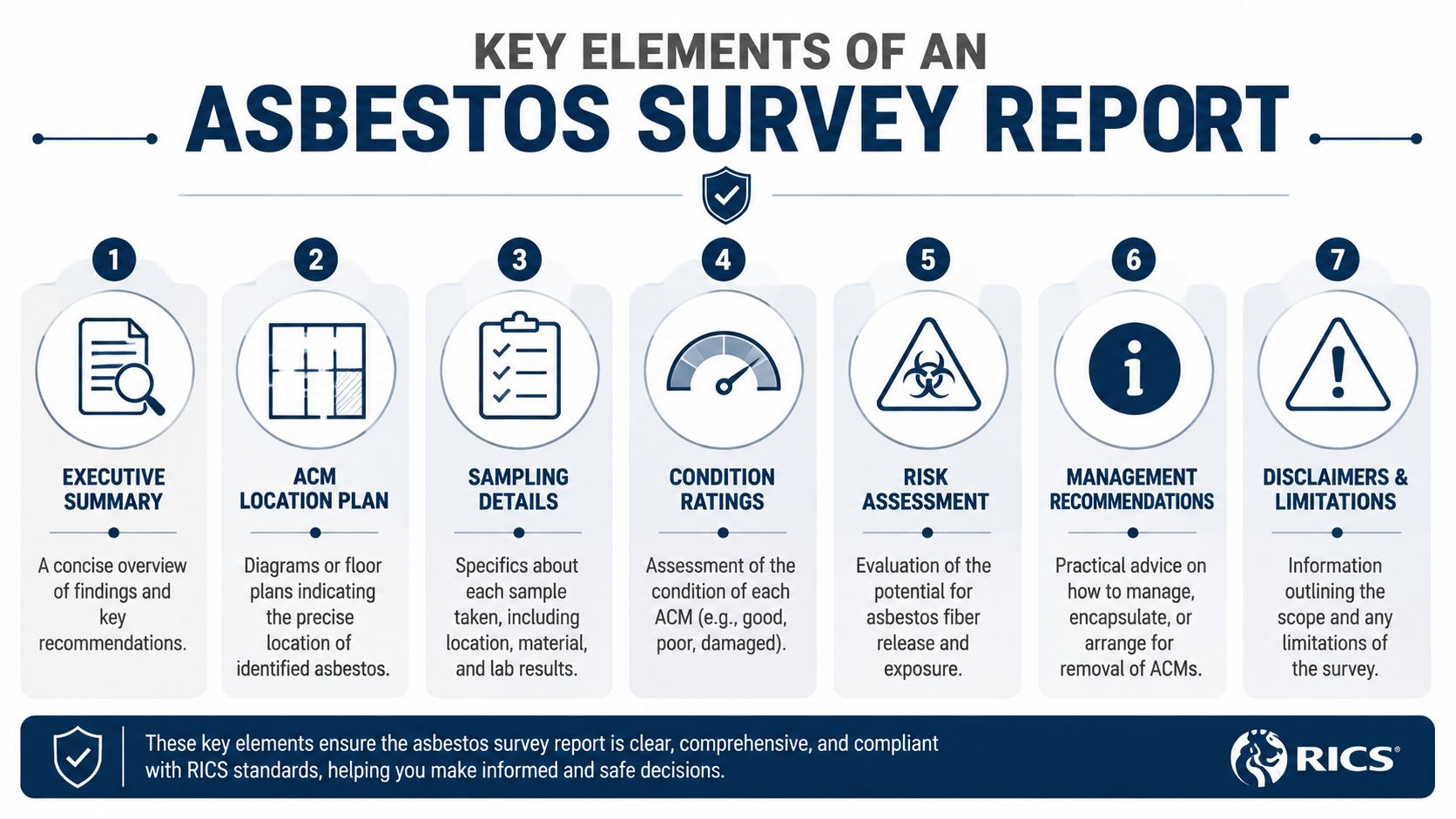
A proper asbestos report should help you make a decision fast. Start with the executive summary, then move straight to the ACM location plan. If the plan does not show exactly where the material is, the report is weak and you will waste time trying to work out what is in each room, riser or cupboard.
After that, read the sampling details and the condition ratings. Those sections tell you what was tested, where it was found, and whether the material is intact, damaged or already breaking down. The risk assessment connects the condition of the material to the chance of fibre release, which is the part that matters if you are buying, letting contractors in, or planning a refurbishment.
The next pages are where buyers often trip up. Read the management recommendations and the disclaimers and limitations carefully. A survey only records suspected ACMs as far as they can reasonably be identified, and where a material is not sampled, it may still be treated as presumed asbestos. HSG264 survey guide
That means no honest report should be treated as an all-clear certificate. If a concealed void was not opened, or a material could not be sampled safely, the report must say so plainly. In Lambeth or Southwark, where converted Victorian stock and split flats are common, that detail matters because buyers often assume a space has been cleared when it has only been partly inspected.
Bottom line: read the caveats as closely as the findings. A report is only as useful as its limitations.
For a buyer, the right question is not whether asbestos exists somewhere in the building. It is where it is, how damaged it is, and what it means for this property. That is the report logic you want before you proceed, renegotiate, or plan the works with a contractor.
FAQs and Next Steps
Do I need an asbestos survey for a flat in Kensington? If the flat was built before asbestos was banned from use, yes, you should assume the risk exists until a proper survey says otherwise. In a flat, the main issue is not just the room you can see, it's the service cupboards, risers and concealed construction.
Can a HomeBuyer Report include an asbestos check? A surveyor can flag obvious suspect materials during a RICS HomeBuyer Survey, but that is not the same as a dedicated asbestos survey with sampling and analysis. If the property raises concerns, ask for a proper asbestos inspection rather than relying on a visual note.
What happens if asbestos is found during remortgage or before works? You deal with it based on condition and proposed disturbance. If you want to recover costs or renegotiate after a survey, read how to negotiate house price after survey.
If you want this handled properly, use an independent RICS surveyor who is not tied to a lender, estate agent or developer. Corinthian Surveyors London LTD is RICS-regulated, CABE-qualified and used to dealing with South East London properties quickly and plainly. Ring 0800 00 16 422 and ask for advice that matches the building in front of you.
Corinthian Surveyors London LTD provides independent residential surveying across London, including RICS HomeBuyer Reports, Building Surveys and practical advice where asbestos is suspected. If you've got a Lewisham terrace, a Bermondsey conversion or a probate property that needs proper eyes on it, visit Corinthian Surveyors London LTD and arrange a survey that tells you what's there and what to do next.