
What Is a Red Book Valuation and When You Need One

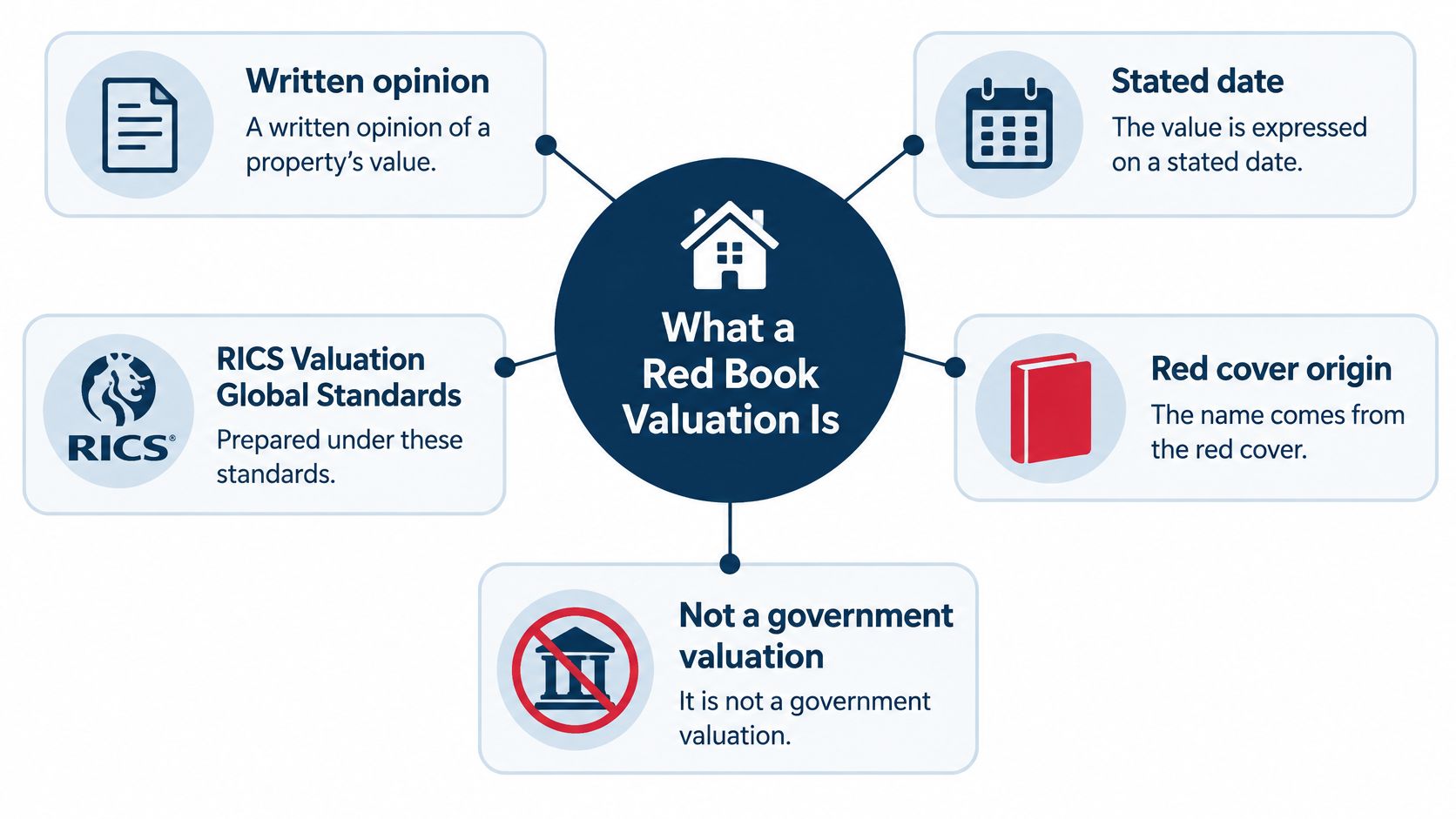
A Red Book valuation is a written opinion of value on a stated date, prepared by an RICS valuer under the RICS Valuation Global Standards and the UK National Supplement.
The common advice is to get a Red Book valuation so you know exactly what your home will sell for. That promises too much. You're buying an accountable professional opinion for a particular purpose, not a guaranteed sale price or confirmation that the building is sound.
Table of Contents
- What a Red Book Valuation Is
- How a Red Book Valuation Differs from Other Figures
- When a Red Book Valuation Is Required
- How a Surveyor Prepares the Valuation
- Market Value and How Firm the Figure Is
- London Homes Where the Evidence Is Thin
- How Long a Red Book Figure Can Be Used
What a Red Book Valuation Is
Say you own a flat in Forest Hill and your solicitor needs a formal valuation. An estate agent's suggested asking price won't necessarily answer the solicitor's question. The valuer must establish which property interest is being valued, for whom and on what assumptions.
Red Book refers to the standards' red cover. It isn't a government house-price tariff. Its value lies in the professional rules behind the conclusion, rather than the appearance of the report.
Why the rules exist
The framework developed after the property boom and collapse of 1972–73, when RICS and the Institute of Chartered Accountants in England and Wales formed a joint working party, leading to Guidance Notes on the Valuation of Assets in 1976, as RICS explains in its history of the Red Book. The problem was inconsistent valuation bases and reporting. Someone reading a valuation needed to understand what the figure represented and how the valuer reached it.
That remains the point. Professional judgement is necessary, but it must be supported by evidence and clear explanations.
Which standards apply
The updated global standards took effect on 31 January 2025, according to RICS's standards update.
The RICS UK National Supplement was published on 19 October 2023, applies to valuation dates on or after 1 May 2024 and was reissued in January 2025 to align references with the global edition. The valuation date determines the applicable standards, not the day you telephone or receive the finished report.
A sound report identifies:
- Purpose and users: Why the valuation is needed and who may rely on it.
- Ownership interest: The freehold, leasehold or other interest being valued.
- Basis and date: What the figure represents and when it applies.
- Investigations: What was inspected and what evidence was considered.
- Assumptions and limits: What the valuer has accepted without verification and what remains outside the instruction.
For an owner in Sydenham or Dulwich, that means a third party can examine the reasoning. You're not left defending a number with no workings.
How a Red Book Valuation Differs from Other Figures
| Document | Prepared by | What it answers | What it does not do |
|---|---|---|---|
| Red Book valuation | RICS valuer under Global Standards and the UK supplement | Opinion of value on a stated basis and valuation date | Investigate condition defects, repair costs or legal title unless included in the instruction |
| Estate agent appraisal | Selling agent | A likely asking price to market the home | Establish a formal basis, independence or reliance by a court, HMRC or a lender |
| Mortgage valuation | Lender-appointed valuer | Whether the property is adequate security for that loan | Advise the buyer or provide a full condition report |
| RICS Home Survey Level 2 or Level 3 | Chartered surveyor | Condition, defects and repair risk | Supply a Red Book value unless valuation is separately instructed |
| Desktop or automated estimate | Model or remote source | A broad price band from recorded data | Provide an inspection or reliably identify lease quirks and local defects |
Formal valuation status doesn't turn a valuation into a condition survey. Equally, an agent's appraisal doesn't become a Red Book valuation because it arrives on headed paper.
An estate agent advises on marketing. That can be useful when choosing an asking price, but the agent may also be seeking the instruction to sell your home. Don't assume their suggested price provides the independent evidence required for a tax or legal matter.
A mortgage valuation can follow Red Book standards
These categories overlap. A mortgage valuation prepared by an RICS valuer can fall under the Red Book framework. The important distinction is who commissioned it and who can rely on it.
A lender's valuation addresses the lender's security. Paying a valuation fee through your mortgage application doesn't turn that report into advice about your proposed purchase.
Buy the report that answers your question, not the report whose name sounds most reassuring.
Condition needs its own investigation
A buyer considering a Victorian terrace in Lewisham may need both a value opinion and a condition survey. The valuation addresses the financial question. An RICS Building Survey Level 3 investigates the building's condition within its agreed scope.
That distinction matters where there's damp at ground level, roof deterioration or evidence of structural movement. A valuation inspection isn't an instruction to diagnose each defect or prepare repair costs. Nor does it replace your solicitor's investigation of the lease, title or permissions.
An automated estimate has a narrower role still. It can help orientate your thinking, but recorded data may not capture a poor conversion, an awkward floor layout or alterations carried out without consent.
Match the document to the decision: marketing price, loan security, formal value or building condition. If you need answers to different questions, agree the separate services before anyone visits.
When a Red Book Valuation Is Required
The same house can need different reports. A valuation for a sale won't automatically satisfy an executor, a housing association or a solicitor dealing with separation.
A formal valuation is appropriate when the person relying on it needs an accountable opinion on an agreed basis. Don't assume every purpose legally requires an identical Red Book report. Confirm the recipient's requirements before commissioning the work.
| Purpose | Usual client | Basis often used | Date point that matters |
|---|---|---|---|
| Sale or purchase | Owner or buyer | Market Value | Evidence must relate to the valuation date, not simply a later offer |
| Probate and inheritance tax | Executor | Market Value on the relevant statutory basis | Fixed at the date of death |
| Capital gains tax | Owner or accountant | Market Value on the relevant tax basis | Often a past tax date, using evidence relevant to that date |
| Matrimonial separation | Solicitor or court-directed parties | Market Value of the interest | The instruction must suit the intended user and required date |
| Shared ownership staircasing | Leaseholder | Market Value as the lease requires | The housing association may specify the instruction and timing |
| Rent review or letting | Landlord or tenant | Market Rent | A rental assessment, not a capital figure |
| Buildings insurance | Owner | Reinstatement cost | A rebuilding assessment, not a Red Book sale figure |
Tax and legal instructions need care
For probate, the valuation concerns the property at the date of death. A later sale may provide useful evidence, but it doesn't automatically establish the earlier value. Changes in condition, marketing and the wider market need consideration.
Our guidance on probate valuations in London explains the practical context for executors. Give the valuer the relevant date and tell them about occupation, tenancy arrangements and changes made since that date.
Capital gains tax work may also require a retrospective opinion. Agree the date with the accountant rather than asking the valuer to choose it from an incomplete account of the transaction.
For matrimonial separation, start with the solicitor's requirements. A privately commissioned report for one spouse isn't automatically suitable for joint reliance or court proceedings.
Not every property figure measures sale value
Staircasing follows the lease and the housing association's requirements. Read those requirements before arranging the instruction, particularly where improvements or report timing are addressed.
Market Rent answers a letting question. Insurance reinstatement addresses the cost of rebuilding, not the amount a buyer would pay for the land and home together. Don't use a sale valuation to set your buildings insurance sum insured.
Name the intended recipient in every formal instruction. That avoids paying for a report which answers the wrong question or cannot be relied on by the person who needs it.
How a Surveyor Prepares the Valuation
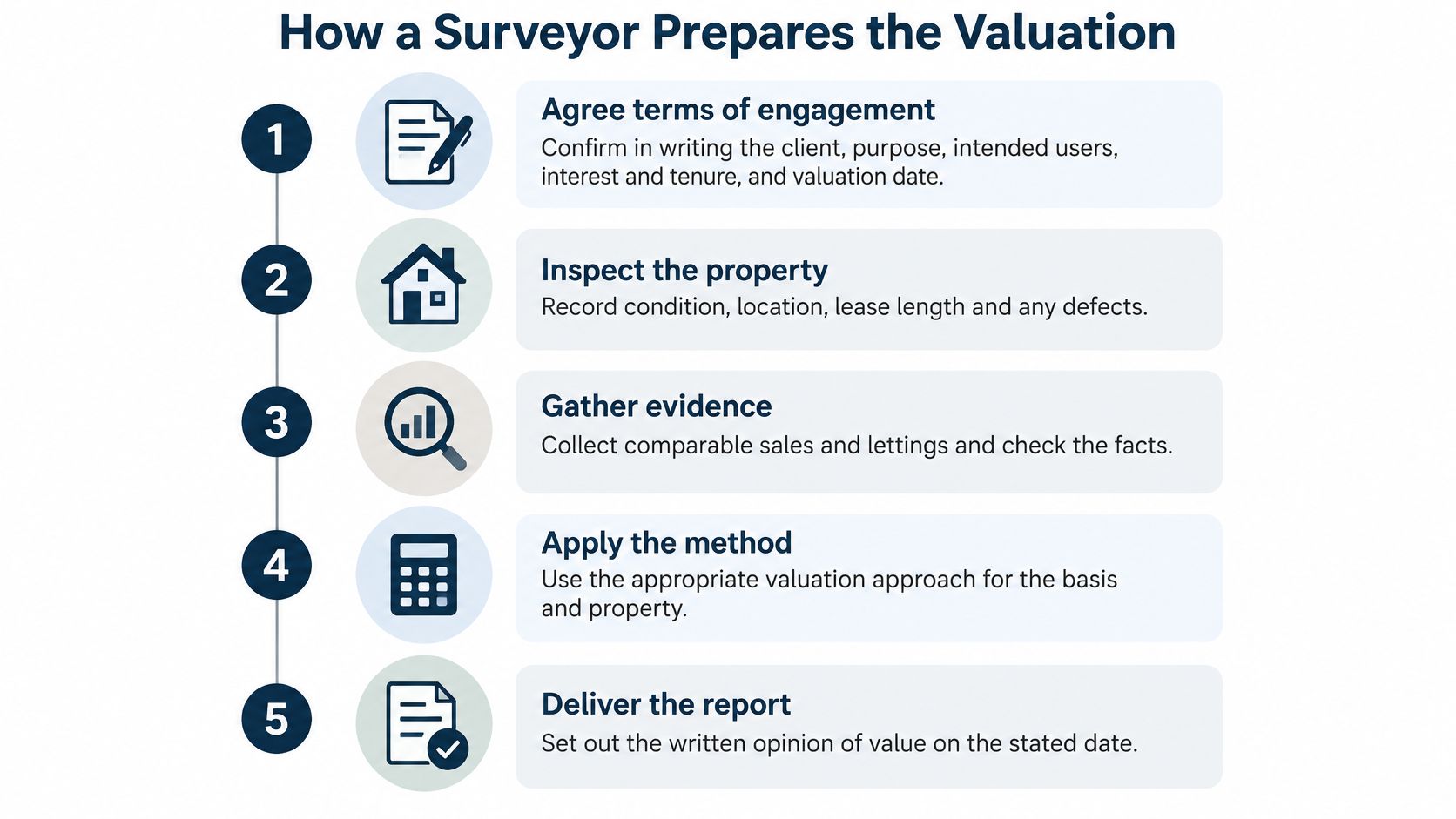
A Red Book valuation begins with a defined question, not a number. The valuer confirms the purpose and valuation date, then gathers evidence relevant to that instruction. The property valuation process shows how these stages fit together.
From instruction to evidence
Agree written terms of engagement.
The terms identify the client, purpose, intended users, ownership interest, tenure and valuation date. Tell the valuer if a solicitor, accountant or housing association has set specific requirements. A report prepared for one purpose may not answer another party's question.Inspect and record limitations.
The inspection records relevant property features within the agreed scope. If the roof void is inaccessible or a room cannot be entered, the report should say so. A flat viewed only from the landing cannot be described as though its interior was fully inspected.Collect and interpret comparable evidence.
The RICS UK valuation supplement supports using recent, relevant evidence from arm's-length transactions. The valuer checks the details rather than treating nearby asking prices as proof of value. In London, lease length, floor level and condition can matter as much as distance. A Brockley flat is not evidence for a Blackheath house without a clear explanation of why the comparison is relevant.
From evidence to a signed opinion
Choose the appropriate method.
Comparable sales are usually the main starting point for an ordinary home. An investment approach may assist with a rented residential property, while a cost approach rarely leads a conventional house sale valuation. The method explains how the valuer has reached the opinion.State assumptions and special assumptions.
An assumption may concern information accepted without independent verification. A special assumption could ask the valuer to consider planning consent that does not yet exist. It must be stated clearly, not hidden inside the figure.Address material uncertainty.
If evidence is limited, the report should explain how that affects the conclusion. Further research or testing may be needed. A precise figure does not make thin evidence stronger.Identify the responsible valuer and sign the report.
The professional taking responsibility must be competent for the property and instruction. RICS Valuers Registration is a relevant credential. You should also know who is acting and whether any conflict of interest needs to be addressed.
Independence matters because the instruction matters. A lender-appointed valuer answers the lender's question. A valuer introduced by an estate agent should explain any relevant relationship and how objectivity is maintained.
Corinthian Surveyors London LTD is an independent firm of RICS Chartered Surveyors and Valuers based in London. Independence does not determine the result. The signed opinion should follow the evidence and address the named purpose, not promise a sale price.
Market Value and How Firm the Figure Is
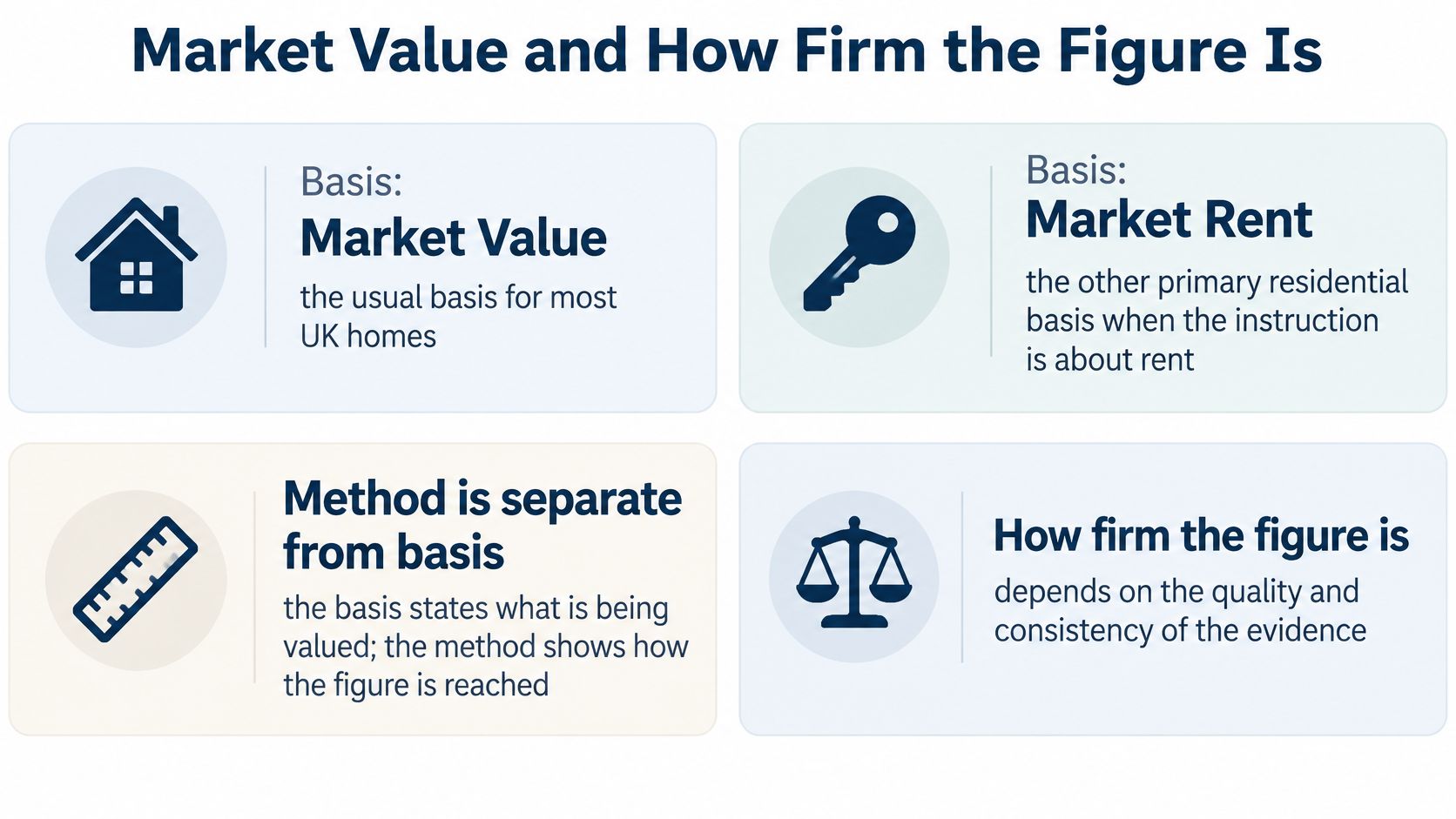
The basis of value and the valuation method are different things. For most UK residential instructions, the basis is Market Value. For a letting instruction, it may be Market Rent.
The RICS UK National Supplement's residential guidance identifies Market Value and Market Rent as the primary residential bases. Market Value concerns the estimated amount the property should exchange for on the valuation date between a willing buyer and willing seller after proper marketing. It assumes an arm's-length transaction with knowledgeable, prudent parties acting without compulsion.
It isn't the owner's target price. Nor is it a figure based on having to sell immediately under pressure. The report should name the basis explicitly, rather than leaving you to interpret an unexplained amount.
Precision isn't the same as certainty
A published RICS discussion of valuation risk and professional judgement gives indicative residential error margins of approximately ±5% where comparable evidence is plentiful, about ±10% for less straightforward property and potentially ±15% for complex, unusual or thinly evidenced assets.
Those are illustrations, not guarantees or automatic tolerances. They aren't a band every valuer must print. They explain why you should assess the strength of the reasoning instead of treating the final digits as proof of accuracy.
Practical rule: A precise-looking figure deserves careful explanation, not automatic confidence.
What to check in the report
- Basis and date: Both should be stated clearly.
- Comparable rationale: The report should explain why the evidence is relevant and how differences affect the conclusion.
- Inspection limits: You should know what the valuer couldn't inspect or verify.
- Property and market risks: Short leases, unusual construction, planning restrictions and scarce transactions should be addressed where relevant.
Our explanation of a house's Market Value helps distinguish that professional basis from a seller's preferred price.
If the market is disrupted, the valuer still has to exercise judgement. The answer isn't to conceal the difficulty or attach an unexplained disclaimer. The report should explain which evidence remains useful and how the uncertainty affects reliance on the conclusion.
London Homes Where the Evidence Is Thin
Consider a hypothetical converted Victorian flat in Brockley with 68 years remaining on its lease. A neighbouring share-of-freehold flat may look similar from the pavement, but its sale price cannot be copied directly. The valuer needs to examine the lease interest, floor level and condition before deciding how useful that transaction is.
A recently modernised New Cross conversion presents another question. New finishes don't establish the quality of the conversion or resolve missing permissions. The valuer needs to distinguish verified facts from information that remains an assumption.
Different buildings create different evidence problems
A listed house in a Blackheath or Greenwich conservation area may retain original windows, lime mortar and features that constrain alterations. A nearby refurbished terrace is weak evidence if the comparison ignores those differences. The issue isn't age alone, but what an informed buyer is acquiring.
For a hypothetical Bromley semi with suspected subsidence, the valuer must explain how that unresolved concern has been treated. A Lewisham terrace with a removed chimney breast and no documented support raises a similar problem. Neither should be valued as though the uncertainty has already been resolved.

The RICS Global Standards make the agreed scope, assumptions and reporting limitations central to how a valuation can be relied upon. Give the valuer lease documents, tenancy details and information about unusual alterations before the inspection. Don't leave a potentially important fact until the report is being signed.
Wider evidence needs stronger explanation
A Bermondsey warehouse flat and a Dulwich cottage belong to different residential markets. A broad London average cannot explain the features buyers consider when choosing between individual homes.
Where close comparables are scarce, the valuer can widen the search and test how sensitive the conclusion is to different inputs. They must explain the compromises rather than suggest the wider evidence is a perfect match.
The UK House Price Index reports collection records a methodology improvement introduced in August 2025 and applied from January 2025 to reduce revisions. That illustrates a practical problem with retrospective work: later information must not be treated as though it was available at an earlier valuation date.
Ask why the chosen properties are comparable. Being nearby is a starting point, not a complete explanation.
How Long a Red Book Figure Can Be Used
A Red Book figure is tied to its valuation date and stated purpose. It is a professional opinion at that point in time, not a guaranteed sale price or a figure that remains current through to exchange or completion.
For a current transaction, the intended recipient may require an updated valuation or a new report. A historic tax valuation remains tied to its specified date, even if the report is prepared later. If the intended user or purpose changes, ask the valuer to agree the correct instruction before relying on the old report.
Frequently asked questions
Does a Red Book valuation expire?
There is no single useful lifespan for every instruction. Whether a report can still be used depends on its purpose, the recipient's requirements and any changes to the property or market. An unchanged building does not make an old valuation a current opinion.
Will different RICS valuers reach the same figure?
Not necessarily. The RICS Red Book framework sets requirements for competence, terms, investigations, assumptions and reporting. It does not set a standard house-price tariff. If valuations differ, compare the evidence and reasoning behind each figure before concluding that one must be wrong.
What should I send before booking?
Provide the property address, the purpose and the required valuation date. Include the lease, if relevant, and any written requirements from the intended recipient. Explain who occupies the property, whether it is tenanted, and whether alterations have been made. This helps the valuer agree the scope before inspection.
Choosing the instruction
Corinthian Surveyors London LTD is an independent firm of RICS Chartered Surveyors and Valuers based in Forest Hill, London. Led by surveyor Clive, the firm has over 30 years' experience in the built environment.
The firm provides market valuation reports for homes being sold across London. Before booking, establish who needs the report and what decision it will support. Send the property address, required valuation date and intended recipient so the firm can discuss the right instruction. A valuation for a sale is a dated opinion for that purpose, not a condition survey or a promise of the eventual sale price.