
UK Property Valuation Process: Steps, Types and Costs
You have two figures for the same house and they don't agree. One came from the agent who wants the instruction. The other came from a lender who only cares whether the loan is safe. Or you're an executor, and the asking price on a similar terrace in Lewisham looks nothing like the figure your solicitor says the tax return needs.
That gap is normal. A valuation is an opinion of value on a stated date, for a stated purpose. Change the date, the purpose or the evidence and a second competent valuer can reach a different figure and still be right.
The property valuation process is the route from that instruction to a written figure you can test. Know the stages and you can see where a number was built, and where it can be challenged.
Table of Contents
- How the Property Valuation Process Runs From Instruction to Figure
- Market, Mortgage and Probate Valuations Compared
- What Valuers Check on Site and the Documents to Gather
- How Comparable Sales and Market Factors Set the Figure
- How to Challenge a Valuation You Disagree With
- Timescales, Fees and Choosing the Valuation Route
- Questions People Ask About a Valuation
How the Property Valuation Process Runs From Instruction to Figure
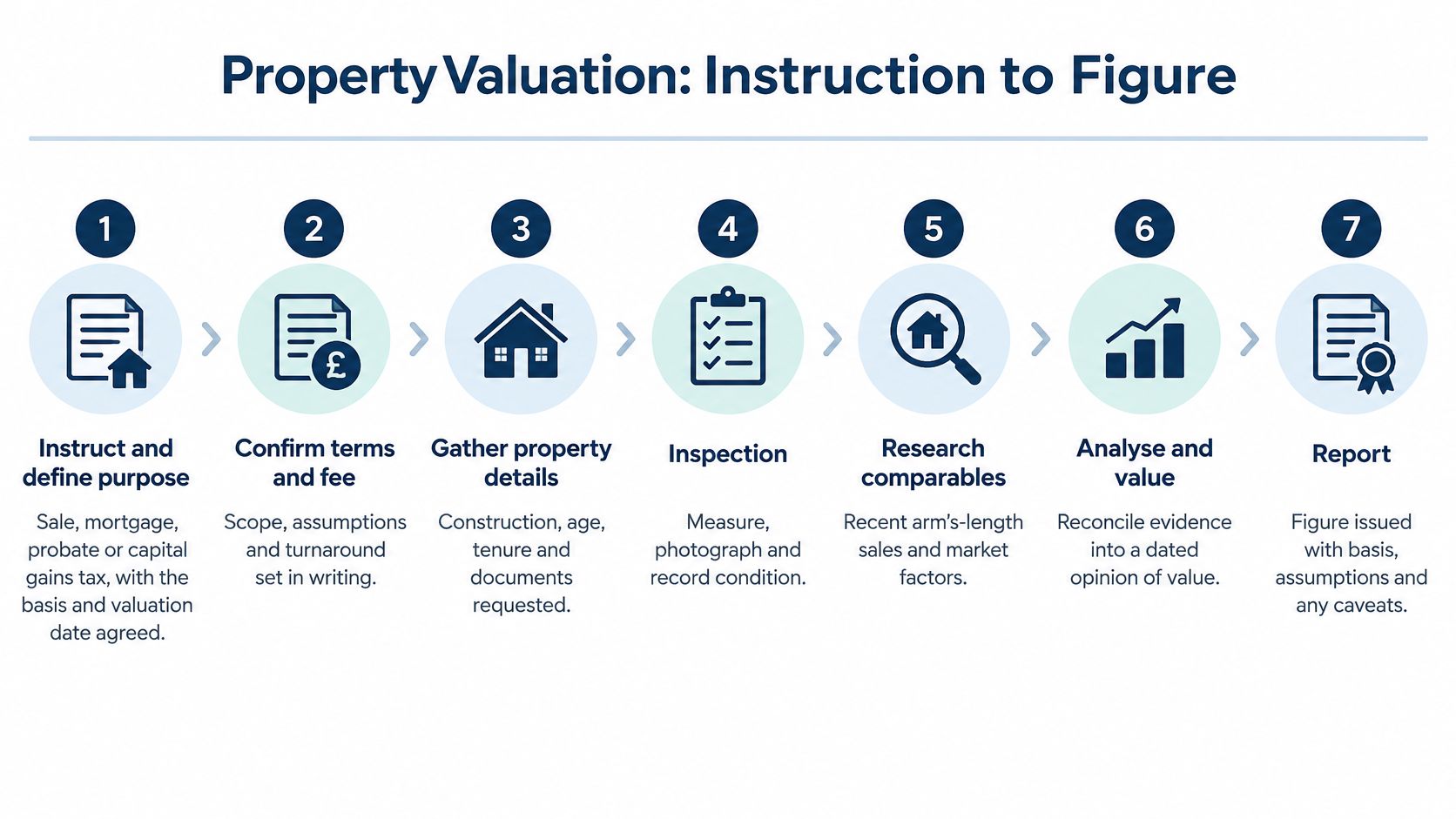
You commission a figure, then you need to know which decision each stage locks in. Seven stages run from instruction to a written number. Miss one and the figure is harder to defend, because you cannot see what was assumed.
- Instruct and define the purpose. Sale, mortgage, probate, capital gains tax or a separation. The basis changes with the purpose, so name the decision the figure has to support before anyone inspects.
- Fix the valuation date. That is the day the figure describes, not the day you read the report. A second opinion on a later date is not the same test.
- Send the particulars. Tenure papers, floor plans and a note of recent works. Missing papers force assumptions, and assumptions widen the range you can still call reasonable.
- Inspect inside and out. Construction, condition, extensions and how easy the place is to reach all feed the adjustments. If the loft or an outbuilding was closed, that limit belongs in the report.
- Gather and verify sales. You want several recent arm's-length transactions, plus what buyers are doing now, not one portal price. A listing is an asking price. It is not a completed sale.
- Adjust the evidence. Size, condition, lease and location. A raw price two streets away is not yet a comparable. Ask which adjustments moved the figure.
- Report the figure in writing. State the basis, the date and the assumptions. If it is not written, you cannot test it against another opinion.
Why the report has to follow a standard
Every stage sits inside the RICS Red Book. After the boom and collapse of 1972 to 1973, valuers were criticised for using different bases and inconsistent reports. RICS and the Institute of Chartered Accountants in England and Wales set up a joint working party in 1973, and the first edition of The Valuation of Assets followed in 1976. That work became the RICS Valuation Global Standards, known as the Red Book. It expects objectivity, competence, transparency, ethics and professional judgement.
Those standards apply to UK valuations and are kept under regular review. For a house or flat, that is why a credible report goes further than a view on an asking price. It names the basis, uses evidence, discloses assumptions and is prepared impartially by a competent professional.
Practical rule: If a lender, a solicitor or HMRC will rely on the figure, the valuer should have no tie to the agent, the lender or the developer.
Timescales follow access, documents and purpose. Ask for a date when you instruct. Do not assume a week because a neighbour in Sydenham got one. Corinthian Surveyors London LTD is an independent firm of RICS Chartered Surveyors and Valuers based in Forest Hill, and takes instructions on that basis across London.
Have these ready before you instruct:
- Purpose and date: the decision the figure supports, and the day it should describe.
- Tenure pack: title register, title plan and, for a flat, the lease.
- Works file: consents, guarantees and invoices for extensions, lofts and kitchens.
- Access: who can open the door, including the loft and any outbuilding.
Market, Mortgage and Probate Valuations Compared
Pick the valuation by who will rely on it. The same bricks can support four different figures because each job asks a different question.
| Valuation type | Usually needed by | Valuation basis | Main limitation |
|---|---|---|---|
| Market valuation | Sellers, buyers and owners | Likely open-market price at the valuation date | Opinion of value, not a guaranteed sale price |
| Mortgage valuation | Lenders | Suitable security for the loan | Not a full condition survey |
| Probate valuation | Executors and HMRC | Open-market value immediately before death | Must reflect the date of death, not the current asking price |
| Capital gains tax valuation | Owners reporting a disposal | Market value at the disposal date | Must reflect the owner's actual share where jointly owned |
Which figure you actually need
A market valuation estimates the price the property would likely achieve if sold on the open market at the valuation date. It suits a seller in Brockley setting a reserve, a buyer in Greenwich testing an asking price, or an owner who wants a realistic number before a separation. It isn't a promise that a buyer will pay it.
A mortgage valuation is the lender's check that the property is suitable security for the loan. It isn't a condition report. Between April and June 2024, six participating lenders recorded approximately 44,000 mortgage valuations for flats across the UK, and an EWS1 form or equivalent was required in 9% of them, according to government lender data. Those figures cover regulated mortgage, buy-to-let and second-home applications. They exclude cash purchases and they aren't a count of mortgages granted. EWS1 paperwork, developed by RICS, UK Finance and the Building Societies Association, deals with external-wall fire safety, especially on higher-rise homes with cladding. Nine in ten flat valuations didn't need one. That still doesn't mean the lender looked at the roof, the damp or the lease.
If you're buying, commission an independent RICS HomeBuyer Report or Building Survey alongside the lender's valuation. Age, non-standard construction, a complicated lease or an external-wall system can all change value and future cost. A mortgage surveyor's valuation answers the lender's question, not yours.
A probate valuation uses open-market value immediately before death, without a discount because the whole estate is being sold together. The current asking price on a similar house in Catford is the wrong anchor.
A capital gains tax valuation uses market value where the disposal wasn't at arm's length or was to a connected person. HMRC's land and leases guidance requires the figure to reflect the asset as it existed on the valuation date. If you own a share, the valuer assesses that undivided share, not the whole house.
When a lender, HMRC, a court or a solicitor will rely on the number, instruct a valuer whose report states the basis, the date and the evidence.
What Valuers Check on Site and the Documents to Gather
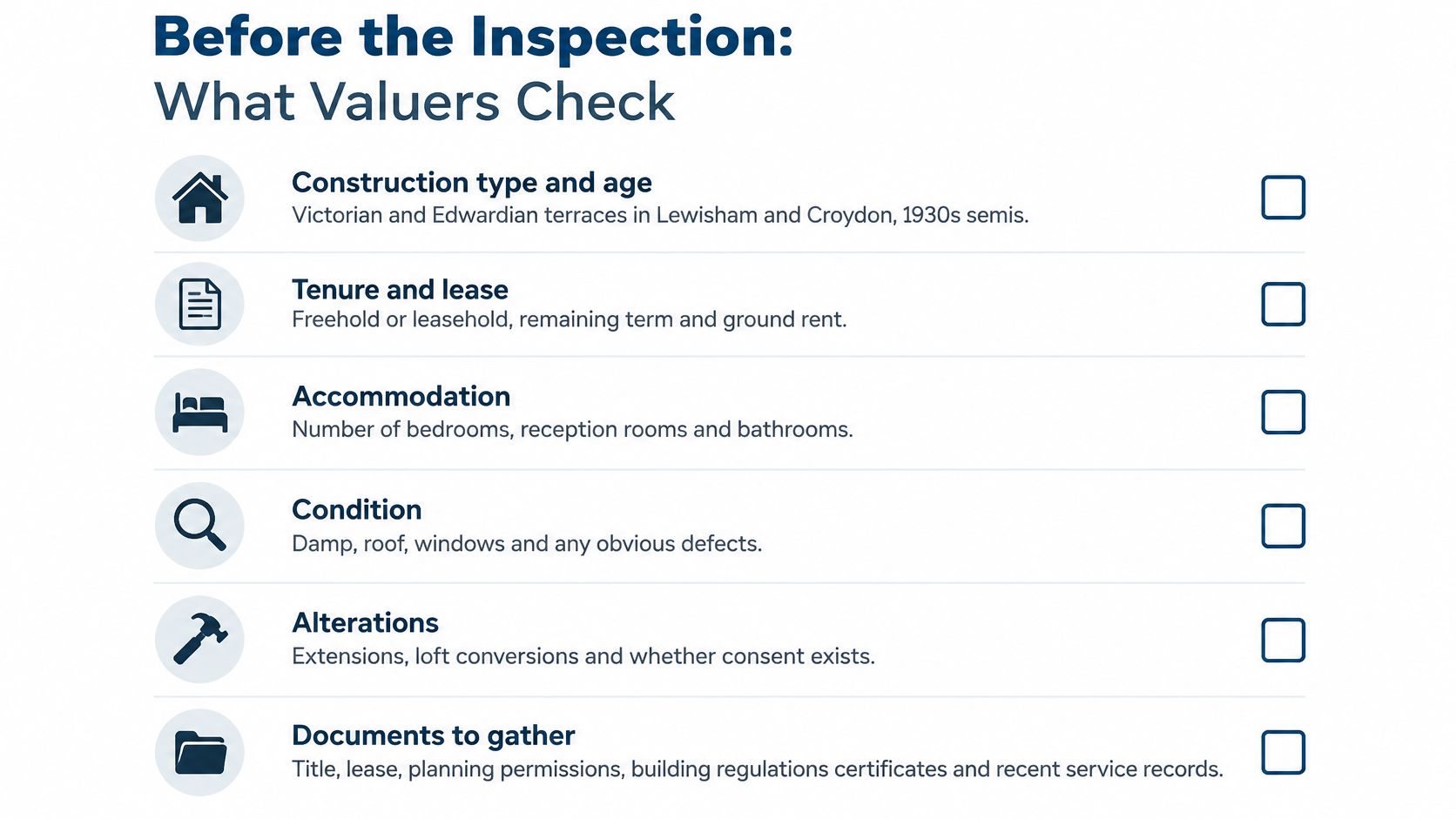
Treat the visit as a checklist you can prepare for. What we record on site is what later justifies an adjustment up or down.
Construction and condition
Start with age and construction, because the risks aren't the same street to street.
- Victorian and Edwardian terraces in Lewisham and Croydon often hide movement, altered openings and old services. A crack over a bay is a value point, not a decorating job.
- 1930s semis in Bromley and Beckenham tend to throw up roof spread, dated wiring and shallow foundations on shrinkable clay.
- Warehouse conversions in Bermondsey bring lease length, service charges and how the block was built.
Outside, look at roof coverings, chimney stacks, gutters and ground levels. Inside, note rising or penetrating damp, timber decay and cracks that may point to subsidence or structural movement. Each one can pull the figure down once a buyer prices the repair.
Period houses in Forest Hill, Dulwich and Blackheath still carry original lead pipework, lime mortar and lath and plaster. A chimney breast taken out without proper support is a defect and a value issue. Say so before the visit. Finding it on site, with no engineer's letter, usually means a cautious figure.
Flats, flood and the file
For a flat in Clapham, Battersea or a taller block, note the external-wall system and whatever fire-safety paperwork the landlord holds. Lenders treat that as a marketability question, not a box-ticking exercise.
Streets close to the Thames need a separate note on flood exposure. RICS-published research on the Thames Estuary found energy-efficiency indicators were consistently significant drivers of value, while flood-exposure and adaptation-zone indicators were weaker or statistically insignificant. Estimated portfolio value losses ranged from 6% to 13% under moderate mid-century scenarios and approached 25% under more severe trajectories. Current sold prices can reflect confidence in current defences rather than the long-term cost of living with them. There isn't one prescribed forward-looking climate adjustment, so a valuer should separate current evidence from that risk and say where the evidence runs out. Insurance availability, mortgageability and future buyer resistance belong in the report as caveats, not as a made-up discount.
Gather the papers before the inspection. Missing paperwork slows the job and weakens the figure.
- Title register and title plan: confirm what is owned, including rights and restrictions.
- Lease, unexpired term and ground rent: a short lease changes the buyer pool and the price.
- Service-charge accounts: a high or rising charge on a Deptford or Rotherhithe flat is a real deduction.
- Planning consents and building-regulation approvals: an unconsented loft is not the same as a lawful extra bedroom.
- Guarantees, floor plans and invoices: recent works only support value if you can show what was done.
How Comparable Sales and Market Factors Set the Figure
A valuation is a dated opinion of value. It isn't a guaranteed sale price, and it isn't the asking price in the window.

The comparable method is strongest with several recent arm's-length sales that closely resemble the subject. RICS guidance on valuation methods says raw transaction data has to be turned into evidence in two stages. First, put the sales on a common measurement basis. Second, analyse the differences. One sale, however convenient, isn't enough, and the evidence should be recorded so a lender or a solicitor can follow it.
Normalise first, then adjust
Before any conclusion, the valuer normalises floor area, plot size, tenure, lease length, condition and transaction date. Only then come the adjustments for location, specification, size, condition, lease terms, incentives, energy efficiency and market movement.
A sale two streets away in Dulwich can carry a longer lease, a lower service charge or a better refurbishment. Its raw price will mislead you if you treat it as a twin. The same trap sits in a postcode average for a short-lease flat in Peckham or a house on a noisy stretch of the South Circular.
| Adjustment | Usual effect on value | London example |
|---|---|---|
| Lease length | Shorter unexpired term lowers value, with a sharper effect once the lease falls below about 80 years | A flat in Balham with 72 years left, set against a similar flat with 110 years |
| Condition and refurbishment | Dated or defective condition lowers value, recent works support it | A sale with a new kitchen and bathroom compared with an unrenovated Victorian flat |
| Floor area | Compare on value per square metre so larger homes are compared fairly | A three-bedroom house compared with a two-bedroom comparable |
| Location | Street, noise, transport and flood exposure shift value | Two streets apart in Dulwich with different traffic or flood risk |
| Energy efficiency | Better performance supports value and buyer demand | A newly insulated home compared with a draughty period house |
| Incentives | Seller contributions reduce the net price paid | A sale price reduced by a contribution towards buyer costs |
| Market movement | Time adjustment where prices have moved since the sale | A comparable agreed a year before the valuation date in a rising market |
RICS guidance on professional judgement treats judgement as a check on the evidence, not a substitute for it. The valuer has to test information from the owner against public records, and test whether the sale was at arm's length with genuine market exposure. An old registered price isn't automatically representative, because conveyancing and registration lag the date the price was agreed.
Why a sound figure can miss the sale price
Three things pull a defensible valuation away from the price you later achieve.
The UK House Price Index is based on completed transactions, which typically take six to eight weeks to reach completion, and the latest 12 months of volumes stay subject to revision. Many of the prices on the register were agreed months earlier. May 2026 recorded 98,000 residential transactions, 16.6% higher than May 2025, so the pool of evidence can shift quickly. In a localised market a similar sale may barely exist, and the report should say so.
Market value is not an asking price, and it isn't an estate agent's marketing appraisal. An appraisal is there to win the instruction. A valuation is there to be reviewed.
Ask for the adjusted comparable list and the valuation date. Together they show how the figure was built. A clear valuation report example sets out selection, adjustments, checks and the uncertainty around the number. If the report only gives you a single figure and a postcode, you can't test it.
How to Challenge a Valuation You Disagree With
A challenge changes the figure only when the evidence changes. Arguing that the number "feels low" doesn't. Work in this order, because the early steps are cheap and they catch most of the errors.

- Read the basis, the date and the assumptions. A probate figure dated at death will not match a market figure dated today. I would start here before I argued with the number. A wrong date explains a lot of angry phone calls.
- Check each comparable. Was it arm's length, a similar size, the same tenure and a similar condition? A refurbished house in Blackheath isn't evidence for an unmodernised one in Eltham.
- Check the property details used. Floor area, lease length, works, defects and flood exposure. A missed bedroom or a lease misread by twenty years moves the figure on its own.
- Put questions in writing. Ask for the adjustments and the evidence, not a different number. A written reply is what you can show a solicitor.
- Supply what was missing. Planning consents, the lease and invoices for recent works, then ask for a review. New facts are the only reliable route to a revised figure.
- Instruct a second independent RICS valuer if the disagreement remains. Check RICS membership and Valuers Registration Scheme status before you pay a fee. Independence matters here: no tie to the lender, the agent or a developer.
- Use the RICS complaints route only where the valuer is RICS regulated and the error is material. A difference of professional opinion, properly evidenced, isn't automatically a complaint.
A mortgage valuation is the lender's decision. Ask the lender for its reasoning rather than treating the panel valuer as your adviser. You can still commission your own market valuation if you need a figure for a price negotiation.
Challenge the date and the basis first, then a comparable that isn't really comparable, then a fact about your own property that the report got wrong.
Timescales, Fees and Choosing the Valuation Route
A buyer who needs a figure before exchange, and an executor facing a tax deadline, are not on the same clock. The deadline decides the route, and it decides how soon you instruct.
For probate, the figure is the price the property might reasonably be expected to fetch if sold on the open market at the relevant time. That basis does not assume a reduction because the whole estate is being sold together. For a death, the point is immediately before death, though some value changes caused by the death may also need to be considered. HMRC's Inheritance Tax Manual states that Inheritance Tax is generally due six months after the end of the month in which death occurs. Instruct early. Waiting for a buyer to test the market on a house in Bromley or Orpington does not produce the date HMRC needs.
For a London sale or purchase, pair a market valuation with an RICS HomeBuyer Report or a Building Survey where the home is older, is a flat, or sits on a flood-sensitive street. The valuation answers price. The survey answers what that price should survive. I would not treat those two figures as rivals. One prices the home as it stands. The other shows defects that may change what you can afford to pay. Test the valuation against the decision in front of you: a sale price, a share purchase, or a tax return. If the date or the basis does not match that decision, the figure can be defensible and still be the wrong one to use.
Shared ownership and what to ask about fees
For Right to Shared Ownership, an official valuation sets the cost of the extra equity, based on what the home would cost if sold on the open market, not the original price or the tenant's existing share. The tenant guidance says the landlord should obtain that valuation within six weeks after being notified of the affordability-assessment outcome, and it is usually valid for three months. A delayed purchase can outlast that period, and the home then has to be valued again. The figure normally goes to the tenant and to the mortgage adviser, so build the three months into the timetable. If exchange sits outside that window, budget for a fresh valuation rather than relying on an expired one.
Timescales depend on access, documents and purpose. Ask for a report date at instruction. A flat with a short lease and missing management accounts will take longer than a freehold house with a clear file.
Fees depend on the property, the purpose and access, so ask each provider for a fixed quote per property in writing. What a house valuation costs should be clear before you instruct, not after the report lands. A solicitor should ask for the basis, the date and the comparables before relying on any figure. That written pack is how you test the number. An open-market figure dated today answers a different question from a probate figure dated at death.
Corinthian Surveyors London LTD is an independent firm of RICS Chartered Surveyors and Valuers in Forest Hill. Reports set out the basis and the evidence so you can test the figure. Contact the firm through its website and say which decision the valuation has to support.
Questions People Ask About a Valuation
Why can two correct valuations differ?
They can describe different dates, different purposes or different evidence. A figure for a lender's security isn't the same job as an open-market figure for a sale, and a thin set of local sales leaves more room for judgement. Ask each valuer for the date, the basis and the adjusted comparables before you decide one of them is wrong.
Is the lender's valuation enough before I buy?
No. It checks whether the property is suitable security for the loan. It doesn't set out damp, roof defects, lease problems or the cost of putting them right. If those could change what you pay, you still need your own survey.
How do I tell a valuation from an agent's appraisal?
A valuation names a basis and a date, uses verified sales and states its assumptions in writing. An appraisal is a marketing view, usually aimed at winning the instruction. Use the appraisal to plan a campaign. Use the valuation when a solicitor, a lender, a court or HMRC will rely on the number.
Corinthian Surveyors London LTD prepares independent residential valuations for sales, probate, tax and separations, with the basis, the date and the evidence set out so you can test the figure. We also carry out RICS HomeBuyer surveys and building surveys where condition should sit alongside price. Visit Corinthian Surveyors London LTD and tell us the decision the valuation has to support.