
What Is a Level 3 Survey? a 2026 Guide
A RICS Level 3 survey, also called a Building Survey, is the most detailed residential survey in the UK. It pairs a thorough physical inspection with a detailed report that explains defects, their likely causes and repair options.
If you are buying a Victorian terrace in Lewisham, a converted flat in Bermondsey or a heavily altered house in Dulwich, this is the survey that tells you what you are really taking on. A mortgage lender's valuation will not do that job. You need a survey that gets under the skin of the place.
Table of Contents
- What a RICS Level 3 Survey Actually Is
- How Level 3 Compares to Level 1 and Level 2 Surveys
- What the Inspection Process Involves
- Understanding Typical Findings and Report Terminology
- When You Genuinely Need a Level 3 Survey
- Costs, Timescales and How Corinthian Surveyors Delivers
- Frequently Asked Questions About Level 3 Surveys
What a RICS Level 3 Survey Actually Is
You buy a flat in Peckham. The walls look tired, the loft has been altered and the chimney breast has gone downstairs. That is the sort of property that needs a RICS Home Survey Level 3.
RICS defines Level 3 as the most detailed residential survey. It gives you a thorough inspection and a detailed report. The surveyor looks at the materials used, visible defects, likely remedial options and future maintenance. They also inspect concealed areas if they can be opened safely or are normally used by occupiers. Services are observed, not tested. That is the right line for a domestic survey RICS Level 3 scope of inspection.
London is full of homes that hide their problems well. Victorian terraces in Lewisham, Edwardian houses in Dulwich, warehouse conversions in Bermondsey and altered homes across Greenwich and Southwark often look tidy from the street. The full picture appears once someone starts tracing what has been changed, what has been covered up and what is likely sitting behind the paint. A cheaper survey often stops at the surface. A Level 3 keeps going until the defects make sense.
Practical rule: If the home is older, altered, non-standard or already showing signs of failure, a Level 3 survey is the sensible choice.
A Level 3 survey is there to tell you what the property is made of, what is going wrong and what that means for you as the buyer. It gives you proper diagnosis. That matters where safety, price or renovation plans could be affected by hidden defects.
If you want the fuller picture of how it sits within the wider survey family, read our guide to what a building survey is.
Corinthian Surveyors London LTD treats Level 3 work as a fact-finding exercise. That is the right approach.
How Level 3 Compares to Level 1 and Level 2 Surveys
The easiest way to think about the three RICS home survey levels is this. Level 1 is for condition only. Level 2 is for most standard homes in reasonable order. Level 3 is for places where you need proper diagnosis, not just a quick look and a traffic light score.
The difference is not just wording. It is how far the surveyor goes, how much they interpret what they see and how much detail you get back in the report. A mortgage valuation does none of that. It protects the lender. It is not a buyer's survey, and it should never be treated as one.
RICS Home Survey Levels Compared
| Feature | Level 1 Condition Report | Level 2 HomeBuyer Report | Level 3 Building Survey |
|---|---|---|---|
| Main purpose | Basic condition overview | Detailed but still concise home survey | Detailed inspection and diagnostic report |
| Inspection depth | Limited visual inspection | Visual inspection of accessible parts | More intrusive where safe and permitted |
| Best for | Simple, modern, conventional homes | Standard homes in reasonable condition | Older, altered, non-standard or poorer-condition homes |
| Defect reporting | Broad condition rating | Condition ratings with practical comment | Cause, remedial options and maintenance implications |
| Level of analysis | Low | Moderate | High |
A Level 1 survey is the lightest touch. A Level 2 HomeBuyer Report is the common choice for newer or conventional houses where the main question is, “Is there anything obvious I need to know?” A Level 3 goes further because it is built for uncertainty. That is why it suits a tired Victorian in Catford more than a neat mid-century semi that has had no serious alterations.
The other common confusion is the valuation. A lender's valuation is there to support the mortgage decision. It is not there to tell you whether the roof is failing, whether the drainage is poor or whether there is hidden structural movement. If you want that level of insight, you need a proper survey what is a RICS survey.
A survey is for your risk. A valuation is for the bank's risk. They are not the same thing.
The practical result is simple. If you are buying a conventional flat in good order, Level 2 may be enough. If the place is older, modified or giving you warning signs already, Level 3 is the safer bet. I would rather explain that plainly now than watch you pay twice later.
What the Inspection Process Involves
A proper Level 3 survey is not a quick wander round with a clipboard. It is a structured inspection from the roof down to the drainage, with the surveyor spending longer where the building needs it.
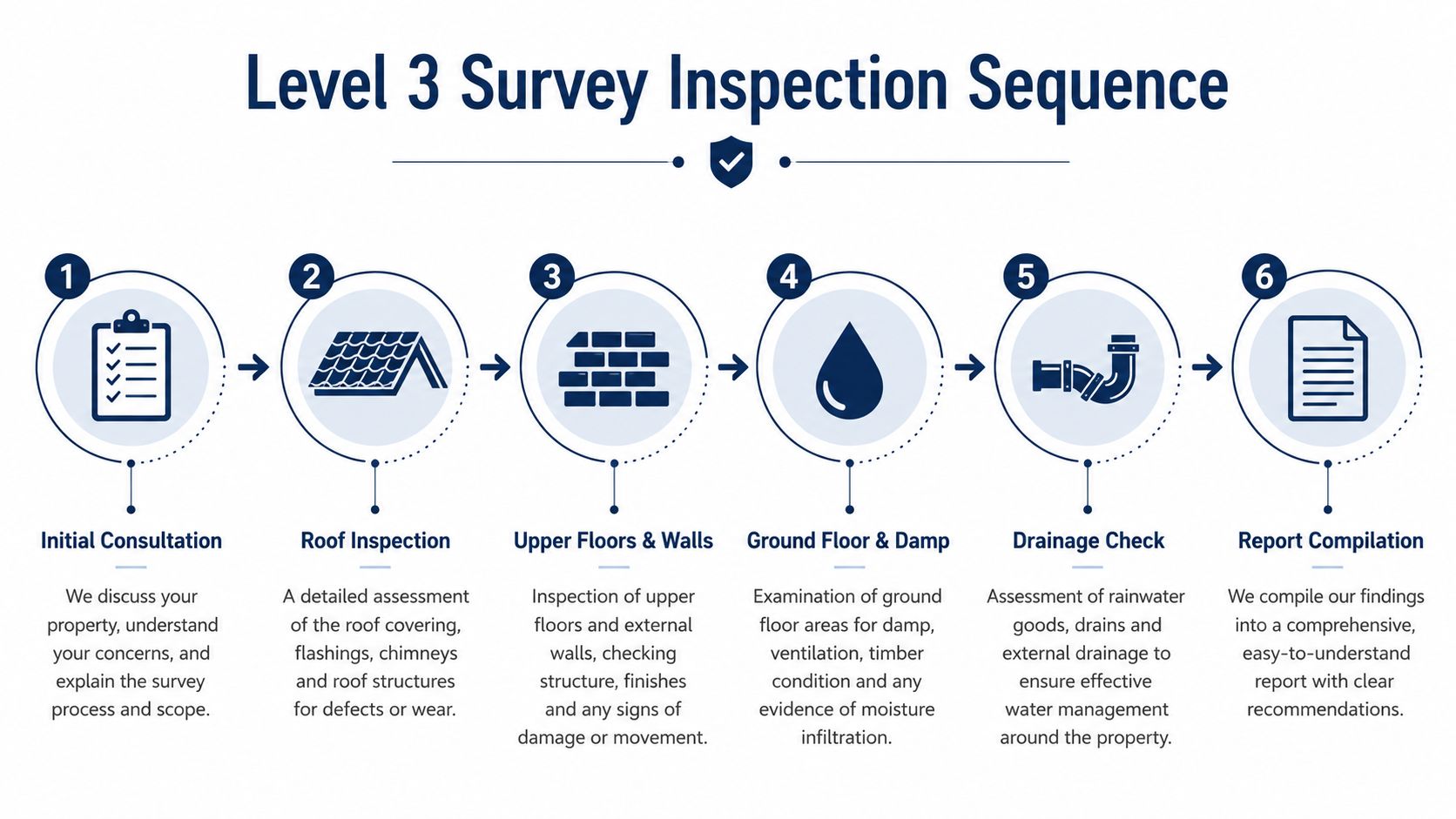
The process usually starts with the overall form of the building. Then the surveyor checks the roof, the external walls, the openings, the internal structure, the floors, the visible services and the drainage arrangements. The order matters because defects in one area often point to trouble somewhere else.
What gets looked at on the day
A Level 3 surveyor will inspect the inside and outside of the main building and any permanent outbuildings. RICS also allows a more intrusive sequence where it is safe and permitted. That can include entering roof spaces, lifting small corners of coverings to identify roof build-up, lifting accessible inspection chamber covers and checking visible services in normal operation RICS Level 3 description.
What the surveyor will not do is just as important. They will not test electrical or gas installations. They will not move heavy furniture. They will not damage the property to satisfy curiosity. This is a survey, not an invasive investigation.
If drains are a concern, a surveyor may flag the need for specialist follow-up. For a useful comparison on that sort of next step, the guide to diagnosing blocked drains gives a good sense of why drainage issues often need a closer look than a visual check alone.
How to prepare the property
Access is everything. If the loft is blocked with stored items, if the inspection chambers are buried or if you have no way to get into certain rooms, the surveyor can only report on what they can see. That limits the value of the inspection.
Practical rule: A Level 3 survey gives you more only if the surveyor can actually get to the areas that matter.
That is why a good surveyor will ask questions before the visit and will want to know about extensions, leaks, recent works and any known defects. A thorough inspection is no substitute for a sensible conversation before the day.
Understanding Typical Findings and Report Terminology
A Level 3 report should read like a diagnosis, not a puzzle. If you cannot see what is urgent, what can wait, and what needs a specialist opinion, the report has failed you.
In older London homes, that matters even more. A Victorian terrace in Peckham, a converted flat in Greenwich, or a house that has been altered several times can hide problems that a cheaper survey will only skim past. A proper Level 3 report should spell out what the surveyor saw, what it probably means, and how serious it is.
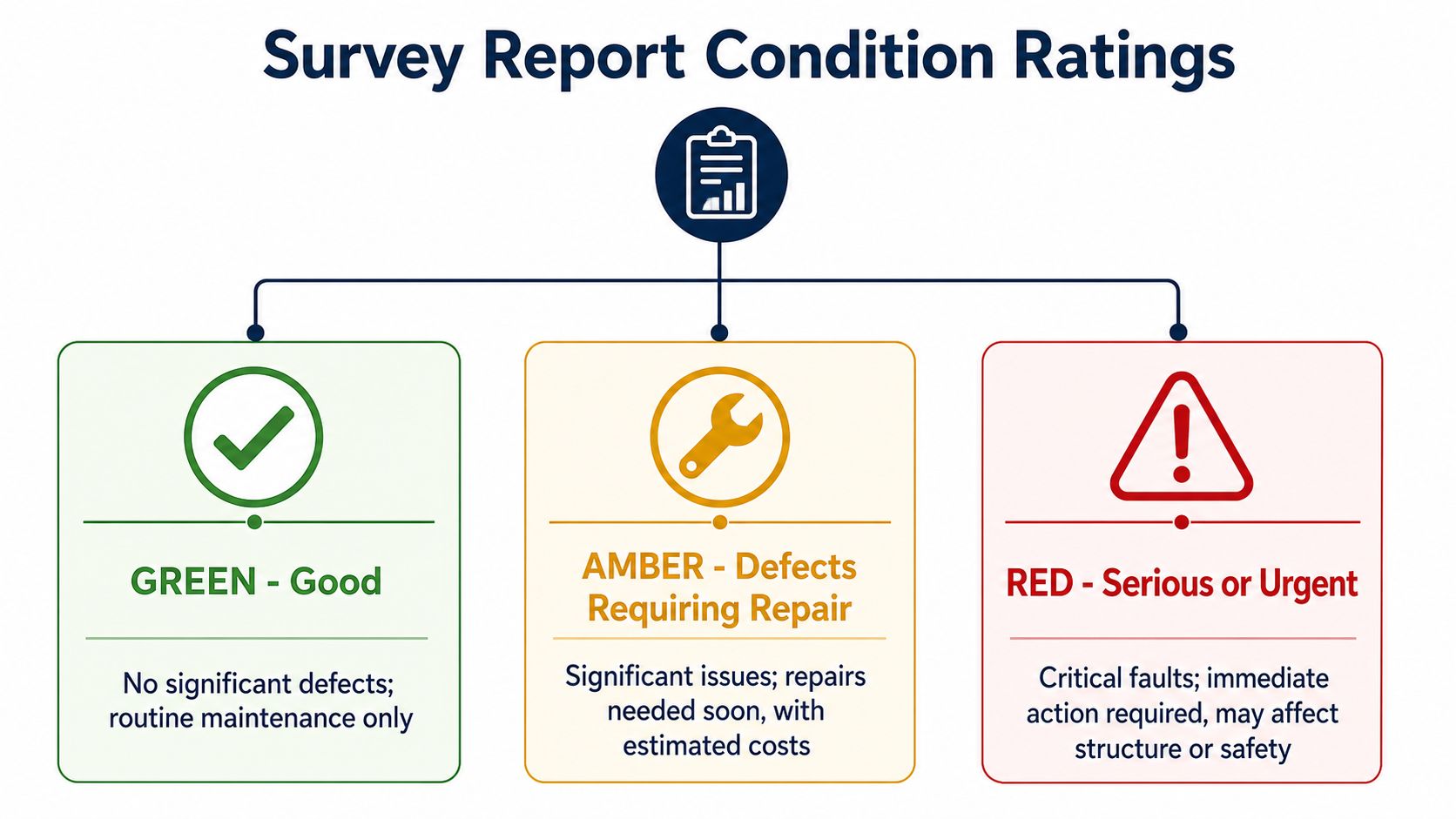
Most RICS-style condition reporting uses a traffic light approach. Green means the element is in good order and only routine maintenance is needed. Amber means there is a defect that needs repair or further attention. Red means there is a serious or urgent issue that may affect safety or the structure and needs immediate action. That sort of language is useful in negotiations and planning, because it points you to the next move rather than burying you in jargon.
The kinds of defects London buyers see most often
London properties throw up the same patterns again and again. Damp penetration shows up where pointing is tired, gutters are blocked, or internal finishes have been altered badly. Timber decay appears in roof spaces and joinery. Structural movement shows in cracks, distorted openings, and uneven floors. Roof coverings fail. Older plumbing and electrical systems can be past their sensible life.
A Level 3 survey does more than name those faults. It links the observation to a likely cause and then sets out repair options and maintenance implications. That is the core value. You are not just told there is a stain on the ceiling. You are told what may be causing it, what needs checking, and what sort of repair path is realistic.
For London's older and altered stock, that extra detail matters. A surface crack in a period terrace might be harmless, or it might point to movement, patch repairs, or past alterations that no one documented properly. A shallow survey will often miss the difference. A Level 3 survey is meant to catch it.
How to use the report properly
Read the urgent items first. Then go straight to anything that affects the structure, roof, or moisture control. After that, work through the maintenance items and decide whether they are part of normal ownership or a sign that the property needs more work than you budgeted for.
If the report points to an expensive repair, do not panic. Use it to renegotiate, to order a specialist opinion, or to reconsider the purchase if the risk is too high. That is what the report is for. It is a decision tool.
When You Genuinely Need a Level 3 Survey
You need a Level 3 survey when the property itself tells you not to mess about. That usually means it is older, altered, non-standard or already showing visible problems.
RICS and experienced surveyors tend to point Level 3 at homes where there is more uncertainty in the fabric. That includes pre-1900 houses, listed buildings, timber-framed properties, thatched homes, heavily altered properties and homes in poor condition Legal & General guidance on building surveys. In plain English, if the building has had a hard life or has an unusual construction, you want the deeper survey.
London examples that make the choice obvious
A Victorian terrace in Peckham with a removed chimney breast is not a casual buy. A 1930s semi in Bromley with original lead pipework and patched repairs needs more than a quick once-over. A flat conversion in a Greenwich conservation area can hide all sorts of issues behind neat decoration. Those are Level 3 jobs.
If the building has been changed more than once, assume there are questions you have not yet asked.
A Level 2 HomeBuyer Report can still be the right answer for a standard, modern property in reasonable condition. That is especially true if the house is conventional in layout and you are not planning major works. The mistake is using Level 2 as a default for every property. That is cheap in the short term and expensive if the defects are hidden.
If you want a practical sense of where the line sits, I would draw it like this. Newer and standard, use Level 2. Older, altered, quirky or visibly worn, use Level 3. Simple as that.
Corinthian Surveyors London LTD handles Level 3 work on residential property across London, and that is exactly the sort of market where local judgement matters. A Forest Hill surveyor who sees Lewisham terraces, Greenwich conversions and Southwark period homes every week will spot different risks than someone working on a generic national script.
Costs, Timescales and How Corinthian Surveyors Delivers
A Level 3 survey costs more because it does more. In London, that matters. Older terraces, split houses, loft conversions, cellar dig-outs and patchwork repairs need a proper inspection, not a quick look from the pavement. UK consumer advice says prices typically range from £630 to £1,500+ depending on property size, location, complexity and value, and other UK guidance places it around £800 to over £1,500 HomeOwners Alliance building survey guidance. The spread is sensible. A compact flat and a large, altered house are not the same job. If you want a wider sense of related inspection pricing, see what roof inspections really cost.
Time on site also rises with complexity. A property with a complicated roof, uneven floors, historic alterations or signs of damp needs more attention, and the report takes longer to write because it has to explain what the findings mean. That is the point of the exercise. You are paying for judgment, not just a list of defects.
What a good independent firm should do
Start with a phone call. Give the surveyor the age of the property, the type of construction, any known alterations and anything the agent or seller has already mentioned. That first conversation should tell you whether Level 3 is the right choice and which areas need emphasis. If you are comparing options, a guide to finding local surveyors will help you judge who knows London stock and who is just taking a generic approach.
Corinthian Surveyors London LTD works as an independent firm of RICS Chartered Surveyors and Valuers. That matters because there are no ties to lenders, estate agents or developers, so the advice stays with the buyer. The firm also holds CABE qualifications and is regulated by RICS, which gives the client a proper professional framework rather than a casual opinion.
The same local logic applies if you are comparing a Forest Hill surveyor with someone who works further afield. A surveyor who sees Lewisham terraces, Greenwich conversions and Southwark period homes every week will spot familiar London defects faster and read the signs properly. That is how you avoid a shallow report on a property that needs careful eyes.
How the process usually runs
The surveyor inspects the property, writes the report and sends it through in a format you can use. The report should explain defects plainly and tell you whether you need repair, further investigation or simple maintenance. That is the standard to expect, and anything less is poor value.
If you are ready to talk it through, Corinthian Surveyors London LTD can be reached on 0800 00 16 422 or through the website at www.corinthiansurveyors.co.uk. A decent conversation upfront saves time later and stops you commissioning the wrong survey for the wrong property.
Frequently Asked Questions About Level 3 Surveys
Do I need to attend the survey?
No. Most buyers do not. What matters is giving the surveyor access and telling them about any known problems before the visit.
How long is a Level 3 report valid for?
There is no fixed legal expiry date. Treat it as a snapshot of the property's condition at the time of inspection. If the purchase drags on or the seller does major works, ask for an updated view.
What happens if the surveyor finds something serious?
You may need a specialist, such as a structural engineer, roofer, drain surveyor or damp specialist. The Level 3 report should tell you when that next step is sensible.
Can I use a Level 3 survey to renegotiate the price?
Yes, if the report identifies defects that affect the cost or risk of the purchase. Use the findings carefully and back your case with the specific repair issues named in the report.
Corinthian Surveyors London LTD carries out RICS Building Surveys, market valuations and other residential surveying work across London and the surrounding area. If you are weighing up a Level 3 survey on an older or altered property, visit Corinthian Surveyors London LTD and make the next move with proper information in hand.