
Survey Report Examples: 7 Reports Explained
A useful survey report example isn't judged by its length. It's judged by how clearly it identifies defects, explains their urgency and supports your next decision. In 2023, about 3.8 million dwellings in England, or 15% of the housing stock, failed to meet the Decent Homes Standard, which considers hazards, repairs, modern facilities and thermal comfort.
You might be comparing three reports for a house in Lewisham: one gives a brief condition overview, another describes defects and recommended repairs, and a third examines an older building in detail. The right choice depends on the property and the decision you need to make. A report should explain its purpose, inspection limits, condition ratings and recommended action without implying that a visual inspection reveals every concealed defect.
The examples below show how residential reports can help buyers, owners and neighbours decide what to do next. Treat the property scenarios as illustrations, not reports of actual inspections. In every case, read the findings as a decision tool, not a technical document. A well-presented report can also make it easier to review findings side by side, much like a PDF comparison guide.
Table of Contents
- 1. RICS Level 1 Condition Report
- 2. RICS Level 2 HomeBuyer Report
- 3. RICS Level 3 Building Survey
- 4. Building Survey for Period, Listed and Non-Standard Construction
- 5. Mortgage Valuation Report
- 6. New Build Snagging Report
- 7. Party Wall Schedule of Condition Report
- Comparison of 7 Survey Report Examples
- Turn Report Findings into Clear Next Steps
1. RICS Level 1 Condition Report
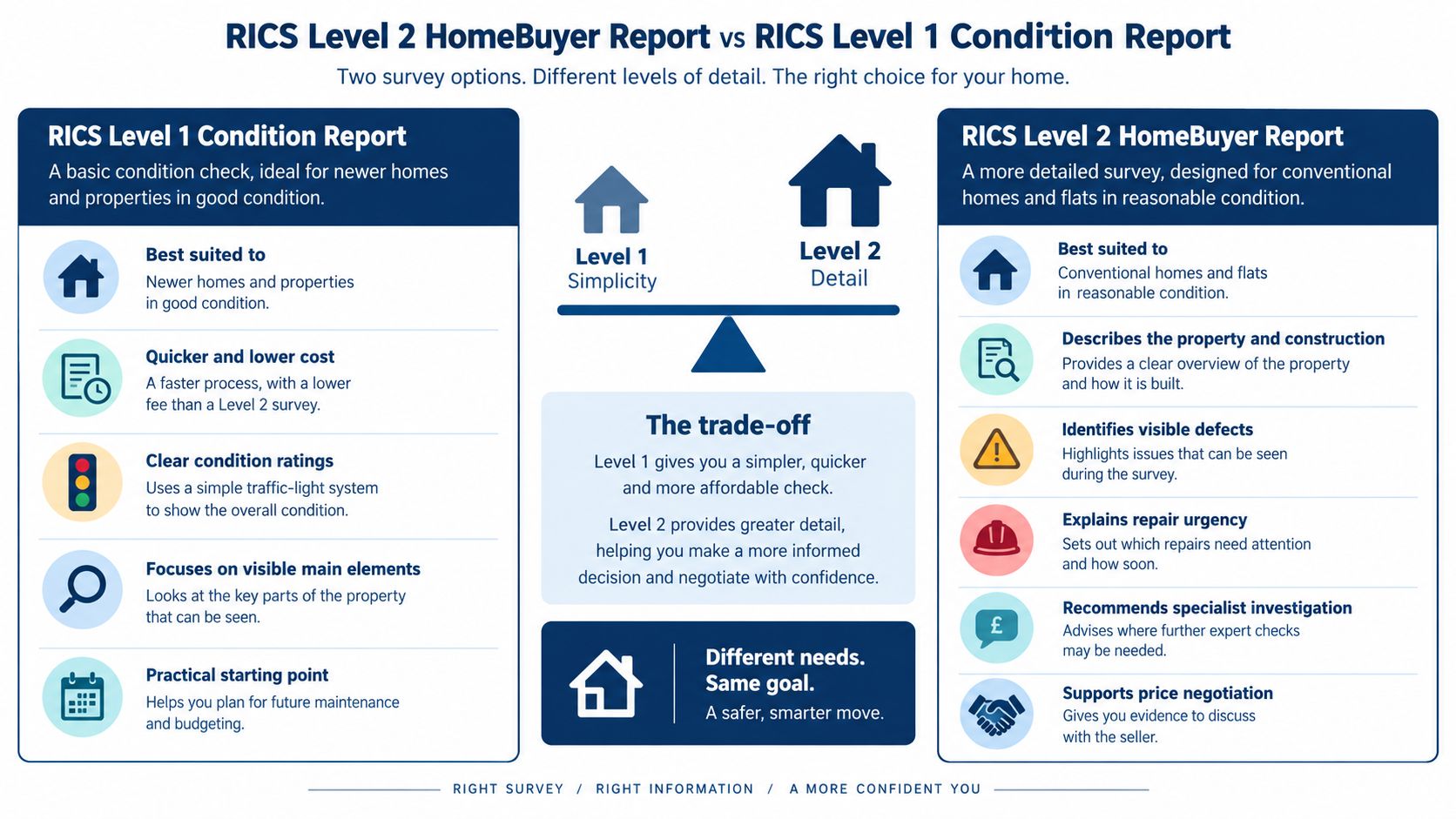
A Level 1 report earns its keep when the property is conventional, reasonably maintained, and the question is simple: what needs attention soon, what can wait, and where should the owner spend money first. It is a visual overview of the main elements, with RICS condition ratings to flag urgency. Treat it as a maintenance triage tool. It will not open up the structure or prove what is happening behind finishes.
For example, an owner of a 1990s semi in Bromley might commission a Level 1 Condition Report before planning a kitchen refit. If the report notes a loose gutter and worn seals around external doors or windows, the sensible sequence is to fix the rainwater and draught points before committing to interior finishes. A homeowner in Sidcup could use the same findings to plan roof checks and external decoration on a sensible cycle.
Read the ratings alongside the inspection notes
Do not treat a rating as a repair specification. Check the explanation and access notes to see what the surveyor observed and which areas could not be inspected. A visible defect can justify a closer look, and the report should say where uncertainty remains.
Act on the highest-priority findings first: get advice or quotes from suitable tradespeople, then decide whether the scope still fits. If the home is older, altered, or unusual, ask whether Level 2 or Level 3 would give a better basis for the decision. Corinthian Surveyors, based in Forest Hill, can discuss that scope before you instruct a surveyor.
For a straightforward check, the Level 1 report can organise maintenance without pretending to be a detailed investigation. Buyers comparing survey scopes can review this homebuyer survey comparison.
2. RICS Level 2 HomeBuyer Report
A buyer agrees a price on a 1950s semi in Lewisham, then the Level 2 survey report example arrives with several amber ratings and one red. The report suits conventional houses, flats and bungalows in reasonable condition and gives a more extensive visual inspection than Level 1, with comments on defects, repairs and maintenance. The surveyor may enter roof spaces and lift drainage chamber covers where access is safe, and the report should state which parts stayed out of reach.
Start with the condition ratings table rather than the summary paragraph. Read every element rated 2 or 3, then follow the traffic-light explanation behind it: rating 1 points to routine care, rating 2 points to repairs or replacement that need planning, and rating 3 flags serious defects or matters needing prompt attention. Treat linked ambers as a pattern. Damp near an external wall, tired window seals and a short gutter drip can point to rainwater management before redecoration.
Work from the ratings to the next instruction
Use the report to choose the next instruction and to frame estimates. If a red rating affects the roof, electrics or movement, get the named specialist or trade before exchange; if the entry calls for further investigation, put that on the purchase timetable. Where the agreed scope includes a market valuation or reinstatement figure, keep those figures separate from the condition findings when negotiating.
- Ask the surveyor to explain any urgent rating and the evidence behind it.
- Book recommended inspections before exchange, before the legal commitment hardens.
- Put contractor estimates beside the report wording before seeking a price change.
The RICS Home Survey Standard, first published in 2019 and effective from 1 March 2021, sets the reporting framework for scope and limitations. Corinthian Surveyors provides RICS Level 2 HomeBuyer Surveys across London and the Home Counties, independently of lenders, estate agents and developers.
3. RICS Level 3 Building Survey
An older, altered or unusual property needs more explanation than a short list of visible defects. A Level 3 Building Survey is intended for properties such as older houses, buildings with significant alterations or homes in poor condition. It gives a more detailed assessment of the structure and fabric, but a market valuation isn't automatically included.
For an illustrative Victorian terrace in Brockley, the survey might describe roof spread, defective lintels above a bay and signs of damp near an altered extension. The report should distinguish what the surveyor observed from what needs confirmation by a structural engineer or another specialist. It should also make clear which defects need prompt attention and which can be managed through planned maintenance.
Use the detail to plan investigations and works
A Level 3 report can help a buyer understand the building before committing to substantial repairs or alterations. It should explain relevant defects, their possible implications and what further action is appropriate. Don't turn a surveyor's observations into a contractor's quotation. Use the report to identify the right trade or specialist, then obtain property-specific advice.
The level can also suit an owner considering changes to an existing home. For example, a buyer of a 1930s house in Bromley planning a loft conversion might need a closer understanding of the roof construction before proceeding with design and building work. A survey does not replace the separate advice needed for that project.
A serious defect isn't a cost estimate. Establish its cause, scope and repair options before you negotiate or commit to work.
Corinthian Surveyors offers RICS Level 3 Building Surveys and can advise on scope for older and altered homes. If a property is listed or sits in a conservation area, check that the surveyor understands the relevant construction and restrictions. Corinthian also provides building conservation advice.
4. Building Survey for Period, Listed and Non-Standard Construction
A standard approach can miss the significance of materials and alterations in an older property. Victorian and Edwardian homes in areas such as Camberwell and Greenwich may have solid walls, lime mortar, lath-and-plaster finishes, original pipework or altered chimney breasts. These features need to be understood in context, not treated as if the building were a modern house.
An illustrative report for a Victorian home in Camberwell might note cement pointing on solid brick walls where moisture is present. The next step is to ask whether the pointing is contributing to the problem and what repair approach is suitable. A listed home in Greenwich with an internal wall removed may also require the buyer to check the alteration's history and any relevant consent with the appropriate authority.
Check the building's history as well as its fabric
Ask your surveyor about experience with the property's construction type. Check the report for limitations and look into previous alterations through the relevant local authority records. A condition report can identify concerns, but it doesn't establish that all historic work has the necessary approvals.
A Level 3 Building Survey is generally the more appropriate option for an older, altered or unusual home than a basic condition check. The surveyor should describe the observed condition and recommend further investigation where the evidence is incomplete. This is especially important before you plan repairs that could affect traditional materials.
Corinthian Surveyors works with period properties across South East London. Its building conservation service can support advice on traditional construction and repair. For more context on historic homes, read this historic building survey guide.
5. Mortgage Valuation Report
A mortgage valuation is not a buyer's survey. The lender uses it to assess whether the property is suitable security for the loan. It may include a value and brief condition observations, but it isn't designed to give you a detailed account of defects or a repair plan.
For example, a buyer in Clapham could receive a lender's valuation that doesn't mention defects, then arrange a separate survey that identifies visible damp in a front bay and concerns about a rear extension roof. The two documents answer different questions. The lender's report addresses lending security; the buyer's survey helps the buyer understand condition and decide what to investigate.
Keep the valuation figures distinct
A Level 2 survey-and-valuation service includes an opinion of market value and an insurance reinstatement figure. These are not interchangeable. Market value relates to the property's value in its market, while reinstatement cost concerns the estimated cost of rebuilding for insurance purposes. The Level 2 survey-only service doesn't include a valuation as standard.
Ask the lender what its valuation covers, but don't rely on it as a substitute for an independent inspection. If you want a property-specific assessment, commission a suitable RICS survey before exchange and follow any recommendations for further testing.
Corinthian Surveyors is independent of lenders, estate agents and developers, so its survey advice is prepared for the client instructing the firm. Buyers looking for a condition report can explore the Level 2 HomeBuyer Survey and decide whether a separate valuation is also needed. A guide to assessing physical premises, such as this warehouse security overview, is a different subject and does not replace a residential survey.
6. New Build Snagging Report
A snagging report records defects in a newly built or converted home, including problems with finishes, fittings, workmanship and damage. It's different from a structural survey. A warranty, including an NHBC warranty where applicable, doesn't replace an independent inspection of the finished property.
An illustrative snagging inspection of a new flat in Greenwich might record uneven skirting, cracked tiles and a sticking door. A report on a new house in Bromley might note poor pointing or a blocked gutter. The value lies in recording exactly what needs attention so the buyer can raise clear, specific items with the developer.
Record defects before they're harder to address
Arrange an inspection before completion where possible. Photograph each issue, describe its location and keep a copy of the defect list and any response from the developer. Ask the surveyor to explain what the inspection can and cannot assess, particularly where an issue may extend beyond visible finishes.
Record the defect, its location and the evidence. A clear list makes follow-up with the developer more practical.
A snagging report doesn't certify every system or establish that concealed work is sound. If the report identifies a concern beyond a finish defect, ask what separate investigation is needed. Keep warranty documents, inspection findings and repair records together.
Corinthian Surveyors provides independent residential inspection and defect analysis. Buyers can read more about the role of a new-build surveyor. The firm's advice can help you distinguish a visible snag from a concern that needs further professional attention.
For a video introduction to new-build inspections, see the snagging inspection video.
7. Party Wall Schedule of Condition Report
A schedule of condition records the visible state of a neighbouring property before building work begins. It commonly uses written descriptions and photographs to provide a reference if a dispute later arises about alleged damage. It doesn't itself give permission for work or establish that a neighbour has agreed to a project.
Before a basement excavation beside a Victorian terrace in Forest Hill, for example, a schedule might record existing cracks above a first-floor window. If the neighbour later reports new cracking, the record helps the parties compare the earlier condition with what they see afterwards. For a loft conversion on a semi in Catford, the surveyor could document relevant areas of the party wall and ceiling below.
Separate notices from other approvals
The Party Wall etc. Act 1996 covers party walls, party fence walls and certain excavation or construction near buildings. If a building owner plans to build a party wall or party fence wall on the line of junction, notice must be served on the adjoining owner at least one month before work is intended to start. The notice must state the intention and describe the proposed wall. Check the legislation itself, and get party wall advice about how the Act applies to the planned works.
The Act's notice process is separate from planning permission and building-regulations approval. A surveyor can identify where party wall procedures may be relevant, but a condition report is not consent to proceed. Start early, record all potentially affected areas and keep the schedule with your property documents.
Corinthian Surveyors provides party wall advice across London, including Lewisham, Southwark and Lambeth. The firm can also advise on residential project management where the work requires additional support.
Comparison of 7 Survey Report Examples
| Survey or Report | Implementation Complexity and Resources | Expected Outcome | Ideal Use Case | Key Advantage |
|---|---|---|---|---|
| RICS Level 1 Condition Report | Low; typically quicker and less costly, with a visual inspection of accessible areas | Basic condition ratings and maintenance priorities | Newer, well-maintained homes needing a straightforward check | Clear, cost-effective overview |
| RICS Level 2 HomeBuyer Report | Moderate; more inspection and reporting than Level 1 | Visible defects explained, repair urgency rated, and further investigations advised | Conventional homes and flats in reasonable condition | Balances useful detail with cost |
| RICS Level 3 Building Survey | High; detailed inspection and reporting, with more time and potentially agreed opening-up work | In-depth assessment of defects, likely causes, repairs, and further investigations | Older, altered, defective, or non-standard properties | Most detailed assessment for planning repairs and costs |
| Specialist Building Survey for Period, Listed, and Non-Standard Construction | High; requires specialist knowledge of materials, alterations, and conservation constraints | Property-specific findings and guidance on compatible repairs and possible consents | Listed, pre-1919, converted, or non-standard buildings | Helps avoid inappropriate repairs and identify consent issues |
| Mortgage Valuation Report | Low for the buyer; arranged through the lender, usually as part of the mortgage process | Property valuation and a brief view of suitability as loan security | Mortgage lending decisions | Confirms the lender's security assessment |
| New Build Snagging Report | Moderate; room-by-room inspection, photographs, and sometimes a follow-up check | Itemised defects for the developer to address | New or newly converted homes, preferably before completion | Creates a clear record and supports defect corrections |
| Party Wall Schedule of Condition Report | Moderate; requires access to the adjoining property and written and photographic recording | Baseline record of existing condition before nearby works | Projects that may affect neighbouring properties | Helps distinguish pre-existing defects from later damage |
Turn Report Findings into Clear Next Steps
A useful report tells you what was inspected, what the surveyor observed and what action should follow. Start by confirming the report's purpose and scope. Then check access limitations and distinguish visible defects from issues that need specialist investigation.
Prioritise findings by consequence, not by how alarming the wording sounds. Safety concerns and active water ingress need prompt attention. Routine maintenance can usually be planned, but don't ignore it if the report explains that delay could lead to further deterioration.
Use the report to ask focused questions. If it recommends a structural engineer, electrician or drainage specialist, arrange that advice before exchange where the finding could affect your decision. If the report includes a valuation, keep the market value separate from the insurance reinstatement figure.
Frequently asked questions
What do RICS condition ratings mean? They indicate the surveyor's assessment of the condition of inspected elements and help show where attention is needed. Read each rating alongside its explanation, limitations and recommended action.
Which survey level should I choose? Level 1 suits a straightforward condition check. Level 2 is intended for conventional homes in reasonable condition, while Level 3 is suited to older, altered, unusual or seriously run-down properties and homes where major work is planned. The property's construction and condition should guide your choice.
Does a mortgage valuation replace a survey? No. A mortgage valuation is for the lender's security assessment. It doesn't provide the buyer with the detailed condition advice of a separate survey.
Corinthian Surveyors London LTD is an independent firm of RICS Chartered Surveyors and Valuers based in Forest Hill. Led by Clive Thompson, who holds RICS and CABE qualifications and has over 30 years' experience in the built environment, the practice advises residential clients across London. For advice on choosing a survey or interpreting findings, call 0800 00 16 422.
If you're buying, planning repairs or assessing a property before building work, Corinthian Surveyors London LTD can provide Level 1, Level 2 and Level 3 surveys, valuations and party wall advice. Visit Corinthian Surveyors London LTD to discuss the property and the report you need.