
Historic Building Survey: Essential for Listed Buildings
You're probably staring at the particulars for a place that looks fantastic on first viewing. High ceilings. Worn stone steps. Original sash windows. Maybe a Lewisham terrace with good proportions, a Greenwich townhouse with lovely brickwork, or a Bermondsey conversion with proper character. The trouble is this. Character hides defects very well.
If the building is listed, sits in a conservation area, or is old enough to have been altered several times, a quick once-over won't do. You need a historic building survey that tells you what's original, what's failed, what's been patched badly and what the council may care about if you change it.
Table of Contents
- That Period Property You Love Requires a Proper Look
- What Is a Historic Building Survey
- Listed Buildings and Conservation Areas Explained
- The Surveyor's Methodology and Scope
- Common Findings in London's Historic Properties
- Commissioning Your Survey and Expected Costs
- Frequently Asked Questions
That Period Property You Love Requires a Proper Look
You don't buy a listed building in London on charm alone. That's how people end up inheriting old damp repairs, hidden timber decay and planning headaches that were obvious to anyone who knew what to look for.
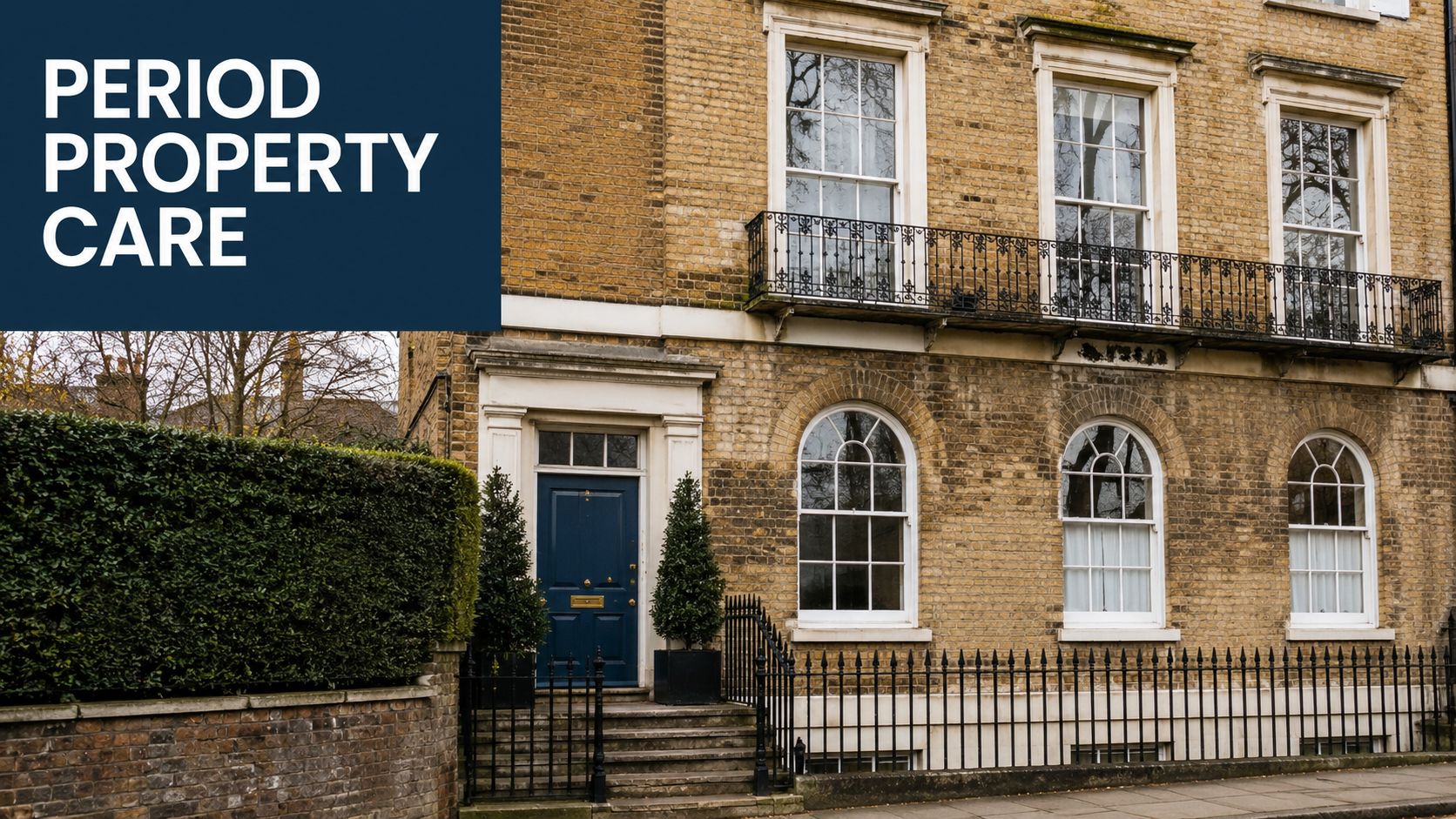
A Victorian terrace in Lewisham can look tidy because it was freshly painted last month. That tells you nothing about sub-floor ventilation, altered chimney breasts or whether cement pointing is trapping moisture in old brick. A Georgian house in Greenwich may feel solid underfoot, but that doesn't mean the roof structure, rainwater goods and internal finishes are behaving as they should.
Start with the risks, not the romance
Estate agents sell the lifestyle. A buyer needs to look at the liabilities.
With older London stock, I'd focus on four things straight away:
- Structure: Has the building moved, settled or been altered badly over time.
- Moisture: Is damp coming from failed gutters, bridged walls, blocked vents or modern materials that don't belong.
- Fabric: Are original materials still doing their job, or has someone replaced breathable finishes with hard modern ones.
- Consent risk: If the place is listed, what work may need Listed Building Consent before you even think about changing windows, walls or layouts.
Practical rule: If the building has stood for a century or more, assume it has a story. Your survey needs to uncover the chapters that matter to your budget.
London properties need local judgement
This isn't just about age. It's about type.
A tall townhouse in Greenwich brings one set of issues. A shallow-fronted terrace in Peckham or New Cross brings another. A converted warehouse flat in Bermondsey may involve historic fabric mixed with late structural alterations, hidden service runs and awkward roof details that don't show in the sales photos.
That's why a proper historic building survey matters. It doesn't treat the property as a generic house. It looks at how that building was put together, how it has changed and what can go wrong next. That puts you in a position to decide sensibly, renegotiate if needed, or walk away before the legal work and the bills pile up.
What Is a Historic Building Survey
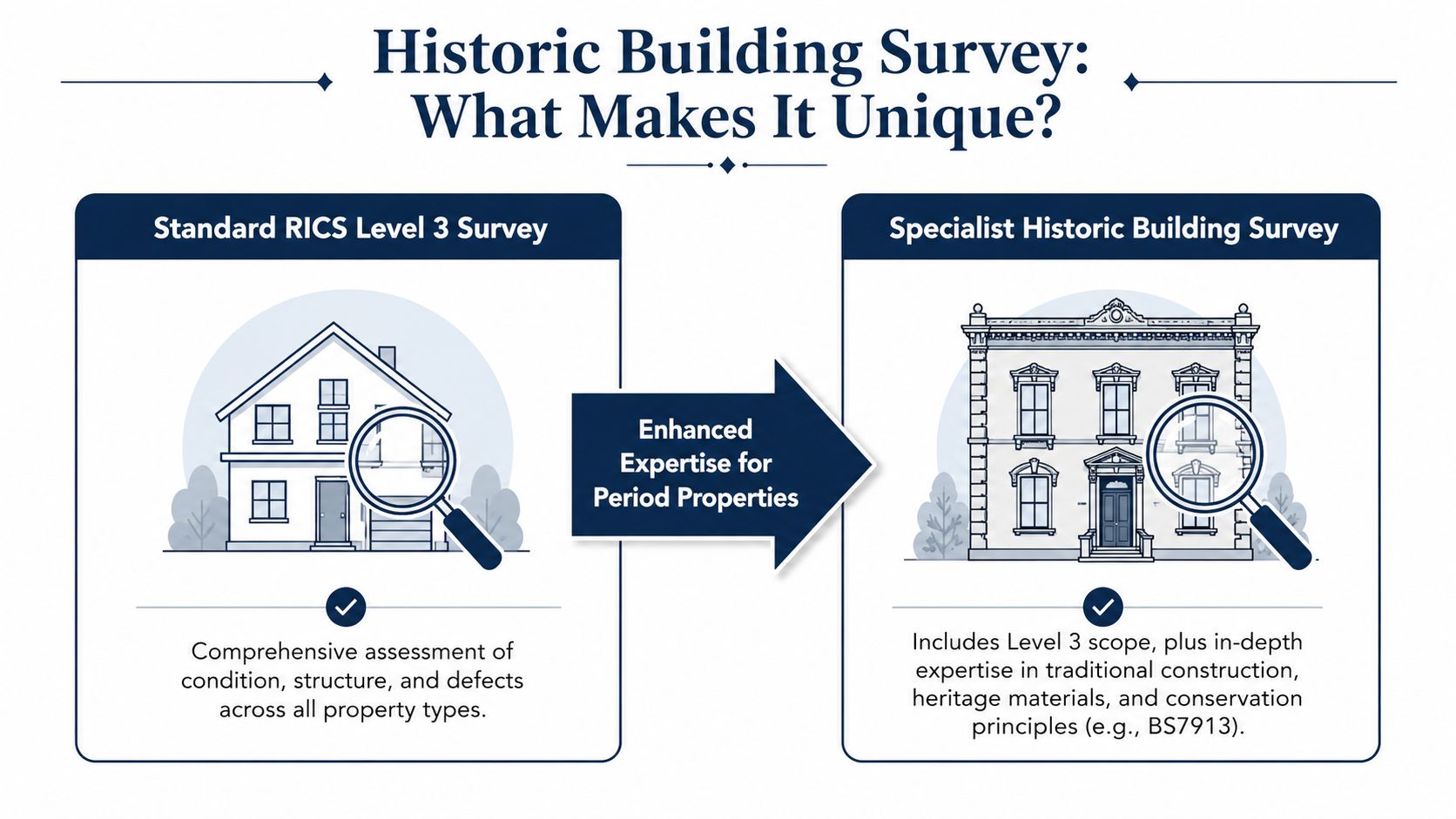
A historic building survey isn't a fancy label for the same old report. In practice, it's a RICS Building Survey at Level 3 carried out by someone who understands old buildings, traditional materials and conservation issues. That distinction matters.
If you use the wrong survey type, you usually get a report that states the obvious and misses the expensive bit. For modern flats and straightforward post-war houses, a Level 2 can be fine. For listed buildings and period property, it often isn't.
It's a specialist Level 3 job
A Level 3 survey is the right starting point when the building is old, altered or built in a non-standard way. That includes most listed property buyers should be worried about.
A proper historic building survey goes further than a routine condition report. It considers:
- Traditional construction: Lime mortar, solid walls, timber framing, lath and plaster, old roof carpentry.
- Patterns of alteration: Removed chimney breasts, replaced floors, cut roof members, changed openings.
- Repair compatibility: Whether past repairs work with the building or are subtly causing harm.
- Future works: What's likely to need specialist repair and what may trigger conservation scrutiny.
For a plain-language overview of survey types, this guide to what a RICS survey is is a useful place to start.
Level 2 and historic property are a bad mix
The line here is very clear. An RICS Level 2 Home Survey is intended for conventional residential property built within the last 70–80 years and in reasonable condition, and it is not suitable for older properties, those with major alterations, or those built with non-standard methods, which require a Level 3 Building Survey according to this explanation of RICS Home Survey suitability.
That matters because a Level 2 is a visual, non-invasive inspection. It tells you about what can be seen readily. It does not do the deeper diagnostic work that an old London building often needs.
Here's the short version:
| Survey type | Best for | Wrong choice when |
|---|---|---|
| Level 2 | Modern, standard construction in reasonable condition | The property is listed, heavily altered, unusually built or plainly old |
| Historic building survey / Level 3 | Period property, listed buildings, unusual construction and complex defects | You want a cheap tick-box report rather than proper advice |
A listed terrace in Dulwich or a converted industrial building in Southwark isn't a standard house. Don't commission a standard survey and hope for the best. That's false economy.
A good historic building survey should tell you not only what is wrong, but why it is wrong and what sort of repair approach makes sense.
Listed Buildings and Conservation Areas Explained
People mix these up all the time. They shouldn't. A listed building and a property in a conservation area are not the same thing, and the buying risk is different.
If the building is listed, the controls attach to the building because of its special interest. If it sits in a conservation area, the wider setting and character of the area matter, and planning controls may be tighter than you expect. In London boroughs such as Southwark, Greenwich, Lewisham and Kensington, that can affect windows, roof coverings, boundary walls, extensions and external appearance.
Listed status and conservation area are not the same thing
In simple terms:
- Listed building: The building itself has legal protection because of its historic or architectural significance.
- Conservation area: The location has recognised character, so changes are assessed in a stricter planning context.
- Both together: That's where buyers really need to slow down and read the building properly before committing.
People often ask about listing grades. The practical point for a buyer is this. Any listed status means you need to be careful. Don't assume a previous owner obtained the right consent for internal changes just because the work looks old.
The survey gives you evidence before you apply for consent
Historic Building Recording Surveys in the UK are structured in four levels, from a basic photographic record at Level 1 to a detailed analytical report with photographic and drawn evidence at Level 4, with the required level often set by the local Archaeological Officer or Heritage Conservation Officer when planning or consent applications are involved, as outlined in this explanation of recording levels for historic buildings.
That matters because the survey becomes evidence. It records significance, condition and fabric before work starts. Without that, you can end up arguing blind with the council.
There's also a very practical reason not to leave this until later. According to Historic England's Survey of Listed Building Owners and Occupiers, 81% support the Listed Building Consent process, but satisfaction with the administration fell to 35%, down from 51% in 2017, which underlines how important it is to have the right survey evidence in hand before navigating consent requirements, as shown in Historic England's listed building owners survey.
If you're planning repairs or alterations, building conservation advice from a specialist practice is the sort of support that helps you line up the survey evidence with what the local authority is likely to want.
Buy first and ask planning questions later is a poor strategy with listed property. You need to know what you're taking on before exchange.
The Surveyor's Methodology and Scope
A proper surveyor doesn't walk in, spot a damp patch and write “monitor”. That's lazy work. Historic buildings need diagnosis, not a shrug.
With old structures, one defect often sits on top of another. A cracked wall may be historic and harmless, or it may relate to movement, moisture and failed repairs. Black mould may be ventilation failure, or it may be the visible result of a much bigger moisture problem. The job is to trace the chain properly.
A proper surveyor traces cause, not just symptoms
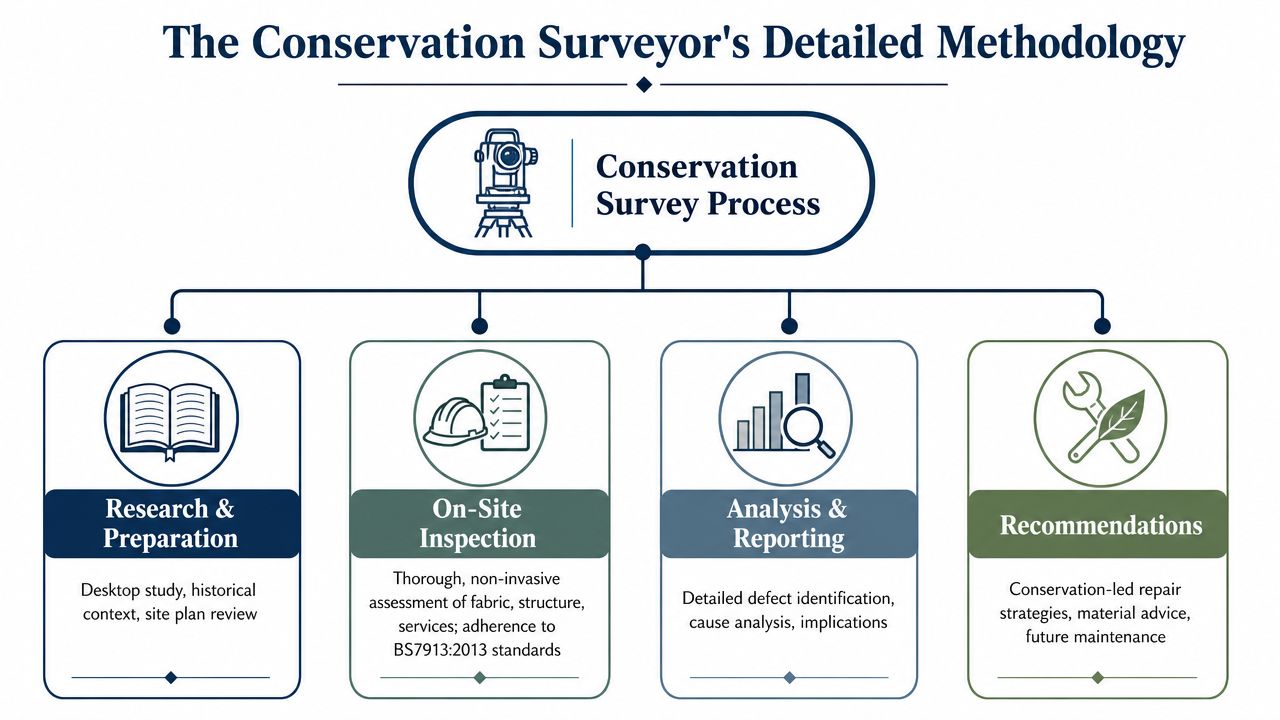
Surveying traditional buildings in the UK means working to BS7913:2013, the guide to the conservation of historic buildings. That standard requires a cause-effect analysis of material decay driven by moisture movement, thermal bridging and inappropriate modern interventions, as explained in this summary of BS7913 requirements for historic building surveys.
That has real consequences on site. It means the surveyor should be asking questions like these:
- Where is moisture getting in: Through roof coverings, parapets, flashings, gutters or dense cement render.
- How is the building meant to breathe: Solid walls and lime finishes do not behave like modern cavity wall construction.
- What changed: Was a suspended timber floor sealed up, were vents blocked, was gypsum plaster introduced where it shouldn't be.
- What's the knock-on effect: Timber decay, salt damage, blistering finishes, trapped condensation, distorted joinery.
A decent report should connect those dots. If it only lists defects with no explanation of mechanism, it's not doing enough.
Research matters with old buildings
Historic work is partly inspection and partly investigation. Old maps, planning history, visible phases of alteration and the building's setting all help explain current defects.
A surveyor looking at a Georgian house in Blackheath, for example, needs to understand what may be original, what was altered later and how the building relates to adjoining structures and ground levels. A warehouse conversion in Tower Hamlets needs a different lens. There, the key questions may be about inserted floors, steelwork exposure, later openings and service penetrations through older fabric.
Here's what a sound methodology usually includes:
- Pre-inspection review of listing details, planning context and available history.
- On-site inspection of accessible fabric, structure, roof spaces where possible and visible service installations.
- Photographic record of defects, materials, junctions and significant details.
- Analysis and repair advice based on conservation principles, not generic patchwork.
The best report is the one that tells a builder, a conservation officer and a buyer the same clear story.
Common Findings in London's Historic Properties
London's old housing stock is never one-size-fits-all. The defects change with the building type, the borough and the way the place has been altered over time.
That's why generic national advice is often useless. A Lewisham terrace, a Bromley semi and a Bermondsey warehouse flat may all be old, but they fail in different ways.
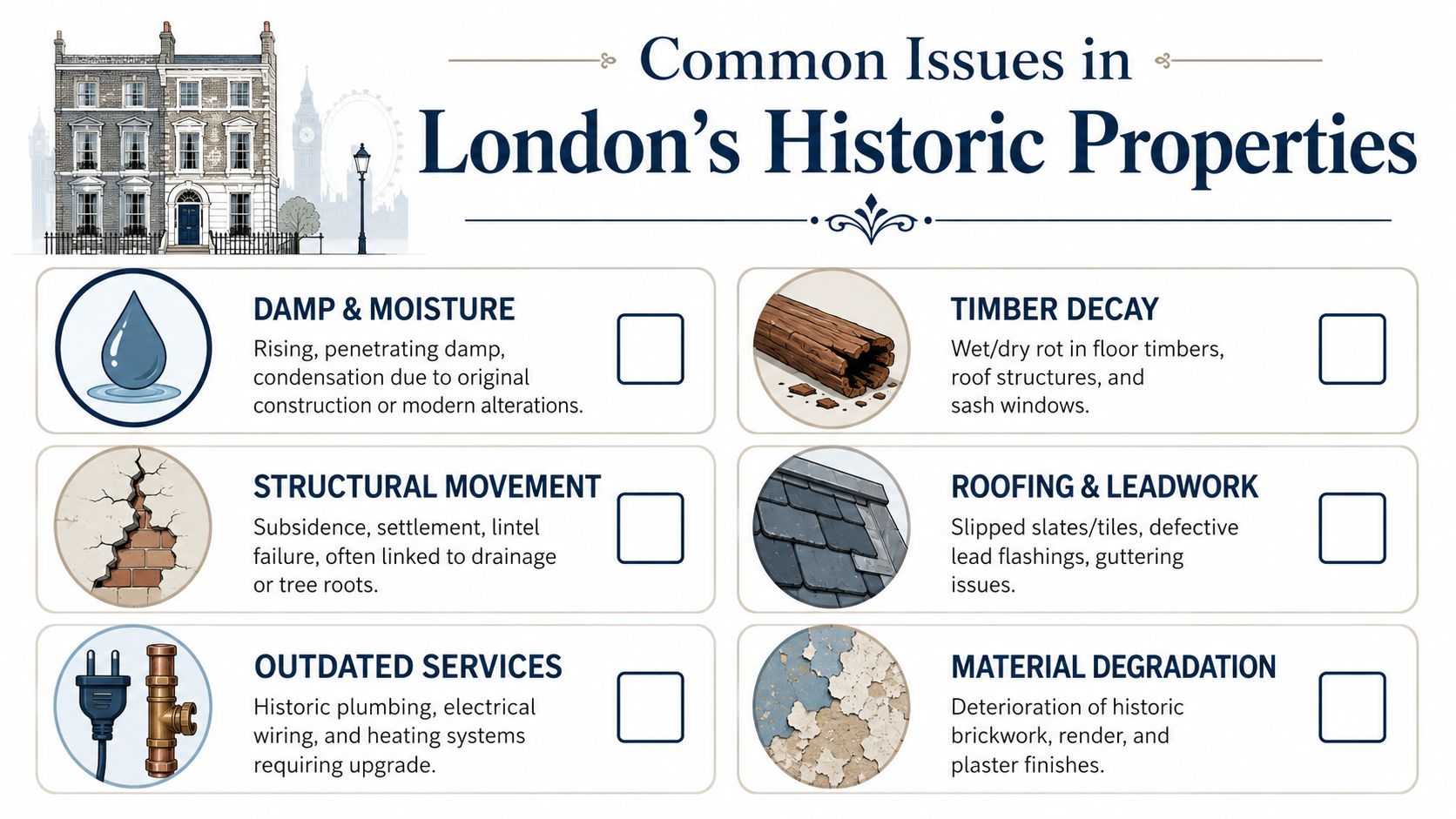
Victorian and Edwardian houses in South East London
In places like Forest Hill, Brockley, Sydenham, Crystal Palace and parts of Lewisham, I'd expect to look hard at suspended timber floors, roof spread, chimney stacks and the effect of years of piecemeal repairs.
Common issues include:
- Blocked or reduced sub-floor ventilation, leading to damp air, stale voids and decaying timber ends.
- Hard cement pointing or render on old brickwork, which can trap moisture and force it elsewhere.
- Chimney breast alterations, especially where internal walls were removed without proper support.
- Lath and plaster fatigue, which may sound hollow, crack or detach where movement and moisture have been ignored.
- Old services, including outdated wiring layouts, historic plumbing runs and awkward later additions.
One detail buyers often miss is flooring and finish material. In period houses with decorative tiled thresholds, hallways or porches, matching replacements properly matters. If you're trying to understand old tile styles before repair work, this guide on identifying historic cement tiles is a useful reference.
Warehouse flats and heavy conversions
Bermondsey, Rotherhithe, parts of Southwark and stretches of Tower Hamlets bring a different set of problems. These are often strong buildings that have been reworked hard.
The survey focus may shift to:
| Property type | Typical concern |
|---|---|
| Converted warehouse flat | Inserted structures, exposed steel or ironwork, roof junctions, fire separation and service routing |
| Large townhouse conversion | Compromised floor structures, sound insulation failures, unauthorised internal changes |
| Former industrial building | Moisture around parapets, ageing roof coverings, mixed old and new materials behaving badly together |
Where a property has little or no obvious historic interior detail left, some owners assume that means the inside no longer matters. That's wrong. Historic England's photographic guidance says surveyors should still capture “sufficient photographs to record this fact” when a building has little historic interior, as set out in official notes on photographing historic buildings. In plain English, even a stripped interior can still carry planning and conservation significance through structure, plan form and surviving fabric.
That matters most in London conversions, where the obvious “period features” may be gone but the important evidence sits in the bones of the building.
Commissioning Your Survey and Expected Costs
If you're buying a listed or plainly historic property, don't overcomplicate the instruction. Find the right surveyor first. Everything else follows from that.
You want someone independent, properly qualified and used to dealing with older residential buildings in London. Not someone tied to a lender, an estate agent or a developer. Ask about RICS status, conservation experience and whether they understand traditional construction in the sort of property you're buying.
What to ask before you instruct
Keep it simple and practical:
- Ask who will inspect the building: Not every firm sends the person you spoke to.
- Ask what survey type they recommend: If they suggest Level 2 for a listed building, be cautious.
- Ask what they need from you: Sales particulars, address, age, listing details and any known alterations.
- Ask how the report handles defects: You need causes, implications and sensible next steps.
- Ask about reporting style: A useful report is clear enough for you and sound enough for your solicitor or contractor.
If you want a feel for how survey findings are usually presented and read, this guide to building survey reports is worth a look before you instruct.
Why the fee is higher than a standard survey
A historic building survey costs more because it takes more time and more judgement.
Historic Building Recording surveys used for planning or Listed Building Consent are set across four levels, from Level 1 scene-setting to Level 4 measured survey, and the photographic protocol is deliberately rigorous so that the extent of the listing is properly documented, which is why this work gives buyers and owners evidence for both conservation decisions and pre-purchase negotiation, as described in this guide to Historic Building Recording survey levels and photographic requirements.
The fee usually turns on the building itself. Size, complexity, accessibility, extent of alteration, location and the level of reporting required all matter. The right way to think about it is not “what's the cheapest survey”. It's “what level of advice stops me making an expensive mistake”.
Frequently Asked Questions
Does every old house need a historic building survey
No. Age alone doesn't decide it. But once a property is listed, unusually built, heavily altered or plainly outside standard modern construction, a specialist Level 3 Building Survey is usually the sensible route. If the building's quirks could affect structure, repair strategy or consent, don't cut corners.
What's the difference between a listed building and a conservation area in practical terms
A listed building puts legal focus on the building itself and its special interest. A conservation area controls change more broadly to protect the character of the area. In practice, listed status usually carries more direct risk for internal and external work, while conservation area controls often affect how you alter what can be seen from outside.
Can a survey affect my mortgage
Yes, indirectly. A survey can uncover serious defects, unauthorised alterations or repair issues that change how a lender views the property. It can also give you the evidence to renegotiate the price or insist on further investigation before you commit. That's far better than finding the problem after exchange.
What should I do after I receive the report
Read the summary first. Then look at the urgent items, the likely repair liabilities and anything that may need further specialist input or consent. Use the report as a decision tool. You may proceed, renegotiate, ask the seller for paperwork, or decide the risk doesn't stack up.
If you need an independent view on a listed or period property in London or the Home Counties, speak to a surveyor who deals with this work regularly and can explain it in plain English. You can discuss the property on 0800 00 16 422.
Corinthian Surveyors London LTD is an independent firm of RICS Chartered Surveyors and Valuers based in Forest Hill, run by Clive Thompson, who holds both RICS and CABE qualifications and has over 30 years in the built environment. For listed buildings, period houses and awkward London conversions, that independence matters. There are no ties to lenders, estate agents or developers, so the advice stays focused on the property in front of you and the risk you're taking on. If you need a careful opinion before you buy, Corinthian covers London, the Home Counties and the South of England, and can advise on Level 3 building surveys, conservation issues and related residential valuation work.