
Section 20 Notice to Leaseholders: What You Need to Know

If a landlord has not followed the Section 20 consultation process correctly, your maximum contribution for qualifying works is normally £250, not the full cost of the works carried out. That protection applies per leaseholder, unless the First-tier Tribunal grants dispensation.
You may be looking at a notice for roof repairs, external decoration or work to the communal areas of a block in Lewisham, Bromley or Southwark. The figures can be uncomfortable, but the first question isn't whether the contractor has done a good job. It is whether the landlord followed the statutory process before trying to recover the cost through your service charge.
That distinction matters. A dispute about the consultation process is different from a dispute about the quality, necessity or price of the works. You may have grounds to challenge one, both or neither.
Table of Contents
- What Is a Section 20 Notice
- The Two Stages of Consultation
- How the Threshold Is Calculated
- When Consultation Fails
- Long Term Agreements and Service Contracts
- What Leaseholders Should Do Next
- Key Takeaways for London Leaseholders
What Is a Section 20 Notice
A Section 20 notice to leaseholders is part of the statutory consultation procedure under section 20 of the Landlord and Tenant Act 1985. A landlord must normally use the procedure before recovering the cost of qualifying works where any individual leaseholder could be required to contribute more than £250 through the service charge.
The rule protects leaseholders from receiving a large bill without a proper opportunity to see what is proposed, comment on the scope and suggest a contractor. It applies to qualifying works rather than every minor repair. A roof replacement, façade repairs, major external decoration or substantial communal repair may fall within it, depending on the amount payable under the leases.
The notice isn't an administrative courtesy. It gives you a formal opportunity to:
- Understand the proposal: The landlord must describe the works sufficiently for you to know what it intends to do.
- Make observations: You can raise concerns about the specification, timing or likely effect on the building.
- Nominate a contractor: You can put forward a contractor for the landlord to consider for an estimate.
- Review estimates: The statutory process requires at least two estimates, including one from a person unconnected with the landlord.
Practical rule: Don't judge the notice by the size of the total building invoice. Check what your own lease requires you to pay.
If the landlord doesn't comply, it generally can't recover more than £250 per leaseholder for the qualifying works unless the First-tier Tribunal, Property Chamber, grants dispensation. The works themselves aren't automatically cancelled. The financial consequence concerns what the landlord can recover through the service charge.
That is why the notice deserves attention even if you think the works are necessary. A landlord may have a strong case for carrying out repairs but still fail to preserve the right to recover the full cost. Conversely, a technically correct consultation doesn't make poor workmanship or an unreasonable charge acceptable.
The Two Stages of Consultation
Section 20 consultation is normally staged. It isn't just a letter followed by a bill.
Stage one, the Notice of Intention
The first document is the written Notice of Intention. Under the statutory wording, it must describe the proposed works, invite written observations, identify the person and UK address to whom those observations should be sent and state the deadline for responses.
The deadline can't be earlier than one month after the notice is served or displayed. The landlord must consider observations received and, unless the works are urgently required, shouldn't begin the works before the date specified in the notice. The process is designed to give leaseholders a genuine chance to respond, not a token opportunity after the contractor has already started.
The notice should also explain how you can nominate a contractor to provide an estimate. If you've got a suitable local firm, send the nomination in writing and keep proof of delivery.
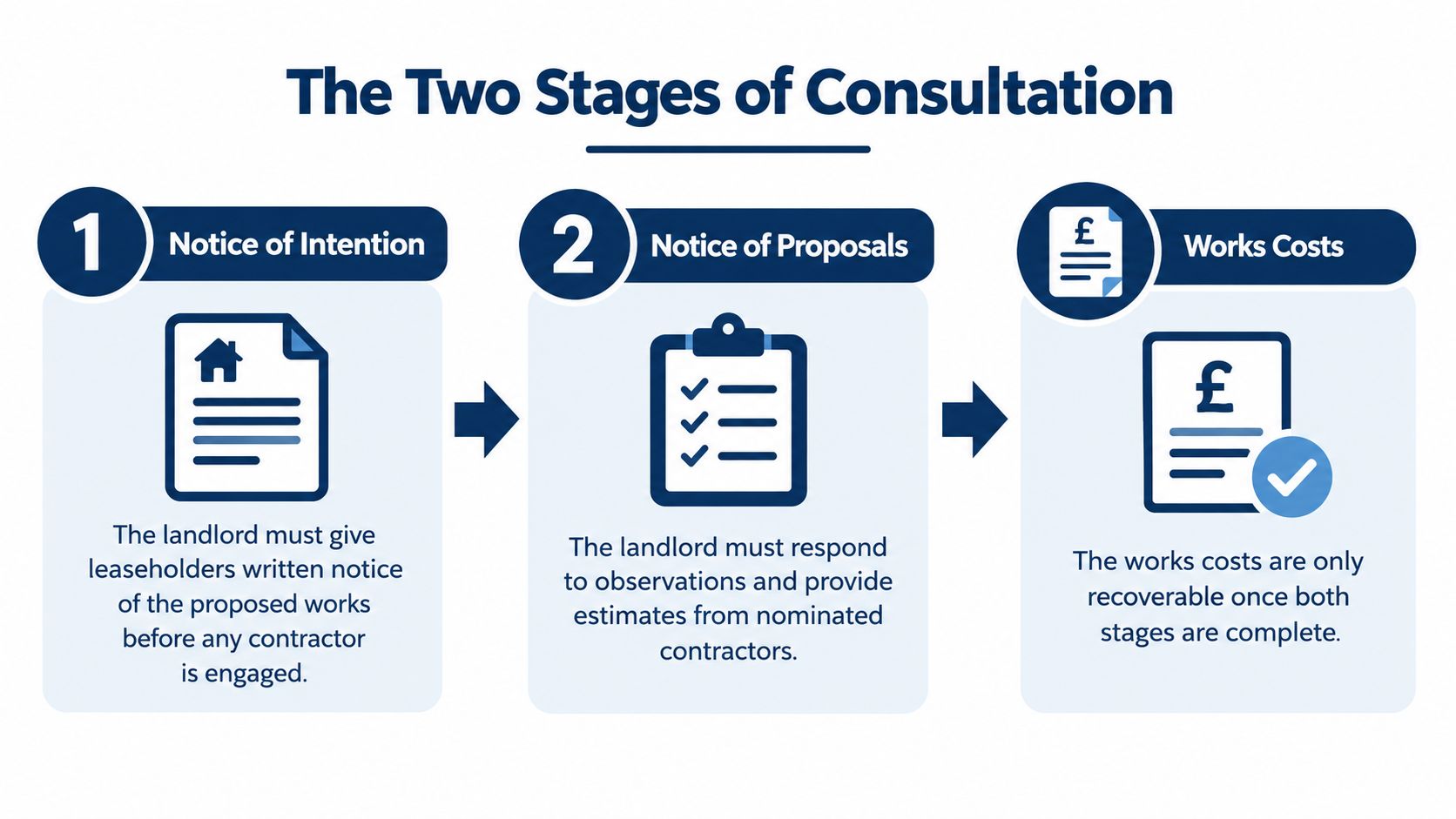
Stage two, estimates and proposals
After the initial consultation period, the landlord normally provides a notice of estimates or proposals. The legislation requires at least two estimates, including one from a person wholly unconnected with the landlord. Copies must be provided to the relevant tenants or displayed where they're likely to come to their attention. A recognised tenants' association must also receive them.
You should compare more than the headline figure. Look at the scope, exclusions, access arrangements, provisional items and proposed materials. Two estimates aren't meaningful if one contractor has priced a full repair and the other has priced a temporary patch.
Write your observations clearly. Refer to the item in the specification, explain the concern and ask for a response. Keep the notice, your email, attachments and any reply together.
How the Threshold Is Calculated
The threshold is assessed per leaseholder, not by adding up the building's total cost. Your lease and the stated apportionment determine your likely contribution.
Take the same £10,000 programme of works. In a block of 40 equally liable flats, the expected contribution is £250 per flat. In a block of 30 equally liable flats, the expected contribution is more than £250 per flat, so the qualifying-works consultation rules may apply. The calculation changes because the number of flats changes, not because the building work changes.
The practical question is therefore: what will I be required to pay? Don't rely on a managing agent's description of the total project. Check the apportionment schedule in the lease and ask how the figure has been calculated.
The legislation also contains a technical threshold expressed as the greater of £25 multiplied by the number of flats in the building or £500. For major works, the practical test explained to leaseholders is generally whether the individual contribution exceeds £250. If the figures don't appear consistent, ask the landlord to identify the statutory basis and the relevant lease provision.
| Total Works Cost | Number of Flats | Per Flat Contribution | Consultation Required |
|---|---|---|---|
| £10,000 | 40 | £250 | The works sit at the threshold. Check the actual apportionment and whether the contribution exceeds it. |
| £10,000 | 30 | More than £250 | The qualifying-works consultation rules may apply. |
The wider accounting treatment can also affect how a service charge is calculated. For useful background on allocating and recording charges, see Action Accountants on landlord service charges, but don't treat accounting guidance as a substitute for checking the lease or the statutory notice.
When Consultation Fails
Consider a typical dispute in a South East London block. A leaseholder receives a service charge demand for £4,500 for roof and façade repairs. The works have already been carried out, but the landlord never issued a proper Notice of Intention and never provided two competitive estimates.
The leaseholder checks the correspondence, asks the landlord to explain the consultation history and then applies to the First-tier Tribunal, Property Chamber. The tribunal finds that the consultation requirements weren't met and that the landlord didn't obtain dispensation.
The result is not that the roof repairs disappear. The result is that the landlord's recoverable contribution is capped at £250 for that leaseholder. The balance can't generally be recovered from that leaseholder through the service charge.
This is the financial point many notices and demands obscure. Failure to consult can affect recovery even when the physical works were necessary. It doesn't automatically prove that the contractor did poor work, that the specification was unreasonable or that the overall bill was excessive.
Those are separate questions. A leaseholder may need evidence from a surveyor or building professional to challenge the condition assessment, scope or workmanship. A procedural challenge instead concentrates on documents, dates, the contents of the notices, the estimates and whether the landlord sought tribunal dispensation.
The landlord doesn't get a full recovery simply because the work was sensible. The statutory process and the quality of the work are different disputes.
A landlord can apply to the First-tier Tribunal under section 20ZA for dispensation from all or part of the consultation requirements. The tribunal must be satisfied that dispensing with the requirements is reasonable. Urgent works may justify an application, but urgency doesn't create an automatic exemption.
If the problem involves wider building works or boundary issues, keep the consultation dispute separate from advice under the Party Wall etc. Act 1996. Party wall procedure and Section 20 consultation address different legal questions.
Long Term Agreements and Service Contracts
Section 20 isn't limited to a one-off roof repair. It can also apply to a qualifying long-term agreement, subject to the statutory exceptions in section 20ZA of the Landlord and Tenant Act 1985.
A qualifying long-term agreement is an agreement entered into for a term of more than 12 months. Where the agreement relates to leaseholder service-charge contributions and the cost to an affected leaseholder exceeds £100 per year, consultation may be required.
That can catch arrangements which don't look like major works at first glance:
- Lift servicing: A multi-year maintenance agreement may create a recurring charge.
- Cleaning and estate services: A contract lasting beyond 12 months may qualify if the annual contribution crosses the threshold.
- Building safety work: A continuing programme can involve both a long-term agreement and separate works.
- Planned maintenance: A framework arrangement may need its own consultation before individual works are instructed.
The long-term-agreement trigger and the qualifying-works trigger are not interchangeable. A landlord may need to consult on the contract itself and then deal separately with qualifying works carried out under that arrangement.
Ask the landlord which trigger it relies on. Is the notice about a contract, physical works or both? What period is being measured? How has your individual annual contribution been calculated?
A modest annual charge can still matter when the contract lasts beyond 12 months. Look at the term and the contribution together.
Urgency or specialist procurement may lead the landlord to seek dispensation from some requirements. That still requires a tribunal decision. It isn't enough for a managing agent to say that a preferred contractor was the only practical option.
What Leaseholders Should Do Next
Start with the paperwork. Preserve every notice, estimate, tender document, photograph, invoice and email. Save attachments in their original form and note when each document was received.
Then work through the notice methodically:
- Check the deadline: Confirm that the response period gives at least the statutory minimum and diarise it immediately.
- Check the scope: Identify exactly what the landlord says it will repair, replace or improve.
- Check the apportionment: Ask how your contribution has been calculated under the lease.
- Nominate a contractor: If you know a competent contractor, make the nomination in writing within the consultation period.
- Request missing documents: Ask for the specification, estimates and tender information if the notice doesn't provide enough detail.
- Respond in writing: Keep observations factual and tied to specific items in the proposal.
Compare the works with the repairing obligations and cost-apportionment provisions in your lease. A Section 20 notice doesn't expand what the lease permits the landlord to charge. It governs the consultation and recovery procedure.

If the landlord says the works are urgent, ask whether it has applied for dispensation or intends to do so. Dispensation may remove some consultation requirements, but it doesn't automatically decide that the cost is reasonable or that every item is recoverable.
An independent RICS Chartered Surveyor can help where the disagreement concerns the specification, condition of the building, scope of work or quality of repairs. A surveyor won't replace a solicitor on a legal dispute, but can provide useful technical evidence. Corinthian Surveyors' guidance on leasehold extension valuation also illustrates why lease documents and property evidence need to be read together.
If informal discussions fail, the First-tier Tribunal, Property Chamber, may be the appropriate route. Get advice before withholding service charge payments, because a dispute about the bill doesn't automatically suspend your obligations under the lease.
Key Takeaways for London Leaseholders
Three points matter most.
First, the £250 per leaseholder cap can be enforceable when the landlord hasn't complied with Section 20 and hasn't obtained dispensation. It isn't a discount negotiated with the managing agent. It concerns the amount the landlord can generally recover through the service charge for the qualifying works.
Second, consultation is staged. The landlord must give leaseholders a meaningful opportunity to comment and nominate a contractor, then provide the required estimate information and allow further observations. A bill arriving after the contractor has been appointed doesn't repair a process that was missed.
Third, long-term contracts matter. A maintenance or services agreement lasting more than 12 months can trigger consultation where the annual contribution to an affected leaseholder exceeds £100. Don't focus only on visible repairs in the communal areas.
Section 20 deals with procedure. It doesn't, by itself, decide whether the works are necessary, whether the contractor has performed properly or whether the amount is reasonable. Those issues may require different evidence and different arguments.
For general background on disputes between landlords and leaseholders, this landlord tenant dispute guide may help you identify the wider issues. For building-safety questions in converted flats and residential blocks, see the practical guidance on flats and fire regulations.
In London, the technical question may involve a Victorian terrace conversion in Forest Hill, a mansion block in Lewisham, a 1930s flat in Bromley or a converted warehouse in Bermondsey. Corinthian Surveyors is an independent, RICS-regulated firm based in Forest Hill, with Clive Thompson holding RICS and CABE qualifications and over 30 years' experience in the built environment. The firm has no ties to lenders, estate agents or developers, and can provide residential surveying and valuation advice across London and the South East.
A RICS Homebuyer Survey may be suitable for a conventional flat or house, while an older or altered property may call for a RICS Building Survey. If the dispute turns on defects, building movement, damp, roof failure or the quality of completed works, a technical inspection may be more useful than arguing over figures alone.
If a Section 20 notice or service charge demand has landed on your doormat, Corinthian Surveyors London LTD can review the building issues, proposed scope and technical evidence behind the charge. Visit Corinthian Surveyors London LTD or call 0800 00 16 422 to discuss independent residential surveying advice in London.