
Schedule of Condition Survey: What to Include and Why
Your neighbour's builders are due next week. Or you're about to sign a lease on a flat with cracked plaster and a damp mark in the bathroom. Either way, the question is the same. How do you prove, months later, that the damage was already there.
That's what a schedule of condition survey is for. It's evidence, not a shield. The same crack can lead to very different outcomes depending on the wording of the record, the date on the photographs and whether the right document was attached to the lease or award.
Table of Contents
- What a Schedule of Condition Records
- When a Schedule of Condition Is Needed
- What Legal Weight a Schedule Carries
- How a Schedule Is Prepared and Written
- What a Schedule Costs and How Long It Takes
- Common Questions About Schedules of Condition
- Choose a RICS Surveyor and Confirm the Schedule Before Work Starts
What a Schedule of Condition Records
A schedule of condition is a dated, itemised record of a property's physical state, written room by room or elevation by elevation and backed by photographs. Its job is to fix a starting point. Later damage can then be separated from defects that were already present.
That matters because common defects are not rare. The English Housing Survey 2023-24 reported that approximately 1.8 million dwellings in England, 7% of the housing stock, had windows in poor condition. A schedule doesn't diagnose every cause. It records what could be seen on that day.
Elements a Schedule of Condition Records
| Element | What the entry records | Why it matters later |
|---|---|---|
| Roofs and chimneys | Covering, flashings, chimney stacks, visible cracks or missing tiles and slates | Shows whether a later roof leak was already present |
| External walls and render | Cracks with location and width, render condition, pointing, damp staining | Separates old movement from new movement |
| Windows and external doors | Frame decay, glazing condition, sealing, whether they open and close | Frequent source of disagreement over repair |
| Internal walls, ceilings and floors | Cracks, sagging, staining, finishes and any lifting boards | Sets the baseline for decoration and damage claims |
| Damp and ventilation | Tide-mark staining, airbricks, visible condensation, ventilation gaps | Distinguishes existing damp from damp that appears later |
| Bathrooms and kitchens | Sanitary ware, tiling, sealants, extractor fans | A common route for water damage to neighbouring areas |
| Visible services | Boiler, visible pipework, electrical fittings and meter location, recorded visually only | Shows what was seen and what was not tested |
| Fixtures, boundaries and shared parts | Garden walls, fences, drives, stairs and common areas | Defines what the lease or award actually covers |
Services are recorded visually only unless testing is separately agreed. A boiler that wasn't run, a drain that wasn't lifted and wiring that wasn't tested should appear as limitations. They should never read as sound.
Practical rule: every element named in the lease, party wall notice or works plan must appear in the record.
Anything left out is hard to prove later. If the rear garden wall is within the works area but missing from the schedule, a later argument about that wall starts from memory. Memory is poor evidence.
When a Schedule of Condition Is Needed
Party wall work is the trigger that brings many clients to a schedule. Extensions, loft conversions and basements in London terraces often affect a shared wall or involve excavation close to a neighbour. The Party Wall etc. Act 1996 governs much of that work and our guide to the Party Wall Act in the UK explains the notice process.
For party wall work in England and Wales, the RICS party wall guidance recommends recording the relevant parts of the adjoining owner's building and grounds that may be affected, then appending the record to the Party Wall Award. The building owner's surveyor usually prepares it. The adjoining owner's surveyor checks and agrees it.
A schedule is not itself a statutory requirement. It doesn't replace the statutory procedure. The building owner still needs the adjoining owner's written agreement or a Party Wall Award before particular works start.
Situations That Call for a Schedule of Condition
| Situation | Why a schedule helps | Who usually commissions it |
|---|---|---|
| Party wall works such as extensions, loft conversions or basements | Dated record of the adjoining property before works start | Building owner's surveyor, checked by the adjoining owner's surveyor |
| Excavation or heavy works on a neighbouring site | Shows cracks and defects that existed before ground movement or vibration | Usually the owner of the works, by agreement with the neighbour |
| Residential lease or tenancy with repair duties | Baseline for what the tenant must repair and what they must return | Landlord and tenant together, agreed before the lease is signed |
| Refurbishment or major works in a shared building | Records the flat, common parts and adjoining areas before contractors start | Freeholder or managing agent, with leaseholders informed |
| Renovation of an older house with planned structural changes | Records the starting condition before alterations hide it | Owner or buyer, before work begins |
Use a simple test. If there's a realistic chance of a dispute about pre-existing cracking or damage, record the condition before anyone starts work.
A routine purchase is different. A buyer in Forest Hill or Catford normally needs a Level 2 Homebuyer Survey or a Level 3 Building Survey. A schedule records condition for a defined purpose. It doesn't value the property or assess every defect.
What Legal Weight a Schedule Carries
A cracked window recorded at the start of a tenancy can lead to very different outcomes later. The schedule is evidence of condition, not a shield against every repair claim. Its effect depends on the lease wording, what the record describes and when it was made.
In England and Wales, a properly incorporated schedule can limit a tenant's repairing obligation so that the tenant does not have to return the premises in better condition than the condition recorded at grant. The lease should identify the schedule as an annex or incorporate it expressly before signing. A report kept separately may be harder to rely on if the lease does not connect it to the tenant's obligations.
Read the repairing, decoration, alteration, statutory compliance and yielding-up clauses together. A limit on general repairs may not remove a separate duty to redecorate, reinstate alterations or comply with a legal requirement.

The Same Defect, Different Outcomes
Suppose a front sash window has a cracked pane and decay to its bottom rail when the tenancy begins. If the schedule records both clearly, and the repairing clause is expressly limited by that schedule, the tenant may not have to return the window in better condition than recorded.
The record does not excuse later damage. If the tenant smashes the already-cracked pane, the schedule establishes the original condition, not permission to cause further damage. If the decay spreads because the tenant ignores a duty to maintain the window, the landlord may argue that the later deterioration is the tenant's responsibility. The lease wording determines how those obligations interact.
A missing pane shows why precise descriptions matter. If the schedule says the pane was absent at the start, that absence is the baseline. If it records intact glazing, a missing pane at the end marks a change. A broad phrase such as “fair condition” gives less useful evidence than a clear description of the defect and its location.
A schedule benchmarks condition at the start. It does not wipe out every future obligation in the lease.
A schedule of condition records the baseline when occupation starts. A schedule of dilapidations is used towards or after the end of a tenancy to identify alleged breaches and the works or costs claimed. They serve different purposes.
Ask your solicitor to compare the lease clauses with the schedule before signing. Keep your own dated photographs as supporting evidence. If the schedule is not attached to the executed lease or expressly incorporated, raise the point before completion rather than waiting until the end of the term.
How a Schedule Is Prepared and Written
A useful schedule is built for comparison. Someone who wasn't at the inspection should be able to stand in the same room later, find the same defect and judge whether it has changed. That requires method, not a folder of unlabelled photographs.
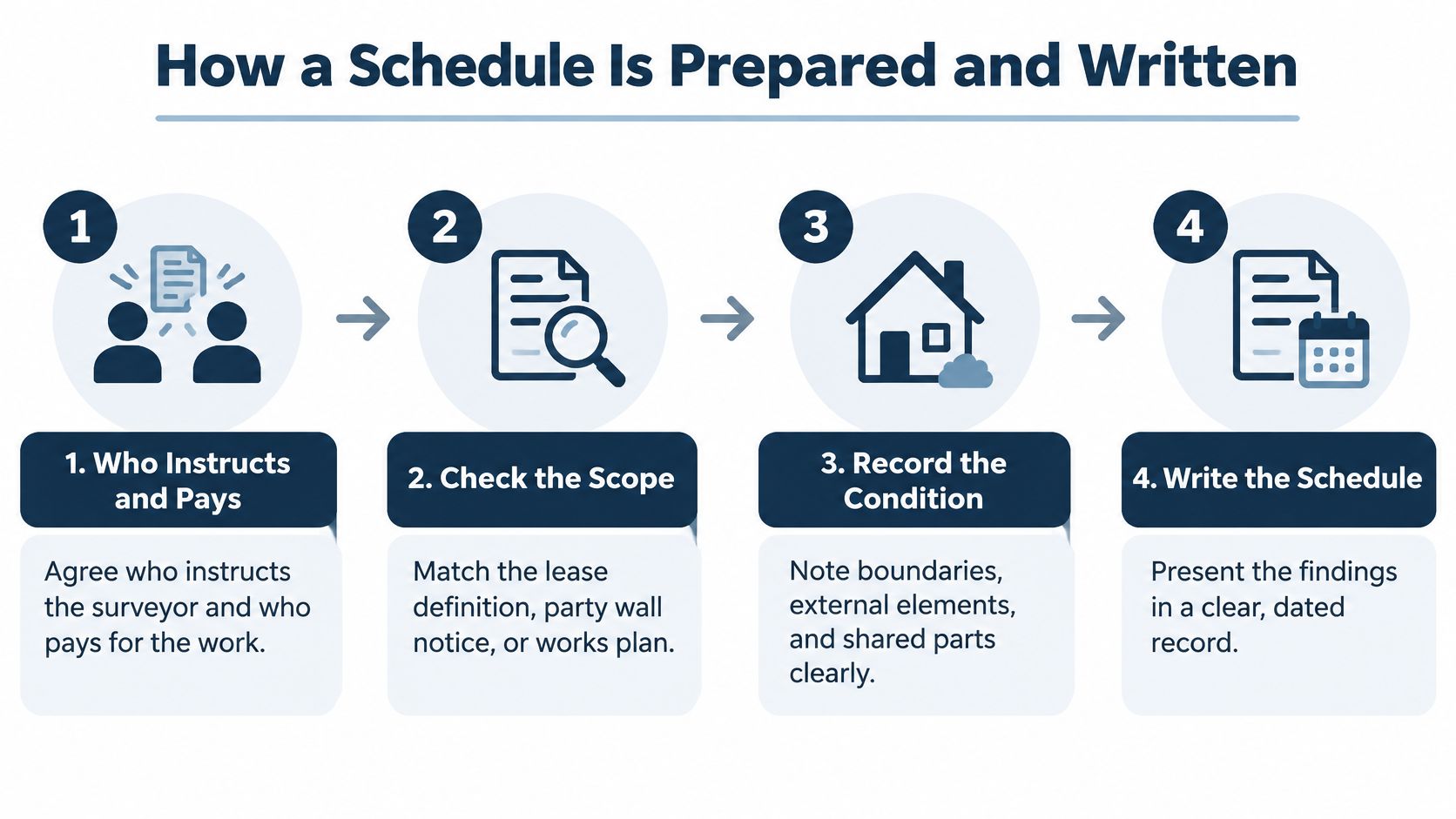
The process below shows the main stages before the detailed steps.
The Eight Practical Steps
Agree who instructs and who pays. The surveyor's duty and reporting line depend on the appointment. In a party wall matter the roles are different from a lease where both sides agree one record. Put the fee arrangement in writing before the visit.
Check scope against the controlling document. I would compare the inspection area with the lease definition, party wall notice or works plan. Boundaries, external elements and shared parts need to be clear. If the demise includes a rear yard and external store, both belong in the schedule.
Inspect in a fixed order. Outside first, then room by room or elevation by elevation. Log access limits as they arise. Don't reconstruct them from memory back at the office.
Write what is visible. Each entry needs location, extent, material and visible symptom. Use measurements where they matter, such as crack width or the size of a damp stain. A tide mark stays a tide mark in the entry. It doesn't become a proven leak without further investigation.
Photograph every numbered entry. Take an overall shot for context and a close-up for detail. Use a scale reference for cracks where width matters. Keep the original files with their date data and don't rename them in a way that breaks the index.
List every limitation. Locked rooms, unsafe roofs and furniture tight against walls all restrict the inspection. A loft viewed only from the hatch is not a loft fully inspected. A rear roof slope seen from the ground is not the same as one seen from a scaffold.
Share and agree the draft. Both parties should check wording, dates and photo numbers. Correct factual errors before signing. Don't let either side alter an agreed entry later.
Attach the signed version. Put it with the lease or Party Wall Award. A survey file held separately may not establish the agreed baseline when liability is disputed years later.
Our property condition assessment checklist is useful when you're preparing access and listing the rooms or elevations that must be covered. It doesn't replace the surveyor's own scope check against the lease or notice.
The short video below is a useful visual reminder of why the record needs to be systematic rather than based on a quick walk-round.
Weak and Strong Schedule Entries
| Element | Weak entry | Strong entry |
|---|---|---|
| Walls | Cracked plaster | Crack in the party wall beside the left chimney breast, width noted in mm, photo 4 |
| Damp | Damp in bathroom | Tide-mark staining to plaster beside the bath panel, extent measured from floor level, sealant split at the bath edge, photo 11 |
| Windows | Window poor | Sash to front bedroom, bottom rail decayed, glazing intact, photo 7 |
| Roof | Roof fine | Rear slope viewed from the ground only, valley gutter not seen, recorded as a limitation |
| Floors | Floor uneven | Timber boards in the rear bedroom slope towards the party wall, two boards lifting beside the fireplace, photo 15 |
| Access | Loft checked | Loft viewed from the hatch, insulation covers the ceiling joists, boarding not inspected |
Vague wording gives nobody anything to check later. Fair condition could mean sound, worn or close to failure. Roof fine is worse because it sounds positive even when the surveyor saw only part of the roof.
Strong entries separate symptom from cause. Brown staining to a ceiling may suggest historic water ingress. It doesn't prove the bath above leaked, the roof failed or a tenant caused it. If cause matters, commission defect analysis rather than asking a schedule to do a job it wasn't designed for.
I would check every entry against its photo number before signing. One mismatched photograph can undermine confidence in the whole record. Check room names too. Front bedroom, rear bedroom and first floor landing must mean the same areas in the text, the photographs and any plan.
Dates deserve the same care. Record the inspection date, the report date and the date works or occupation began. If there's a gap, say so. A schedule inspected before building work but signed after the contractor started is still useful if the dates are honest. It becomes a problem when the paperwork implies a sequence that didn't happen.
What a Schedule Costs and How Long It Takes
There's no single price for a schedule of condition survey. Cost follows the size of the property, the complexity of the building and the purpose of the record. Corinthian Surveyors provides a quote for each property rather than a standard rate.
Factors That Change the Cost and Timescale of a Schedule
| Factor | Effect on cost | Effect on timescale |
|---|---|---|
| Property size and number of rooms | More rooms and elevations mean more inspection and photographs | Extends the site visit |
| Roof and external access | Scaffold, ladders or specialist access adds cost | May need booking ahead |
| Age and construction | Period or non-standard build takes longer to describe accurately | More detailed recording on site |
| Party wall or neighbouring works | Two surveyors and an award add fees | Adds time for agreement and the award |
| Lease complexity | Checking the demise and clauses adds work | Depends on when the solicitor provides the lease |
| Tenants in occupation or limited access | Repeat visits add cost | Scheduling around occupiers can delay the visit |
| Draft review and number of copies | Additional copies and revisions add cost | Each round of agreed changes adds time |
When you ask for a quote, send the full address and property type. Add the age if you know it and state the purpose of the record. Include the lease or party wall notice if you have it.
Tell the surveyor about access problems at the start. Tenants in occupation, locked outbuildings and difficult roof access affect both price and programme. It is cheaper to plan one proper visit than pay for avoidable returns.
The site visit is only part of the work. Writing the draft, agreeing comments from the other party and attaching the final version can take longer than the inspection. Ask for the expected sequence in writing, including when the draft will be ready for review.
A schedule agreed before works or signing is normally easier to settle than one commissioned during an argument. Once positions harden, even simple wording corrections take longer.
Common Questions About Schedules of Condition
Can a Schedule Be Done After Work Has Started
Yes, but it records what remains rather than a clean baseline. The limitations should state that work was already under way and identify what had been stripped out or covered. Expect more argument about anything that changed before the inspection.
Who Should Keep the Signed Copy
Each party should keep a complete copy with the photographs. The version attached to the lease or Party Wall Award is the one that carries weight. Don't store the text in one place and the dated photographs in another.
What If an Item Was Missed After Signing
Add it only by written agreement of both parties. Date the addition and support it with photographs. Never alter the signed entries as if the change had been there from the start.
Choose a RICS Surveyor and Confirm the Schedule Before Work Starts
A tenant and a neighbour can point at the same crack and face very different bills. The difference is rarely the crack itself. It is the wording of the entry, whether the schedule is attached to the lease or the Party Wall Award, and the dates on the photographs. Choose the surveyor and confirm the schedule before work starts. The schedule is evidence. It is not a shield.
Corinthian Surveyors London LTD is a member of the Royal Institution of Chartered Surveyors. The practice is an independent firm of RICS Chartered Surveyors and Valuers based in London, offering chartered surveyor services in Forest Hill. Surveyor Clive leads the residential instructions. I would want that person named on the instruction, because the individual who inspects is the one whose notes may later be read in a lease negotiation, a party wall award or a defect argument.
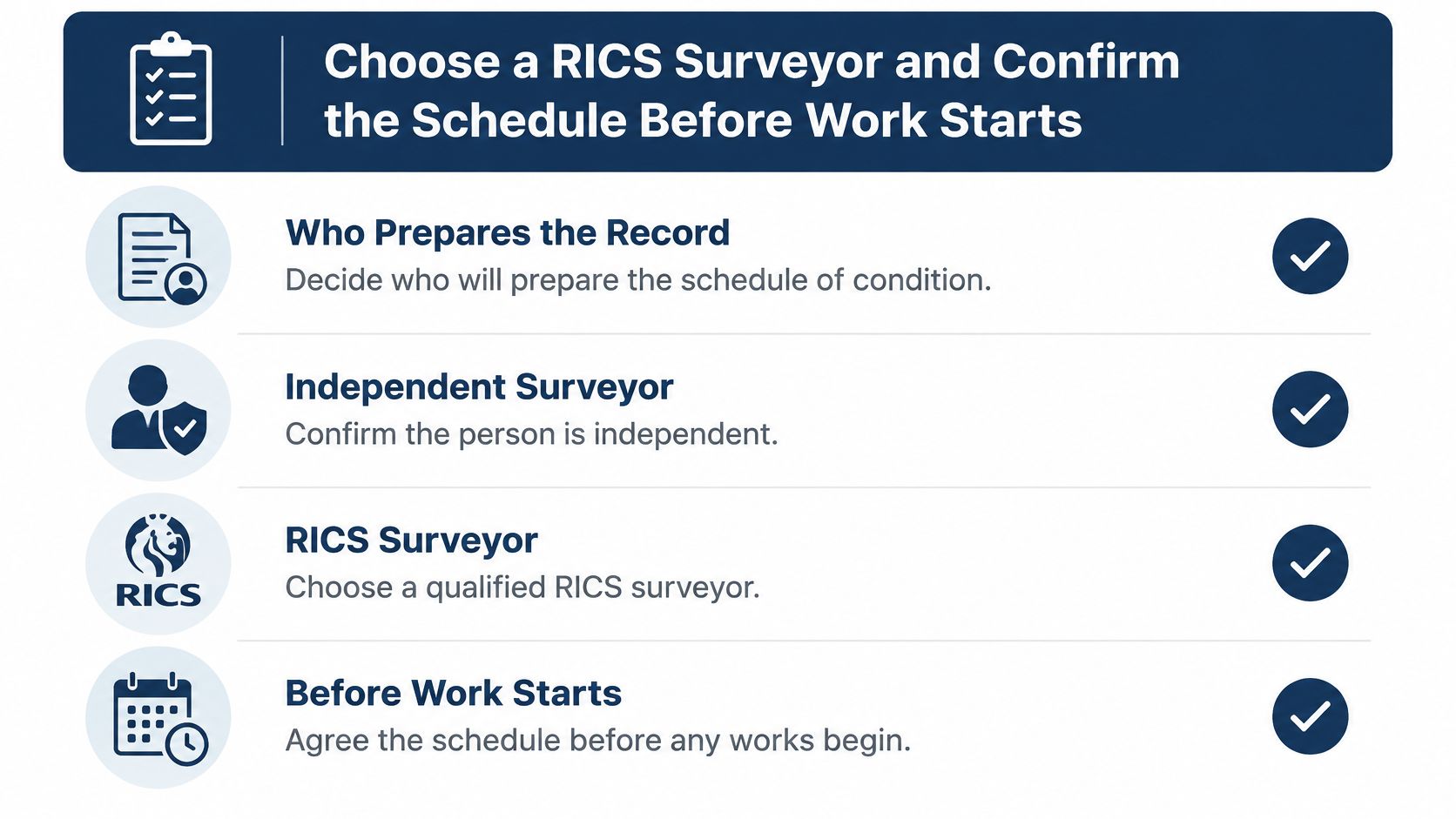
Run these checks before you appoint anyone:
- Confirm RICS membership: check the firm and the individual who will inspect.
- Ask who they act for: in a party wall matter, each side needs to know whose instructions the surveyor is following.
- Ask for a sample: look at entry wording, photo indexing and limitations.
- Ask about local housing stock: Victorian and Edwardian terraces in Lewisham, Lambeth, Southwark and Bromley often share walls, chimney breasts and rear additions.
- Get the timetable in writing: agree inspection, draft review and final issue dates.
Our guidance on how to choose a building surveyor sets out the questions to put before instruction. For a quote on a particular property, use the contact page on corinthiansurveyorslondon.co.uk. Send the address, the purpose of the record and any lease or party wall notice so the fee matches the property.
Agree the draft with the other party. Sign it, and have the final version attached to the lease or award, before work or occupation starts. Loose wording or an undated photograph leaves the same defect open to two readings.