
Residential Building Survey: Scope and When to Book
Approximately 2.0 million English dwellings, or 8% of all homes, contained a Category 1 hazard in 2023, according to the English Housing Survey housing quality chapter. That's the right way to think about a residential building survey. It isn't paperwork for your lender. It's a check for defects that can affect safety, repair costs and whether the agreed price still makes sense.
Use the report as a decision tool. Separate condensation from penetrating damp. Separate historic movement from movement that may be active. Then decide whether each finding is a repair, a price discussion or a reason to pause before exchange.
Table of Contents
- What a Residential Building Survey Covers
- Level 1 Level 2 or a Full Building Survey
- What a Residential Building Survey Costs
- What the Surveyor Checks on a London House
- Reading Damp and Movement in the Report
- How Findings Change the Purchase
- Limits of a Visual Survey
- Booking the Survey Before You Exchange
What a Residential Building Survey Covers
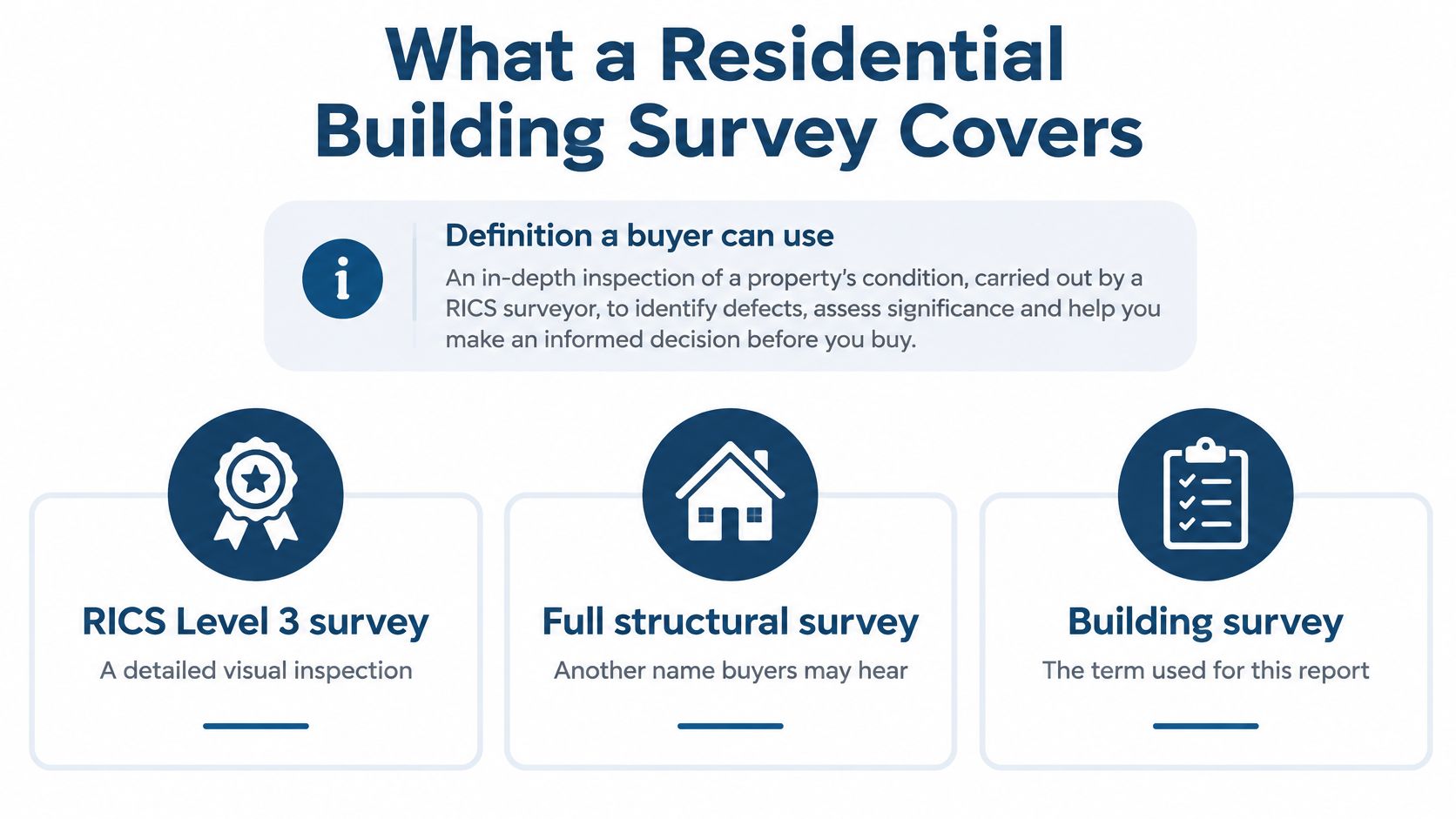
A residential building survey is the RICS Level 3 Home Survey. You'll also hear it called a full structural survey or a building survey. It is a detailed visual inspection of a house or flat, followed by a written report on construction, condition, likely causes of defects and repairs worth budgeting for.
That definition matters because a survey is not a mortgage valuation. A lender's valuer checks whether the property gives adequate security for the loan. The valuer doesn't need to explain a failing flat roof, a removed chimney breast or a stepped crack that should be monitored. A Level 3 surveyor does.
Why Condition Cannot Be Judged From Decoration
The English Housing Survey 2023 to 2024 drivers and impacts of housing quality report found that 3.8 million dwellings, or 15% of England's housing stock, failed the Decent Homes Standard in 2023. It also found that approximately 2.0 million dwellings, or 8% of all homes, contained a Category 1 hazard under the Housing Health and Safety Rating System.
The failure rate was 21% in the private rented sector, compared with 14% of owner occupied homes and 10% of social rented homes. A home fails the standard if it contains a serious health and safety hazard, isn't in reasonable repair, lacks reasonably modern facilities or doesn't provide reasonable thermal comfort.
Those are national figures, not a verdict on one London house. Their value is simple. They show why presentation tells you little. A freshly decorated terrace in Lewisham can have failed pointing and a leaking valley. A converted flat in Bermondsey can look clean while the shared roof is letting in water.
Plain point: If the defect would change what you'd pay, you need it identified before exchange, not after completion.
The report should name the element, describe the defect and explain why it matters. Vague wording doesn't help you instruct a roofer, ask for a price reduction or decide to withdraw.
Level 1 Level 2 or a Full Building Survey
| Survey | Suits this property | What is inspected | What the report is for |
|---|---|---|---|
| RICS Level 1 Home Condition Survey | Newer conventional home in apparently good condition | Visual check of obvious issues only | A simple record of visible condition, not a repair budget |
| RICS Level 2 Home Survey | Conventional home in reasonable condition with a simple layout | More extensive visual inspection, including roof space and drainage chambers where accessible. Secured panels, electrical fittings and chamber covers are not removed | Visible defects, urgent items and matters for further investigation. Optional market valuation and reinstatement figure |
| RICS Level 3 residential building survey | Older, unusual, heavily altered or visibly defective homes, including many London Victorian and Edwardian houses | In-depth visual assessment of condition, construction and defects | Likely causes, repairs, maintenance and future budgeting |
Use that table before you instruct anyone. The right level depends on the building, not on which report sounds most reassuring or costs least.
When Level 1 Is Enough
Book Level 1 only for a newer conventional home that already looks sound and has no unusual alterations. It records obvious visual issues. It doesn't open the building up and it won't give you a detailed repair strategy for an old house with a history of movement.
If you're buying a modern house with a straightforward layout, Level 1 may be proportionate. If you're relying on the report to price roof work, damp repairs or structural alterations, it isn't.
What Level 2 Does Well
The RICS consumer guide to house surveys describes the RICS Level 2 Home Survey as suitable for conventional properties in reasonable condition with a simple form and layout. Its inspection includes the roof space and drainage chambers where accessible, and the report identifies visible defects, serious problems requiring urgent attention and issues requiring further investigation.
Level 2 remains visual. The surveyor doesn't remove secured panels, electrical fittings or inspection chamber covers. The survey and valuation option can add a market valuation and an insurance reinstatement figure. That reinstatement figure is useful because an incorrect sum insured can leave you underinsured after fire or other serious damage.
For a straightforward post war house in Bromley or a conventional flat with no obvious defects, our RICS Homebuyer Surveys at Level 2 may be the correct instruction. An independent surveyor should tell you that plainly rather than selling you the longest report.
When to Book Level 3
Book the Level 3 residential building survey when the property is older, unusual, heavily altered or visibly defective. That covers most Victorian and Edwardian houses in Lewisham, Brockley, Greenwich and Dulwich. Bays, chimney breasts, rear additions, loft alterations and replaced windows are routine in those houses. Each alteration needs to be understood in context.
Level 3 spends more time on cause, repair and future maintenance. It should discuss how the building was constructed, what has changed and which defects are likely to need money first. Our RICS Building Surveys at Level 3 are for that type of instruction.
Corinthian Surveyors London LTD is a member of the Royal Institution of Chartered Surveyors. The practical question we'd ask is direct. Is the building conventional and apparently sound, or is it an old London house with alterations and visible defects? If it's the second type, don't buy a shorter report and hope.
Level 3 is still not a guarantee. It doesn't test every service and it can't see structure concealed by floors and finishes. Its value lies in a fuller visual assessment and clearer advice on what should happen next.
What a Residential Building Survey Costs
We quote each residential building survey by property. There's no single published price that would be honest for a one bedroom conversion in Catford and a large detached house in Dulwich. The fee reflects time on site, time writing the report and the level instructed.
What Changes the Fee
- Size and storeys: More rooms and more roof forms take longer to inspect properly.
- Age and construction: A solid wall Victorian terrace needs different checks from a modern cavity wall house.
- Alterations and extensions: Rear additions, loft rooms and removed walls must be traced through the building.
- House or flat: A leasehold flat raises questions about demised parts and shared structure.
- Access: A sealed loft hatch or blocked drainage chamber limits what can be inspected.
- Travel: Distance from our base in Forest Hill affects the visit.
Compare like with like. Ask for Level 2 and Level 3 for the same address if you're unsure. A cheaper quote that inspects less isn't a saving if it leaves the main defect unexamined.
Information to Send for a Quote
- Give the full address and postcode.
- Say whether it's a house or flat and whether a lease applies.
- List known extensions, loft works and chimney breast removals.
- State whether you need a valuation with the survey.
- Ask what the quote excludes, including specialist tests and drainage investigation.
Specialist follow up work is priced separately. A structural engineer, drainage contractor or damp specialist charges for a different inspection. The survey fee doesn't buy those tests.
What the Surveyor Checks on a London House
Start outside and work from the roof down. That's how water moves and it's how most defects should be read. The checklist below shows the first part of that route.
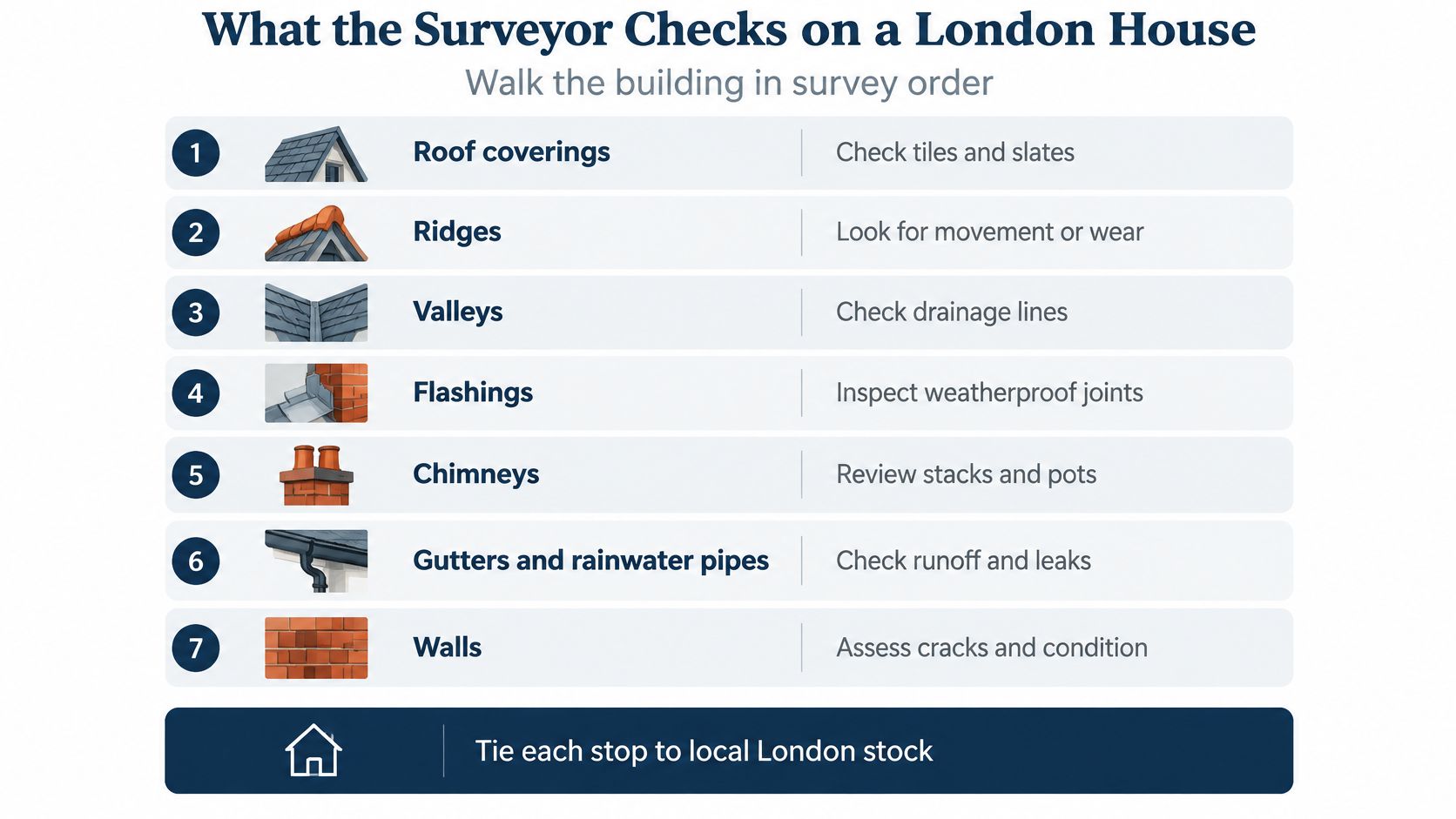
Look at roof coverings, ridges, valleys and flashings first. Then check chimneys, parapets, gutters and rainwater pipes. A slipped slate matters. A cracked valley or failed lead flashing matters more because it can wet timbers for months before a stain appears below.
Next, inspect the walls. Check pointing, render, lintels and sills. Look at cracks beside openings and at the junction with next door. Note external ground levels, air bricks and any path or patio built up against the wall. Those details often explain damp better than a moisture reading.
Match the Inspection to the House Type
A Victorian terrace in Lewisham or Forest Hill is often solid brick with lime mortar, sliding sash windows and a front bay. Hard cement pointing can trap moisture in that brickwork. A bay can move slightly differently from the main wall. An original slate roof may have nail fatigue even where the surface still looks tidy.
A 1930s semi in Bromley or Beckenham is more likely to have cavity walls. The questions change. Look for wall tie corrosion clues, blocked cavities, failed render and alterations around wider window openings. Movement and damp follow a different pattern from a solid wall terrace.
A converted warehouse flat in Bermondsey raises other issues. Ask about the original frame, inserted floors, shared roofs and later alterations. A terrace survey checklist won't answer those questions on its own.
The short film below is useful background before you walk round a property with the report in mind.
Inside, check whether floors slope excessively and whether doors bind or no longer fit their frames. Look at stair strings, ceiling linings and cracking around bays. If a chimney breast has been removed, look for a visible support. A plastered ceiling isn't evidence that the remaining masonry is properly carried.
In the roof space, where it's safe to enter, inspect rafters, purlins, struts and felt. Look for daylight, split timbers, old leaks and insulation pushed into the eaves. Blocked eaves ventilation can leave condensation on the underside of the roof covering.
Services are noted only as far as a visual inspection allows. Old lead pipework should be recorded. An old consumer unit is a prompt to instruct an electrician. A boiler flue can be checked visually for obvious defects, but the surveyor isn't servicing the boiler.
For flats and maisonettes in Clapham, Balham or Crystal Palace, separate what's demised from what's communal. Your survey can report a defective shared roof. It can't make the freeholder repair it. That distinction affects timing, service charges and what your solicitor should ask.
Chartered surveyor services are offered in Forest Hill, London, and that local base matters on site. We recognise the construction because we inspect it every week. The report should still prove each point by naming the element, the defect and why it matters.
Reading Damp and Movement in the Report
Treat damp as building pathology, not as a stain to be injected. A moisture meter tells you that material is wet. It doesn't tell you where the water came from.
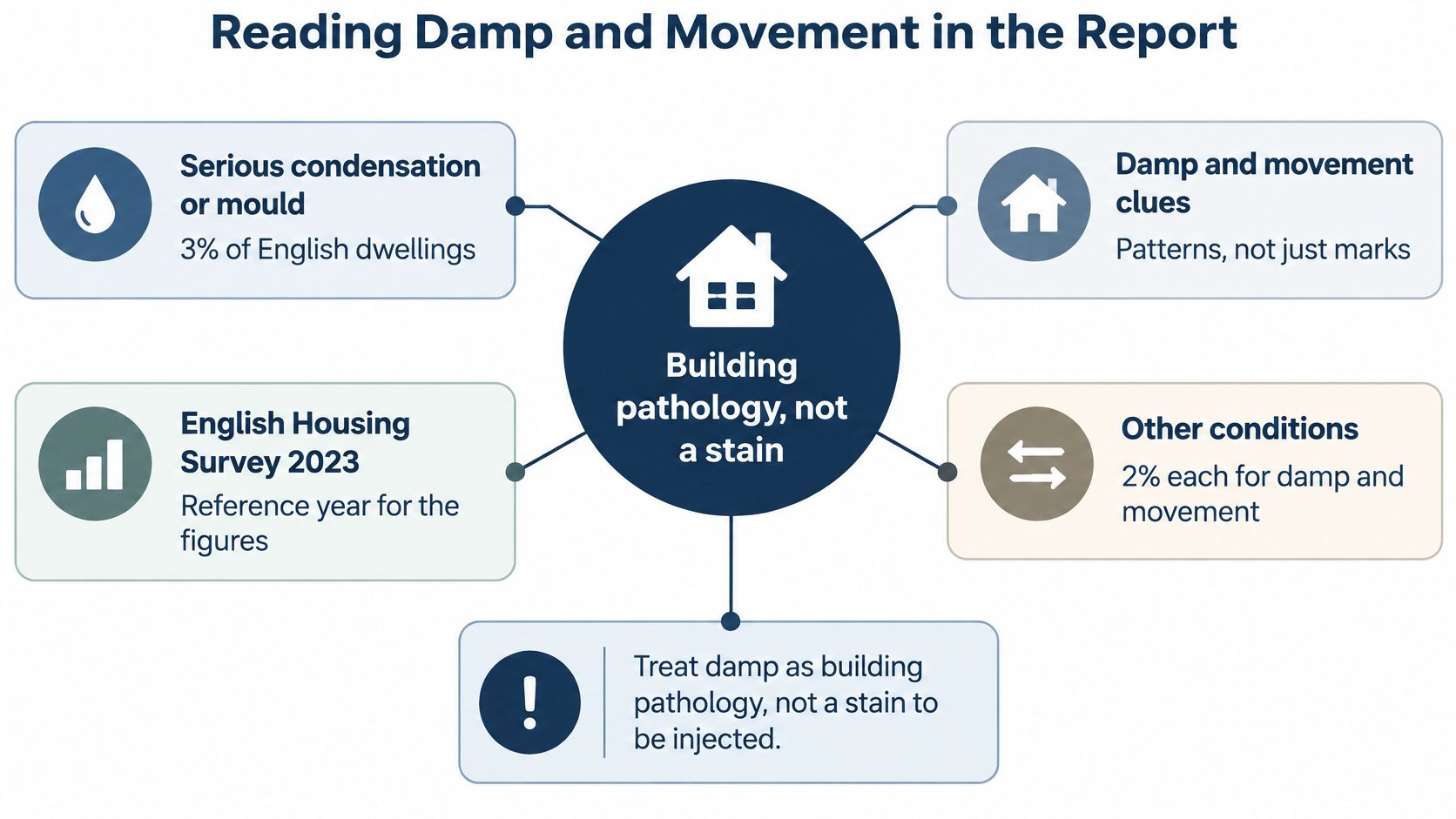
The English Housing Survey 2023 to 2024 headline findings on housing quality and energy efficiency recorded serious condensation or mould in 3% of English dwellings in 2023, compared with 2% for penetrating damp and 2% for rising damp. Since 2019, serious condensation or mould increased from 2% to 3%, while penetrating damp and rising damp each rose from 1% to 2%.
That order matters. In many occupied London flats, condensation is more likely than a failed damp proof course. Don't let a sales visit reverse the diagnosis because injection treatment is the product being sold.
A Sensible Damp Inspection Order
First, check ventilation and indoor humidity. Are bathroom and kitchen extract fans present and working? Are trickle vents open? Is washing dried indoors with windows shut? A cold, underheated room with moist air will produce mould on the coldest surfaces.
Second, inspect cold bridges. Look at window reveals, external corners, roof and wall junctions and wall areas behind furniture. Black mould in those places often points to condensation. It doesn't prove that rain is coming through the wall.
Third, test the pattern against the building. Does the stain sit below a gutter, valley or flashing? Does it align with a bathroom or a leaking pipe? Is it at low level beside raised external ground? Each pattern points to a different repair.
A tide mark is evidence of moisture. It is not, on its own, a diagnosis of rising damp.
Condensation usually requires better extraction, airflow and heating patterns. Rain penetration points to gutters, flashings, pointing, cracked render or a bridged cavity. Low level staining may come from a bridged damp proof course, high external ground or the floor construction. Those defects don't share one remedy.
Our survey report example shows how findings should be set out so you can distinguish an observation from a cause. Read yours the same way. If the report only says damp was found, ask what mechanism the surveyor considers most likely and what evidence supports it.
Reading Cracks Without Panic
Movement needs the same discipline. A Victorian terrace may have historic settlement that stopped long ago. Thermal cracking can open and close slightly with temperature. A failed lintel over a bay can produce local stepped cracking. Possible subsidence is a different concern and needs stronger evidence.
London clay and nearby trees in Dulwich, Sydenham or Blackheath make that distinction important. The surveyor should consider crack width, direction, age, distortion and whether doors and windows still operate. Fresh mortar repairs can hide the history, so the pattern around openings matters.
A good report says what was seen, what it probably means and what it doesn't prove. If monitoring or a structural engineer is justified, it should say why. If the crack is minor and historic, it should say that just as clearly.
How Findings Change the Purchase
A residential building survey describes condition. It doesn't price building work. Once a defect is identified, a specialist or contractor should inspect the relevant element and provide the estimate you'll use in negotiation.
The English Housing Survey 2024 to 2025 headline findings on housing quality and energy efficiency reported that 1.4 million dwellings, or 5% of the housing stock, had a damp problem in 2024, up from 2022. Damp affected 10% of privately rented homes and 4% of owner occupied homes in 2024. Homes with solid masonry walls were most likely to report storm related moisture damage at 28%, compared with 14% for cavity masonry.
That last contrast is directly useful in London. Read a solid wall Lewisham terrace differently from a cavity wall Bromley semi. Exposure, wall type and ventilation change both the likely cause and the repair.
| Finding | What it usually signals | Next step before exchange |
|---|---|---|
| Condensation and mould on cold surfaces | Humidity and weak ventilation more often than a failed damp proof course | Check extract fans and heating patterns. Price ventilation improvements if the fabric is otherwise dry |
| Staining below gutters, flashings or a valley | Rain getting through the roof or rainwater goods | Get a roofing estimate. Ask about wet roof timbers if the loft is stained |
| Low level damp with high outside ground | Bridged damp proof course, high ground or floor construction, not automatically rising damp | Do not accept a generic injection quote. Relate the stain to ground levels and floors |
| Cracking to a bay, lintel or flank wall | Historic settlement, a failed lintel, thermal movement or possible subsidence | Ask whether monitoring or a structural engineer is justified before you renegotiate |
| Removed chimney breast with no visible support | An alteration that may lack proper carrying structure | Ask for the builder's detail or an engineer's view before treating it as cosmetic |
Turn Each Rating Into One Action
Check the condition rating scale in your report. Don't skim the photographs and ignore the ratings. A minor item can be monitored after completion. A defect needing a specialist quote should be priced before exchange. An urgent or serious item should be resolved, priced or reflected in the contract terms.
Use evidence in negotiation. Send your solicitor and the selling agent the relevant report extracts and written estimates. Ask for a price reduction, completion of specified work or a retention where your solicitor advises that a retention is workable. Don't base a reduction on a verbal figure from a contractor who hasn't visited.
Some findings justify withdrawal. Unsupported structure, active movement that can't yet be explained and extensive roof failure can change the risk completely. Walking away before exchange costs fees. Buying the defect can cost far more.
Tell your lender and insurer what they need to know. Movement, flat roofs and non standard alterations may prompt questions. Concealing a survey finding doesn't make the building easier to insure.
My recommendation is firm. Don't renegotiate from adjectives. Renegotiate from a named defect, a credible cause and a written price for the next step.
Limits of a Visual Survey
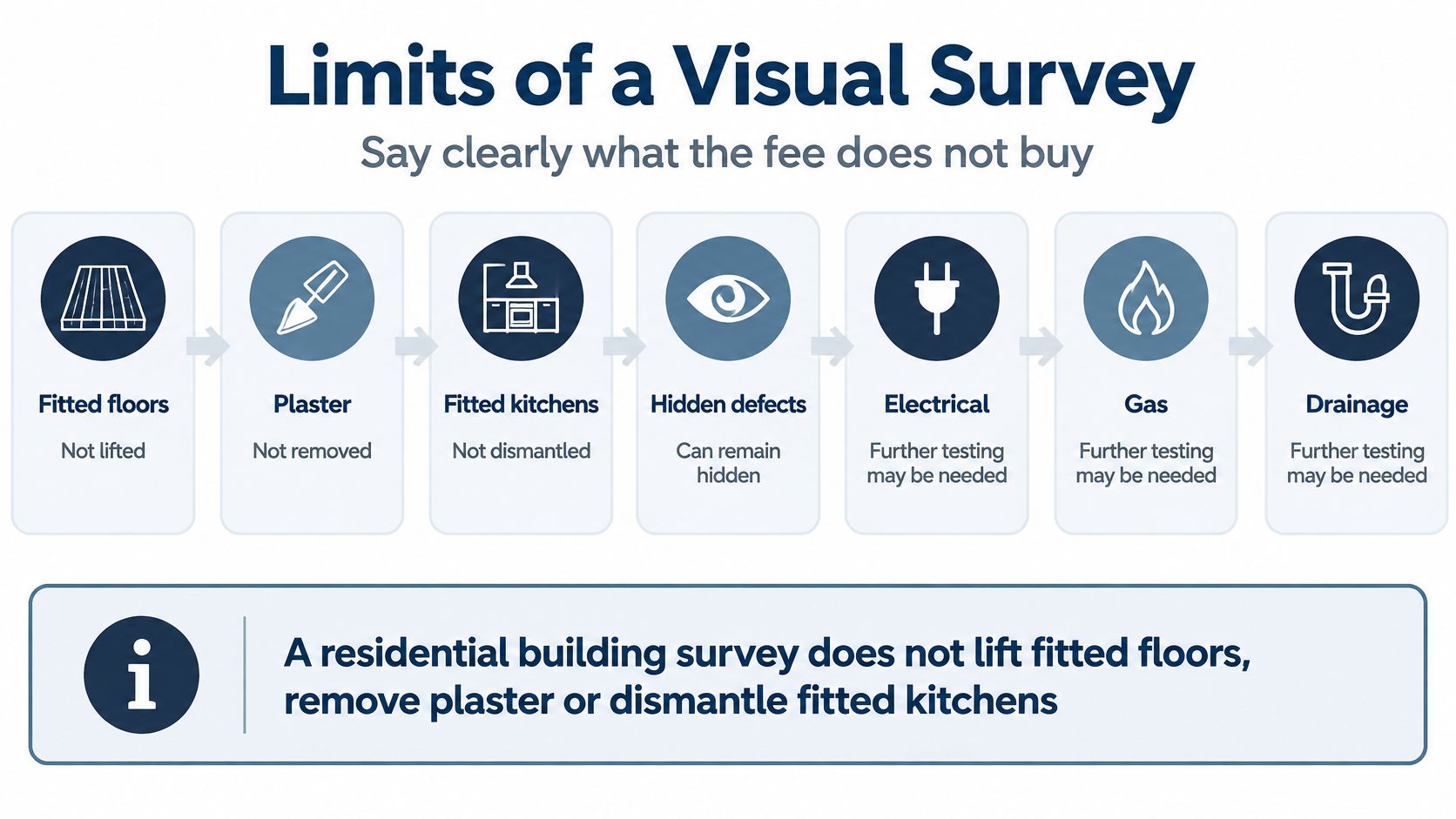
A residential building survey doesn't lift fitted floors, remove plaster or dismantle fitted kitchens. Hidden defects can remain hidden. If an area couldn't be inspected, the report should say so and explain the risk.
Tests the Survey Does Not Replace
- Electrical work: An electrician tests circuits and certifies safety.
- Gas work: A Gas Safe engineer tests appliances and pipework.
- Drainage: A drainage contractor can camera drains where chambers couldn't be seen or levels look wrong.
- Damp: A specialist should diagnose the mechanism for that construction, not quote for a product.
- Structure: A structural engineer answers a defined question about load, support or movement.
Our guide to specialist property surveys explains how those follow up inspections differ. If the report recommends a test, obtain the written result. A seller's verbal assurance that everything works isn't a test certificate.
An NHBC or similar warranty isn't a substitute for an inspection either. A warranty may respond to certain defects under its terms. It doesn't tell you the present condition of every roof covering, wall and alteration before you buy.
Party Wall Notices Are Separate
Building work after purchase can bring separate legal duties. The Party Wall etc. Act 1996 explanatory booklet states that a party structure notice must generally be served at least two months before work to an existing party wall starts. The adjoining owner may agree to an earlier start but isn't obliged to do so. The notice ceases to have effect if the work hasn't begun within 12 months from the date it was served.
Building a new party wall or party fence wall on the line of junction has a different notice period of one month before the intended start. Getting the category wrong can delay a loft conversion, basement dig or rear extension in Peckham, Camberwell or Greenwich.
A pre work condition record helps show what was already cracked. It doesn't replace the statutory notice. It also doesn't replace an agreed surveyor where a dispute arises.
Booking the Survey Before You Exchange
Book your survey early enough to act on the findings before exchange. Choose an independent RICS Chartered Surveyor and confirm the survey level, exclusions, access arrangements and expected report date in writing. For the usual sequence involving the selling agent and solicitor, see who arranges the survey when buying a house.
Local building knowledge matters. A Forest Hill terrace, a Croydon conversion and a Richmond villa have different construction details and common defects. Ask whether the surveyor has any conflict of interest in the sale.
Corinthian Surveyors London LTD is an independent firm of RICS Chartered Surveyors and Valuers based in London, with over 30 years of experience working in the built environment. It is a member of the Royal Institution of Chartered Surveyors. Call 0800 00 16 422 for advice and a quote, or use the /contact-us/ page to send the property details.
Frequently Asked Questions
How long does a residential building survey take to arrive?
Agree the reporting date when you instruct the surveyor. Access, property size and survey level affect the timetable. Leave time to obtain specialist estimates before exchange if the report recommends further investigation.
Can I rely on a survey the seller or estate agent provides?
Instruct your own independent surveyor. A report commissioned by someone else may not be prepared for your needs, and the surveyor may not owe you a duty of care.
Do I need to be present during the inspection?
No. Access is usually arranged through the selling agent or occupant. Tell the surveyor about any cracks, stains or alterations that concern you so they can be considered during the inspection.
For an older or altered London home, ask whether a Level 2 survey is suitable or whether a Level 3 residential building survey is the better choice. The report should explain defects clearly enough to help you decide what to repair, discuss in the price or investigate before exchange. Send the address through the Corinthian Surveyors London contact page to ask about the right survey.