
Who Arranges the Survey When Buying a House in London
In England, Wales and Northern Ireland, the buyer arranges and pays for the survey directly. It's not the seller's job, and it's not your solicitor's job.
A lot of buyers in London get caught by this. They've had an offer accepted in Brockley, Blackheath or Bromley, the mortgage application is moving, the solicitor has sent paperwork, and they assume a survey is happening somewhere in the background. Then nothing turns up, because nobody instructed one.
That mix-up usually comes from one simple mistake. People confuse the lender's valuation with a proper property survey. They are not the same thing. If you want advice that protects you, not the bank, you need to arrange your own survey.
Table of Contents
- The Short Answer Who Pays and Who Arranges
- Why Your Solicitor and Lender Will Not Do It
- Mortgage Valuation Versus RICS Survey
- Choosing the Right RICS Survey Level
- Commissioning an Independent Surveyor in London
- Timing Your Survey in the Purchase Process
- FAQs About House Surveys in London
The Short Answer Who Pays and Who Arranges
If you're asking who arranges the survey when buying a house, the answer is straightforward. In England, Wales and Northern Ireland, the prospective buyer pays for the survey and receives the report, and there is no law requiring either side to obtain one before completion, while in Scotland the seller must arrange a Home Report for buyers to see, as set out in this guide on who organises a survey when buying a house.
That means the responsibility sits with you as the buyer. Not the estate agent. Not the seller. Not the conveyancer.
The mistake buyers make
The usual problem is delay. A buyer agrees a price on a flat in Greenwich or a Victorian terrace in Catford and assumes the lender or solicitor will sort the inspection. They won't. Weeks pass, and only then does the buyer realise no survey has even been booked.
That delay matters because surveys are there to tell you what you're buying. If there's damp, timber decay, roof spread, movement, poor alterations or signs of old chimney breast removals, you need to know before you commit yourself.
Practical rule: Once your offer is accepted, book your survey. Don't wait for someone else to mention it.
What this means in practice
You should treat the survey as one of your first buyer jobs after the deal is agreed. The normal order is simple:
- Offer accepted: You agree the purchase price with the seller.
- Surveyor instructed: You choose the surveyor and give them the property details.
- Inspection arranged: Access is sorted through the estate agent or seller.
- Report issued to you: The survey report comes to you because you commissioned it.
RICS also says buyers are strongly recommended to commission a survey, even though it isn't legally required. Their consumer guide is clear that in England, Wales and Northern Ireland the buyer usually arranges and pays for it, and can choose an independent RICS surveyor rather than rely on the lender's valuation, as explained in this RICS guide to house surveys, costs, types and benefits.
If you take one thing from this article, take this. If you don't instruct the survey, you probably won't get one.
Why Your Solicitor and Lender Will Not Do It
Buyers often assume one of the professionals already in the transaction will handle the survey. That's not how the process works.
Your solicitor deals with the legal side. Your lender deals with the mortgage. Your surveyor inspects the building. Three different jobs.
Your solicitor handles law, not condition
The conveyancer checks title, searches, leases, restrictions and legal paperwork. They are not the person who goes into the loft, checks for roof spread, looks for cracking, tests visible damp risk or comments on structural movement.
RICS draws a clear line between the two roles. The surveyor carries out the physical inspection under the Home Survey Standard and looks at condition, risks and potential legal issues linked to the building, while the conveyancer handles the legal work, as explained in the RICS Home Surveys standard.
Your lender protects its loan
A bank or building society may arrange a valuation for mortgage purposes. That does not mean they are arranging a buyer's survey for you.
The lender wants to know whether the property is suitable security for the loan. That is their concern. Your concern is broader. You need to know if the converted flat in Peckham has signs of damp ingress, if the Edwardian house in Sydenham has movement, or if the 1930s semi in Bromley has defects hidden behind recent decoration.
The lender checks the asset for lending. The surveyor checks the building for you.
Estate agents can suggest names, but they don't appoint the surveyor
Estate agents, brokers and solicitors often have surveyors they know. That's common enough. But the buyer still chooses and instructs the surveyor directly.
There's nothing wrong with taking a recommendation if the person is properly qualified and independent. Just don't assume an introduced surveyor has somehow already been appointed. They haven't, until you instruct them.
A simple way to keep things straight is this:
| Party | What they do | What they do not do |
|---|---|---|
| Solicitor | Legal conveyancing | Inspect the building |
| Lender | Mortgage and valuation for lending | Advise you on condition |
| Surveyor | Physical inspection and report | Handle the legal transfer |
That division matters. If you want a survey, you need to order it yourself.
Mortgage Valuation Versus RICS Survey
Most confusion begins here.
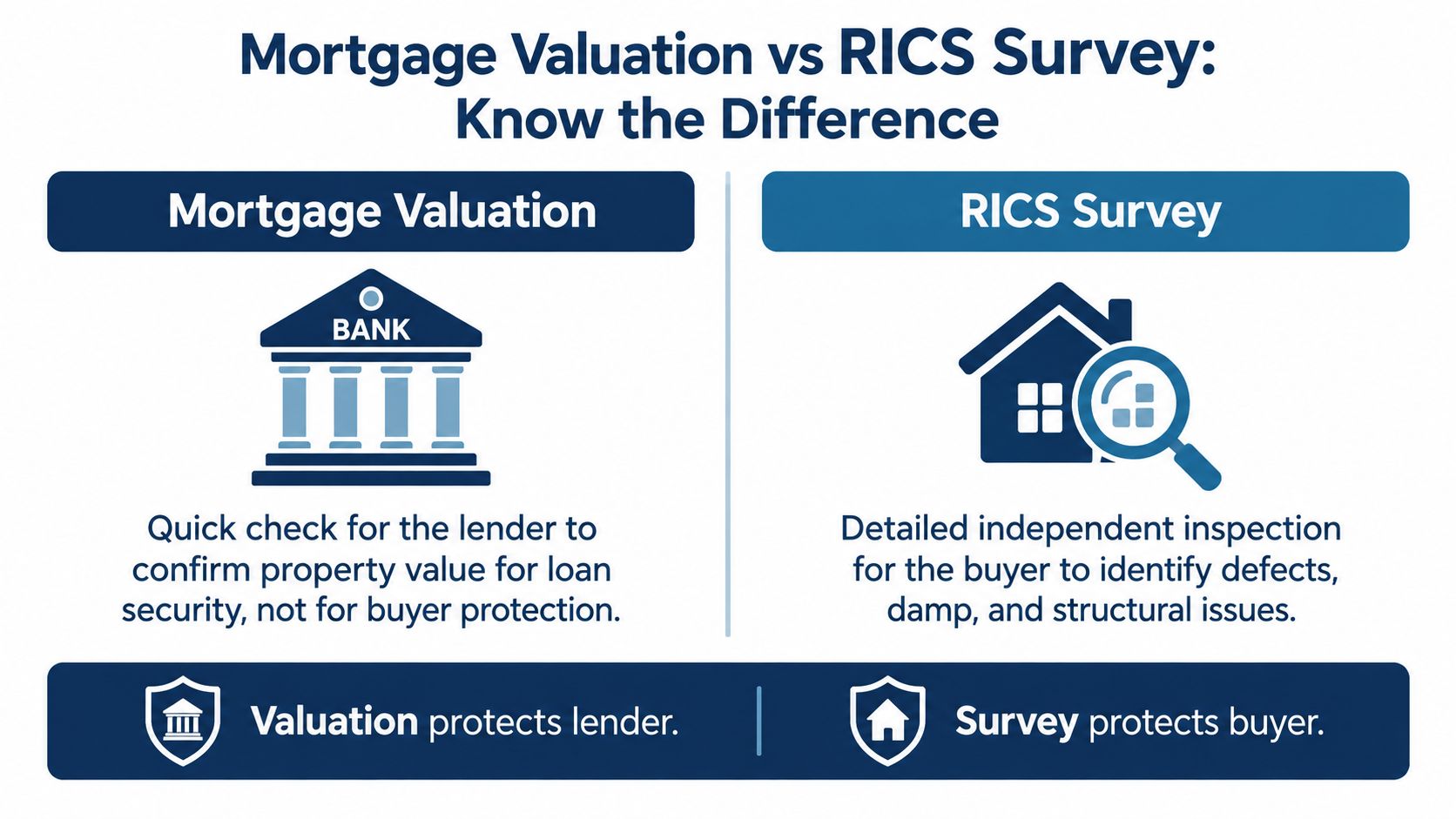
A mortgage valuation is not a proper survey. It might be brief. It may be limited. In some cases, the buyer won't get much useful detail from it at all. A RICS survey is a separate inspection meant to help you understand the property's condition.
The two reports have different jobs
A valuation is about value in the context of a loan. A survey is about condition, risk and defects.
That distinction matters even more in London because the housing stock is so mixed. A flat in a Bermondsey warehouse conversion raises different questions from a Victorian terrace in Lewisham or a period maisonette in Dulwich. If you want a clearer breakdown from the valuation side, read this guide on what a valuation surveyor does.
Here's the practical difference:
- Mortgage valuation: for the lender's lending decision
- RICS survey: for your buying decision
- Valuation outcome: can be enough for the bank
- Survey outcome: tells you what may need repair, investigation or renegotiation
What a survey is more likely to pick up
A proper survey is where defects start to become visible in plain English. That can include:
- Damp issues: staining, high moisture readings, poor ventilation or bridging
- Structural concerns: cracking, movement, distortion and signs of settlement
- Roof defects: slipped coverings, ageing flashings, leaking points or poor maintenance
- Timber problems: decay, infestation risk or damp-related deterioration
- Alteration concerns: missing support, poor workmanship or warning signs around removed walls and chimney breasts
This video gives a useful plain-English overview of the difference:
If you're buying in South East London, don't kid yourself that a valuation is enough. A lot of housing looks tidy on a viewing and still hides issues behind fresh paint, laminate flooring or recently boxed-in pipework.
Choosing the Right RICS Survey Level
Not every property needs the same level of inspection. That's where buyers get the next decision wrong. They know they need a survey, but they pick the wrong type.
RICS identifies three survey levels for UK homebuyers: Level 1, Level 2 and Level 3, with Level 2 formerly called a HomeBuyer Report and Level 3 formerly called a Building Survey, so the survey should match the property rather than a one-size-fits-all approach, as explained in this guide to house surveys and the different RICS levels.
Level 1, Level 2 and Level 3
If you want the simple version, it works like this:
- Level 1 suits more straightforward properties where you want a basic condition snapshot. Corinthian offers RICS Home Condition Surveys for that level of instruction.
- Level 2 is often right for conventional homes in reasonable condition. Think many purpose-built flats, modern houses and standard suburban stock.
- Level 3 is the one I'd lean towards for older, altered or quirky buildings. Victorian terraces in Forest Hill, period houses in Brockley, converted properties in Camberwell and homes with visible cracking or damp risk usually need that deeper look.
Match the survey to the property, not your optimism
Buyers often under-order because they're watching costs. I understand that. Deposit pressure is real, especially in London, where first-time buyers are already stretched. One market explainer notes the average deposit share is 23% in London compared with a UK average of 18.7%, which helps explain why some buyers try to trim survey spend, as discussed in this article about surveys when buying a property.
That's exactly when bad decisions happen. Someone buying a period house in Nunhead or Crystal Palace thinks, “It looks fine, I'll keep it simple.” Then the report they needed was the one with more depth.
My rule of thumb: The older the property, the more altered it is, or the less certain you are, the more likely you need a Level 3.
A quick decision guide
| Property type | Usual survey direction |
|---|---|
| Modern flat | Often Level 2 |
| 1930s semi in Bromley or Sidcup | Often Level 2, sometimes Level 3 if there are concerns |
| Victorian or Edwardian terrace in Lewisham, Peckham or Brixton | Often Level 3 |
| Listed building or unusual construction | Level 3 |
If you're still unsure, start by asking the surveyor what they'd recommend for the exact property, not the estate agent's version of it. This explainer on what a RICS survey is is also useful if you want the survey levels set out clearly before you instruct.
Commissioning an Independent Surveyor in London
Independence matters more than convenience. That's especially true in London, where one street can have solid houses next to badly converted flats and heavily altered period stock.
I've seen buyers in places like New Cross and Walthamstow rely on whoever the agent suggested, because it felt easier. Sometimes that works perfectly well. Sometimes the buyer ends up with a report that doesn't answer the questions they should have asked in the first place.

What to check before you instruct
Start with qualifications and independence. For residential purchase work, I'd want to see RICS regulation at the very least. CABE credentials can also be a useful trust signal where building knowledge and technical background matter.
Ask direct questions:
- Who will inspect the property. Don't assume the named person on the email is the one attending.
- What survey level they recommend. Make them justify it based on age, type and condition.
- Whether they have local experience. A surveyor who knows Lewisham terraces, Croydon semis or Bermondsey conversions will usually ask better questions.
- Whether they have any ties to the agent, lender or developer. You want a clear answer.
Why local knowledge changes the advice
London stock is not uniform. A Georgian property in Southwark, a mansion block flat in Westminster and a 1930s house in Beckenham do not fail in the same way.
That's why an independent practice can be useful. Corinthian Surveyors London LTD is one example of that setup. It is an independent firm in Forest Hill, regulated by RICS, with Clive Thompson holding both RICS and CABE qualifications, and it has no ties to lenders, estate agents or developers. If you're comparing local options, this guide on finding surveyors near you will help you sort the serious firms from the generic listings.
Don't choose a surveyor because they were easiest to forward from the estate agent's email. Choose the one who will tell you what's wrong with the building.
Timing Your Survey in the Purchase Process
The right time to book the survey is after your offer is accepted. Not after the mortgage offer lands. Not after the solicitor has been working for weeks. As soon as the deal is agreed, get it moving.
That timing gives you room to think. If the survey flags damp, roof defects, structural movement or poor past alterations, you still have options. You can renegotiate, get specialist advice or decide the property isn't for you.
A simple timeline that works
Use this order and you'll stay out of trouble:
- Offer accepted
- Choose your survey type
- Instruct the surveyor
- Let the agent arrange access
- Read the report properly
- Decide what needs follow-up
Don't leave the report unread while you obsess over paint colours and furniture. There's plenty of time for that after you know the building is sound. If you're already thinking ahead to move-in day, a practical checklist like make your new house a home is useful, but only after the serious buying checks are dealt with first.
What usually slows things down
The biggest delay is hesitation. Buyers wait because they hope the legal work or mortgage process will somehow answer building questions. It won't.
The second delay is poor coordination. Give the surveyor the full address, estate agent details and any known concerns straight away. If you've already noticed cracking, condensation, sloping floors or a patched roof, say so at the start.
FAQs About House Surveys in London
Does my solicitor book the survey for me
Usually, no. The buyer should instruct the surveyor directly. The solicitor deals with conveyancing, not the physical inspection of the property.
Can I rely on the mortgage valuation instead
No. The valuation is for the lender's purposes. If you want advice on condition, defects and repair risk, book your own RICS survey.
Which survey should I choose for an older London property
For many older homes, especially Victorian terraces, altered houses and period conversions, a Level 3 is often the safer choice. A standard flat or newer house may suit Level 2. The right answer depends on the building, not just the postcode.
What if the survey finds serious problems
Don't panic. Read the report carefully, ask the surveyor to talk you through the key issues and decide what matters most. You may renegotiate, ask for further specialist reports or walk away if the risk is wrong for you.
If you need clear advice before you commit, Corinthian Surveyors London LTD provides RICS Level 1, Level 2 and Level 3 surveys across London, the Home Counties and the South of England, along with valuations and specialist residential surveying work. If you want to talk it through properly, call 0800 00 16 422 and explain what you're buying, where it is and what's worrying you.