
Minor Subsidence Cracks Explained for London Homeowners
You spot a thin crack above a window in your Victorian terrace in Lewisham. Or perhaps it's above the front door of a 1930s semi in Bromley. It looks small, but the word subsidence has a way of making a small defect feel much bigger.
Most fine cracks are cosmetic. Some indicate movement that needs watching. The difficult part is telling the difference without relying on the crack's width alone. A narrow diagonal crack that keeps opening can matter more than a wider mark that appeared during one dry summer and closes after a wet winter.
This is a practical guide to minor subsidence cracks in London homes. It explains what to look for, why South East London's clay ground creates seasonal movement and when an RICS survey is sensible. Corinthian Surveyors London LTD is an independent RICS Chartered Surveyors and Valuers practice in Forest Hill. Plain-English triage matters because the right next step might be decoration, monitoring, a survey or an insurer's involvement. It shouldn't automatically be a builder digging around the foundations.
Table of Contents
- What Minor Subsidence Cracks Look Like Up Close
- Why Minor Cracks Appear in London Homes
- How to Tell Cosmetic Cracks From Signs of Movement
- How Surveyors Assess Minor Subsidence Cracks
- Remedial Options and What They Typically Involve
- Next Steps for London Homeowners and Buyers
What Minor Subsidence Cracks Look Like Up Close
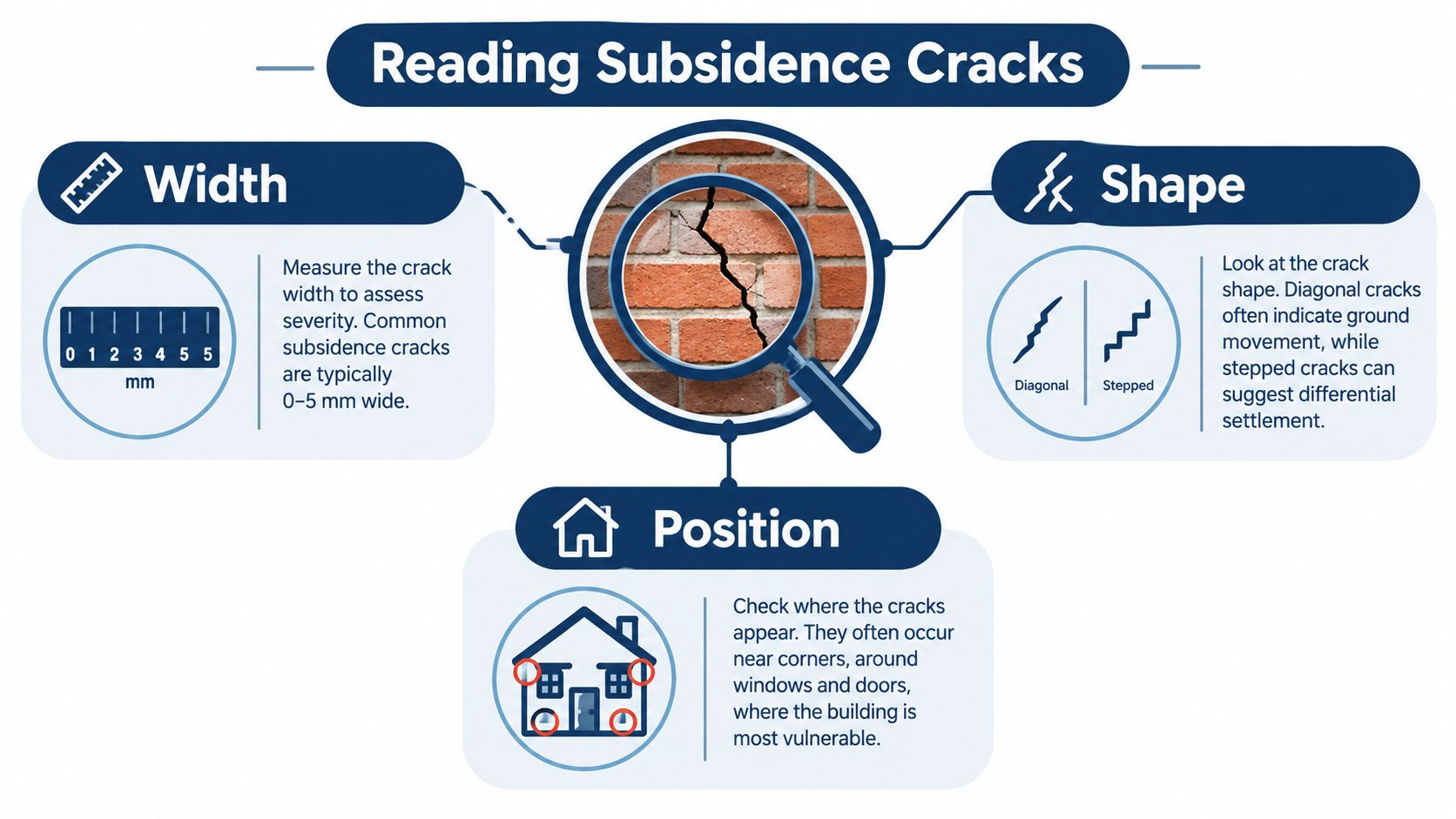
A fine crack above a window can look alarming, especially when it runs through plaster or brickwork. Its width gives you a starting point, not a verdict. A surveyor reads three features together: width, shape and position.
Hairline cracks under about 0.1mm are generally negligible, according to the Subsidence Forum's structural movement scale. Cracks up to 1mm are classed as very slight and are normally dealt with during decoration. Openings up to 5mm may indicate slight movement. Filling may be enough, while some external repointing can help keep the wall weather-tight.
A 3mm crack is roughly comparable with the edge thickness of a 10p coin. RICS says there is rarely cause for real concern unless a crack appears suddenly and measures more than 3mm, as explained in its consumer guidance on subsidence. Treat that as a triage point, not a diagnosis. On London's clay ground, a crack of this size may look cosmetic in August, then reopen or widen by February. Monitoring through wet and dry cycles matters more than one measurement.
Shape gives the next clue
A vertical crack through plaster may come from shrinkage, a joint between materials or historic settlement. A diagonal crack beginning near a window or door and widening towards one end deserves closer attention. In brickwork, a stepped crack that follows mortar joints can indicate differential movement.
Check both ends. A crack with the same width throughout differs from one that tapers or opens noticeably. Look on the other side of the wall too. Internal plaster cracking that matches an external masonry crack carries more weight than an isolated mark in paint.
Position matters
Windows and doors interrupt the wall, creating weaker points. Bay windows, rear extensions and junctions between older and newer parts of a building deserve inspection. Note cracks above an opening, at an extension corner or near a change in roofline.
Photograph the defect with a ruler beside it, then record whether doors or windows stick. “A diagonal crack above the rear window, wider at the left end and visible outside” gives a surveyor useful evidence. “There's a small crack in the wall” does not.
Why Minor Cracks Appear in London Homes
London's building stock and ground conditions create several plausible explanations for cracking. A Victorian terrace in Catford may have older masonry, lime-based materials and later alterations. A 1930s semi in Beckenham may have different foundations, an extension and mature planting close to the building. The crack can look similar while the cause is different.
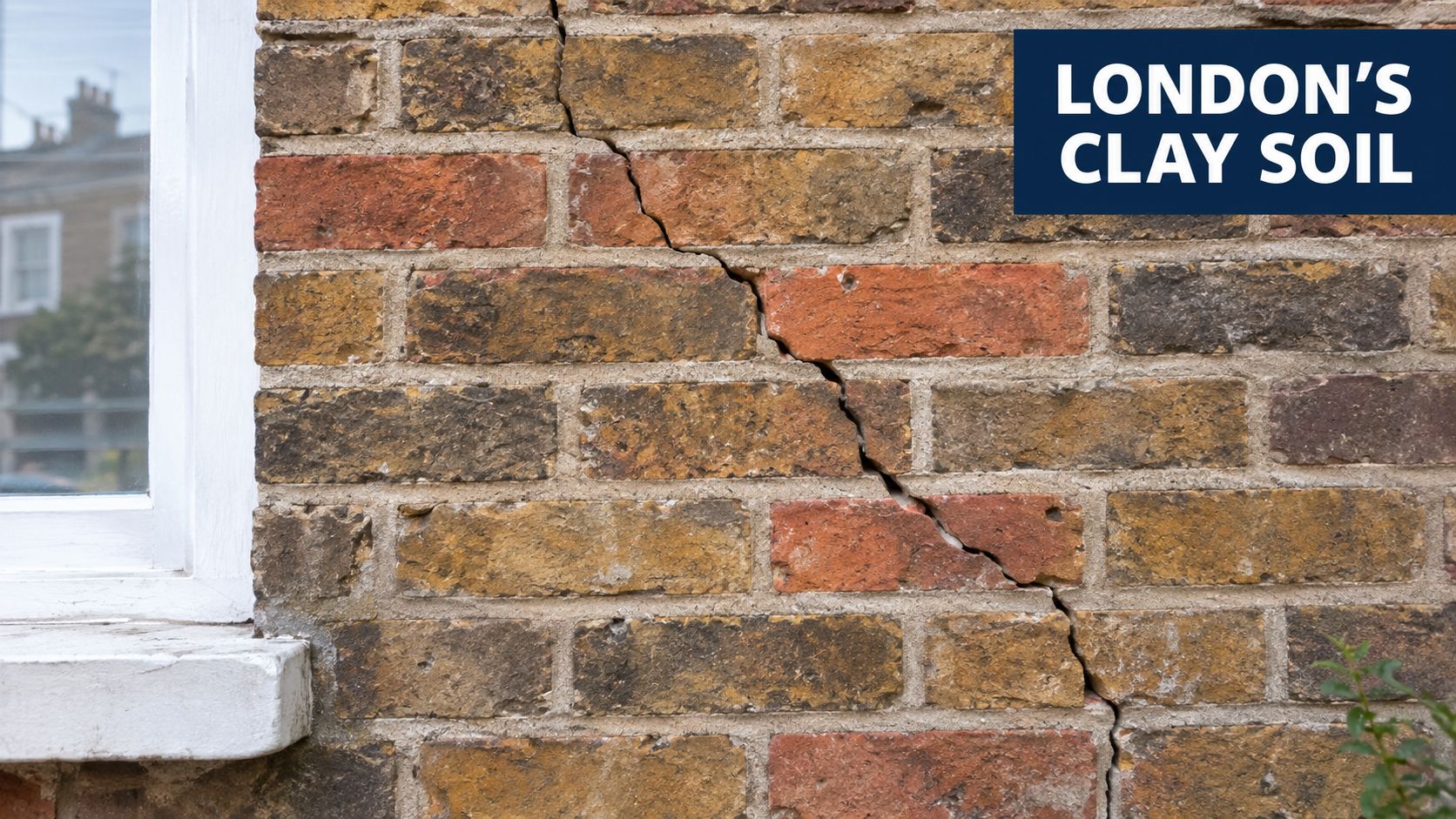
Much of South East England contains shrinkable clay soils. During a hot, dry period, clay loses moisture and contracts. Foundations supported by that ground can move downwards or unevenly. Wetter winter conditions allow the clay to swell again, so a crack that opens in August may partly close after the winter.
The Association of British Insurers' guidance on subsidence damage notes that homes on shrinkable clay can develop minor cracks up to 5mm during unusually dry spells. Those cracks may close again after wetter winter weather. If they remain open or continue widening beyond 5mm, the pattern suggests a longer-term issue and should be discussed with the insurer.
Not every seasonal crack is subsidence. Thermal movement can open and close finishes as temperatures change. Older settlement may have stopped long ago. Poor repointing, incompatible render or a previous repair can crack again without active foundation movement.
Local causes deserve attention
Trees can draw moisture from clay, particularly during dry weather. A mature tree close to a shallowly founded extension may be relevant, but its presence doesn't prove that roots caused the crack. A leaking drain can also alter ground moisture and contribute to movement.
Period properties need extra care. Chimney breast removals, rear additions and altered openings can change how loads move through a wall. In Greenwich, Blackheath, Dulwich and Sydenham, a surveyor will often need to consider the age of the property, later work and the relationship between original and extended construction.
Drainage and tree conditions should be investigated where the pattern points that way. For general background on the interaction between roots and foundations, this guide to fixing tree root foundation damage provides useful context, although it doesn't replace a property-specific inspection.
A crack's history matters as much as its appearance. Note the weather when you first saw it, compare dated photographs and check again after contrasting wet and dry conditions. That record helps separate one-season clay shrinkage from progressive structural movement.
How to Tell Cosmetic Cracks From Signs of Movement
The safest distinction is not “thin equals harmless”. It's stable pattern versus progressive pattern.
A fine vertical crack in an internal finish that hasn't changed for years is more likely to be cosmetic. So is a small crack confined to plaster, with no corresponding external defect and no change in doors, windows or floors. That doesn't prove the wall is sound, but it gives a surveyor a less concerning starting point.
A diagonal or stepped crack that widens at one end deserves more attention. Concern increases when it appears internally and externally, becomes longer or wider, or arrives alongside a door that suddenly sticks. The RICS guidance on signs of subsidence inside a house gives homeowners a useful visual reference before arranging professional advice.
| Feature | More likely cosmetic | More likely needs investigation |
|---|---|---|
| Width | Hairline or fine, particularly under 1mm | Sudden opening above 3mm, or a crack continuing to widen |
| Shape | Short, vertical or confined to plaster | Diagonal, stepped or wider at one end |
| Location | Isolated internal finish | Around openings, extensions, bay windows or wall junctions |
| Sides of wall | Visible on one surface only | Present inside and outside in a matching position |
| Change over time | Stable or closes seasonally | Progressively longer or wider |
| Other symptoms | No associated distortion | Sticking doors or windows, uneven floors or external ground gaps |
Use time as the test
A crack measured once tells you what exists today. It doesn't tell you whether the building is moving. That's why surveyors often recommend recording the opening through the seasons rather than filling it immediately and losing the evidence.
The UK insurance market reflects this approach. Crack and deformation monitoring commonly runs over 6 to 12 months, and a full year is often used in clay areas to capture seasonal wetting and drying, as described by Point and Level's guidance on crack monitoring. Progression is the important question. A crack's appearance on one day is only part of the assessment.
Practical rule: A narrow crack with the wrong pattern can justify advice. A wider crack that closes after a wet winter may be seasonal. Record the change before deciding what it means.
Treat cost and resale as separate questions
A crack can be structurally minor but still create difficulty during a sale or insurance discussion. Buyers, lenders and insurers may ask whether it has been investigated, monitored or repaired. That's why “it's only 3mm” isn't a complete answer.
If the pattern is diagonal, stepped, visible on both sides or linked to sticking doors and windows, arrange an inspection even if the opening looks small. The aim is not to label every crack as subsidence. It's to avoid dismissing the wrong one.
How Surveyors Assess Minor Subsidence Cracks
A surveyor starts with the building, not just the mark on the wall. The inspection considers the crack's width and direction alongside the age of the property, extensions, roof form, ground conditions, trees, drainage and other signs of distortion.
For many ordinary properties, an RICS HomeBuyer Survey, Level 2 can identify visible defects and recommend further investigation. It's not a destructive investigation and won't expose concealed foundations or confirm every possible cause. For an older Victorian terrace, a listed property, a conversion or a house with substantial alterations, an RICS Building Survey, Level 3 is usually the more suitable choice. The difference is explained plainly in this guide to what a Building Survey is.
What happens during the inspection
The surveyor normally works through a sequence:
- Inspect inside and outside. Internal finishes, external brickwork, openings, corners, roof lines and visible ground conditions are compared.
- Photograph and measure. The report records location, direction and approximate width. A ruler in the photograph gives the reader useful scale.
- Look for associated movement. Doors and windows, floors, ceilings, joints and external paths can show whether the issue extends beyond one patch of decoration.
- Consider likely causes. The surveyor reviews clay shrinkage, nearby trees, drainage, historic settlement, alterations and previous repairs.
- Recommend proportionate action. That may be decoration, monitoring, targeted investigation, insurer notification or referral to a structural engineer.
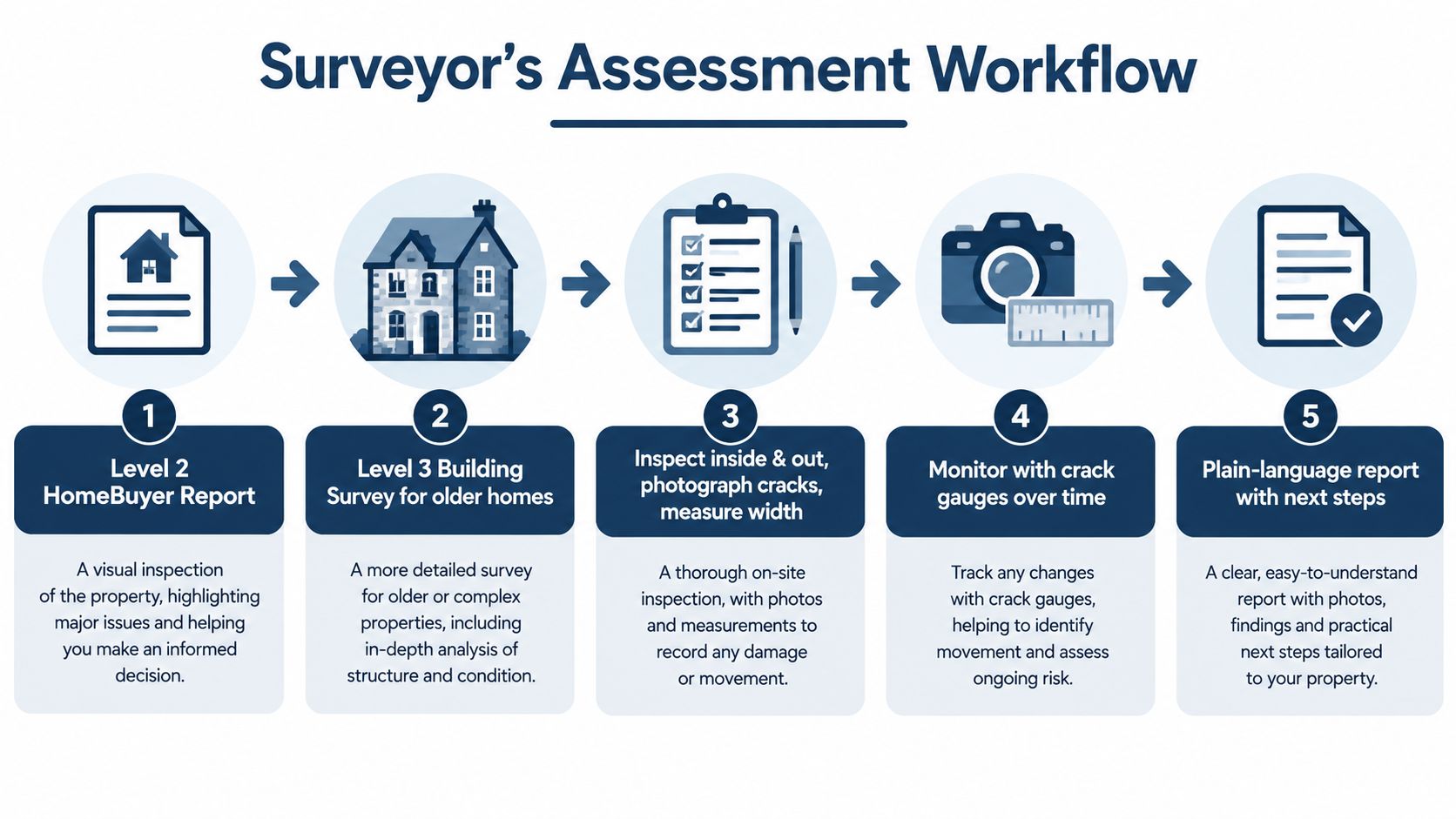
A monitoring arrangement may use crack gauges or tell-tales fixed across the crack. The readings show whether the gap changes and help identify seasonal behaviour. A monitoring report should set out the locations, dates, measurements and interpretation, rather than state that a crack has been observed.
Who needs to be involved
A surveyor may recommend an insurer's involvement where active subsidence is suspected. A structural engineer may be needed for technical design or specialist calculations. A drainage contractor may investigate suspected leaks, while an arboricultural specialist may assess a tree where roots and clay are relevant.
Corinthian Surveyors is based in Forest Hill and works across London boroughs and the Home Counties. The practice is independent, with no ties to lenders, estate agents or developers. It's regulated by the RICS, led by Clive Thompson, who holds RICS and CABE qualifications with over 30 years' experience in the built environment, and insured by Royal Sun Alliance.
The point of independence is practical. You receive an opinion about the property's condition, not a recommendation shaped by a lender's panel or a developer's sales process.
Remedial Options and What They Typically Involve
Repair should follow the diagnosis, not the crack's width alone. A gap around 3–5mm may look cosmetic in August, when London clay has dried and shrunk, yet become more concerning by February if it remains open after wet weather. A stable defect in the lower categories of the structural movement scale may need filling, redecoration or local repointing to keep the wall weather-tight.
Monitoring is often the right first remedy when the evidence is unclear. A surveyor may install a crack gauge, take dated photographs and review readings through wet and dry conditions. The useful question is whether the crack closes and reopens with the seasons, or keeps progressing through them.
Targeted work depends on the confirmed cause. Repairs may involve a leaking drain, defective rainwater goods or specialist advice about vegetation and clay. Tree removal is not automatic. If roots are relevant, seek advice on fixing tree root foundation damage before taking action, because poorly chosen work can create further ground or ecological problems.
Why underpinning isn't the default
Underpinning is a major structural intervention. It may be suitable where progressive movement has been demonstrated and other measures cannot address the cause. A minor crack alone does not justify it. Insurers usually require evidence of ongoing movement and a clear diagnosis before agreeing to major remedial work.
The practical sequence is usually:
- Stable cosmetic defect: Fill, redecorate and keep the wall weather-tight.
- Uncertain seasonal movement: Monitor through the relevant wet and dry cycle.
- Identified local cause: Repair the drain, correct defective construction or obtain suitable tree advice.
- Proven progressive movement: Commission specialist investigation and agree a repair strategy with the insurer.
Costs vary with access, damage, property type and location. A rear extension in Forest Hill, a listed building in Greenwich and a converted property in Bermondsey will present different repair conditions. Corinthian Surveyors London LTD should give property-specific advice rather than attach a standard figure to a photograph.
Next Steps for London Homeowners and Buyers
Start by making the evidence useful. Photograph the crack with a ruler, include a wider view showing its position and write down the date. Record whether it's internal or external, whether it appears on both sides of the wall and whether any door or window has started sticking.
Don't fill the crack before it's documented if you're concerned about movement. Keep the photographs in one folder and compare them after changes in weather. If the crack grows, becomes more pronounced or is joined by other symptoms, seek advice rather than relying on decoration.
Choose the survey level carefully
A Level 1 Home Condition Survey is a basic visual condition report for a straightforward property. A Level 2 HomeBuyer Survey is suited to many conventional homes where visible defects need assessment. A Level 3 Building Survey is the safer choice for Victorian terraces, older properties, listed buildings, unusual construction, substantial extensions and complex conversions.
For a buyer in Lewisham, Catford, Brockley or New Cross, the property's alteration history can matter as much as its age. A Victorian terrace with a rear extension and removed chimney breast needs a different level of scrutiny from a relatively straightforward 1930s semi in Bromley. If the survey identifies a crack, the report can support a sensible conversation with the seller rather than an emotional decision.
The guide to cracks in house walls can help you organise your observations before commissioning a survey. Tell your insurer when the evidence points to possible active subsidence or when your policy requires notification. Don't instruct underpinning or remove a mature tree solely because a crack looks alarming.
Questions London homeowners ask
Can a minor crack be seasonal?
Yes. In shrinkable clay areas, a crack can open during an unusually dry spell and close after wetter winter weather. The important test is whether it closes, remains stable or continues to widen.
How long should cracks be monitored?
Monitoring commonly runs over 6 to 12 months, with a full year often used to capture seasonal wetting and drying in clay areas. The appropriate period depends on the crack, property and surveyor's recommendation.
Can I buy a house with minor subsidence cracks?
Possibly, but don't decide from width alone. Ask for the survey, monitoring records, insurance history and evidence of repairs, then have an independent surveyor assess the pattern and likely cause before committing.
Corinthian Surveyors London LTD is based in Forest Hill and covers London, the Home Counties and the South of England. If you're buying, selling or dealing with cracks in an existing home, speak to an independent RICS Chartered Surveyor before committing to costly repairs. You can call 0800 00 16 422 with the property type, crack location, photographs and any monitoring history ready.
Corinthian Surveyors London LTD provides RICS Level 2 HomeBuyer Surveys, Level 3 Building Surveys and defect analysis for residential properties affected by suspected movement. Visit Corinthian Surveyors London LTD to arrange an independent assessment and get a clear view of what the crack means and what should happen next.