
Home Buyers Survey: RICS Guide to Levels, Costs and Choices
In 2023, 3.8 million dwellings in England, 15% of the housing stock, failed the Decent Homes Standard. A home buyers survey exists to identify whether the property you love carries repair, safety or structural risks that a viewing will miss.
You may be standing in a freshly painted Victorian terrace in Lewisham, or looking around a converted flat in Bermondsey with excellent light and a smart kitchen. The estate agent says the property is in good condition. Your offer is accepted. You're already thinking about furniture.
That's exactly when you need to slow down. A home buyers survey is not a box-ticking exercise and it isn't a pass or fail certificate. It's a risk screen. It tells you what the surveyor can see, what may be happening behind the finishes and what needs further investigation before you exchange contracts.
Table of Contents
- Why a Home Buyers Survey Matters Before You Exchange
- RICS Home Survey Levels Explained
- What Defects a London Home Buyers Survey Should Cover
- Using Survey Findings in Negotiations and Next Steps
- Survey Costs and the Financial Case for Commissioning One
- Why Mortgage Valuations and Estate-Agent Descriptions Are Not Enough
- Choosing the Right Surveyor and What to Ask Before Instructing
Why a Home Buyers Survey Matters Before You Exchange
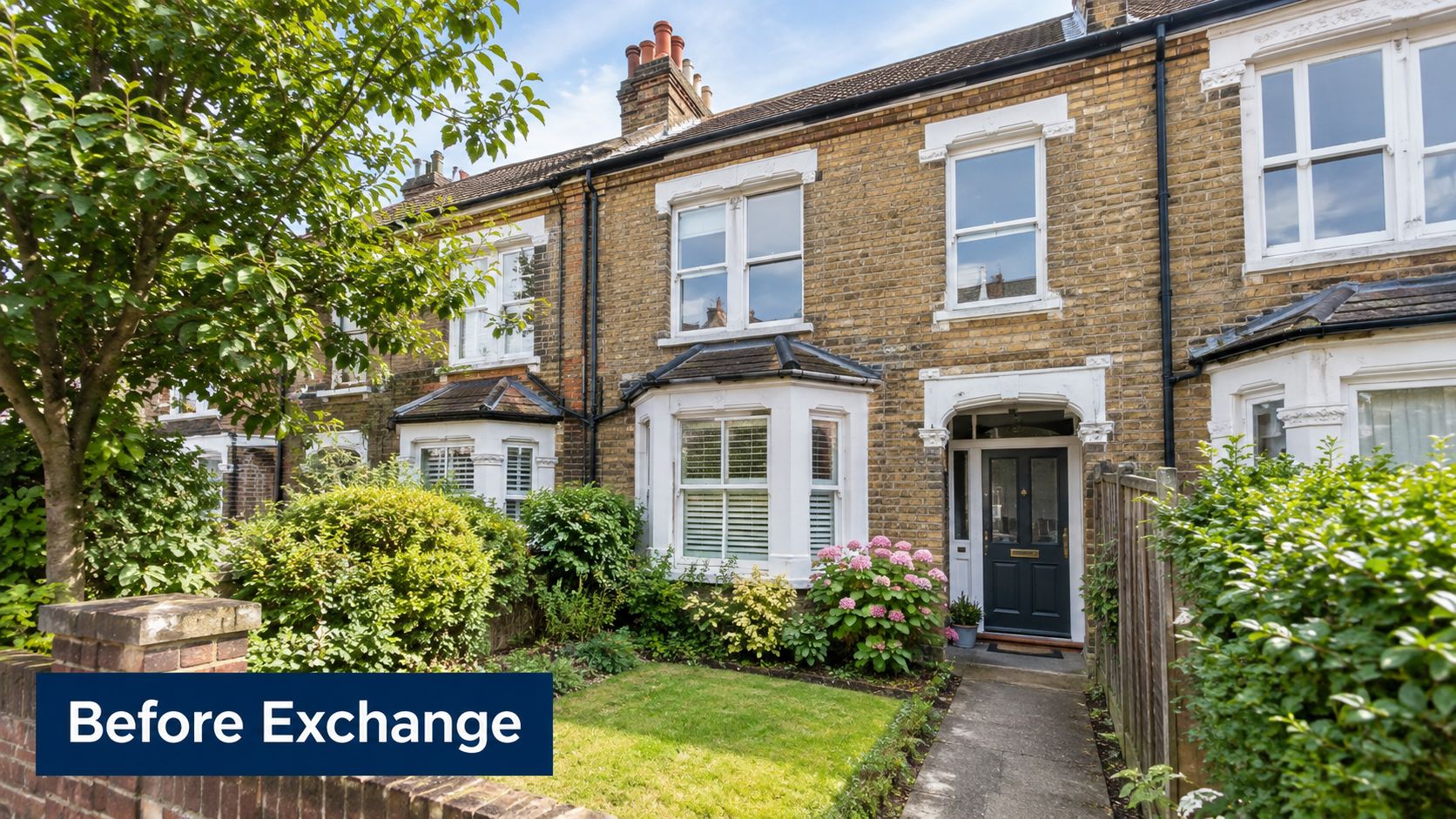
A period terrace can look perfectly sound while hiding roof defects, damp behind modern plaster, timber decay or movement around an extension. A converted flat may have a tidy interior while leaving questions about roof coverings, drainage, alteration work, ventilation or the condition of shared parts.
A viewing tells you whether you like the property. It doesn't tell you whether the roof is near the end of its useful life or whether a crack is historic settlement rather than active structural movement. An estate-agent description is useful for selling the property. It isn't an independent assessment of its condition.
The practical question is simple: what could cost you money, delay the purchase or change your decision?
The English Housing Survey found that approximately 2 million dwellings in England, equivalent to 8% of the housing stock, failed the Housing Health and Safety Rating System criterion in 2023. It also recorded 1.8 million dwellings with windows in poor condition, 1.3 million with bathroom problems and 1.1 million with external doors in poor condition. Those figures are England-wide, not a prediction about one London house, but they show why attractive presentation isn't evidence of sound construction. English Housing Survey findings summarised by Barratt Homes
Practical rule: Don't ask whether the property “passes” the survey. Ask which risks you're prepared to accept, which need pricing and which require specialist advice.
If you're organising your purchase for the first time, a practical checklist such as the Orange Box Self Storage buying guide can help you keep track of the wider process. The survey sits alongside that preparation by giving you independent condition information before you're legally committed.
RICS Home Survey Levels Explained
The right survey depends on the building, not just the asking price. A Level 2 report may suit a conventional flat in Bromley, but it may be the wrong choice for a heavily altered Victorian house in Forest Hill or a listed property in Greenwich.
| Level | Scope | Suitable property types | Typical output |
|---|---|---|---|
| Level 1 | A less extensive visual inspection of the building, services and grounds | Conventional properties in reasonable condition where only a basic condition snapshot is needed | Description of condition, obvious risks and relevant legal issues, with traffic-light ratings |
| Level 2 | A more detailed visual inspection of the main elements, services and grounds | Conventional houses, flats and bungalows built with common materials and a reasonably simple layout | Defect information, repair and maintenance advice, traffic-light ratings and, where commissioned, a valuation |
| Level 3 | The most detailed inspection, with fuller consideration of visible defects and potential hidden problems | Large, older, unusual, run-down, altered or heavily renovated properties | Detailed defect descriptions, repair options and likely consequences if problems remain untreated |
A Level 1 Home Condition Survey is a basic snapshot. It can be suitable where the building is conventional and you want a straightforward record of visible condition. It won't provide the depth of analysis needed for a property with significant alterations or obvious defects.
A Level 2 Home Survey, commonly called a homebuyer report, is the usual choice for a reasonably conventional London property. It gives more detail than Level 1 and may include a valuation, depending on the service commissioned. The survey-only service includes a more extensive visual inspection of the roof space and drainage chambers, but it isn't a building pathology investigation.
A Level 3 Building Survey is the sensible choice for a large Edwardian house in Dulwich, a converted warehouse in Bermondsey, a property with a basement extension or a house with unusual construction. It's also more appropriate where the surveyor sees defects that need deeper explanation.
Read what a RICS survey involves before you instruct anyone. The important point is suitability. Choosing a cheaper level that can't answer the questions raised by the building is false economy.
What Defects a London Home Buyers Survey Should Cover
London housing stock demands judgement. A Victorian terrace in Catford has different risks from a 1930s semi-detached house in Bromley. A flat conversion in Peckham may require attention to alterations and shared elements, while a property in a conservation area may contain older materials that shouldn't be assessed as though they were modern construction.
The survey should identify symptoms and explain their likely significance. It should also state its limitations. A visual inspection can flag staining or mould, but it may not prove the cause where the relevant structure, service or roof area is concealed.
Damp needs a proper diagnosis
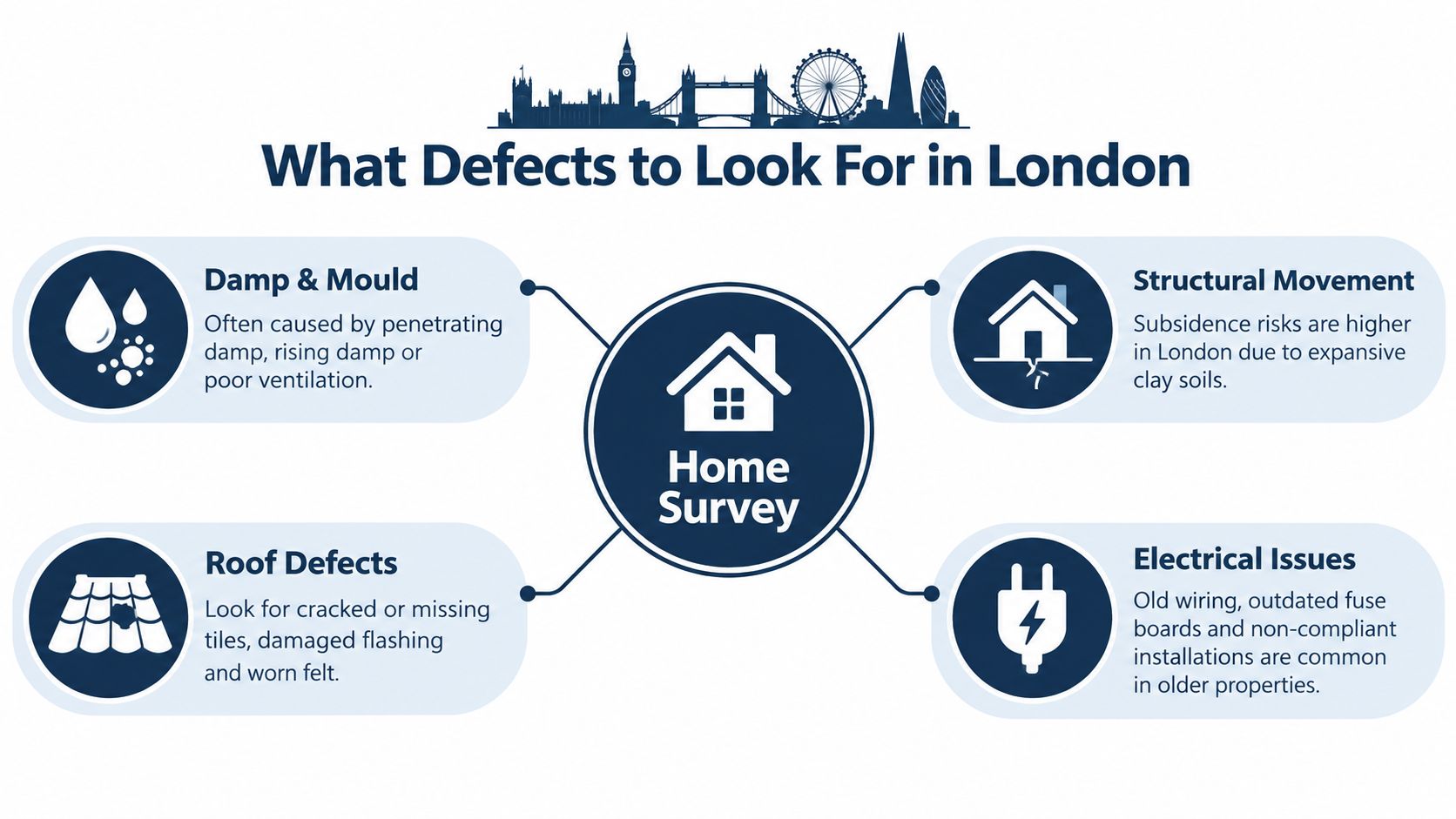
The latest English Housing Survey found that 1.4 million dwellings in England, 5% of the housing stock, had a damp problem in 2024. Owner-occupied homes were affected at 4% while privately rented homes were affected at 10%. The same survey found that 31% of households reported an issue with condensation, damp or mould, which is broader than defects recorded during physical inspection. English Housing Survey 2024 to 2025 findings
A damp mark isn't automatically proof of major structural failure. It may relate to penetrating damp from defective pointing or gutters, rising damp, a plumbing leak or condensation caused by ventilation and occupancy. Dismissing it as cosmetic is just as careless.
The useful framework is:
- Observed symptom: staining, mould, peeling finishes or a musty smell.
- Likely mechanism: roof, wall, ground-floor, plumbing or condensation-related moisture.
- Evidence required: further opening-up, moisture assessment, drainage checks or specialist inspection.
- Urgency: immediate safety concern, repair before occupation or routine maintenance.
- Next referral: building surveyor, roofing contractor, drainage specialist or other suitably qualified professional.
Movement and the building envelope
Stepped cracking, distorted openings and sloping floors need context. The surveyor will consider the pattern, position, age and surrounding construction before deciding whether the issue appears to be historic or requires investigation. In London, that matters in areas with older terraces, extensions and changing ground conditions.
The inspection should also cover roof coverings, flashings, chimneys, rainwater goods, external walls, windows, doors and drainage. Timber decay may affect roof timbers, joist ends or window frames. Poor ventilation can worsen moisture problems and create avoidable damage.
The government's 2022 to 2023 evidence recorded 3.5 million households in England, 14% of all households, living in homes failing the Decent Homes Standard, with 2.1 million households, 9%, having at least one Category 1 hazard and 1.0 million, 4%, reporting damp. Those categories measure different things, but together they reinforce the point: surface presentation is a poor substitute for condition evidence. English Housing Survey housing quality and condition
Using Survey Findings in Negotiations and Next Steps
A survey report becomes useful when you act on it. Don't send the whole document to the seller with a vague request for money off. Separate routine maintenance from defects that affect safety, durability or the price you're prepared to pay.
Start with the traffic-light ratings, then read the written comments behind them. The colour is a prompt. The explanation tells you what the surveyor saw, how serious it may be and whether further investigation is needed.
Sort the findings into decisions
Accept and budget. Minor maintenance, decoration and ageing components may be normal for the property. Record them in your ownership budget rather than turning every item into a dispute.
Request evidence or investigation. If the report identifies possible movement, concealed damp or unsafe services, ask for the relevant specialist inspection. Don't negotiate a figure for a defect whose cause and extent remain unknown.
Seek remedial work or a price adjustment. A roof defect, significant timber decay or serious damp may justify asking the seller to complete defined work before completion or reducing the price to reflect the risk.
Reconsider the purchase. If the likely cost, disruption or uncertainty no longer fits your finances, walking away may be the correct decision. A survey doesn't make that decision for you. It gives you the information to make it without relying on hope.
Use the report with your conveyancer. Legal questions about alterations, planning records, building regulations, lease terms, rights of access or guarantees need legal follow-up. The surveyor can identify a concern, but shouldn't pretend to provide conveyancing advice.
A good report doesn't give you false certainty. It tells you where certainty ends and what you need to do next.
For example, “damp present” is not enough to price a negotiation. You need to know whether the surveyor suspects a leaking gutter, condensation, defective plumbing or another mechanism. The same applies to cracking. A recommendation for monitoring is different from a recommendation for structural investigation.
Survey Costs and the Financial Case for Commissioning One
Survey fees vary with the property's size, construction, location and the level of inspection required. Compare what the service will examine, not only the headline price. A cheaper report can be poor value if it is unsuitable for an altered London property or leaves the main building risk unanswered.
A UK Government study found that buyers who failed to identify property problems before purchase spent an average of £2,500 putting them right afterwards. One buyer spent more than £10,000 on remedial work. The study also recorded that a buyer's report including a valuation for an average property priced between £200,000 and £250,000 cost approximately £500 to £700, while surveyors canvassed by DTZ indicated that buying the same product directly could cost about £350 to £550. RICS building surveying standards and government condition-information study
Those figures provide historical context, not a quotation for your London purchase. For current price guidance, see our breakdown of the cost of a RICS HomeBuyer Report. Any survey practice, Corinthian included, should price each instruction according to the actual building and the level of service required.
The useful comparison is the fee against the cost of an undiscovered defect. A suitable survey may help you negotiate a reduction, request defined repairs, obtain specialist evidence or avoid a purchase that no longer works financially. It can also show that the property is sound enough to proceed. That reassurance has value, provided the inspection matches the building and the risks you need assessed.
Commissioning a survey is not a legal requirement in England and Wales. Research cited by Aviva found that 21% of surveyed homebuyers in England, Wales and Northern Ireland didn't commission a property survey for their most recent purchase. Among those who did, 45% said the survey uncovered property issues, including 5% who said it identified major problems. RICS consumer guide to Home Surveys
Why Mortgage Valuations and Estate-Agent Descriptions Are Not Enough
A mortgage valuation answers a lender's question about the property and the loan security. It isn't a full condition inspection for the buyer. If you rely on it to identify damp, roof failure, timber decay or structural movement, you're asking it to do a job it wasn't commissioned to do.
The same applies to a viewing. Fresh paint can hide staining. Furniture can cover cracking. A well-presented kitchen tells you very little about drainage, roof space ventilation or the condition of concealed services.
Buyer attention often goes elsewhere. A historical UK study of 155 first-time buyers and 100 estate agents, conducted in November 2011, found that location was the leading consideration at 35%, followed by garden or outside-space size at 27% and local amenities at 21%. Only 5% regarded signs of subsidence as an important search consideration. First-time buyer and estate-agent research
That isn't irrational. Buyers are choosing a place to live. The problem starts when emotional priorities replace technical due diligence.
The same research found that only 18% of buyers identified damp as an important question for vendors, 21% asked about boiler condition, 18% asked about central-heating condition and 33% asked whether alteration documentation existed. Estate agents advised buyers to focus more strongly on property maintenance, with 49% of agents recommending that question compared with 16% of buyers. The same first-time buyer research
That gap matters in London. If you're buying an extension in Sydenham, a period house in Blackheath or a converted flat in Southwark, ask what has changed and how the work was done. Then commission an independent RICS survey to assess the physical result rather than accepting a verbal assurance.
Choosing the Right Surveyor and What to Ask Before Instructing
Choose the surveyor after looking at the building, not before. A lender-appointed valuation may be convenient, but convenience doesn't turn it into an independent buyer's survey. Find out who owes you the advice and whether the surveyor has relevant experience with the type of property you're buying.

Ask these questions before instructing:
- Which level suits this property? A surveyor should explain why Level 1, Level 2 or Level 3 fits the construction and condition.
- What London housing stock do you inspect? Experience with Victorian terraces, flat conversions, listed buildings and post-war homes improves the relevance of the report.
- What does the inspection exclude? Ask about concealed services, inaccessible roof voids, drainage, shared parts and specialist testing.
- How will you describe uncertainty? The report should distinguish an observed defect from a suspected cause and a recommendation for further investigation.
- What qualifications and regulation apply? Look for an RICS Chartered Surveyor. CABE qualifications can also provide relevant evidence of built-environment expertise.
- Who carries professional indemnity insurance? Confirm the practice has suitable cover and a clear complaints process.
- Are there conflicts of interest? An independent surveyor should have no ties to the lender, estate agent or developer involved in the transaction.
Corinthian Surveyors London LTD is an independent RICS-regulated practice based in Forest Hill. Clive Thompson holds RICS and CABE qualifications and has over 30 years' experience in the built environment, with residential work across London, the Home Counties and the South of England. The firm is also a member of the RICS Valuers Registration Scheme and insured by Royal Sun Alliance.
The firm's questions to ask before instructing a surveyor are useful before you compare proposals. You should understand the scope, the report format, the expected timing and the circumstances in which the surveyor will recommend a specialist.
For a plain explanation of the process, this video is worth watching:
Frequently asked questions
Is a home buyers survey the same as a mortgage valuation?
No. A mortgage valuation is primarily for the lender. A home buyers survey is commissioned to give the purchaser condition information and highlight defects, risks and further investigations.
Which RICS survey is best for a Victorian house?
A Level 2 may suit a conventional Victorian house in reasonable condition with a simple layout. Choose Level 3 if the property has substantial alterations, unusual construction, extensive defects, a basement, a loft conversion or other features that require deeper analysis.
Can a surveyor tell me exactly what repairs will cost?
A survey can identify defects, explain likely causes and recommend further investigation. It may not provide a contractor's quotation, especially where the defect is concealed or specialist testing is needed. Use the report to obtain appropriate estimates before negotiating.
Should I still commission a survey for a flat?
Yes, but the scope needs careful attention. The surveyor should consider the flat itself and relevant visible shared parts, while your conveyancer checks the lease, service-charge information, planned works and legal documents.
Corinthian Surveyors London LTD provides RICS Level 2 Homebuyer Surveys, Level 3 Building Surveys and Level 1 Home Condition Surveys for residential buyers across London. For advice on the right level for a property in Lewisham, Bromley, Southwark or elsewhere in the service area, call 0800 00 16 422 or visit Corinthian Surveyors London LTD before you exchange contracts.