
Dry Rot vs Wet Rot: Signs, Causes and Fixes
Most of what you'll read about dry rot vs wet rot starts in the wrong place. It hands you a spotter's guide: cuboidal cracking means dry rot, spongy dark timber means wet rot, orange spore dust settles the argument. The symptoms aren't wrong. Using them as your first test is.
By the time timber has cracked into cubes, the fungus has been feeding for months and the repair bill is already set. The two questions that decide the diagnosis are simpler and far more useful. Where is the water coming from, and what is the moisture content of that piece of timber today? Answer those and the label follows. Skip them and you'll spend money treating a symptom while the leak keeps running.
Table of Contents
- Dry Rot and Wet Rot Side by Side
- How Moisture Readings and Site Checks Reveal Which Rot You Have
- What Each Type of Rot Puts at Risk
- How to Treat Wet Rot and Dry Rot Properly
- Where Rot Turns Up in London Homes
- When to Book a RICS Survey for Rot
- Frequently Asked Questions About Dry Rot and Wet Rot
Dry Rot and Wet Rot Side by Side
The appearance of decay can point you in the wrong direction. Both dry rot and wet rot are fungal decay, but they differ in the moisture conditions that support them and in how far the damage can spread.
Wet rot is more common. The New Forest National Park's guidance on damp, rot and insect attack reports that it accounts for up to 90% of wood decay in buildings and grows best at timber moisture contents of about 50% to 60%. It is often associated with timber kept wet by a leak, overflowing gutter or rainwater entering around a window.
Dry rot can develop at lower moisture levels. The same guidance gives a typical timber moisture range of 20% to 30%, with relative humidity around 95%, and says growth usually stops above 25°C. It can spread through fungal strands into masonry and plaster, so the visible damage may be some distance from the damp timber. Concealed areas such as floor voids, wall cavities and the space behind panelling can allow moisture to persist.
Dry rot and wet rot compared
| Feature | Dry rot | Wet rot |
|---|---|---|
| Moisture source | Trapped, concealed moisture that stays in the structure | Persistent wetting from leaks, rainwater goods, roofs or plumbing |
| Typical visible signs | Deeper cracking and fungal strands | Darkening, bleaching or shallow cuboidal cracking |
| Spread | Fungal strands can carry it into masonry and plaster | Usually remains in persistently wet timber |
| Relative frequency in buildings | Less common | Up to 90% of wood decay in buildings |
| Typical locations | Wall cavities, floor voids, sill plates, behind panelling | Near leaking gutters, roof valleys, pipework and wet joinery |
A dark patch beneath a leaking downpipe may look alarming, but the active water source and wet timber often point to wet rot. Appearance alone cannot confirm the type: a surface symptom can mislead, and the timber itself needs checking.
Practical rule: Use the water source and the timber moisture reading to guide the diagnosis. Treat visible signs as clues, not proof.
How Moisture Readings and Site Checks Reveal Which Rot You Have
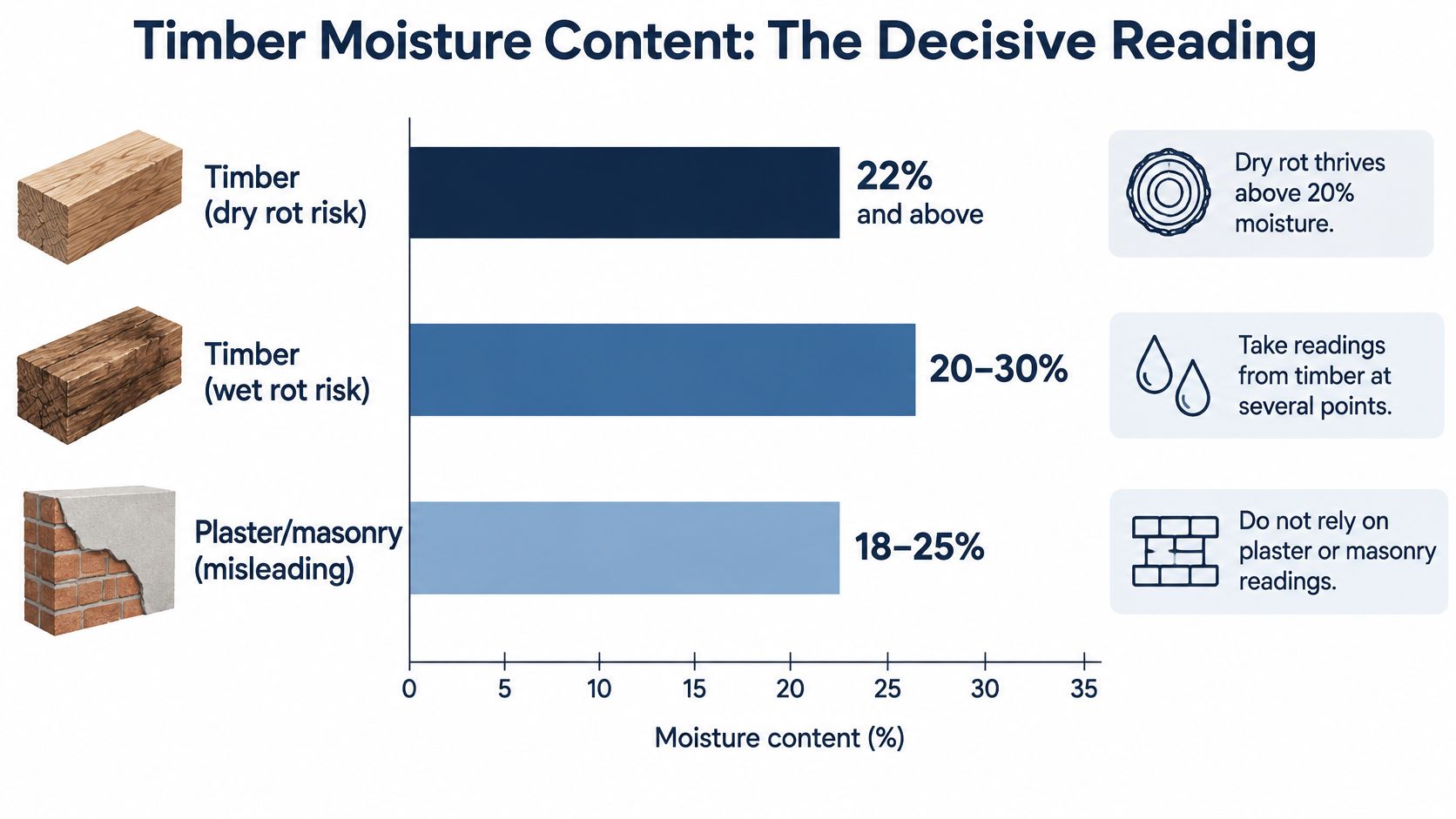
A damp reading taken on plaster tells you a wall is wet. It doesn't tell you whether the joist behind it is decaying. The number that decides the diagnosis comes off the timber itself, taken at several points, written down with the date and the location so a later reading means something.
Here's how those readings line up against the materials that get tested by mistake.
Read the Timber, Not the Plaster
Historic England states that timber becomes vulnerable to rot and insect attack once its moisture content exceeds approximately 25%, and that dry-rot spores may germinate above about 28%. Those figures describe wood. A wet wall might be cold bridging, a failed flashing or a leak that never reached timber at all.
A pin-type meter pushed into a joist, a skirting or a sill plate gives you something you can hold against a threshold and against a reading taken six weeks later. That's the whole method. Diagnosis by eye, without a meter, is a guess with confident phrasing.
The Thresholds in Order
UK government guidance on suspended timber floors states that moisture content should not exceed 20% and that timber is generally free from decay risk below that figure (suspended timber floors best practice guidance). That same 20% line is the one you come back to when you're checking whether a repair worked.
Timber moisture thresholds and what they mean
| Timber moisture content | What it means | Source |
|---|---|---|
| Under 20% | Generally free from decay risk; dry rot becomes inactive | UK floor guidance and Forest Research |
| Above 25% | Timber becomes vulnerable to rot and insect attack | Historic England |
| Above 28% | Dry-rot spores may germinate | Historic England |
| About 20% to 30% | Typical range for true dry rot, with relative humidity around 95% | New Forest National Park guidance |
| About 50% to 60% | Optimum moisture content for wet rot | New Forest National Park guidance |
The Site Checks That Settle It
- Note the cracking pattern. Shallow surface checking over a wet patch points one way. Deep cuboidal cracking, timber that's light and brittle with strands running across masonry, points the other. Record where the decay sits relative to the damp area.
- Trace the water. Gutters, downpipes, hopper heads, roof valleys, flashings, waste pipes and overflows. In London terraces the culprit is often a partially blocked hopper that's been discharging down the wall for years.
- Get into the concealed timber. Lift the floor covering, open the hatch, pull the skirting. Probe with a flathead screwdriver: sound wood resists, rotten wood lets the tip sink with barely any pressure.
- Test suspended ground floors properly. Drill a small hole into joists near their bearing ends and take a reading there, not on the floorboards above.
- Check ventilation and condensation. Blocked air bricks, sub-floor voids filled with rubble, trickle vents sealed during a refurb, extractors venting into the loft. Poor airflow keeps timber damp long after the leak is fixed.
- Decide whether the decay is active. Dry timber with old damage and a reading under 20% is history, not a defect. Wet timber with fresh growth is live.
Active Decay or Old Damage
Visible damp is not the same as decaying timber, and it's not the same as rot at all. The English Housing Survey chapter on housing quality found severe condensation was the most common recorded form of damp at 3%, against 2% for penetrating damp and 1% for rising damp. It also found 30% of households reported condensation, damp or mould, but only 13% of those households lived in dwellings where surveyors observed damp. Occupants notice moisture long before anyone confirms it.
If the pattern points at rising damp, what causes rising damp is worth reading before you accept a damp-proof course quote. A chemical injection won't fix a leaking gutter.
The question to put to any surveyor: where is the water coming from, and what is the timber moisture content right now?
What Each Type of Rot Puts at Risk
Rot only matters where timber is carrying something. A crumbled skirting is an irritation. A crumbled floor joist is a structural problem, and the gap between those two bills is large.
Load-bearing timber is where the decision gets made. Floor joists, the boards they carry, sill plates and roof timbers all lose capacity as the fungus breaks down the wood. Once a section of a joist has gone, no amount of surface treatment puts the strength back. That's why the first question about a rotted joist is how much of its cross-section is gone, not which fungus did it.
Dry rot has a second risk that wet rot doesn't. It can run through strands into brickwork and plaster, so it reaches timber that was never wet on its own. The repair then becomes wider than the leak: plaster off the wall, skirting replaced, floor lifted in a room that showed no sign of damp.
Wet rot stays with the wet timber. That's still expensive when the timber is a bay window frame, a set of French doors or the joinery around a bay in a Victorian terrace. It just doesn't travel.
The moisture behind either type affects people as well as structure. The English Housing Survey 2024 to 2025 headline findings recorded damp in 1.4 million dwellings, or 5% of homes, in 2024, and found it more prevalent in privately rented homes at 10% than in owner-occupied homes at 4%. Those figures cover damp rather than rot, but damp is the condition that precedes decay and the one occupants live with.
What delay costs: every month a leak runs is another month of timber sitting above the threshold, and every repair grows with the moisture. Fix the water and the damage stops spreading.
How to Treat Wet Rot and Dry Rot Properly
Drying is a control measure, not the last job on the list. Swap the order and you waste both the treatment and the new timber, because fresh wood in a wet void rots on the same schedule as the old.
Here's the order that works.
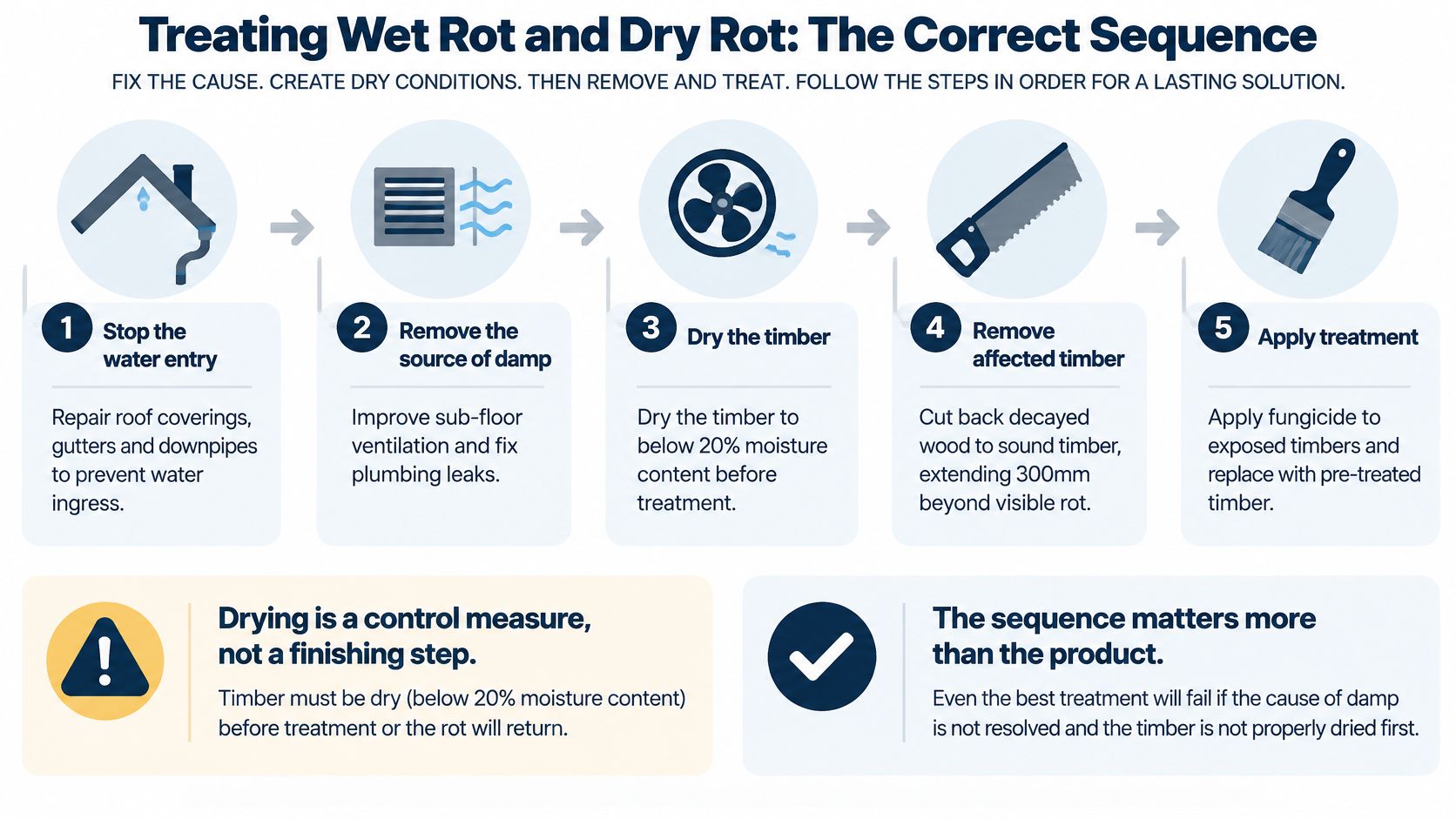
1. Stop the water entry. Repair the roof covering, clear and reconnect the rainwater goods, replace failed flashings, fix the plumbing. This comes first because everything downstream depends on it. The common mistake is treating timber and leaving the gutter to be dealt with later. It never gets dealt with later.
2. Remove the source of damp that isn't a leak. Improve sub-floor ventilation, clear blocked air bricks, stop external ground levels sitting above the damp-proof course. Trapped moisture does the same damage as a leak and gets diagnosed far less often.
3. Dry the timber and measure it. Forest Research guidance states that dry rot becomes inactive when moisture is reduced below 20%, and that buildings can take months to dry, with timbers monitored during that period (Forest Research dry rot guidance). Take readings as you go. Apply a chemical treatment to timber that's still at 35% and you've done nothing except make it wetter.
4. Replace what's lost. Drying stops the fungus. It doesn't rebuild a joist. Load-bearing or otherwise important rotten timber should still be replaced even after the readings drop, per the same guidance. Cut back to sound timber with a decent margin past the last visible decay and use pre-treated replacements.
5. Treat only where treatment is justified. Chemical treatment is usually unnecessary, although the guidance notes a fungicidal barrier can sometimes be appropriate while drying takes place. It is not a substitute for steps one to three.
Historic England makes the same point from the other direction, naming roof coverings, working rainwater goods and adequate ventilation as the measures that prevent dry rot taking hold or spreading.
A repair isn't finished when the new timber goes in. It's finished when the meter stays under 20% through a full heating season.
Where Rot Turns Up in London Homes
Rot follows water, and the water follows the building type. In London that means the defect usually announces itself by postcode and construction long before anyone lifts a floorboard.
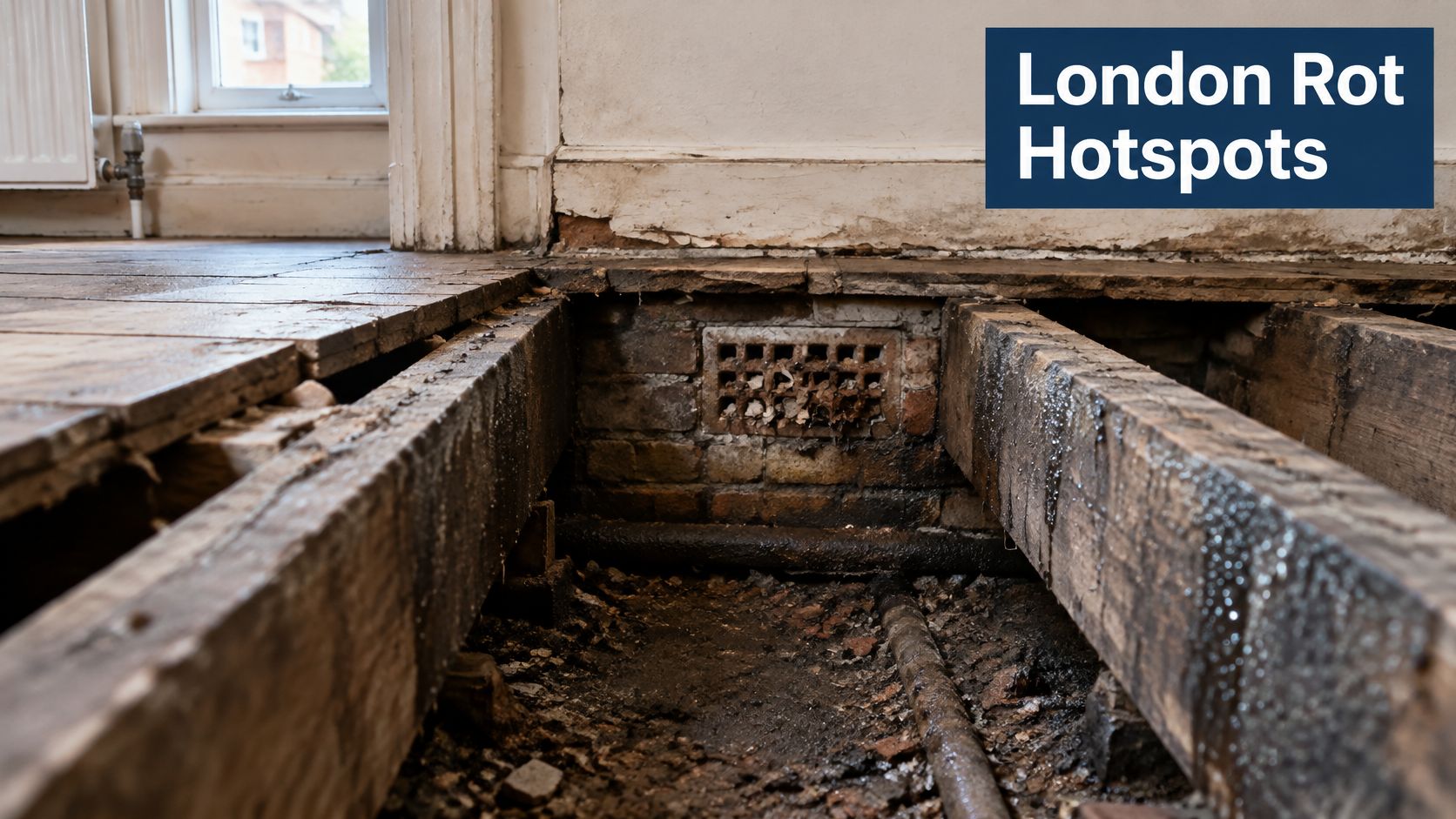
Victorian and Edwardian terraces across Lewisham, Forest Hill, Honor Oak and Peckham. Bay roofs, valley gutters and party-wall parapets are the usual entry points. A bay roof that's been patched twice starts leaking into the bay ceiling, then into the joist ends behind the bay window. The tell is a cold spot and a bubbling paint line above the window.
Houses with suspended timber ground floors. Sub-floor voids stay damp when air bricks are blocked or the external paving has been raised above the damp-proof course. Joist bearing ends sit in the dampest part of the void and go first. Ask whether the void has been inspected and what the joist end readings were.
Converted flats and warehouse conversions in Bermondsey, Deptford and Rotherhithe. New finishes go straight over old timber: plywood, engineered flooring, tiled bathroom pods. Concealed timber behind those finishes gets no airflow and no inspection. Ask what's underneath and whether it was checked during the conversion.
Lower ground floors and basements in Brixton, Camberwell and Clapham. Wall cavities and floor voids here sit against wet ground and are the hardest places to dry. Ask for the moisture readings and how long the drying period ran.
The property condition assessment checklist is a sensible way for a buyer to structure those questions before a viewing.
When to Book a RICS Survey for Rot
A visible mark does not identify the type of rot or show how far decay extends. Book a RICS Building Survey when a property has suspected timber decay, a history of leaks, or concealed areas where damp may have affected the structure. The inspection can assess accessible parts of the property, but covered timber may remain out of view unless access is available.
A RICS HomeBuyer Report can flag damp and timber concerns when you are buying a property. The inspection is less detailed than a Building Survey, so it may leave questions about concealed timber unresolved. Choose the survey to match the property's condition and the level of access needed.
What to Ask Before You Instruct
Ask what the survey will establish, not just whether it will mention damp.
- Will the surveyor take moisture readings from timber and include them in the report? Plaster readings do not establish timber moisture content. A report should distinguish between readings from each material.
- Will the inspection look for the likely water source? Ask whether accessible roofs, gutters, flashings, plumbing and ventilation will be considered, and whether the report will explain any limits.
- Which concealed areas can be inspected? If access is restricted, ask which timbers could not be checked and what uncertainty remains.
Corinthian Surveyors London LTD is an independent RICS firm based in Forest Hill, led by surveyor Clive. The firm carries out RICS Building Surveys and RICS HomeBuyer Reports on properties customers are buying across London, as well as market valuation reports for homes being sold.
The residential building survey service explains the scope of a building survey. Contact Corinthian Surveyors London LTD to talk through a property before you instruct anyone.
Frequently Asked Questions About Dry Rot and Wet Rot
Is dry rot more serious than wet rot? Either can lead to costly repairs. Dry rot may spread through timber and extend into nearby masonry, while wet rot is usually confined to timber that remains damp. The repair cost depends on which timbers are affected and how much strength they have lost.
Can I tell dry rot from wet rot just by looking at it? No. Darkening and cracking can occur with either, and a sound-looking surface can hide decay. Diagnosis depends on moisture readings taken from the timber and identifying the water source. Where the evidence remains unclear, laboratory testing may be needed.
Does rot stop once the timber is dry? Dry rot can become inactive when timber moisture content falls below 20%. Drying does not restore lost strength, so damaged structural timber may still need replacement.
Do I need a survey if the timber looks sound? A visual check cannot establish timber moisture content or rule out decay in concealed areas. If you are buying a property and have concerns about timber, a RICS survey can help identify visible defects and indicate where further investigation may be needed.
Corinthian Surveyors London LTD carries out RICS Homebuyers surveys on properties customers are buying and provides Building Surveys across London. A survey can describe visible defects and areas where access limits inspection, helping you understand what may need further investigation before you commit to a purchase. Visit Corinthian Surveyors London LTD to discuss the property and the appropriate survey.