
Drainage System Inspection Guide for London Homebuyers

You're buying a Victorian terrace in Forest Hill, or perhaps a converted flat in Bermondsey. The survey mentions an inaccessible manhole. The estate agent says the drains have always been fine. That sounds reassuring, but it isn't evidence of the condition of the underground pipework.
A standard RICS survey may identify visible clues, such as damp, unusual ground settlement or a blocked inspection chamber. It generally won't establish the condition of every buried drain. That's where a drainage system inspection, often involving CCTV, becomes a separate decision about evidence, responsibility and possible repair liability.
Table of Contents
- What a Drainage System Inspection Really Covers
- Why Drainage Inspection Matters for London Homebuyers and Homeowners
- How Drains Are Inspected From Manhole Checks to CCTV Surveys
- Signs Your Drains Need Closer Investigation
- Understanding Your Drainage Report and What Happens Next
- Costs Timelines Legal Considerations and Next Steps in London
- Drainage System Inspection FAQs for London Buyers
What a Drainage System Inspection Really Covers
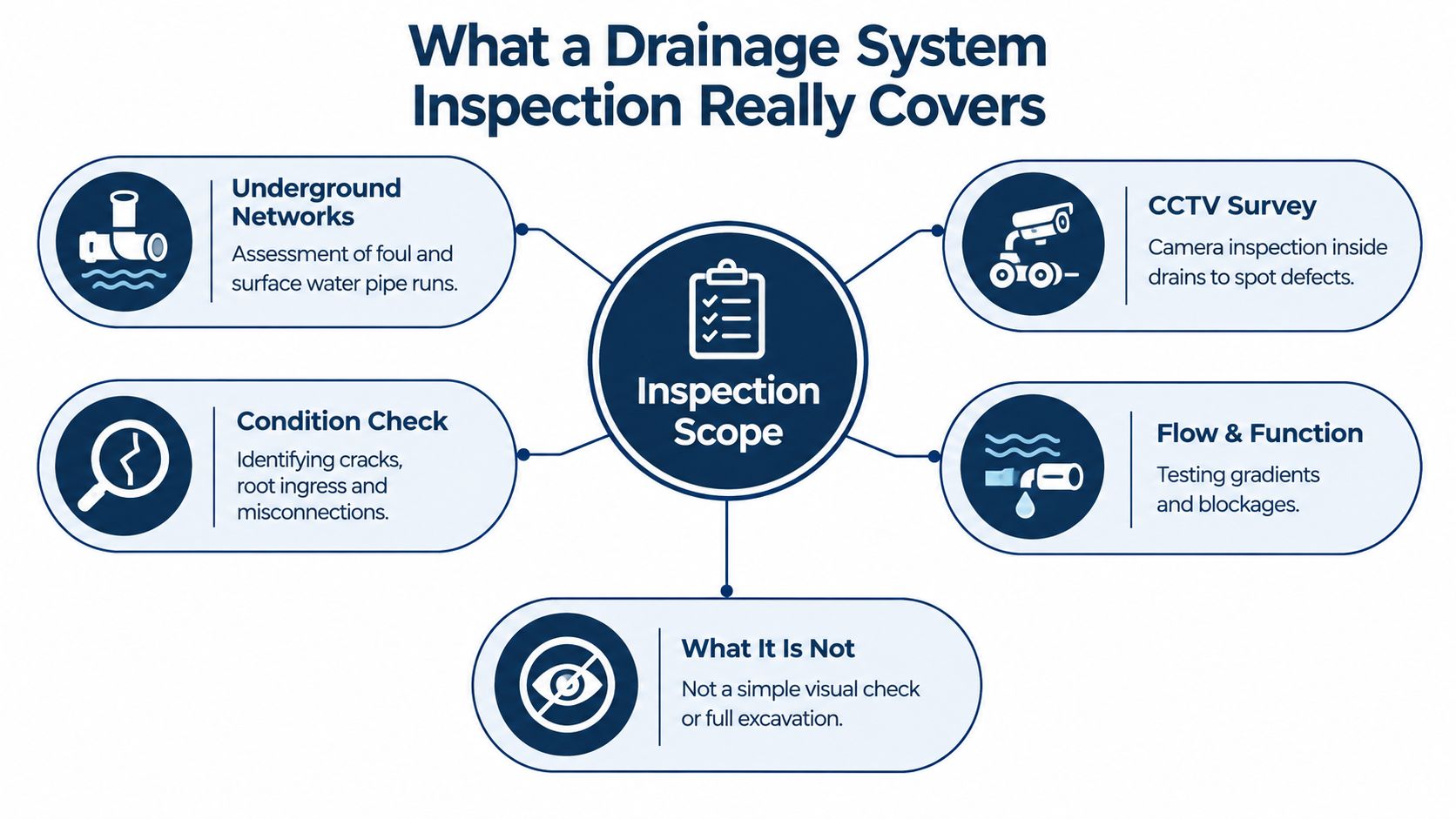
A drainage system inspection is a targeted assessment of underground foul and surface water drainage. It can cover private drainage runs within a property, lateral drains leading from the property boundary towards the public sewer and accessible chambers or inspection points.
It isn't the same as the visual inspection included within an RICS Level 1, Level 2 or Level 3 survey. A surveyor can inspect accessible features and comment on visible signs, but a camera survey is needed to see the inside of a buried pipe. This distinction matters in London, where Victorian terraces, Edwardian houses and converted flats often have old clay or altered drainage arrangements beneath later extensions and hard landscaping.
What the inspector looks for
At chamber level, the inspection can reveal poor flow, deposits, standing water, surcharge marks and evidence of repeated blockage. A CCTV camera then travels through the accessible pipe runs to identify cracks, displaced joints, root ingress, obstructions, open joints, fractures and possible misconnections.
A lateral drain survey commonly examines the section from the property boundary to the public sewer connection. In the UK, these surveys are typically carried out to BS EN 13508-2, with defects graded using the WRc Manual of Sewer Condition Classification. A sonde can locate the camera underground, helping establish where a defect or boundary sits. That is important because responsibility can change at the property boundary. (lateral drain survey guidance)
The inspection should produce more than a vague statement that the drains appear satisfactory. Useful evidence includes footage, still images, a plan of the route and coded descriptions of defects. For a buyer, that evidence can support a decision to proceed, request further investigation or ask the seller to address a material problem.
Practical rule: An inaccessible manhole is not proof of a defect. It is a limit on what the surveyor can verify.
Access and preparation matter. If you're dealing with unexplained damp or suspect a concealed plumbing leak, a practical checklist for finding hidden leaks can help you organise the visible checks before arranging specialist drainage work.
Why Drainage Inspection Matters for London Homebuyers and Homeowners
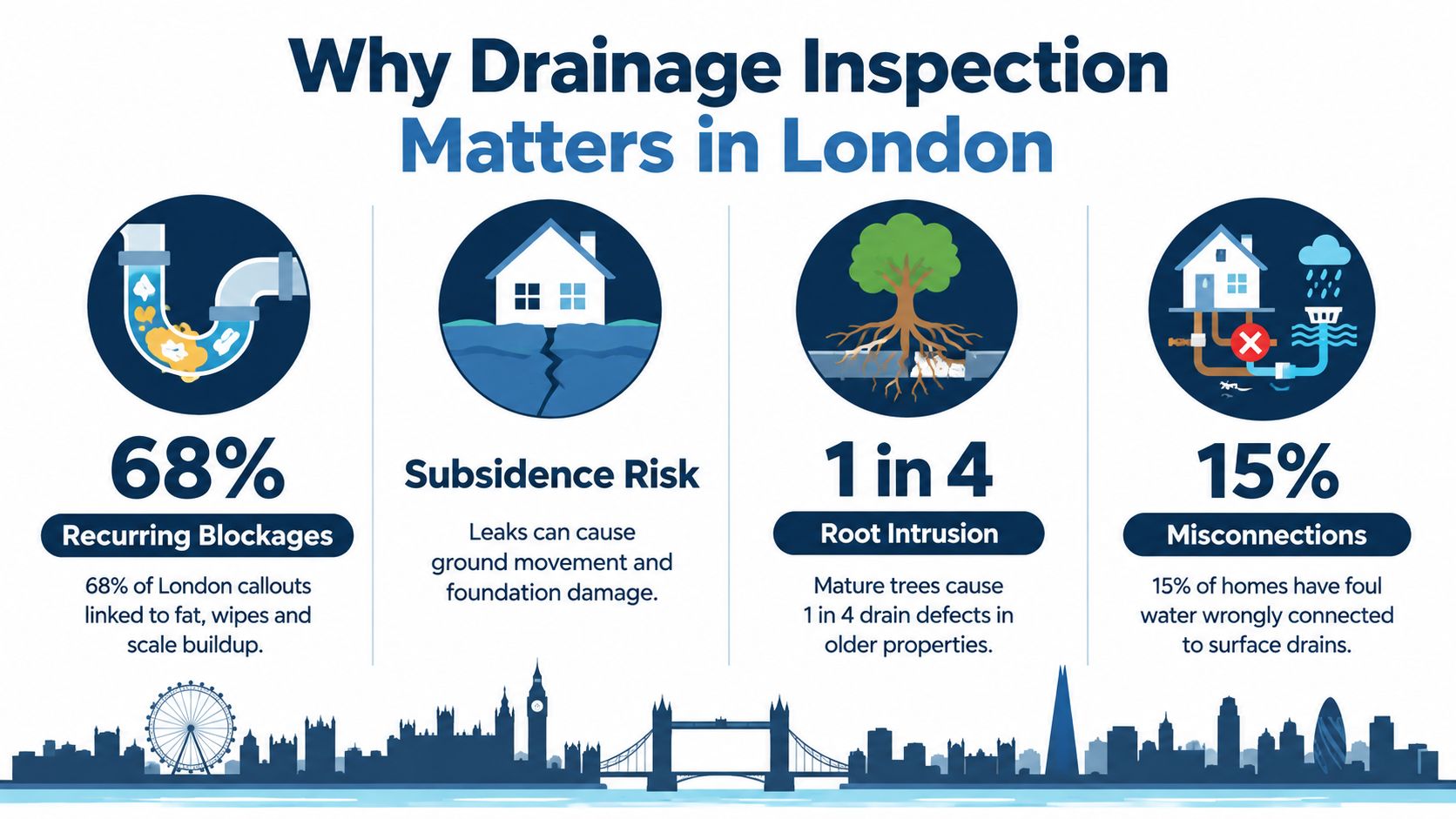
Drainage problems rarely announce themselves as a dramatic collapse. More often, a sink drains slowly, a toilet gurgles or a patch of lawn grows unusually well above a buried pipe. The property may look perfectly presentable while a leaking joint allows water into the surrounding ground.
That water can wash out soil or keep ground beside foundations persistently wet. In a London house with an older rear extension, a shallow drain run and mature trees, the combination can contribute to settlement or make existing movement harder to diagnose. The point isn't that every damp patch means subsidence. The point is that a drainage inspection can help separate a plumbing nuisance from a defect with structural implications.
Older housing creates complicated routes
Victorian terraces in Lewisham, Forest Hill, Brockley and Camberwell often have drainage altered over many years. Rear additions may sit above or close to original runs. A converted house in Greenwich or Southwark may have shared drainage, several kitchens and bathrooms and unclear responsibility between flats.
Root ingress is another concern where mature trees stand close to old clay pipes. Misconnections can also send foul water into surface water drainage, creating an environmental problem rather than just a private blockage. A camera survey can identify the physical condition of the pipe, while dye testing may help establish where water is travelling.
England's wider sewerage figures show why this shouldn't be treated as a minor maintenance issue. Water and sewerage companies recorded 2,469 sewerage pollution incidents in 2024, compared with 1,902 in 2023, and the government described the result as the worst performance since 2013. The same report recorded 3,614,428 hours of monitored storm-overflow spills, covering 450,398 spill events and an average of 31.8 spills per overflow. (Water and sewerage companies in England environmental performance report for 2024)
What the evidence changes
For a buyer, the main benefit is not just finding a blockage. It's understanding who may have to repair it, how urgent it is and whether the defect affects the price or the decision to proceed.
For an owner, footage can help distinguish a cleanable obstruction from a damaged pipe that needs excavation, relining or local repair. It can also provide a record before building work, an extension or a sale.
A general guide to preparing for a home inspection is useful for organising access and documents. For London properties with older construction or alterations, you can also compare the wider risks covered by a London building survey.
How Drains Are Inspected From Manhole Checks to CCTV Surveys
The right method depends on the question you're trying to answer. A chamber inspection may show that water is backing up. It won't necessarily show whether the cause is a cracked pipe, a displaced joint or a restriction further along the run.
The methods side by side
| Method | What It Shows | When to Use It |
|---|---|---|
| Chamber-level visual check | Flow, deposits, standing water, surcharge marks and visible chamber condition | Start here when chambers are accessible |
| CCTV survey | Internal pipe condition, blockages, cracks, root ingress, open joints and misconnections | Use when underground condition or repair liability matters |
| Sonde tracing | The surface position of the camera and a buried defect or connection | Use to locate a defect or establish a boundary |
| Dye testing | The route taken by discharged water and possible cross-connections | Use where flow paths or misconnections are suspected |
| Flow testing | Whether water moves through the system as expected | Use when poor gradient, restriction or capacity is in question |
| Soakaway testing | Whether surface water can disperse into the ground | Use where a property relies on a soakaway rather than a direct connection |
| Chamber and access check | Whether inspection points are present, usable and safely maintained | Use during surveys, alterations and handover checks |
A competent inspection usually begins with the chambers. The inspector notes the water level, deposits and any marks showing that the chamber has recently surcharged. CCTV then provides the internal evidence, with defects recorded in real time and significant locations marked at the surface using a sonde. (domestic CCTV drainage survey guidance)
The report should refer to BS EN 13508-2 and the WRc Manual of Sewer Condition Classification, MSCC5, where appropriate. These references give the footage a consistent language. They don't remove the need for professional judgement, but they make it easier to compare defects and decide what needs attention. (UK CCTV drainage reporting standards)
Access is part of the inspection
UK drainage guidance requires inspection access at the head of a drain run, at junctions, at changes of direction greater than 30 degrees, at changes of pipe size and at changes of gradient. Straight runs are limited to 22 metres between access points for 100 mm pipework and 45 metres between adjacent chambers on a straight run. (inspection chamber access guidance)
Access chambers must remain available for maintenance and must not be buried or obstructed. Covers should suit their location and load class, including vehicular loading where a chamber sits in a driveway. (guidance on accessible inspection chambers and covers)
Depth also affects the type of chamber used. Guidance summarising Building Regulations Part H identifies shallow chambers up to 0.6 metres, universal inspection chambers up to 1.2 metres and deeper installations up to 3 metres, depending on the specified system. (inspection chamber product and installation guidance)
If you want a plain explanation of camera work and the questions to ask before arranging it, Encano Plumbing & Drainage Ltd. explains pipe inspections. For the building context around older homes, a Level 3 survey explanation is also relevant.
Signs Your Drains Need Closer Investigation
A standard survey becomes less reassuring when the property gives you a reason to look below ground. One symptom may have an innocent explanation. Several together deserve a proper drainage system inspection.
Start with what the house is telling you
Look for these signs during viewings and before exchange:
- Slow drainage: A sink, bath or shower that repeatedly drains slowly may indicate deposits, scale or a restriction further along the run.
- Gurgling toilets: Air moving through a restricted or poorly vented pipe can produce gurgling sounds.
- Recurring blockages: Repeated clearing suggests that the cause may remain in the pipe rather than at the fixture.
- Foul smells: Persistent odours can point to stagnant water, a damaged joint or an ineffective trap.
- Damp ground: A wet patch beside an external wall or paved area may indicate leakage from a buried drain.
- Unusually vigorous growth: A strip of lush grass or plants above a drain run can reflect extra moisture, though it isn't conclusive on its own.
- Settlement or a depression: A small sinkhole, sunken paving or cracking near a known drain route needs investigation.
- Recent building work: An extension, loft conversion or rear alteration may have covered chambers or changed the route of a drain.
A clean bathroom doesn't tell you whether the drain beneath the floor is sound.
London's mixed housing stock adds uncertainty. Victorian terraces in Forest Hill and Brockley may retain old clay runs. Beckenham houses can have mature trees near drainage routes. Conversions may use shared drains, with access hidden behind paving, kitchens or communal areas. Historic lead supply pipework is a separate issue from foul drainage, but it's another reason not to assume that an apparently tidy period property has modern services throughout.
The following video gives a visual introduction to the kind of camera inspection buyers may encounter. It doesn't replace a site-specific report.
Ask the seller or agent about previous blockages, repairs, insurance claims and any shared drainage agreement. If the answer is unclear and access is limited, treat that uncertainty as a reason to obtain evidence rather than as reassurance.
Understanding Your Drainage Report and What Happens Next
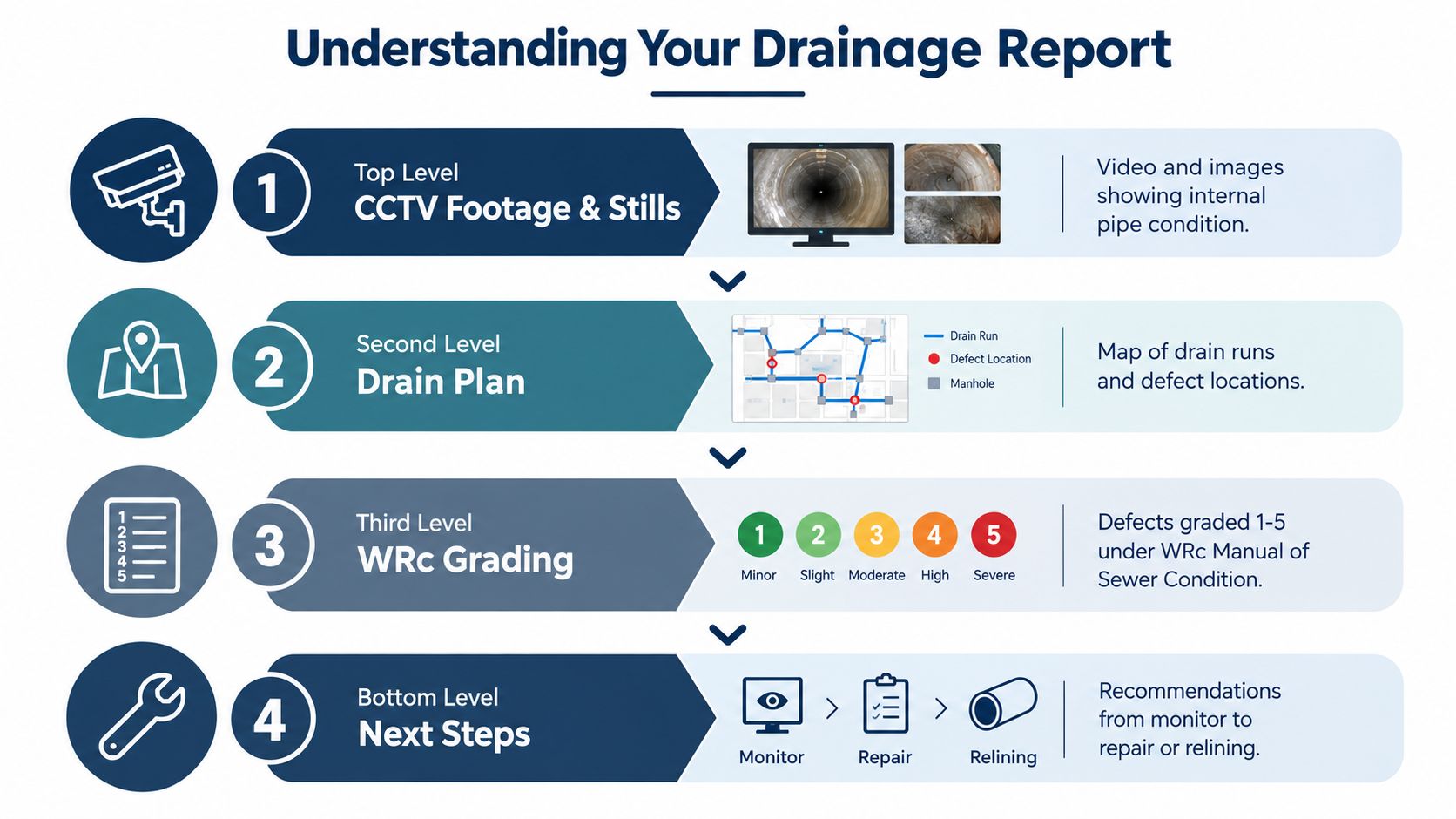
A useful report lets you move from “there may be a problem” to “this is the defect, this is where it is and this is what should happen next”. CCTV footage and still images show the internal condition. A drainage plan places the pipe runs and defect locations in relation to the house, boundary and other chambers.
Read the report in four passes
First, check the route. Confirm which runs were inspected and which were inaccessible. A report covering only one chamber doesn't establish the condition of an unconnected run beneath an extension.
Next, identify the defect. The wording should distinguish a service issue, such as deposits or a minor obstruction, from a structural defect, such as a fracture, displaced joint or collapsed section.
Then, check the location. A sonde can mark a defect at surface level. That helps a contractor quote for a local repair and helps establish whether the defect falls within private, shared or potentially public drainage responsibility.
Finally, read the recommendation. “Monitor” is different from “repair”. “Further investigation” means the available evidence isn't enough to decide. “Urgent repair” should be supported by the defect shown and its effect on flow or surrounding ground.
The WRc Manual of Sewer Condition Classification provides a system for grading structural and service-condition defects from CCTV footage, alongside BS EN 13508-2. A grade is not the whole decision. The position of the pipe, the history of blockages, the building's foundations and the consequences of failure all matter.
Testing gives objective evidence
UK design and construction guidance requires new sewers up to and including 1000 mm nominal diameter to be tested by air or water. Acceptance is based on leakage not exceeding 0.5 litres per linear metre of pipeline per metre of nominal bore in 30 minutes. (UK sewer design and construction guidance)
That threshold is mainly relevant to new construction, handover and adoption. It illustrates the wider principle that drainage condition can be tested against an engineering measure rather than judged by appearance alone. The same guidance refers to CCTV and light-line inspections as part of the modern UK inspection approach.
For a purchase, the practical outcomes are usually clear:
- Proceed: The findings show serviceable drainage and no material concern.
- Investigate: Access or evidence is incomplete, so a specialist needs to inspect further.
- Renegotiate: A material defect creates a foreseeable repair liability.
- Repair before handover: The seller or developer should address the problem and provide evidence.
- Refer: A structural engineer, drainage contractor or water authority may need to deal with the issue.
Costs Timelines Legal Considerations and Next Steps in London
Domestic CCTV survey costs vary because the work varies. Access, the length of the run, the number of chambers, cleaning requirements and whether the pipe is shared all affect the quote. A short, clear run from an accessible chamber is a different job from tracing several altered routes beneath a converted house.
Ask what the price includes. You should know whether it covers cleaning, CCTV footage, still images, a drain plan, sonde tracing and a written report. You should also ask what happens if the camera cannot pass an obstruction. A survey that stops at the first blockage may not answer the question you need answered.
Allow time for the right evidence
The site inspection may be arranged quickly, but access can delay the work. Agents, sellers, managing agents or neighbours may need to provide keys. Shared drains in flats can require agreement from more than one owner.
The report should follow after the footage has been reviewed and the route and defects recorded. Don't rely on a verbal comment from a contractor standing beside the chamber. Keep the written report and footage with your conveyancing papers.
Responsibility is not always obvious
A lateral drain can connect a property to the public sewer, but responsibility depends on the location, adoption status and the arrangement serving the building. In a converted maisonette or flat, a shared drain may create obligations between leaseholders or the freeholder.
Your conveyancer should check the legal documents and raise enquiries about known drainage defects, repair history and shared access. A surveyor can identify physical risk, but legal responsibility needs to be confirmed against the title, lease and relevant records.
Drainage access also matters for future maintenance. An inspection chamber that has been buried beneath an extension or blocked by paving makes later investigation more disruptive. Building Regulations Part H-based guidance requires access points to remain available, so record any inaccessible chamber and ask how it will be restored.
The Environment Agency reports more than 10,000 inspections of water company assets in 2025–2026, leading to around 3,000 improvement actions. (Environment Agency enforcement information) That enforcement context reinforces a sensible property principle: drainage evidence supports risk management, not just convenience.
Start with the survey report. If it identifies a warning sign, arrange a specialist CCTV inspection before you commit to an uncertain repair liability. Corinthian Surveyors London LTD is an independent RICS-regulated practice in Forest Hill, led by Clive Thompson, who holds RICS and CABE qualifications and has over 30 years' experience in the built environment. Where a drainage concern falls outside a visual survey, the firm can explain the limitation and identify when specialist drainage input is needed.
Drainage System Inspection FAQs for London Buyers
Does a standard RICS HomeBuyer Survey include a full drain inspection?
No. An RICS Level 1, Level 2 or Level 3 survey generally involves visual inspection of accessible features. It doesn't normally include CCTV examination of buried drains or excavation. If manholes are inaccessible, damp is visible or blockages are reported, ask for a specialist drainage system inspection.
Who is responsible for a lateral drain?
Responsibility depends on the drain's location, adoption status and whether it serves one property or several. The physical boundary can be identified with a sonde, but your conveyancer should confirm the legal position using the title, lease and relevant enquiries.
Should older London homes be inspected again after purchase?
Consider re-inspection when the property has recurring blockages, new damp, settlement, unusual smells or building work near a drain route. A camera survey is also sensible before an extension if existing access points or pipe routes are uncertain.
What should I do if the manholes are inaccessible on viewing day?
Ask the seller or agent to provide access before exchange. If access can't be provided, record the limitation in your survey and decide whether the uncertainty justifies a specialist inspection. More practical questions to raise with your surveyor are set out in this guide to questions to ask for a survey.
Corinthian Surveyors London LTD provides independent RICS HomeBuyer Surveys, RICS Building Surveys and defect advice for residential properties across London, including Victorian terraces and converted flats. If your report raises a drainage concern, call 0800 00 16 422 or visit Corinthian Surveyors London LTD to discuss the right next step before you take on an avoidable repair liability.