
Party Wall Agreement UK: When You Need One and How It Works
You've got the drawings back, the builder is pencilled in for spring, and the new rear extension sits tight against the wall you share with next door. Then someone mentions the Party Wall Act in passing, three weeks before the dig, and the start date slides into the following season. Nothing has gone wrong legally at that point. The homeowner has treated a party wall agreement UK requirement as paperwork to sort out at the end, rather than a separate statutory process with its own clock, its own triggers and its own failure modes.
Table of Contents
- When a Party Wall Notice Is Required
- How to Serve a Party Wall Notice Step by Step
- What a Party Wall Award Actually Decides
- The Surveyor's Role and How to Choose One
- Resolving Disputes When Neighbours Object
- Frequently Asked Questions About Party Walls
When a Party Wall Notice Is Required
Your extension is drawn hard against the boundary wall. The loft above it needs a steel beam let into the same wall. Neither point comes up at planning stage, and building control won't raise either of them. Both are party wall matters, and they run on a timetable that has nothing to do with your planning permission.
The framework is the Party Wall etc. Act 1996, which received Royal Assent on 18 July 1996 and came into force on 1 July 1997, as the government's explanatory booklet on the Act sets out. It applies across England and Wales only. Scotland and Northern Ireland sit outside it entirely.
That same guidance makes the second point that catches people out. Party wall obligations arise from the Act itself, not from planning permission or building regulations. A neighbour who wrote a supportive letter to the council about your application has not consented under the Act, and an approval has no bearing on whether a notice is valid.
The table below is the practical version. Match your work to a row and the row tells you whether notice is needed and how long before the start date it must go in.
Party wall notice requirements by type of work
| Type of work | Notice needed | Notice period before work | Adjoining owner response |
|---|---|---|---|
| New wall on or at the boundary | Yes | Two months | 14 days |
| Work to an existing party wall or party structure | Yes | One month | 14 days |
| Excavation within 3 metres of a neighbour's building and below its foundations | Yes | Two months | 14 days |
| Excavation within 6 metres and below a 45-degree line from the neighbour's foundations | Yes | Two months | 14 days |
| Work wholly within your own land, not touching a party structure | No | Not applicable | Not applicable |
Those rows mirror the Act's own categories of work. A building owner must serve notice on every relevant adjoining owner before covered work begins, and the neighbour's response, whether consent, dissent or agreement with conditions, happens inside the statutory procedure rather than in a conversation over the fence.
Work that stays outside the Act
Replastering, a new kitchen, shelving, rewiring that doesn't chase into the shared wall. None of it needs notice. Work wholly inside your own boundary that doesn't touch a party structure normally falls outside the Act too. The moment a chase, a beam pocket, a flashing or a foundation trench reaches the boundary line, you're in scope.
The test to run before anything else
Take the drawing set and list every element that touches the shared wall, the boundary or the neighbour's foundations. If a single item appears, treat notice as required and work backwards from your intended start date.
A Victorian terrace in Forest Hill or Brockley shows why the check has to be item by item. A rear extension and a loft conversion on the same house can both touch the shared wall, and each lands on a different row of the table. Houses of that age often share a chimney breast with the neighbour, so even a small alteration there can bring the Act into play when nothing else on the job does.
Two processes, two clocks. Planning permission decides whether you may build. The party wall notice decides when you may start.
Loft conversions are the classic case where owners underestimate what's involved. If the beams go into the shared wall, the party wall process for a loft conversion has to run alongside your structural calculations, not after them.
How to Serve a Party Wall Notice Step by Step
The notice itself is not complicated. The timing around it is where jobs get lost, so treat the sequence below as a programme, not a form.
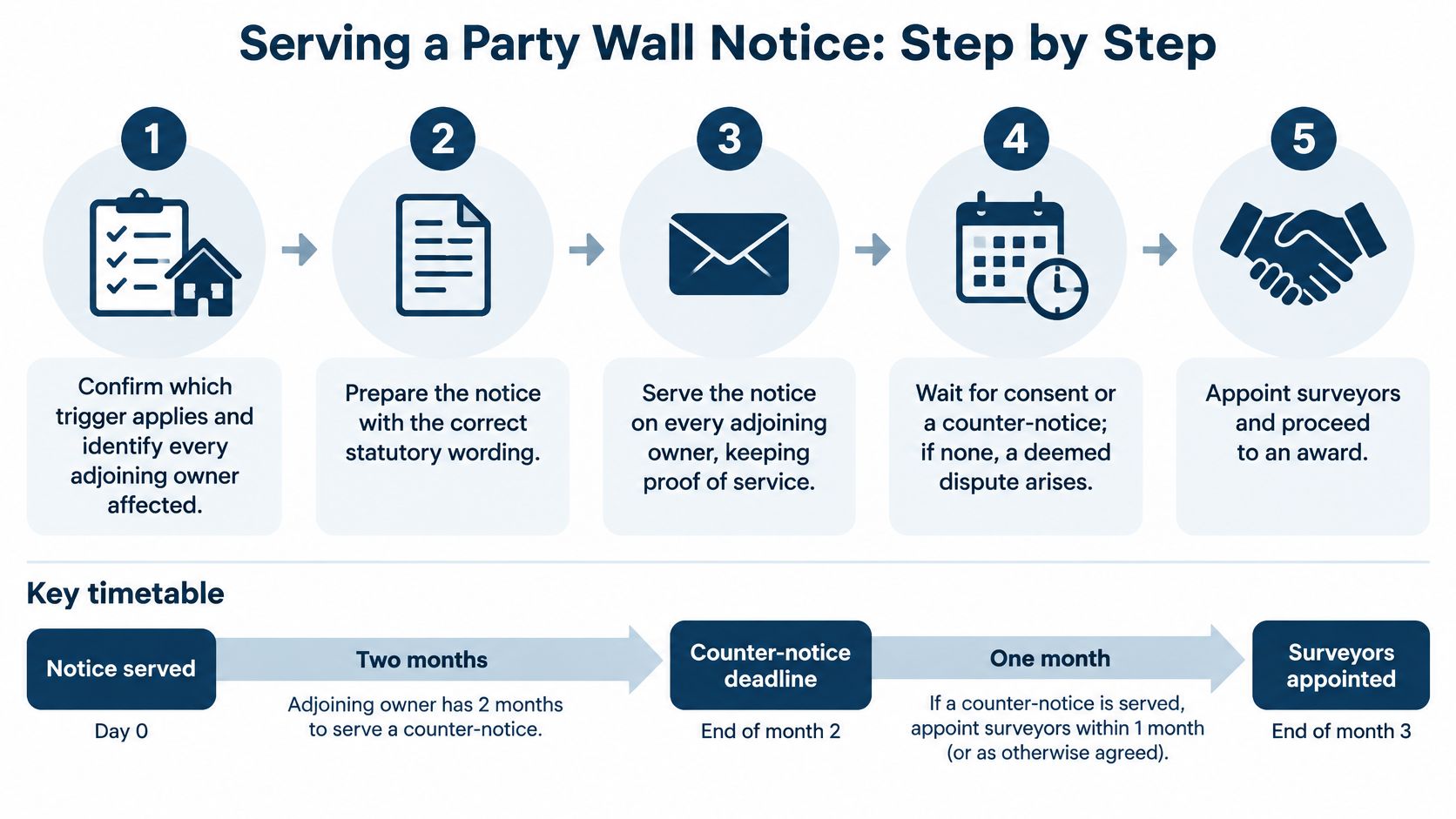
- Confirm which trigger applies. Work from the table and identify every adjoining owner affected by the work. In a terrace that's often one neighbour, but a mid-terrace with works both sides means two independent processes. Leaseholders with an unexpired term of 12 months or more can be parties in their own right. Miss one and the notice is defective, which restarts the clock.
- Identify the legal owner, not the occupant. The name on the notice must be the freeholder or the leaseholder as registered. Serving "the man next door" by first name because that's who answers the door is the single most common defect I'm asked to unpick.
- Draw the package properly. Dimensioned plans, excavation depths, foundation information and the proposed method for safeguarding neighbouring structures all belong in the envelope. The Party Wall etc. Act 1996 makes those details the difference between a notice that stands up and one nobody can assess, because they determine whether the excavation trigger applies at all and let the surveyors judge protective measures. Vague drawings cost more time than drawing properly.
- Serve it in writing, with a start date. State the work, the proposed start date and the section of the Act you're relying on. Allow two months for a new wall or excavation and one month for work to an existing party wall. Hand delivery with a photograph of the envelope, or recorded post. Keep the proof.
- Hold the 14-day window. The adjoining owner has 14 days to consent in writing, consent with conditions or dissent. Do not chase the builder during those two weeks; chase nothing, because the clock is running on its own.
- Treat silence as dissent. No written consent inside the 14 days means dissent is deemed and a dispute has arisen. Surveyors must then be appointed. This surprises everyone. A neighbour who is delighted about your extension but never puts pen to paper has, in law, objected.
Counting back from your intended start date
Do the arithmetic before you book anyone. Take the start date, subtract the notice period for your row, then subtract the 14-day response window, and that's your latest service date. For work to an existing party wall that's roughly six weeks before the dig. For a new wall or excavation it's closer to ten.
Add contingency for the surveyor route if you expect a dissent or no reply. Appointing, inspecting and drafting an award adds weeks, not days.
Practical rule: serve the notice the same week the drawings fix the position and depth of the work. Nothing else on the job needs to be finished first, and nothing else on the job can shorten the statutory clock once it starts.
Where notices usually go wrong
- Wrong recipient. The occupant, the tenant or the managing agent instead of the registered owner.
- Plans too thin to assess. No depths, no foundation details, no method statement.
- One notice for two triggers. A rear extension that cuts a steel into the shared wall and digs within 3 metres of next door hits two rows with two different notice periods.
- A start date already in the past by the time the notice lands.
Before the first day on site, check the award's start date, permitted hours and access arrangements. Those three items are what a contractor will trip over at 8am on a Monday.
What a Party Wall Award Actually Decides
A party wall award is not an informal note in which everyone agrees the work can go ahead. It's the formal document that decides whether, when and how the work happens, produced by surveyors acting under the Act.

Fix the vocabulary before you argue about any of it. A notice starts the process. A consent is the neighbour's written agreement, sometimes with conditions attached. A dissent turns the matter into a dispute. An award is what comes out of the surveyor route, and it binds both sides.
Under section 10 of the 1996 Act, an award may determine the building owner's right to execute the work, the time and manner in which it must be carried out, and other matters connected with the dispute, including the costs of making the award. Where two surveyors are appointed and can't agree, either party or either surveyor may call on a third surveyor to settle the point.
What an award controls in practice
- Working hours. Noisy work confined to weekday daytime, with Saturday mornings at most and nothing on Sundays.
- Access. The times and notice required for surveyors and contractors to enter the neighbour's property, and what happens if access is refused.
- Protective measures. Temporary support, monitoring, dust and vibration control, and who pays for them.
- A schedule of condition. A dated written and photographic record of the neighbour's property before work begins. Why the schedule of condition matters more than any other annex when a crack appears eighteen months later.
Say a loft conversion goes to an award. It might permit work from a stated date, restrict cutting and drilling to weekday hours, and require photographs of the neighbour's flank wall before the first beam goes in. That's an ordinary award, not a punitive one.
One timing point people miss. The appointed period for the work generally cannot begin until the relevant statutory notice period has expired, unless the owners agree otherwise. An award sits on top of the notice timetable; it doesn't erase it.
Three checks before the first day on site. The start date, the permitted hours and the access arrangements. If any of the three is unclear, get the surveyor to confirm in writing while the scaffold is still in the yard.
The Surveyor's Role and How to Choose One
A neighbour's response determines the appointment route, but the notice timetable begins when the notice is served, not when they first hear about your plans. The work and excavation triggers, not planning permission, determine whether notice is required. Once a dispute arises, the surveyor process sets out how the matter will be decided.

Agreed surveyor. If both owners agree, one surveyor can act for both and prepare the award. This can reduce costs and help avoid delays when the owners are able to work together.
Two surveyors. If an owner dissents and a dispute arises, each side appoints a surveyor. The two surveyors then seek to agree the award.
Third surveyor. If the appointed surveyors cannot agree, a third surveyor can decide the disputed points. Either party or either surveyor can ask the third surveyor to determine them.
Why independence matters
A party wall surveyor must make decisions under the Act impartially, rather than advance the interests of the person paying their fee. Before appointment, ask about any relevant connections that could affect the surveyor's ability to act impartially.
Check these points before instructing anyone:
- RICS membership. Confirm the surveyor's qualifications and membership, and check that they have experience with party wall matters.
- Conflicts of interest. Ask whether the surveyor has any relevant connection with the building owner, adjoining owner or professionals involved in the project.
- Fee basis. Clarify whether fees are hourly or fixed, and who is expected to pay. The building owner usually pays the reasonable fees of both surveyors.
- Relevant experience. Ask about the type of work involved, such as loft conversions, chimney breast removal or excavation near a neighbouring building. Experience relevant to your project helps the surveyor identify the issues that need addressing.
Corinthian Surveyors London LTD is an independent firm of RICS Chartered Surveyors and Valuers based in Forest Hill, a member of the Royal Institution of Chartered Surveyors, with over 30 years' experience in the built environment.
Questions worth asking any surveyor
Ask what information they need to prepare a draft award, how they handle disagreements between appointed surveyors, and how they will keep you informed. Their answers should make the process, responsibilities and likely next steps clear before you appoint them.
Resolving Disputes When Neighbours Object
Most party wall disputes aren't really about the extension. They're about noise at the wrong hour, a crack nobody photographed, or a letter that went unanswered for a fortnight.
The 14-day rule does the heavy lifting. A neighbour who never replies has started a dispute whether they meant to or not, and the surveyor route takes over from there. Nobody needs to fall out for that to happen.
Dispute stages and what to do at each
| Situation | What happens | Next step |
|---|---|---|
| No written reply within 14 days | Treated as dissent and a dispute is deemed to have arisen | Appoint a surveyor or agree a single surveyor |
| Surveyors cannot agree on a matter | A third surveyor decides the points in dispute | Give the third surveyor both written cases and the inspection record |
| Noise outside the agreed hours | Breach of the award terms | Record the time and date and raise it with the building owner in writing |
| Damage to the neighbour's wall | Evidence is compared with the schedule of condition | Photograph the damage and ask the surveyors to inspect |
The escalation route, in order
Start with a dated written request to the building owner, copied to both surveyors if any are appointed. If the matter is a breach of the award, the award itself is the lever. If the surveyors can't resolve it between them, the third surveyor decides.
Damage claims are where the paperwork earns its keep. The schedule of condition from the award is the most useful evidence available, because it records the state of the neighbour's wall and finishes before your contractor lifts a hammer. Without one, a pre-existing crack becomes your crack.
Keep every conversation about dates, times and work in writing. A text saying "the drilling was at 7 again" is worth more than a month of recollection.
When the problem is the surveyor
A complaint about a surveyor's conduct can go through the Royal Institution of Chartered Surveyors complaints and dispute resolution process. That route exists precisely because the surveyor's duty runs to the Act and not to the person paying.
My advice is blunt. Never stop work by text message argument, never start work early to beat the clock, and never assume a friendly neighbour waives a notice period. Put every request in writing, with dates and times, and keep the photographs.
Frequently Asked Questions About Party Walls
Do I need a party wall notice if my neighbour agrees to the work?
Yes, if the planned work is covered by the Act. A friendly conversation does not replace written notice or consent. Serve notice on each relevant adjoining owner before starting the work, and keep any agreement in writing. The notice timetable begins when notice is served, not when your neighbour first hears about the plans.
Does the Party Wall etc. Act 1996 apply in Scotland?
No. The Act applies in England and Wales. Scotland and Northern Ireland have different rules, so guidance for a London property may not apply to a home elsewhere in the UK.
Do I need a party wall notice for a garden shed?
Usually not if the shed is entirely on your land and does not affect a party structure. The work itself determines whether notice is needed. Check the excavation plans if foundations will be close to a neighbour's building or garage. Planning permission does not decide whether the Act applies.
Questions about costs are common. Read how party wall surveyor fees are worked out to understand who pays the surveyors' fees and why the building owner usually covers both sides.
If you are unsure whether your project falls within the Act, Corinthian Surveyors London LTD is an independent firm of RICS Chartered Surveyors and Valuers based in Forest Hill, London. The firm offers advice and a quote by phone on 0800 00 16 422.
For homeowners planning an extension or loft conversion in London, Corinthian also provides residential surveying services. Visit Corinthian Surveyors London LTD for information about its services.