
Party Wall Surveyor Fees in London: What to Expect
In 2025, UK party wall surveyor fees typically ranged from £800 to £2,500 per surveyor, according to Ideal Home's guide to party wall surveyor costs. There's no statutory tariff, so the total depends on the work included and how the matter is handled.
For a rear extension in Bromley or a basement excavation in Lewisham, a quote may cover only the initial appointment. Inspections, a second surveyor or dispute work can cost extra. Compare the scope and likely total, not just the headline fee. A low quote can lead to a higher final bill if key work is excluded.
Table of Contents
- What Party Wall Surveyor Fees Typically Cost
- How Surveyors Calculate Their Fees
- Single Agreed Surveyor or Two Separate Surveyors
- Factors That Push the Fee Up or Down
- Who Pays the Surveyor and What a Dispute Adds
- Worked Example of How a Party Wall Bill Builds Up
- Check the Quote Before You Appoint a Surveyor
- Frequently Asked Questions
What Party Wall Surveyor Fees Typically Cost
The published UK range is £800 to £2,500 per surveyor in 2025, according to Ideal Home's guide to party wall surveyor costs. That's a per-surveyor figure. If the owners appoint separate surveyors, there are two appointments and potentially two sets of fees.
There's no official price list that tells a surveyor what to charge. The table shows the main bill items, who usually pays and what the available pricing information supports.
Party wall surveyor fees by cost item
| Cost item | Usually paid by | Charging basis | Typical range |
|---|---|---|---|
| Building owner's surveyor | Building owner | Fixed fee or hourly rate | £800 to £2,500 per surveyor (UK, 2025) |
| Adjoining owner's surveyor | Building owner where works solely benefit them | Lump sum based on time incurred | £800 to £2,500 per surveyor (UK, 2025) |
| Single agreed surveyor for both owners | Shared, as the surveyor allocates under the award | Fixed fee or hourly rate | Not published |
| Post-award inspections | Allocated by the surveyor | Per visit or hourly | Not published |
| Dispute work | Allocated by the surveyor | Hourly | Not published |
The published range isn't a guaranteed quote or a statutory limit. It also doesn't tell you what a particular appointment includes. Check whether the fee covers notice advice, review of drawings, a schedule of condition, award preparation and any site visits.
A single agreed surveyor may avoid duplicated work, but the surveyor still needs to carry out the tasks required for the matter. Ask for the agreed surveyor's fee and any later costs to be shown separately.
Practical rule: Ask for every likely cost item to be listed. Treat one headline figure as a starting point, not the whole budget.
How Surveyors Calculate Their Fees
The Government's explanatory booklet on the Party Wall etc. Act 1996 confirms that the Act doesn't prescribe fixed surveyor charges. Surveyors set their own fees, which must be negotiated with the client. The legislation refers instead to reasonable costs for preparing an award, carrying out reasonable inspections and handling other matters arising from the dispute.
That's why a quote should be built around the actual work, not a percentage of the construction budget. A straightforward extension with complete drawings is not the same appointment as a basement project with several adjoining owners and unresolved structural details.
Fee bases compared
| Fee basis | How the charge works | Suits | Main risk |
|---|---|---|---|
| Fixed fee | One agreed sum for a defined scope | Straightforward single-storey extensions with a clear scope | Variations and extra visits may cost more unless the scope is written down |
| Hourly rate | Time recorded and billed at an agreed rate | Works where the scope is uncertain | Total is hard to predict unless hours are estimated |
| Per linear metre | Charge based on the length of wall affected | Projects with a clearly measurable boundary length | May exclude inspections and dispute time, so check what's left out |
A fixed fee is useful when the work and deliverables are clearly stated. It's less useful when “award” is the only description and the quote doesn't say how revisions, inspections or additional adjoining owners are treated.
An hourly rate can suit a job whose scope is uncertain. Ask for the rate, an estimate of hours and the points at which the surveyor will update you. A per-linear-metre charge is a possible pricing method, not a published rate. It doesn't tell you whether negotiation or visits are included.
If you think a charge is unreasonable, Government guidance says you may request a breakdown showing the hourly rate and number of hours charged. Ask for that information before accepting the charging basis, not after extra work has been completed.
Single Agreed Surveyor or Two Separate Surveyors
Both owners can appoint one agreed surveyor, or each can appoint a separate surveyor. A single appointment can reduce duplicated work when both owners are comfortable using the same professional. Separate surveyors give each owner their own appointed surveyor, but the process involves two sets of fees.
East Riding of Yorkshire Council's party wall guidance explains that a third surveyor can be selected if the two appointed surveyors can't agree. It also notes that the person serving the notice usually pays the surveyor's fees. The adjoining owner may need to contribute where work addresses defects or lack of repair, or pay for additional work requested through a counter-notice.
| Appointment | Who appoints | Cost pattern | When it fits |
|---|---|---|---|
| One agreed surveyor | Both owners, jointly | One set of fees, shared under the award | Both owners trust one surveyor and expect little disagreement |
| Separate surveyors | Each owner appoints their own | Two sets of fees, with the building owner's usually paid first and allocated under the award | Owners want independent appointments or the works are contested |
| Third surveyor | Chosen if the two appointed surveyors can't agree | An additional fee on top of the other two | Only where the two surveyors can't agree on the award |
The right arrangement depends on trust, the technical demands of the work and the owners' preferences. A single agreed surveyor isn't just a cheaper version of separate appointments: both owners need to be comfortable with the appointment and the surveyor's role.
A lower hourly rate can still produce a higher overall bill if two surveyors spend time reviewing and discussing the same material. Compare the likely total and the scope of each appointment, not the rate alone. For a plain-English explanation of the role, see what a party wall surveyor does.
Factors That Push the Fee Up or Down
Party wall surveyor fees reflect the professional work involved. The Government booklet identifies the appointment structure, complexity, number of adjoining properties, inspections, drawings, structural information, negotiations and disputes as relevant factors.
| Factor | Effect on the fee | Typical example |
|---|---|---|
| Number of adjoining properties | Raises the fee, as each neighbour may need separate notice and award work | A terrace with neighbours on both sides |
| Complexity of the works | Raises the fee where excavation or structural change is involved | A basement dig compared with a single-storey extension |
| Site inspections | Adds cost for each additional visit | Inspections before and after works |
| Drawings and structural information | Adds work if the surveyor must obtain or review information | Missing structural details for a new opening |
| Negotiation | Adds time and cost as correspondence and discussions accumulate | A neighbour questions the design details |
| Dispute | Can raise the fee sharply through further work | A neighbour refuses access and the award is contested |
A basement excavation beneath a Victorian terrace in Lewisham or Brockley can require more structural information and negotiation than a single-storey rear extension on a semi-detached house in Bromley. The fee can differ even if the affected boundary length looks similar.
Good drawings help the surveyor understand the work and identify questions early. If the design changes after the award process starts, the surveyor may need to review revised information or undertake further work. A schedule of condition can record the adjoining property's relevant condition before building work begins.
If an unexpected feature appears, such as an undisclosed party structure, ask the surveyor to explain in writing how it changes the scope and what additional work is proposed. That gives you a chance to understand the cost before the work proceeds.
Who Pays the Surveyor and What a Dispute Adds
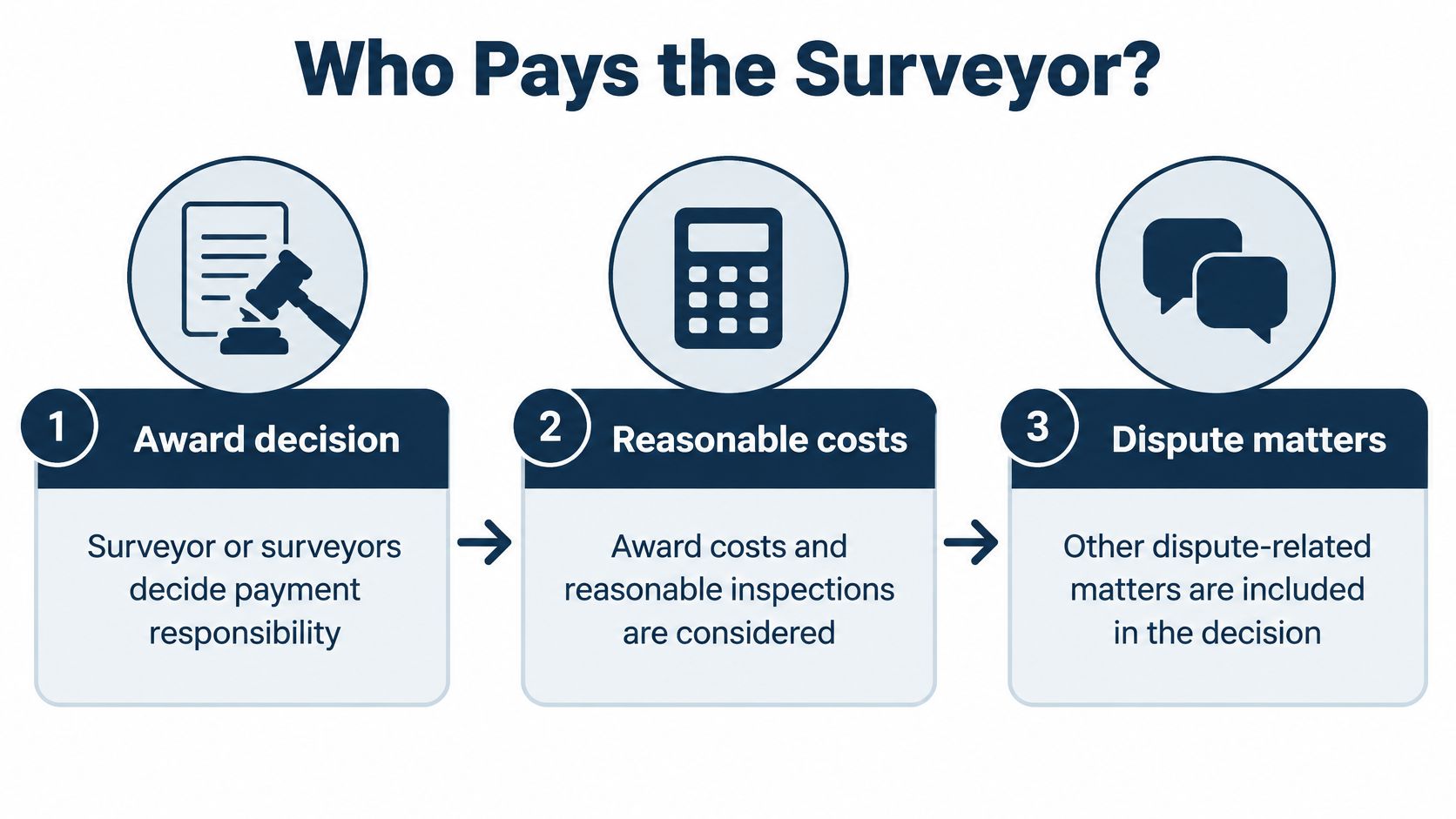
Under section 10(13) of the Party Wall etc. Act 1996, the surveyor or surveyors making the award decide who pays the reasonable costs of preparing or obtaining it, reasonable inspections and other matters arising from the dispute. The Act's section 10(13) cost provisions are the basis for the allocation.
The usual position is that the building owner pays the reasonable award costs, including the adjoining owner's surveyor, when the work is solely for the building owner's benefit. Costs can be apportioned where the works address shared disrepair, shared responsibility or a jointly used structure.
Work through the allocation in order:
- Confirm the benefit. Establish whether the proposed work is solely for your benefit or also addresses a shared issue.
- Check for shared responsibility. If the work addresses shared disrepair, expect the surveyors to consider apportionment.
- Get the allocation in writing. Ask the surveyor to state how the award deals with each cost.
- Read the issued award. Check that its allocation matches what you understood.
The adjoining owner's surveyor's charge is commonly included in the award as a lump sum based on time incurred, with an allowance for necessary later inspections. Only fees proportionate to the tasks needed to make the award should be included, according to the Party Wall etc. Act's cost provisions. The award can also allocate reasonable inspection and dispute-related costs.
A dispute can add negotiation, further inspections or work to resolve an issue. Those costs may be recoverable if reasonable. A disagreement about a charge is not resolved by refusing to pay: ask what work was done, how much time it took and why it was needed. For practical guidance on party wall agreement disputes, focus first on the issue and the records supporting the charge.
Keep the process controlled:
- Agree the scope in writing before any notice is served.
- Ask for rates and time records at each stage where work is hourly.
- Raise concerns early rather than letting disputed work accumulate.
- Keep design changes separate from the award stage where possible.
- Challenge disproportionate charges by asking for an itemised explanation.
List the building owner's surveyor, the neighbour's surveyor and later inspections or dispute work as separate lines in any quotation.
Worked Example of How a Party Wall Bill Builds Up
The figures below are illustrative arithmetic, not quotes or market rates. Replace them with the figures in your own quotation. The example is a single-storey rear extension on a semi-detached house, with one adjoining owner and no dispute.
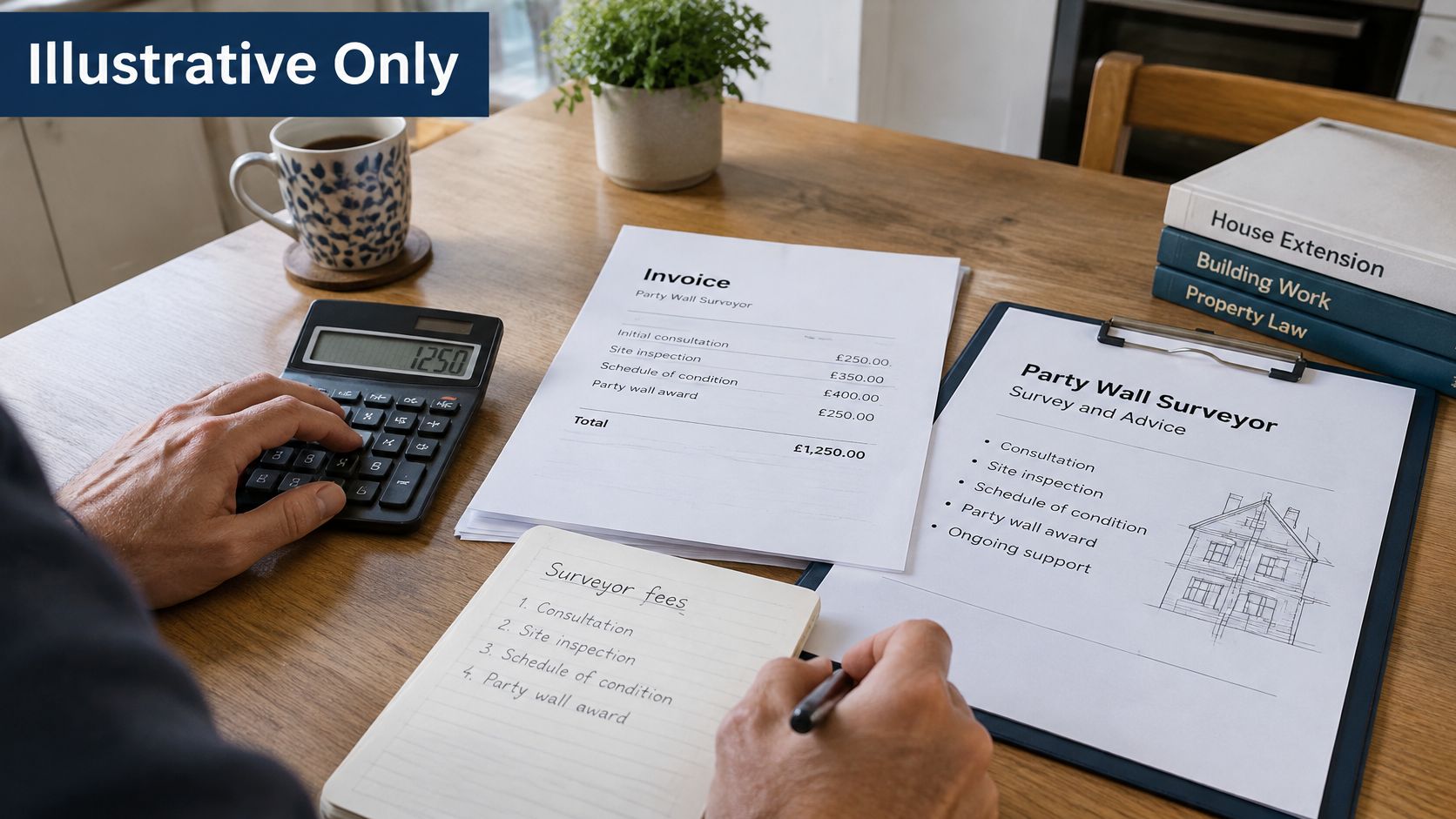
Suppose the illustrative quote gives the building owner's surveyor a fixed fee of £900 for notice advice, an inspection and award preparation. The adjoining owner's surveyor charges an illustrative £600 lump sum based on time incurred, including an allowance for one inspection. These figures are placeholders only.
Add an illustrative post-award visit at £150. The arithmetic is:
- Building owner's surveyor: £900
- Adjoining owner's surveyor: £600
- One post-award inspection: £150
- Illustrative total: £1,650
If the work is solely for the building owner's benefit, the building owner would usually be expected to pay the reasonable award costs, subject to the allocation in the award. The example doesn't establish what a surveyor should charge for a real project.
Now add a dispute. Assume, purely for illustration, that negotiation takes two hours at £150 per hour, a revised award takes one hour at £150 per hour and a second inspection costs £150. The added work is £300 + £150 + £150, or £600. The illustrative total becomes £2,250.
This shows why a quote needs to say what happens when the matter changes. Ask for the hourly rate and expected hours before work starts, and ask the surveyor to explain when they'll seek approval for further work.
The example uses round figures to make the calculation easy to follow. Put your own quoted fees into the same lines rather than treating these numbers as a guide price.
A short video can help you think through the cost questions to raise before appointing a surveyor.
Check the Quote Before You Appoint a Surveyor
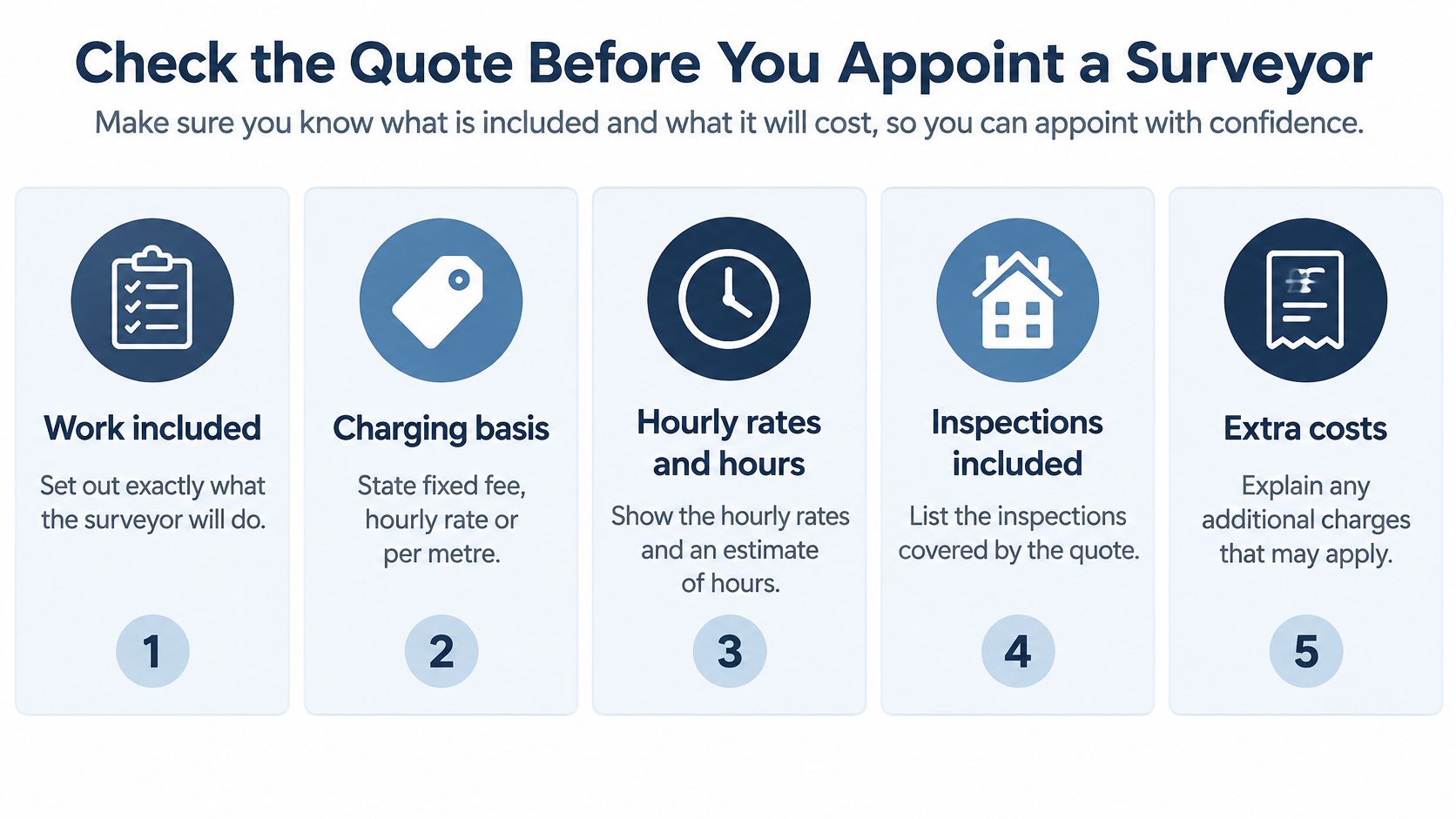
A low headline fee can lead to a higher final bill if the scope is narrow, inspections are extra or dispute work is charged separately. Before appointing anyone, get a written quote that identifies the work covered, charging basis, hourly rates and estimated hours, included inspections, VAT treatment, assumptions and how additional fees can be queried. Without those details, you cannot compare likely costs fairly.
Check the surveyor's credentials and independence. Look for RICS membership and ask whether any ties to a lender, estate agent or developer could affect impartiality. Other qualifications may be relevant to the work, but confirm what they mean for the service being offered.
Corinthian Surveyors London LTD is an independent firm of RICS Chartered Surveyors and Valuers based in Forest Hill, serving homeowners, buyers and property professionals across London. Its residential surveying services include RICS HomeBuyer Reports, Building Surveys and market valuations. For a party wall appointment, compare the proposed scope with your project: a terrace with several adjoining owners may require more work than a simple extension with one neighbour.
Before signing, check that the quote answers these questions:
- What work is included? Confirm whether notice advice, drawing review, inspections and award preparation are covered.
- What's the charging basis? Check whether the fee is fixed or hourly, and whether any other basis applies.
- What can add cost? Identify the allowance for inspections, revisions, negotiation and dispute work.
- How are costs allocated? Check whether the quote separates each surveyor's work from later work.
- How are extra fees reviewed? Agree how additional charges will be explained and queried.
Ask for the quote in writing, then compare the likely total, not just the opening fee. Corinthian Surveyors London LTD can be contacted on 0800 00 16 422 for advice and a quote.
Frequently Asked Questions
Is there a fixed fee for a party wall surveyor?
No. The Act sets no statutory fee tariff. Surveyors set and negotiate their fees, so ask for the scope and charging basis in writing. A low headline quote may not cover the work needed if the matter becomes more involved.
Who usually pays the adjoining owner's surveyor?
The building owner usually pays the reasonable costs of the award, including the adjoining owner's surveyor, when the works benefit only the building owner. The surveyor or surveyors making the award determine how costs are allocated.
Can I challenge a party wall surveyor's fee?
You can request an itemised breakdown if a charge seems unreasonable. Check the hourly rate and hours charged, then consider whether the work was proportionate to the task.
Corinthian Surveyors London LTD is an independent firm of RICS Chartered Surveyors and Valuers based in Forest Hill. To discuss your project and get a quote, call 0800 00 16 422.