
Market Value House: How Valuers Set the Figure
A London average cannot value an individual house. Market value depends on the property and the valuation date, so a citywide figure cannot tell you what a particular home would exchange for.
A postcode and sold-price website can produce a number quickly, but that number has no stated valuation date, basis or list of comparable sales. You cannot properly test it, or explain how it was reached, to a lender, HMRC or a solicitor.
Check the evidence behind any figure you receive: which sales were used, how closely those homes match the property, and what adjustments were made. A valuation is only useful when you can see how its evidence supports the conclusion.
Table of Contents
- What Market Value Means for a House
- How Valuers Build the Figure From Comparable Sales
- Adjusting Comparables for Size, Condition and Tenure
- Why London Averages Cannot Value One Home
- Market Value for Probate, Divorce and Tax Purposes
- Checking a Valuation Report Before You Act
- Common Questions About Market Value
What Market Value Means for a House
The RICS Red Book definition is deliberately narrow. Market value is "the estimated amount for which a property should exchange on the valuation date between a willing buyer and willing seller in an arm's-length transaction, after proper marketing, with both parties acting knowledgeably, prudently and without compulsion," as the RICS Property Journal sets out.
Read it slowly and notice what it isn't. It isn't the asking price. It isn't the agent's informal view given over a coffee. It isn't even the price already agreed with a buyer, because that figure reflects one negotiation between two specific people rather than a properly marketed open-market sale.
Every valuation is a statement about a hypothetical transaction on a stated date. That word hypothetical does a lot of work. The valuer answers a question about what the market would pay, not what one particular buyer has offered.
The four figures people call value
Most confusion comes from mixing up which number you're looking at. They're set by different people, they measure different things, and they're useful for different decisions.
| Figure | Who sets it | What it measures | Best used for |
|---|---|---|---|
| Market value | Registered RICS valuer | Estimated price for a properly marketed sale on the valuation date | Sale, lending, probate and tax purposes |
| Asking price | Seller and estate agent | Opening figure in negotiation | Starting a sale, not a valuation |
| Agreed sale price | Buyer and seller | The figure one transaction settled on | One data point that may be unusual |
| Lender's valuation | Lender's panel valuer | Security for the loan, tested against market evidence | Deciding how much a lender will advance |
| Automated estimate | Software model | Statistical estimate from past data | A rough guide only, weak for unusual homes |
The lender's figure is where this bites most often. It can come in below the price you agreed, not because the valuer is being awkward but because they're testing the house against market evidence rather than adopting the number you shook hands on. That gap has killed plenty of purchases, and it usually means the agreed price ran ahead of the evidence.
The test I'd apply: does the figure describe what a willing buyer would pay after proper marketing, and on what date? If either part is missing, you've got a price, not a valuation.
How Valuers Build the Figure From Comparable Sales
Where there's enough transaction evidence, the comparable method is the principal technical approach for UK residential market value. The guidance in the RICS valuation methods paper is that evidence should come from a body of sales rather than one, each closely similar to the subject property, recent enough to represent the valuation date, independently verifiable, completed at arm's length and reflective of underlying demand.
The sequence runs like this.
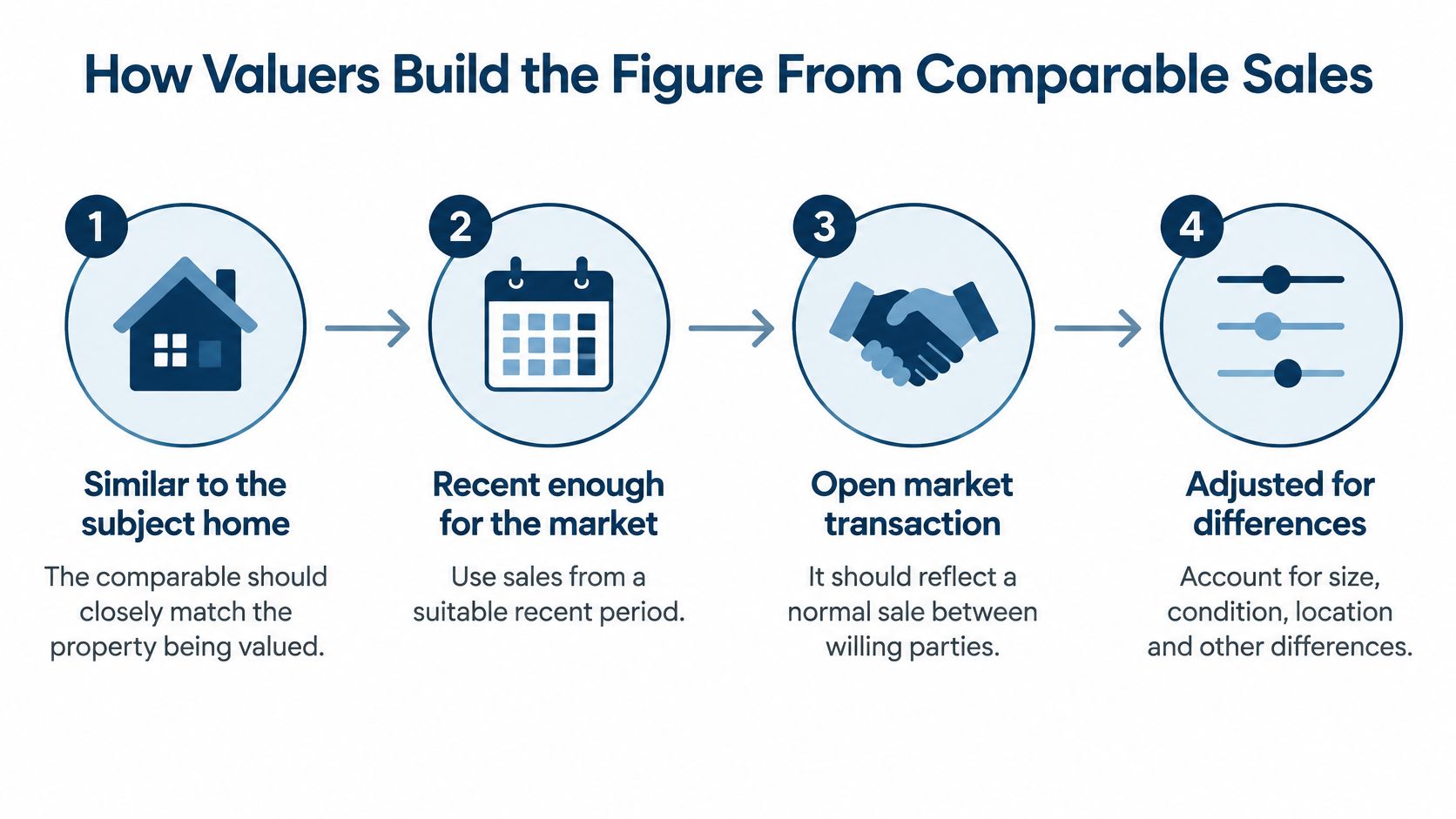
- Find recent completed sales of similar homes. Same borough, same property type, similar accommodation. A three-bedroom Victorian terrace in Lewisham is compared with other three-bedroom Victorian terraces nearby, not with the borough average or a new-build flat half a mile away. Completed sales matter because asking prices are wishes.
- Test each sale before you rely on it. A sale between connected parties, one pushed through on weak marketing, or one completed under pressure tells you less about the market. Older or unusual transactions either carry reduced weight or need adjusting, and the report should say which.
- Adjust for the differences you can measure. Floor area, bedroom count, condition, extension quality, parking, outdoor space, floor level, lease length and service-charge burden all move the figure. Each adjustment should be traceable back to evidence rather than pulled from the air.
- Weight the sales into a range. A defensible opinion is a weighted range of local comparables, not an average of headline prices. If the range is wide because the evidence is thin, the valuer says so and explains why.
The timing trap catches out automated tools and careless humans alike. The Land Registry records the completed sale, which can lag the date the price was agreed by weeks or months. Pulling the most recent records in a moving market means valuing today's house on last spring's prices. Ask when each comparable was agreed, not just when it completed.
If you'd rather hear it explained than read it, this walkthrough covers the same ground.
What to ask for: the list of comparables, why each one is genuinely similar, and the reasoning behind every adjustment. A valuer who can't produce that list hasn't finished the job.
Adjusting Comparables for Size, Condition and Tenure
Selecting the sales is half the work. The other half is the arithmetic between each sale and your house, and it's where a thin valuation shows itself immediately.
| Difference | What the valuer checks | Usual effect on value |
|---|---|---|
| Floor area | Internal measured size against each comparable | Larger homes usually support higher value, adjusted per square metre |
| Bedrooms and bathrooms | Count and layout against each comparable | An extra bedroom or bathroom usually raises value |
| Condition | Repairs, damp, roof, kitchen and bathroom age | Work needed usually lowers value |
| Extension quality | Planning status, build standard and usable space | A good extension adds value when it adds usable space |
| Parking and outdoor space | Garage, driveway and garden size | Scarce parking or garden raises value in dense areas |
| Floor level and lift access | Flat's floor, lift access and natural light | Higher floors and light can raise value; no lift can lower it |
| Lease and service charges | Years remaining, ground rent and annual service charge | Short leases and heavy charges lower value |
Floor area is the anchor. Calculate the price per square metre for each comparable, apply it to the subject's measured area, then sanity-check the total against the whole range. If the arithmetic throws out a figure at the top of the range for an unmodernised house, you've measured something wrong.
Condition is priced as the cost of the work plus the discount a buyer will demand for taking it on. Nobody pays full price for a house needing a roof and then pays for the roof. Lease length and service charges matter most for London flats, and the effect sharpens as the lease shortens: a flat with decades left is a different proposition from one with a handful of years on it, whatever the square footage says.
Where the arithmetic gets harder
Some differences don't price cleanly. A noisy road, a poor outlook, a railway at the end of the garden, an awkward internal layout, a flying freehold over a neighbouring entrance. Those still belong in the reasoning, stated plainly with a view on what they do to value and why.
Take a house where the closest comparable is one bedroom smaller on the same street and completed at a similar time. The extra bedroom and the added floor area support an upward adjustment, but the reasoning has to be written down: this much per square metre, this much for the bedroom, and the basis for that figure. An unexplained round number isn't an adjustment, it's a preference.
Ask this: what adjustment was made for each difference, and why that amount? Vague answers about the valuer's feel for the market are a warning sign, not an explanation.
Why London Averages Cannot Value One Home
London is the clearest case against area averages. In August 2026 the average London residential property was valued at £554,000, which was 2.2% lower than a year earlier, according to the UK House Price Index summary for August 2026. That average sat £15,000 below the July 2025 peak of £569,000 and £8,000 above the March 2026 low of £546,000.
| Property type | Average price | Change over the year |
|---|---|---|
| All London residential | £554,000 | 2.2% lower |
| Detached | £1,164,000 | Increased |
| Semi-detached | £731,000 | Increased |
| Terraced | £649,000 | Increased |
| Flats or maisonettes | £427,000 | 5.0% lower |
The composition effect explains most of that headline fall. Flats dropped 5.0% over the year while average house prices rose, and flats make up roughly half of London sales compared with about one fifth across Great Britain. Weaker flat prices therefore drag the citywide figure down even where houses are holding or gaining.
Now forget the average and look at three streets. A Victorian terrace in Lewisham with a rear extension, a 1930s semi in Bromley with a garage and a long garden, and a converted warehouse flat in Bermondsey with a short lease and a hefty service charge. Similar floor areas, three completely different markets. Borough, street, conservation area status, transport and known local issues do the rest.
A London average describes a market. It never values a house.
Before you instruct anyone, it's worth gathering the local evidence yourself. Our guide to checking a property's value in the UK shows what to pull together and what to ignore.
Market Value for Probate, Divorce and Tax Purposes
The same house can have different market values on different dates. The figure must match the purpose and valuation date in the instruction. A valuation report should state its basis and purpose, as RICS explains.
For probate, the relevant date is usually the date of death. For capital gains tax, the valuation may need to reflect an earlier acquisition or disposal date. For divorce, the date should match the one required for the case. In each instance, a market valuation report can be prepared for the relevant date. Corinthian Surveyors London LTD provides market valuation reports for homes being sold.
A sale valuation addresses the property's market value for a sale. A lender's valuation addresses the property as security for a loan. The purpose must be clear because it shapes the instruction and the assumptions behind the figure.
Before commissioning a valuation, agree these points:
- Valuation date: Specify the date the figure must reflect.
- Basis of value: State that market value is required, if that is the purpose.
- Scope of inspection: Confirm whether the valuer will inspect internally, take measurements or rely on assumptions.
- Who will rely on the report: Identify whether it is for HMRC, a court, a lender or your own use.
Get the date and basis confirmed in writing. For a retrospective valuation, the evidence must relate to the specified date, not just the conditions when the report is prepared.
Checking a Valuation Report Before You Act
A valuation figure is only as sound as the evidence and reasoning behind it. Check the report before you set a price, make an offer or agree a settlement.
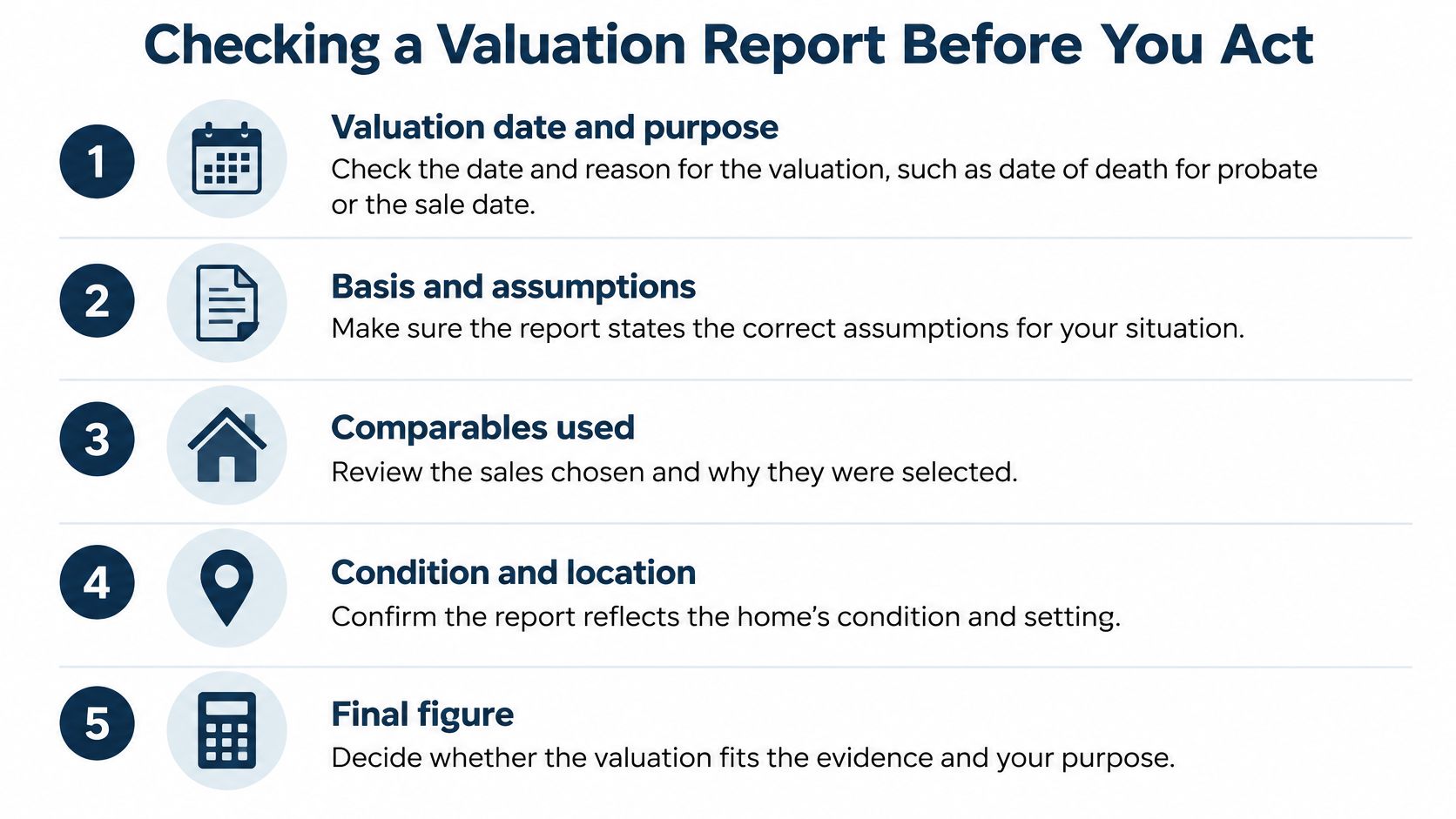
- Valuation date and purpose. Confirm the date matches the task, then check it against the terms of engagement. A figure for one date may not answer a question about another.
- Basis of value and assumptions. Look for the stated basis, such as market value, and read the assumptions, including anything the valuer did not inspect. Assumptions about lease terms or structural condition can affect the figure.
- The comparables. Check that the report identifies relevant recent sales and explains why they suit the property. A sale in the same borough may still be a poor match if the property type or features differ.
- The adjustments. Each material difference between your house and a comparable should have a reasoned adjustment. If the report identifies a difference but does not account for it, ask the valuer to explain.
- The cross-check. Compare the figure with the UK House Price Index for the relevant borough and property type, using it only as a broad check. The UK House Price Index reports average prices and changes over time. Its figures are provisional and can be revised, so they cannot confirm the value of one house.
Warning signs: a lone comparable, adjustments without explanations, a date that does not fit the purpose, or no stated basis of value.
A valuation report example can help you see how comparable evidence and adjustments should be set out.
Before acting, ask the valuer in writing to confirm the report's purpose, date and basis. Request the comparable list and ask how each adjustment affected the final figure. Corinthian Surveyors London LTD is an independent firm of RICS Chartered Surveyors and Valuers based in Forest Hill. It provides market valuation reports for homes being sold, setting out the comparables and adjustments so you can follow the reasoning behind the figure.
Common Questions About Market Value
Can an estate agent's appraisal be used for probate? Usually not on its own. An appraisal is a marketing opinion. Probate and tax work require a valuation with a stated date and basis, with the assumptions recorded. Check the requirements with your solicitor before relying on an appraisal.
Is a free online estimate good enough for a sale? Use it as a rough guide, not a final figure. Automated estimates can miss features that affect value, such as an unusual layout, a recent extension or a short lease.
What happens when there are few close comparables for an unusual home? Ask the valuer to explain how they handled the shortage, which adjustments they made and why. Period houses, flat conversions and listed buildings may need wider comparisons. The report should explain the reasoning.
If you need a market value figure for a home being sold, Corinthian Surveyors London LTD, an independent RICS firm based in Forest Hill, prepares market valuation reports for homes in London. The report sets out the comparables and adjustments behind the figure. Contact the firm through its website to discuss your property and the date you need.