
Valuation Report Example for Probate and Sale
An executor in Lewisham is staring at one figure on a scrap of paper. A seller in Forest Hill has an asking price from the agent and a lower number from the bank. Neither knows whether that number will stand up for a sale, a solicitor or HMRC. The useful question is not "what is it worth in a headline". It is which parts of a valuation report example sit behind the figure, and whether a third party can follow the judgement.
Table of Contents
- What a Valuation Report Example Should Show
- Three Kinds of Valuation Advice Compared
- Scope Purpose and Basis of Value
- London Market Evidence in the Report
- Comparables and Adjustments Worked Through
- Reading the Conclusion and a Down-Valuation
- Probate Tax Rent and Reinstatement Cross-References
- Quick Reference for Using the Report
What a Valuation Report Example Should Show
A proper valuation report example is an annotated residential report for probate or sale. It is not a brochure price and it is not a text from an agent. The number only becomes usable once the file shows who asked for it, what was inspected, which basis was used, what was assumed, which sales were relied on and how those sales were adjusted.
Read the front of the report before you read the figure. These are the parts that have to be there.
- Instruction and intended users: names the client and who else may rely on it. A buyer, a solicitor and HMRC are not the same user.
- Inspection scope: states what was seen and what was closed off. A locked roof space or unseen common parts change how hard you lean on the figure.
- Basis of value: names the standard being applied, usually Market Value on a stated date.
- Assumptions and limitations: set out vacant possession, tenure, title and anything the valuer was told rather than checked.
- Market evidence and adjustments: record the sales used and the reasons one flat or house was preferred to another.
- Reasoned conclusion: lands on a point or a narrow range that matches that evidence.
If any of those parts is missing, do not treat the figure as ready for a contract, a probate return or a negotiation. The Red Book grew out of the 1972–73 boom and collapse, after a joint working party with the Institute of Chartered Accountants in England and Wales was set up in 1973. The first edition, The Valuation of Assets, came out in 1976 because bases and report formats were inconsistent. RICS reviews and reissues the standards every two years. Ethics, objectivity, competence and transparency are the point of the format.
Practical rule: open any report and tick those parts off before you trust the figure. A headline without them is an estimate, not evidence.
An independent RICS and CABE valuer writes the report so someone who was not in the house can still follow the judgement. That is the standard I work to at Corinthian Surveyors in Forest Hill. The next sections separate the products people mix up, then walk the front of the report and the sales behind it.
Three Kinds of Valuation Advice Compared
People searching for a valuation report example often have three different products in one pile. They do different jobs. Using the wrong one is how estates get queried and how sales stall.
The comparison below is about how much of the property is seen. It is not the same split as agent, lender and Red Book, but it shows why a remote note and a full inspection are not interchangeable.
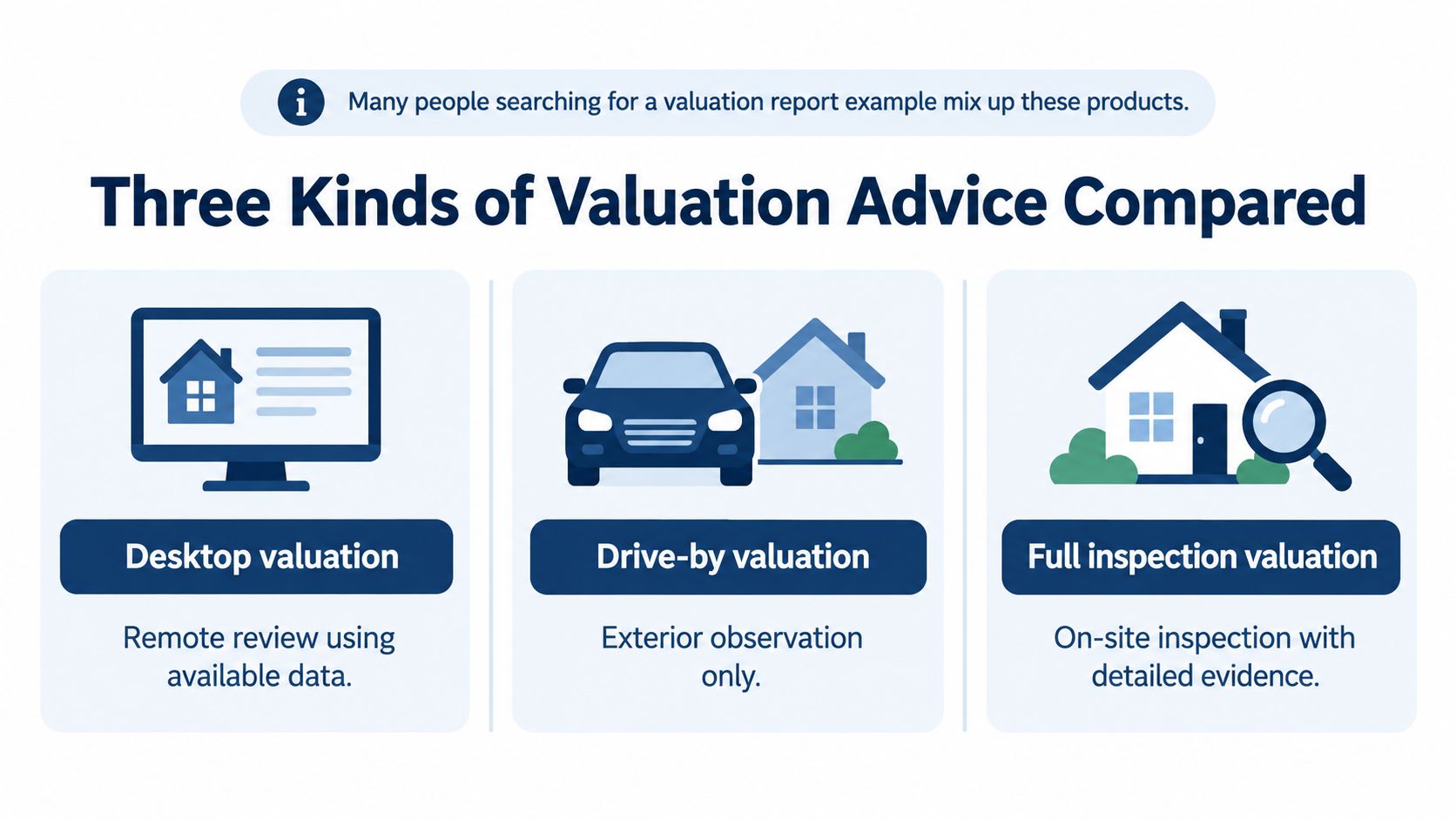
What each product can do
An estate agent marketing appraisal is a view of what might be asked in order to win the instruction. It can be a sensible starting conversation for a sale in Sydenham or Brockley. It is not written to a stated basis, it is not usually tied to achieved prices with adjustments, and it is not the document a solicitor wants for a taxable estate.
A lender mortgage valuation is a security check for the bank. Inspection is often limited. The report is written for the lender, not for the buyer and not for the estate. It can come in below an asking price without anyone having valued the home for sale or for tax. You cannot hand it to HMRC and call it a probate valuation.
A formal RICS Red Book valuation is an independent opinion for a stated purpose, date and user. For probate the relevant figure is open-market value at the date of death. It is not a rebuild cost and it is not an asking price. The report should show purpose, valuation date, assumptions, comparable evidence, limitations and intended users.
Referrals of inheritance-tax property valuations to the UK Valuation Office Agency rose from 11,845 to 14,631 in the 12 months to 30 September 2025, an increase of 23.5%, as recorded in The Gazette's note on those referrals. A thin informal note can cost time if the estate is taxable, the London property is unusual, or beneficiaries disagree. A cheaper scrap of paper is often the expensive route.
Independence matters when the same home is being discussed by an agent, a lender and the family. Corinthian has no ties to lenders, estate agents or developers, so the opinion is not written to win a listing or to support a loan.
A short walk-through of how these products differ in practice is here.
Look for the purpose on page one. If the purpose is missing, you do not yet have a valuation you can file.
Scope Purpose and Basis of Value
Check identity before evidence. A UK report should name the client, the intended users, the purpose, the property interest, the valuation date, the inspection scope, the information relied on and the valuer's independence. Under the RICS Valuation – Global Standards effective from 31 January 2025, that mandatory content sits in VPS 6.
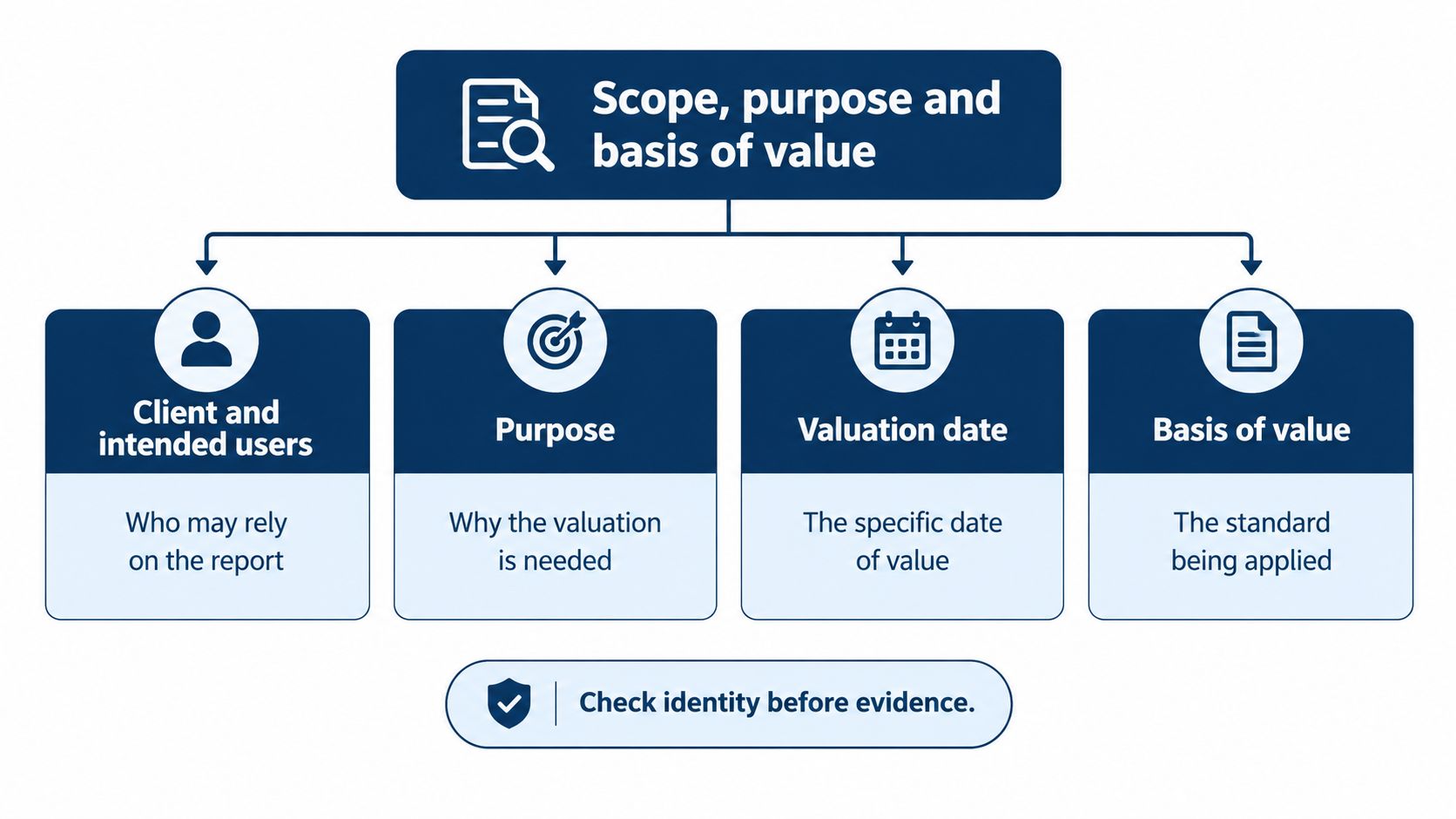
The words that fix the figure
Market Value is the estimated amount for which an asset should exchange on the valuation date between a willing buyer and a willing seller in an arm's-length transaction, after proper marketing, with both parties acting knowledgeably, prudently and without compulsion. That is a definition, not a hope about what someone pays on a Saturday.
A line you should be able to recognise reads: "Market Value as at [date], assuming vacant possession." Everything after that line has to match it.
What a London residential example then sets out
The legal interest comes next. Freehold of a Victorian terrace in Catford is not the same interest as a long lease of a mansion flat in Dulwich. Tenure, accommodation, condition and location follow, in plain terms a buyer would recognise.
Planning and title assumptions need to be written out. If the valuer has assumed a loft is lawful, or that a chimney breast removal was properly supported, that assumption is part of the price. So is any limit on inspection. A flat seen without the common parts, or a house with a locked roof space, is not fully evidenced.
All assumptions and special assumptions should be set out in full, with reservations where they matter. The report should say whether the client agreed them. An agreed special assumption, such as vacant possession when the property is still let, produces a different figure from the interest as it stands.
If the date, the users or the assumptions are vague, the figure is not auditable. It is not a promise of the price achieved on completion, and it is not a promise of what a lender will advance.
For a sale instruction that is not a tax valuation, the same front-of-report discipline is set out in this note on property valuation reports. Read that front page before you argue about the number at the end.
London Market Evidence in the Report
A regional percentage is context. It is not a valuation of your house or flat.
The UK House Price Index put London's average house price at about £551,000 in December 2025, after a 1.0% annual decrease and a 0.8% monthly decrease from November. London had the lowest annual price movement among English regions. In February 2026 the average for London flats and maisonettes was £426,470, against an all-property London average of £546,113.
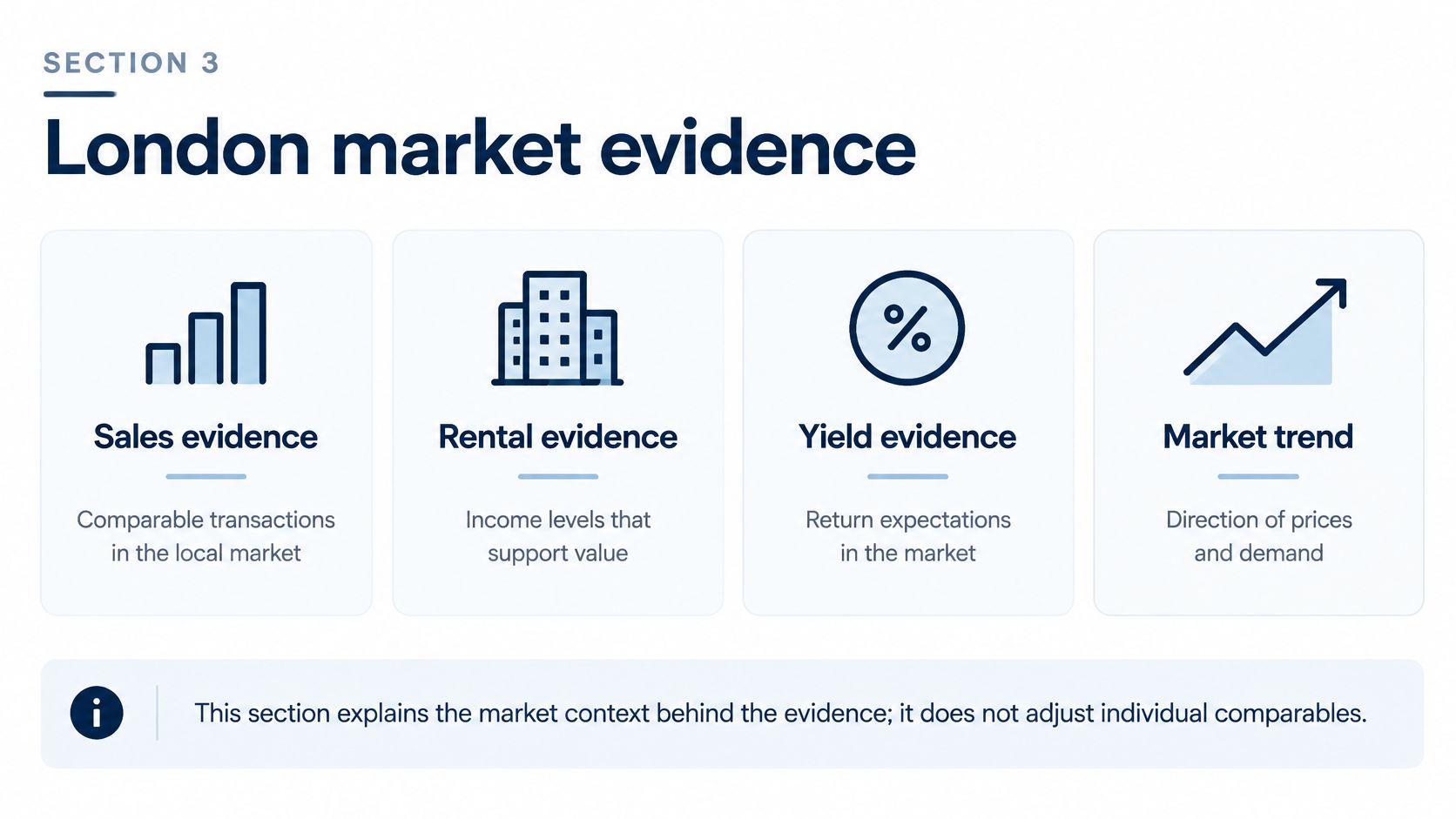
Why one London percentage fails
Those gaps are the reason a report cannot drop a single London-wide change onto a 1930s semi in Bromley or a leasehold flat in Forest Hill. A flat in Forest Hill needs similar leasehold flats nearby. It does not need detached houses in another borough.
The index itself is built to compare like with like, not to price one home. The UK HPI quality and methodology uses a hedonic regression model. It adjusts for local authority, Acorn classification, property type, floor area, number of rooms and whether the property is new or old, then combines predicted prices with a geometric mean. Sales that are not at market value, including remortgage figures that are valuations rather than prices, are left out.
The comparison of UK house price indices records around 100,000 transactions a month across HM Land Registry, Registers of Scotland and Land and Property Services Northern Ireland. Weights are updated annually from the previous year's transactions. That is a market thermometer. It cannot see a short lease in Greenwich, a tired kitchen in Peckham or a garden that backs a railway in Sydenham.
What the report still has to describe
Even with that context, the report should describe location, tenure, size, condition, accommodation, floor level, outside space, parking and the sales relied on. Put the valuation date next to recent evidence, especially when prices are slipping.
A 1% regional fall can matter on a high value. A short lease, poor condition or a different micro-location can move the figure by more than the headline trend. Index context supports the story. It does not replace inspection or comparables, and it must not be used as the valuation itself.
Comparables and Adjustments Worked Through
A list of asking prices is not a valuation. The conclusion is built from achieved sales, differences and a reason for the weight given to each sale.
Take a two-bedroom leasehold flat in Forest Hill, valued for sale with vacant possession. The valuer records the subject, then two or three sales of a similar interest. For each comparable the file should show an address or reference, transaction date, achieved price, type, tenure, floor area, bedroom count, condition, location and the differences that matter.
HM Land Registry Price Paid Data is a primary source for England and Wales because it records residential transactions sold for value and lodged for registration. It is collected through registration and combined with attributes from the Valuation Office Agency and UK Finance, including size and related property information. It is not a ready-made value for your flat. A historic price still needs a test for timing, condition, improvements, tenure, floor area, micro-location and odd sale circumstances. A remortgage figure is excluded from the official index because it is a valuation, not a sale.
RICS residential valuation standards expect that evidence to be explained, not dumped.
How the adjustments are made
Work through the differences in a fixed order so nothing is double-counted.
- Type and tenure. A house is not a flat. Freehold is not leasehold. If Comparable B is a house, it is context only.
- Lease and costs. Lease length and service charge move a Forest Hill flat more than a small change in the regional index. A short lease is a different product.
- Floor, outside space and parking. A garden flat and a second-floor flat with no outside space are not equal, even on the same street in SE23.
- Condition and alterations. An extended or refurbished comparable needs a downward adjustment if the subject is tired. The reverse applies if the subject has the better kitchen and the comparable does not.
- Street. One turn towards the station, or one turn towards a busier road, is a real adjustment in Crystal Palace, Honor Oak and Sydenham.
Then reconcile. The closest lease, floor area and condition carry more weight. A sale with an odd buyer, a very short lease or a different postcode is mentioned and then set aside. The opinion lands on a point or a narrow range, with the reason written in one paragraph.
| Record | Subject flat | Comparable A | Comparable B |
|---|---|---|---|
| Identity | Two-bed leasehold, Forest Hill | Similar two-bed, same micro-location | Larger flat, adjacent street |
| Tenure and lease | Long lease, service charge noted | Long lease, similar charge | Shorter lease, higher charge |
| What was recorded | Floor area, beds, condition, floor, garden, parking | Achieved price, date, same interest | Achieved price, date, different lease |
| Adjustment | Baseline | Small adjustment for condition only | Heavier adjustment for lease, floor and outside space |
| Weight | The property being valued | Greater weight | Lower weight, used as a check |
Asking prices do not go in that achieved-price column. If you only have asking prices, you do not yet have the evidence. For a sale reader, the same pattern of record, adjust and reconcile is what sits behind a house valuation. A price list without reasons is not a report you can defend.
Reading the Conclusion and a Down-Valuation
The opinion is the reconciliation, not a fresh guess. It should say which sales were preferred, which were rejected and where the evidence is thin.
Uncertainty belongs in that paragraph. Lease length, service charges, defects, planning status, extensions and a shortage of local sales all widen the range. A Victorian terrace in Lewisham with an open chimney breast and a rear addition is a different judgement from a purpose-built flat with a clean lease. If the valuer cannot see the alteration or the planning record, the conclusion should say so.
When the bank's figure is lower
Buyers meet this after a mortgage offer. A down-valuation is the lender's security assessment. It is not automatically an independent market valuation, and it is not automatically wrong.
Recent UK evidence, reported by Mortgage Solutions, put the average newly listed property 11.6% above its automated valuation-model value in Q2 2026, up from 5.7% a year earlier. That gap shows asking prices and modelled values can diverge. It is not a London house price and it is not a fee.
Separate the two jobs before you argue.
- Factual errors you can raise: a missed improvement, a wrong floor area, a comparable on a different tenure, or a sale that is not the same interest. Put the correction in a short note with the document that proves it.
- Differences you should not treat as mistakes: a different purpose, a different date, a restricted inspection, or a model that never saw the inside of the flat.
- What to do next: reconcile the evidence before you renegotiate or proceed. A lower lender figure is a decision signal. It does not prove the asking price is fair, and it does not prove the surveyor is wrong.
Prepare a one-page note for your solicitor: the date, the basis, the sales relied on and the single fact you say was missed. Do not send a stack of portal listings and call it a challenge.
That note is enough to reopen a price talk. It is not a substitute for a report that already shows its working.
Probate Tax Rent and Reinstatement Cross-References
The same report discipline serves more than one instruction. The figure does not travel with you unchanged.
For probate, keep two things in view: value at the date of death and the vacant-possession assumption if that is what was agreed. The report is written so it can be read again if HMRC asks questions. Executors sometimes confuse the valuation with a listing of the estate's assets. A listing records what is there. A valuation says what the open market would pay for the property interest on that date. The distinction is set out clearly in Brillant Law's note on estate inventory versus probate property listings.
Capital gains uses a statutory meaning
For capital gains, "market value" is not a casual estimate. HMRC's Capital Gains and other taxes manual states that, under section 272 of the Taxation of Chargeable Gains Act 1992, market value is the price an asset might reasonably be expected to fetch in an open-market sale. No reduction is made merely because the whole holding is assumed to be placed on the market at the same time. Where inheritance tax is chargeable and a value has been established for that tax, section 274 generally treats that value as the asset's market value at the date of death for capital gains tax.
A properly dated probate valuation can therefore affect both the estate return and a beneficiary's later gain. Do not overwrite that date with a current asking price.
The same front-of-file habits, applied to a death valuation, are set out in this guide to a probate valuation of property.
Figures that must not be reused as market value
Neighbouring instructions use the same care and produce a different opinion.
- Market rent is for landlords and tenants. It is not the capital figure for a sale or a probate return.
- Shared ownership staircasing values the share being bought under that lease. It is not a freehold vacant-possession price.
- Building reinstatement cost is a rebuild figure for insurance. It is not market value, and it is the wrong number to put on an inheritance-tax form.
If the instruction changes, the date, the users and the basis change with it. Do not photocopy yesterday's sale figure onto a tax return.
Quick Reference for Using the Report
Keep this beside the report. If a line is blank, the figure is not ready.
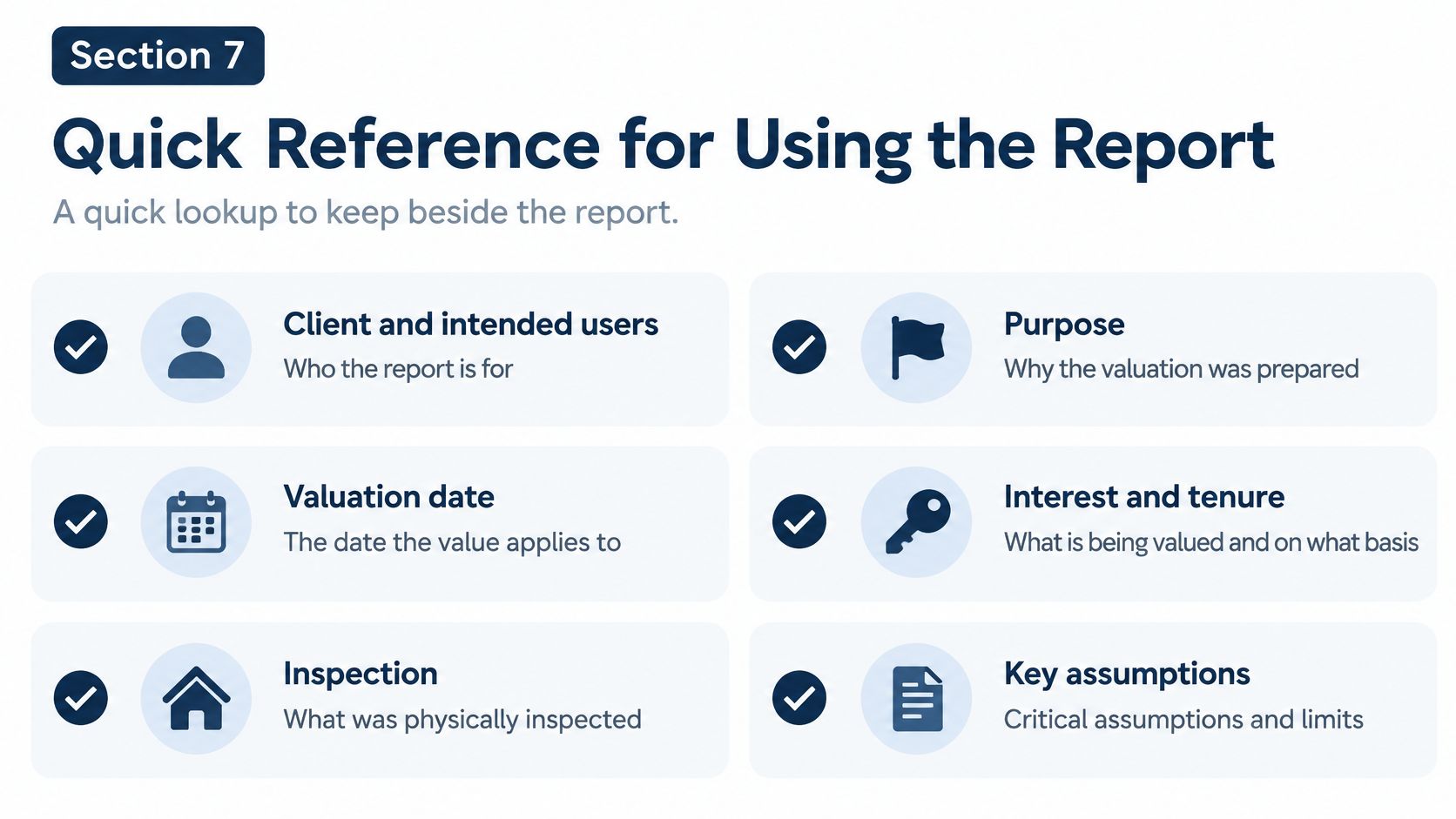
How to use the checklist
For a sale, the figure informs price talks. It is not the marketing headline the agent puts on the portal.
For probate, the solicitor needs the date of death and the open-market basis, plus the assumptions on vacant possession and tenure.
For a purchase, set the report next to the lender figure. Challenge errors of fact. Do not treat a different purpose as a mistake.
Add the comparables, the adjustments and a conclusion that matches that evidence. Those three items are what make the number reviewable.
Questions the file still raises
Can two competent valuers reach different figures and both be properly reasoned?
Yes. A narrow range is normal where leases, condition or thin local sales leave room for judgement. What is not acceptable is two figures with no working. If both reports show their sales and their adjustments, you can see why they differ. If one of them does not, prefer the one that does.
What should a solicitor send if HMRC queries the return?
Send the report itself: instruction, users, date, interest, inspection limits, basis, assumptions, comparables and the reconciliation. Do not send a one-line value with a covering email. The query is about evidence, not about the typeface on the front page.
Is a desktop note enough for a Victorian terrace in Lewisham where condition and alterations drive value?
No. Chimney breast removals, rear additions, damp and roof cover are inside the house. A desktop note cannot see them. Where those items move the price, you need an inspection and a report that says what was seen.
If the report in front of you is missing the date, the users or the comparable reasons, it is not ready to rely on. Corinthian Surveyors is an independent RICS and CABE practice in Forest Hill, regulated by RICS and on the Valuers Registration Scheme, and can prepare a residential valuation for sale or probate across London and the Home Counties. Call 0800 00 16 422.
Corinthian Surveyors London LTD prepares independent residential valuation reports for sale, probate and related tax dates, with the instruction, assumptions and comparable reasoning written so a solicitor or HMRC can follow them. If you are holding a single figure for a London house or flat and cannot see the date, the users or the sales behind it, that file is not ready to rely on. Visit Corinthian Surveyors London LTD to arrange a residential valuation.