
Home Buyers Survey London: A Practical Guide

Your offer's been accepted. The agent wants your solicitor's details, the mortgage application is moving and you're already thinking about where the furniture will go. Before you commit any further, arrange a home buyers survey in London that matches the building you're buying. The important question isn't whether the kitchen looks good. It's what you might have to repair after completion.
Table of Contents
- Why London Buyers Need a Survey Before Exchange
- Choosing Between RICS Level 1, Level 2 and Level 3
- What a Surveyor Actually Inspects in a London Home
- Timing the Survey Around the London Transaction
- How to Choose the Right Surveyor in London
- Using Survey Findings to Renegotiate the Price
- Practical Next Steps After the Survey Report Arrives
- Frequently Asked Questions About Home Buyers Surveys in London
Why London Buyers Need a Survey Before Exchange
A survey gives you an independent assessment of the property's condition before you become contractually committed. It helps you identify defects, understand repair priorities and decide whether the purchase still makes financial sense. It doesn't guarantee a fault-free home.
Your lender's valuation serves a different purpose. It checks whether the property is suitable security for the mortgage. It may not involve a physical inspection and doesn't protect you if defects emerge later, as GOV.UK's home-buying guidance explains.
That distinction matters when you're stretching your budget. The ONS housing affordability figures put London's average home at 10.6 times annual full-time earnings in 2025, compared with 7.6 times across England. Those are regional benchmarks, not valuations of your particular property. My advice is simple: don't commit most of your available money to the purchase price without investigating the building.
Inspect the building rather than the decoration
A freshly painted Victorian terrace in Lewisham needs a different assessment from a conventional semi in Bromley. A converted flat in Peckham raises different questions from an ex-local-authority flat in Southwark. Choose the inspection around construction, condition and alterations, not just the number of bedrooms.
Start with the elements that could change your buying decision:
- Structure and alterations. Ask about cracking, removed walls and changes to chimney breasts.
- Weather protection. Roof coverings, flashings and rainwater disposal deserve attention before decorative finishes.
- Moisture and timber. Ask what's causing any dampness and whether concealed timber could be affected.
- Shared responsibility. With a flat, establish which defects concern the wider building and need legal enquiries.
For background on one easily overlooked element, Four Seasons Roofing's guide to why inspect the roof pre-sale is useful supplementary reading. It isn't a substitute for an inspection of your London property.
Practical rule: Don't exchange while a material survey concern remains unexplained.
Skipping the survey can leave you making a major decision with very little condition evidence. Spend your attention on what could affect safety, repair liability and your ability to own the property comfortably. A new bathroom won't answer those questions.
Choosing Between RICS Level 1, Level 2 and Level 3
Choose the survey for the building, not the lowest quotation. A straightforward property in reasonable condition and an extensively altered period house don't need the same service. Send the surveyor the sales particulars and explain any concerns before accepting a recommendation.
The RICS guide to home survey choices describes Level 2 as suitable for conventional properties built with common materials and in reasonable condition. A simple layout matters too. Numerous extensions or alterations can make a building less suitable for that level.
RICS Home Survey Levels at a Glance
| Level | Best Suited To | Format | Includes Valuation |
|---|---|---|---|
| Level 1 | Straightforward property where basic condition reporting meets the buyer's needs | Basic condition report | No |
| Level 2 survey only | Conventional house or flat in reasonable condition | Condition ratings with defect and maintenance advice | No |
| Level 2 survey and valuation | The same property types where value advice is also required | Condition report plus market valuation and reinstatement figure | Yes |
| Level 3 | Older, unusual, run-down or substantially altered property | More extensive inspection and detailed analysis | No |
Level 1 is the basic option. I wouldn't choose it just because a property has attractive decoration. Ask whether its limited reporting will answer the questions you really have.
For a conventional house with no obvious complexity, Level 2 is a sensible starting point. It provides more than a basic condition report, including advice about defects and likely future maintenance. It's not automatically the right choice for every London flat or every property described as modern.
When more detail is justified
Consider Level 3 for a period house with structural alterations, a neglected property or a building you intend to change substantially. The important issue is uncertainty: how much needs explaining before you can make a sound decision?
RICS guidance on Level 3 surveys describes a more extensive inspection. It includes normally accessible concealed areas where safe and practicable, such as roof spaces and cellars. The report considers probable causes, remedial work and the consequences of leaving defects unrepaired.
Don't confuse condition advice with valuation advice. The Level 2 survey-and-valuation adds both a market valuation and an insurance reinstatement figure. Level 3 doesn't include a market valuation, so raise that requirement before instruction rather than assuming it's part of the fee.
What a Surveyor Actually Inspects in a London Home
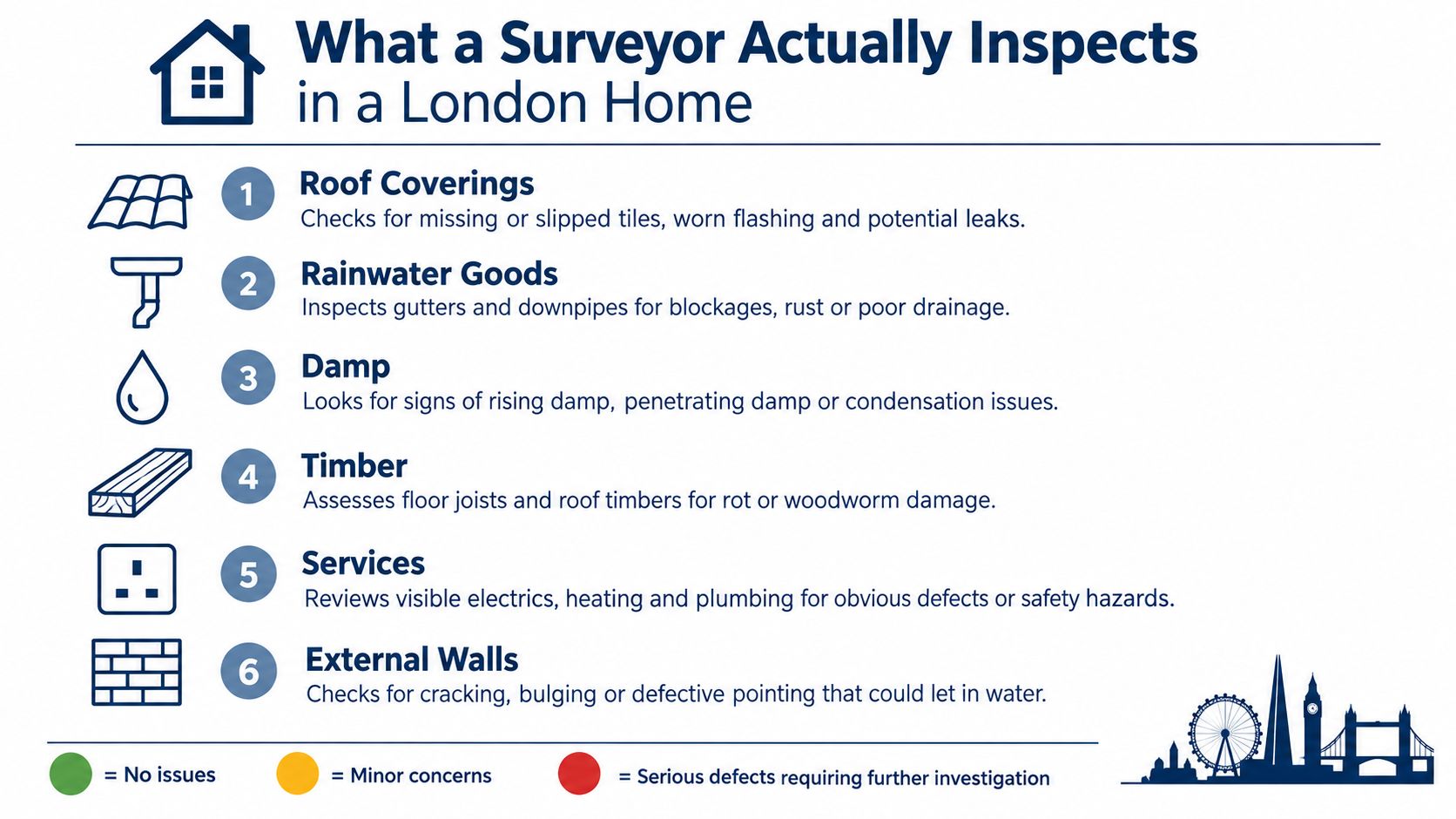
The surveyor examines the visible and accessible building, then interprets what the evidence means. Finding a damp patch is only the start. The useful advice concerns its likely cause, the risk to adjoining materials and what investigation or repair should follow.
Use this checklist to keep your attention on the main building elements.
Look beyond the visible symptom
On a Victorian terrace in Forest Hill, ask about the roof and any parapet above a bay window rather than concentrating on the stain beneath it. In a converted flat, ask whether a soil-pipe defect affects only your accommodation or requires access elsewhere. For a solid-walled Georgian property, ask for the reasoning behind any damp diagnosis before agreeing to a treatment.
These are examples of questions to investigate, not claims that every property of that type has those defects. The report should distinguish an observed problem from a suspected hidden risk.
- External fabric. Look for findings about coverings, gutters, walls, windows and weatherproofing.
- Internal condition. Read the comments on visible timber, dampness, floors, ceilings and ventilation.
- Services. Treat visual observations as observations, not electrical, gas or drainage test certificates.
- Inspection limits. Check which areas couldn't be accessed and what uncertainty remains.
For a broader way of organising condition notes, PropLab's building inspection checklist for flips offers a supplementary framework. Don't let an investment checklist replace a properly scoped residential survey.
Read the ratings alongside the explanation
The RICS Home Survey reporting framework uses standardised reports, including colour-coded condition ratings for Level 2. Read each rating with its accompanying text. A colour alone won't tell you the repair scope or resolve an inspection limitation.
Treat red findings as priorities for discussion, not an automatic instruction to abandon the purchase. Ask whether the issue requires urgent repair, specialist investigation or both. Green doesn't mean maintenance will never be needed.
The video below provides an additional visual reference for the inspection discussion.
Keep the inspection's limits in mind. Covered floors and boxed-in structure can prevent confirmation of hidden conditions. A useful report identifies that uncertainty and tells you whether it matters enough to investigate before exchange.
Timing the Survey Around the London Transaction
Instruct the surveyor once your offer is accepted and access can be arranged. Don't wait until everyone is asking for an exchange date. You need room to understand the report, obtain specialist advice and make decisions without artificial urgency.
Transaction evidence supports planning ahead. The Council for Licensed Conveyancers' transaction research reports that 84% of transactions take three or four months from accepted offer to completion. That doesn't give your purchase a guaranteed timetable. It does show why leaving condition checks until the end is poor coordination.
Agree the dates before you instruct
Ask for separate expectations for the inspection and the written report. Access arrangements, property complexity and the agreed service affect the programme. Don't accept a general promise of fast turnaround without understanding what it covers.
Corinthian's guide to how long a HomeBuyer survey takes is a useful starting point for that conversation. Confirm the actual arrangements for your property directly.
| Transaction stage | Your practical task |
|---|---|
| Offer accepted | Send the particulars and known concerns to the surveyor |
| Instruction agreed | Confirm scope, access and reporting expectations |
| Inspection completed | Ask whether anything urgent needs immediate attention |
| Report received | Coordinate specialist advice and legal enquiries |
| Before exchange | Resolve material uncertainty and confirm your decision |
Use early findings without rushing the conclusion
Early commissioning doesn't mean demanding an instant answer about every crack. It means discovering concerns while there's still time to investigate them properly. A structural concern might need engineering advice; a drainage concern might need a separate inspection.
Waiting until you feel committed doesn't make a defect smaller. It makes the decision harder.
Survey work can introduce another coordination task. The alternative is discovering a significant concern after you've spent more money and mentally moved in.
Tell the surveyor about your proposed exchange date, but don't ask them to fit the conclusion around it. If the evidence isn't sufficient, change the timetable rather than pretending the risk has disappeared.
How to Choose the Right Surveyor in London
Ask who will inspect the property and write the report. A recognisable logo isn't enough. You need a named professional whose experience matches the building and whose scope answers your questions.
Start with RICS qualifications and regulation. CABE qualifications are also relevant built-environment credentials, but they don't remove the need to check the specific service being offered. If you're commissioning valuation advice, ask about the RICS Valuers Registration Scheme.
Ask questions that reveal experience
Local knowledge should produce specific discussion, not a list of boroughs. Ask how the surveyor would approach your particular property. A useful answer should address its construction and alterations rather than recite a standard sales explanation.
- For a Lewisham terrace. Ask how previous wall removals or a loft conversion affect the recommended scope.
- For a Bromley semi. Ask whether extensions change the suitability of a Level 2 inspection.
- For a Bermondsey warehouse flat. Ask how the original construction and conversion influence the assessment.
- For a leasehold purchase. Ask what can be inspected beyond the flat and which issues should go to your solicitor.
These questions test judgement. Nobody should diagnose the building from the listing alone, but they should explain what needs checking and why.
Compare responsibility as well as price
A lender-appointed valuation addresses the lender's security requirements. A buyer-appointed survey is a separate instruction. If a firm offers both services, make sure you understand which appointment you're purchasing and who can rely on the report.
Ask about referral arrangements and possible conflicts involving the lender, agent or developer. Independence needs to be clear, not assumed from the word surveyor.
Corinthian's advice on how to choose a building surveyor provides further questions to use when comparing appointments.
Before accepting a quote: Request the written scope, exclusions, insurance details and arrangements for discussing the report.
A low fee isn't proof of poor work. A vague scope is a more useful warning sign. Equally, a higher price doesn't automatically buy better advice.
Check whether quotations cover the same survey level and valuation requirements. Ask whether you can speak to the inspecting surveyor afterwards. A report you can't understand leaves you poorly equipped to decide what happens next.
Using Survey Findings to Renegotiate the Price
Negotiate from evidence, not alarm. The strongest discussion identifies a material defect, establishes a credible remedy and explains why it changes the purchase decision. A long list of minor maintenance jobs is less persuasive.
Keep cosmetic preferences separate. An unfashionable kitchen is something you could see when offering. A previously unidentified roof defect or concern about structural alterations is a different proposition.
Research published in the HomeOwners Alliance conveyancing report found that 40% of respondents wrongly believed a conveyancer checks structural soundness. Don't make that mistake when negotiating. Your surveyor explains the physical concern; your solicitor deals with the legal implications.
Match the request to the finding
| Survey finding | Sensible next action | Possible negotiating position |
|---|---|---|
| Defined repair defect | Obtain a suitable written quotation | Discuss a price adjustment |
| Uncertain structural concern | Commission the recommended investigation | Delay a final decision until clarified |
| Concern about alterations | Ask the solicitor to investigate documentation | Reconsider terms once the position is understood |
| Shared-building defect | Establish repair responsibility and available information | Assess your potential liability before proceeding |
| Decorative wear | Include it in your own refurbishment budget | Usually a weaker basis for revisiting the price |
A contractor's quotation should describe the work, access requirements and assumptions. Don't turn a surveyor's warning into a precise repair demand without establishing the likely scope.
Be careful with seller-arranged repairs
A seller's promise to repair something isn't the same as evidence of a satisfactory repair. Ask who will carry out the work and how its completion will be checked. Where hidden work is involved, photographs and paperwork may matter as much as the finished appearance.
A retention isn't a universal answer either. Ask your solicitor whether a proposed arrangement is workable and whether lender approval is needed. Don't assume money can be held back just because you request it.
Corinthian's guidance on negotiating the price after a survey can help you organise that discussion. The seller can refuse any adjustment. Your protection is the ability to make an informed decision before exchange, including deciding not to proceed.
Practical Next Steps After the Survey Report Arrives
Read the summary first, then the detailed findings and inspection limitations. Don't start by forwarding the most worrying photograph to the agent. Establish what the surveyor recommends.
The English Housing Survey's housing quality findings reported that 14% of owner-occupied homes in England failed the Decent Homes Standard in 2023, while 8% had a Category 1 hazard. These aren't London-specific probabilities for your purchase. They reinforce the need to distinguish safety concerns from ordinary maintenance.
Turn the report into an action list
- Clarify the priorities. Ask the surveyor which findings need action before exchange and which can form a maintenance programme.
- Define specialist instructions. Give each specialist a clear question, such as assessing structural support or investigating a suspected drain defect.
- Brief your solicitor. Send relevant extracts about alterations, shared-building responsibilities and documents requiring investigation.
- Inform the mortgage broker or lender. Raise material findings that could affect value or security and ask what information is required.
- Update your decision. Consider the repair burden alongside the price, available funds and your willingness to manage works.
Keep one record of unresolved issues
Use a simple list showing the concern, responsible professional and evidence still required. Mark an issue resolved only when you understand the answer. A seller's reassurance shouldn't replace a recommended investigation.
At Corinthian Surveyors, the practice is based in Forest Hill and covers all London boroughs. Clive Thompson holds RICS and CABE qualifications and brings more than three decades of built-environment experience. The firm is RICS-regulated and participates in the RICS Valuers Registration Scheme.
For advice on commissioning the appropriate inspection, call 0800 00 16 422 with the property address, sales particulars and any known alterations. That gives the surveyor something useful to assess before recommending a service.
Frequently Asked Questions About Home Buyers Surveys in London
How much does a home buyers survey in London cost?
Ask for a property-specific quotation rather than relying on a general price range. Size, construction, condition and alterations influence the work required. Check what the fee includes and whether valuation advice is part of the instruction.
Does a HomeBuyer Report include a market valuation?
Only if you commission the survey-and-valuation service. Check the written quotation rather than relying on the term HomeBuyer Report. If you need condition advice and an opinion of value, say so at the outset.
How long will the inspection and report take?
Agree both with the appointed surveyor. Time on site isn't the same as report turnaround, and access difficulties can affect arrangements. Tell the surveyor about transaction deadlines before accepting the appointment.
Should I proceed if specialist investigation is recommended?
First establish what question remains unanswered and how serious the uncertainty is. Ask whether the recommendation should be completed before exchange. Don't treat every recommendation as a reason to withdraw, but don't dismiss an unresolved material risk because the transaction is nearly finished.
Corinthian Surveyors London LTD offers RICS Level 2 HomeBuyer Surveys, Level 3 Building Surveys and residential valuation advice across London. Visit Corinthian Surveyors London LTD to discuss the property you're buying and arrange the right inspection before exchange.