
How Long Does a Homebuyers Survey Take in the UK

From booking to receiving the written report, a homebuyers survey commonly takes 2 to 4 weeks. The inspection itself usually takes 2 hours to a full day, followed by 3 to 7 working days for a Level 2 report or up to 10 working days for a Level 3 report.
You've had an offer accepted on a house in Lewisham, a flat in Bermondsey or a Victorian terrace in Forest Hill. The estate agent wants progress, your solicitor is asking for information and the seller is talking about exchange. You need to know when the surveyor will attend and when you'll have findings you can use.
The important point is that the survey has three separate stages. First comes booking. Then the physical inspection. Finally, the report is written, checked and issued. Most lost time comes from treating those stages as one event.
Table of Contents
- What to Expect From the Survey Timeline
- Matching the Survey Type to Your Property
- The Three Stages From Booking to Report
- Property Factors That Change Inspection Time
- Why Report Turnaround Often Runs Longer Than the Visit
- Inspector Availability and London Demand
- Practical Ways to Speed the Whole Process Up
- Key Takeaways and Common Buyer Questions
What to Expect From the Survey Timeline
The practical answer to how long does a homebuyers survey take is 2 to 4 weeks from booking to written report, as reflected in guidance based on the RICS process and report-writing timetable (RICS survey timing guidance). That total includes the wait for an available surveyor, access arrangements, the visit itself and the written analysis.
The inspection is usually completed in one visit. RICS says the site inspection generally takes between 2 hours and a full day, although particularly large properties can take several days (RICS guidance on house surveys). Independent UK guidance places a Level 2 inspection at roughly 90 minutes to 4 hours and a Level 3 inspection at 4 to 8 hours or more for older or larger homes.
The report takes longer than many buyers expect. A Level 2 survey normally returns within 3 to 7 working days, while a Level 3 report can take up to 10 working days, depending on the property and the amount of detail required (HomeOwners Alliance survey timetable).
The three-stage clock
- Booking: You instruct the surveyor, confirm the property details and arrange access.
- Inspection: The surveyor examines the visible and accessible parts of the building.
- Report: Notes, photographs and findings are turned into a written report you can use.
Practical rule: The inspection date isn't the finish line. The useful deadline is the day you receive the report.
Property size, age, construction and access all move the timing. A compact leasehold flat in Greenwich may be inspected quickly. A substantial Victorian house in Dulwich with extensions, a loft conversion and limited access can occupy most of a working day.
Sellers should also understand why inspection access matters. This guide to home inspection importance for sellers is useful for explaining why rooms, lofts and external areas need to be available. A locked loft or missing key doesn't just inconvenience the surveyor. It can leave important parts of the property uninspected and cause a second visit.
Matching the Survey Type to Your Property
Choose the survey level before you start comparing appointment dates. The fastest survey isn't necessarily the right one, and a short inspection can be false economy if the property is old, altered or built using unusual materials.
A Level 1 Home Condition Survey is the briefest option. It suits a newer, conventional and apparently well-maintained home where you don't expect significant defects. The inspection is often around an hour, with the report commonly returned in 1 to 3 working days. It gives a condition overview, but it doesn't provide the depth of a Level 2 or Level 3 assessment.
A Level 2 HomeBuyer Report is the usual choice for a conventional flat, maisonette or house in reasonable condition. It examines visible and accessible parts of the building and commonly takes 2 to 4 hours on site, followed by a report in 3 to 7 working days.
A Level 3 Building Survey is appropriate for older, listed, extensively altered or non-standard properties. Period houses in Blackheath, converted buildings in Peckham and homes with loft conversions or basement works often justify the extra depth. The inspection may take a full day or sometimes two visits, with the report taking 7 to 10 working days under the timetable set out for this comparison.
Survey levels compared by time
| Survey Level | Typical On-Site Time | Report Turnaround |
|---|---|---|
| Level 1 Home Condition Survey | Around 1 hour | 1 to 3 working days |
| Level 2 HomeBuyer Report | 2 to 4 hours | 3 to 7 working days |
| Level 3 Building Survey | Often a full day, sometimes two visits | 7 to 10 working days |
These figures are practical planning ranges, not promises for every property. The RICS position is broader, with the inspection ranging from 2 hours to a full day and exceptionally large properties taking longer (RICS home survey types and timing).
For a fuller comparison of the decisions involved, read this explanation of HomeBuyer Report versus Building Survey. Corinthian Surveyors London LTD provides Level 1, Level 2 and Level 3 residential surveys, with Clive Thompson bringing RICS and CABE qualifications and more than 30 years in the built environment.
The Three Stages From Booking to Report
The first stage starts when your offer is accepted. Send the surveyor the property address, estate agent details, survey level and any deadline linked to the chain. A sensible booking window is 1 to 5 working days from first contact, although London demand and a popular firm's workload can make it longer.
The surveyor then needs access confirmed. The agent must have the right keys, the seller must agree to the appointment and any alarm or gate arrangements need to be clear. If the surveyor arrives and can't enter the loft, garage or rear garden, the inspection may be incomplete.
What happens during the visit
During the inspection, the surveyor walks around the outside and inside of the property. They photograph relevant areas, examine roof coverings and rainwater goods where visible, check the loft if safely accessible, inspect the consumer unit and look for signs of damp, timber decay, subsidence and structural movement.
They don't strip out the building or move heavy furniture. The survey is based on visible and accessible conditions. That limitation matters in a furnished flat in Tower Hamlets or a tenanted house in Croydon.
The third stage is the report. The surveyor sorts photographs, checks notes, assesses the significance of defects and carries out the necessary review before sending the PDF. This usually adds 3 to 10 working days, with Level 3 reports tending towards the longer end.
Here is a short video explaining the process in practical terms:
Don't confuse a same-day inspection with a same-day answer. A professional report needs enough time to distinguish a cosmetic crack from possible movement, or surface staining from a more persistent damp problem.
Property Factors That Change Inspection Time
The property itself controls much of the time spent on site. A small, empty flat with clear access is straightforward. An occupied Victorian house in Brockley with a converted loft, rear extension and stored belongings requires more movement, more checking and more explanation.
Age matters because older buildings often contain alterations and materials that need closer consideration. Lime mortar, lath and plaster, original roof structures, chimney breast removals and historic damp repairs are common issues in London period housing. Listed buildings and non-standard construction call for particular care because the surveyor must understand how the building has been altered and maintained.
Access is just as important as size. A blocked loft hatch, locked garage, overgrown garden or furniture against external walls limits what can be seen. Tenants, contractors and ongoing works can slow the inspection because the surveyor can't move freely through every area.
How property factors shift inspection time
| Factor | Typical Effect on Inspection Time |
|---|---|
| Property size | More rooms, floors and external areas require more inspection |
| Age | Older construction usually needs closer examination |
| Construction type | Non-standard materials need additional assessment |
| Alterations | Extensions, loft conversions and removed walls add complexity |
| Access | Locked or obstructed areas can delay or limit the visit |
| Occupancy | Furniture, tenants and contractors can slow movement |
| Outbuildings | Garages, sheds and separate structures add areas to inspect |
| Visible defects | Damp, roof damage or cracking require more notes and photographs |
Concerns about Japanese knotweed or asbestos can also require additional attention and specialist advice. Don't expect the surveyor to identify asbestos through sampling or to provide a specialist treatment plan. The useful step is to flag the concern before the appointment so the surveyor can allow enough time and recommend the right follow-up.
For a practical list of inspection points, see what house surveyors look for. Send known issues in advance. A crack beside a bay window, a history of flooding or a previous loft conversion is relevant before the surveyor arrives, not after the report is drafted.
Why Report Turnaround Often Runs Longer Than the Visit
The surveyor's work doesn't stop when they leave the property. The report must explain what was observed, how serious it may be and what you should do next. That requires more than transferring handwritten notes into a template.
The post-visit work can include sorting and annotating photographs, reviewing damp readings, checking roof and drainage observations, considering comparable evidence and recording limitations. If a defect needs specialist investigation, the report may also recommend the appropriate next step.
The desk work behind the PDF
A Level 2 report still needs professional judgement. The surveyor must decide whether a defect is routine maintenance, a repair priority or a sign that further investigation is needed. They also need to apply the relevant traffic-light condition ratings consistently so you can distinguish urgent work from ordinary upkeep.
A Level 3 Building Survey goes further. It provides more detailed commentary on construction, defects, alterations and repair implications. An older property in Richmond or a listed house in Greenwich can take longer to explain properly because the report needs to reflect the building's history and limitations.
The published UK benchmark is 3 to 5 days for Level 1 and Level 2 surveys, with full structural surveys taking up to 10 working days (HomeOwners Alliance guidance). A complex report can sit towards the longer end even when the inspection itself went smoothly.
A short site visit doesn't mean a short report. The surveyor's responsibility is to give you usable advice, not hurried observations.
A busy firm may have several reports in progress at once. That affects the handover date. You should ask for the expected report date when you instruct, then tell the surveyor if you have an exchange deadline.
Inspector Availability and London Demand
The first delay often happens before anyone visits the property. London has a large number of homes, but the available pool of RICS-accredited surveyors who will travel across multiple boroughs is limited. A firm may cover Forest Hill, Catford and Bromley but have no practical route to attend a property in Islington on the same day.
Demand also changes through the year. Spring and summer conveyancing activity can fill diaries quickly. In a tight postcode, several local firms may already be booked for the week when your offer is accepted.
Independent firms and lender panels
A lender-appointed valuation isn't the same as arranging your own survey. Panel providers often work to the lender's workflow and may have less flexibility about the appointment and report process. An independent firm can discuss the property directly with you, agree the appropriate level and explain its current availability.
That doesn't mean every independent firm is immediately available. Ask direct questions:
- Current diary: When is the earliest inspection date?
- Report date: When should the written report arrive?
- Access: Who will arrange entry and confirm the keys?
- Surveyor: Is the person attending RICS regulated and appropriately qualified?
- Independence: Does the firm have ties to the lender, estate agent or developer?
Corinthian's guide to finding a surveyor near you is relevant for buyers comparing local availability. Corinthian Surveyors London LTD is an independent RICS-regulated practice based in Forest Hill, serving London, the Home Counties and the South of England. It has no ties to lenders, estate agents or developers, which is important when the report may influence a negotiation.
Don't wait for the mortgage valuation before booking your survey. The two processes serve different purposes and run on separate timetables.
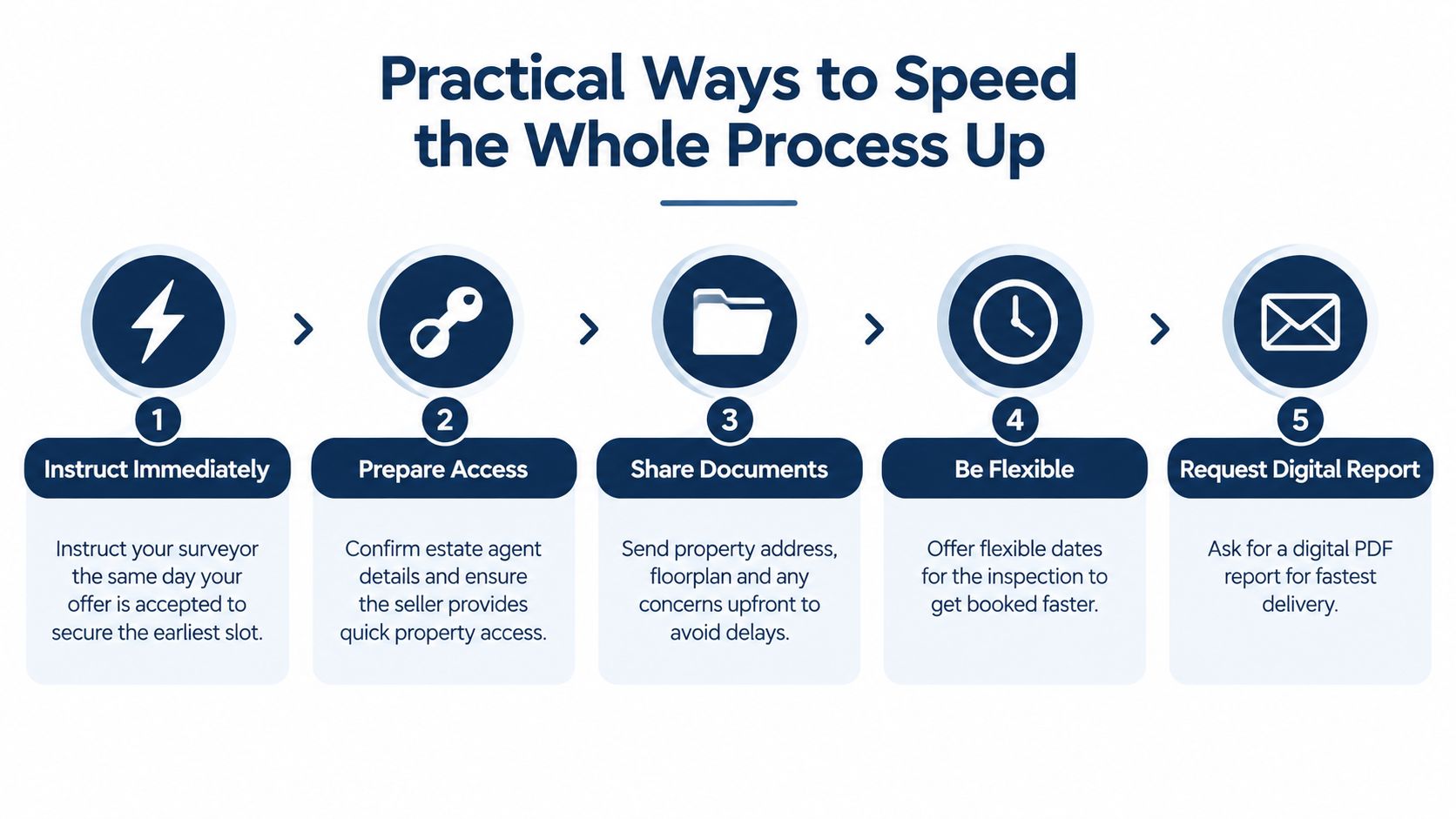
Practical Ways to Speed the Whole Process Up
You control more of the timetable than you might think. Take these steps as soon as the offer is accepted.
Instruct immediately. Contact the surveyor on the same day. You can adjust the appointment later, but you can't recover a diary slot that has already gone.
Confirm access early. Give the surveyor the agent's name and contact details. Ask the agent to confirm that keys, alarm codes and access to the loft, garage and garden will be available.
Send useful documents. Provide the address, floor plan and any previous survey or repair information. Tell the surveyor about known cracking, damp, building works or roof leaks before the visit.
Prepare the property. Ask the seller or agent to clear the loft hatch, consumer unit, boiler cupboard and garage entrance. Stored items against walls can prevent a proper visual inspection.
Offer flexible dates. A buyer who can accept different appointment times is easier to book than someone who has only one narrow slot. Ask for a digital PDF so the report can be delivered without a physical posting delay.
Contact two or three independent firms at the same time if timing is critical. Compare their actual inspection availability and report commitment, not just the headline survey type. A cheap appointment that arrives after your negotiation deadline isn't useful.
Share the chain deadline at the outset. A surveyor can tell you whether the requested timetable is realistic and whether a Level 3 inspection needs more planning.
Key Takeaways and Common Buyer Questions
The practical answer remains 2 to 4 weeks from booking to written report. The surveyor may spend 2 hours to a full day on site, then prepare the written findings over 3 to 7 working days for a Level 2 survey or up to 10 working days for a Level 3 survey, based on the published UK guidance already cited.
The building controls the inspection time. Size, age, alterations and access determine how much can be examined. The surveyor's workload and the complexity of the findings have more influence over the report wait.
Do I need a survey for a new-build flat?
Yes. A new-build flat can contain poor finishes, incomplete work and defects that aren't obvious during a sales viewing. A snagging inspection can identify problems before handover, while a broader survey may be appropriate where the construction, conversion or surrounding building raises concerns.
An NHBC warranty isn't a substitute for independent advice. The warranty provides a route for certain defects and obligations, but it doesn't give you the same independent pre-purchase assessment as a survey.
Can I negotiate after the survey finds defects?
Yes. A report can give you evidence for a price discussion, a request for remedial work or a decision to proceed on different terms. The surveyor shouldn't tell you what price to offer, but the report should identify defects, likely implications and where specialist advice is needed.
Don't use every minor maintenance item as a negotiating weapon. Focus on material defects such as roof failure, significant damp, timber decay, subsidence indicators or unsafe alterations. Your solicitor and estate agent can help with the contractual side of any renegotiation.
Does a mortgage valuation count as a survey?
No. A mortgage valuation protects the lender by assessing whether the property provides suitable security for the loan. It isn't a detailed inspection for the buyer and may not identify defects that a Level 2 or Level 3 survey would report.
Buyers are also using virtual tours to narrow down properties before arranging physical inspections. These Virtual Tour Easy buyer trends are useful for viewing behaviour, but a virtual tour can't replace an inspection of the building.
If you're ready to book, Omev provides access to a UK-wide panel of RICS surveyors and can be reached on 0800 048 8958. For London buyers, compare that option with an independent local practice that understands the difference between a Victorian terrace in Lewisham, a 1930s semi in Bromley and a converted warehouse flat in Bermondsey.
Corinthian Surveyors London LTD provides independent RICS HomeBuyer Surveys, Level 1 Home Condition Surveys and Level 3 Building Surveys across London, the Home Counties and the South of England. Led by Clive Thompson, who holds RICS and CABE qualifications and has over 30 years of built-environment experience, the practice can help you choose the right survey and plan the inspection and report timetable. Visit Corinthian Surveyors London LTD with your property address, type and deadline ready.