
Stamp Duty Changes in 2025: What London Buyers Must Know

You've agreed a price on a London home, lined up your mortgage and started planning the move. Then the Stamp Duty Land Tax figure arrives, and the budget no longer looks as comfortable. That's a familiar problem, especially for buyers whose purchase sits close to a tax threshold.
The stamp duty changes in 2025 are not just a tax-rate issue. Your completion date, first-time buyer status, ownership of other homes and the final agreed price all affect the bill. A survey or valuation can also change the numbers if it gives you sound grounds to renegotiate before exchange.
Table of Contents
- What Changed for London Buyers This Year
- How the 2022 Temporary Thresholds Were Reversed
- The Marginal Rate Bands Explained in Plain Terms
- First-Time Buyer Relief and the £500,000 Cliff Edge
- Higher Rates for Additional Dwellings and the Corporate Rate
- Worked Stamp Duty Calculations for London Prices
- Planning the Transaction Around Stamp Duty Changes
- Frequently Asked Questions About Stamp Duty Changes
What Changed for London Buyers This Year
From 1 April 2025, the standard residential nil-rate threshold in England and Northern Ireland returned to £125,000, after a temporary increase to £250,000. The first-time buyer threshold also returned to £300,000, and relief is unavailable on purchases above £500,000. These rules are set out in the government's current SDLT rates and guidance.
For a standard purchase at £500,000, SDLT is £15,000 under the post-change bands. A qualifying first-time buyer purchasing at the same price pays £10,000 under first-time buyer relief. That difference matters when a buyer is already stretching to cover the deposit, legal costs, survey and moving expenses.
There are four things to check before you decide whether the change affects your purchase:
- The completion date: The rules in force on the transaction's effective date usually determine the tax.
- Your buyer status: First-time buyer relief has strict conditions and a maximum purchase price.
- Other property ownership: An additional home can bring a surcharge on top of standard SDLT.
- The agreed price: SDLT is calculated in bands, and crossing a relief limit can change the calculation sharply.
The distinction between the tax figure and the transaction budget is important. A buyer can calculate SDLT correctly and still be caught out by a delayed completion, a defect uncovered during the survey or a valuation that doesn't support the agreed price.
If your purchase is comfortably within the standard bands, focus on budgeting the correct tax. If it's close to £500,000, involves another property or could complete near a rule-change date, get the position checked by your conveyancer before relying on a headline estimate.
How the 2022 Temporary Thresholds Were Reversed
The temporary thresholds began on 23 September 2022. The standard residential nil-rate threshold rose from £125,000 to £250,000. First-time buyer relief applied up to £425,000, and the maximum property value qualifying for that relief rose from £500,000 to £625,000. Those temporary limits ended on 31 March 2025, as the government explains in its guidance on the temporary SDLT threshold increase.
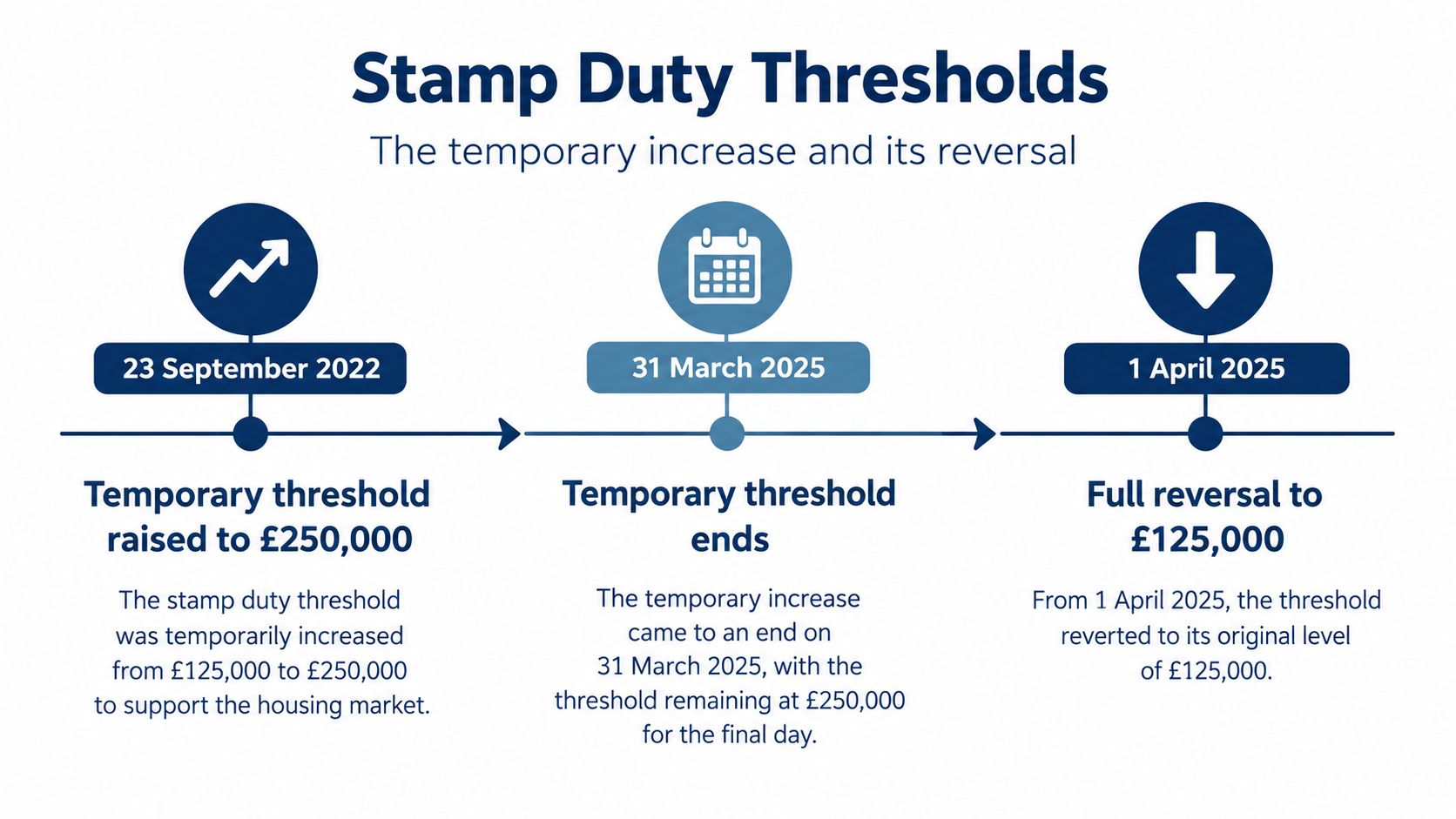
The key date is normally the transaction's effective date, which is usually completion, not exchange of contracts. A buyer who exchanged before the deadline but completed after it could therefore fall under the reverted thresholds, subject to any applicable transitional rules. That's why a chain delay or an outstanding lender requirement can have a tax consequence as well as a practical one.
The rule is straightforward, but the planning risk isn't. Completion dates can move when a chain stalls, a mortgage offer needs attention or conveyancing enquiries remain unresolved. Don't build your budget around an expected completion date if the tax treatment would change when that date slips.
Practical rule: Ask your conveyancer to confirm the effective date and the applicable SDLT position in writing, especially if the transaction is near a tax deadline.
HMRC-based analysis reported total SDLT receipts of £15.2 billion in 2025–26, up £1.3 billion, or 9.2%, from 2024–25 after the nil-rate threshold returned to £125,000. Those receipts reflect prices, transaction volumes and the mix of purchases, including additional properties. They show that the overall tax take rose, but they don't prove that higher SDLT left buyer demand unchanged.
The Marginal Rate Bands Explained in Plain Terms
Standard residential SDLT is marginal. Each rate applies only to the part of the price within its band, not to the whole purchase price. The government's SDLT rates and allowances set out the bands applying from 1 April 2025.
| Standard Residential SDLT Bands from 1 April 2025 | Rate |
|---|---|
| Up to £125,000 | 0% |
| £125,001 to £250,000 | 2% |
| £250,001 to £925,000 | 5% |
| £925,001 to £1.5 million | 10% |
| Above £1.5 million | 12% |
Take a £300,000 purchase. There's no tax on the first £125,000. The next £125,000 is taxed at 2%, and the final £50,000 at 5%, giving a total SDLT bill of £5,000. It would be wrong to apply one rate to the full £300,000.
The £925,000 boundary deserves attention in London. If a property's price moves above that point, the 10% rate applies only to the portion above £925,000. It doesn't retrospectively change the rate on the earlier slices. A price adjustment can therefore affect the SDLT on the relevant portion without changing the treatment of the whole purchase.
Keep the valuation and tax calculation separate
A valuation should state the property's market value, while the buyer's acquisition budget should show SDLT and other purchase costs separately. Record the assumed completion date and ownership status too, since they can affect which rules apply.
That distinction is useful when a lender's valuation differs from the agreed price or a survey uncovers defects. A surveyor can report on condition and value; a conveyancer or tax professional should confirm the SDLT calculation.
First-Time Buyer Relief and the £500,000 Cliff Edge
After 1 April 2025, a qualifying first-time buyer pays no SDLT on the first £300,000 of a purchase. The buyer pays 5% on the portion from £300,001 to £500,000. If the price exceeds £500,000, first-time buyer relief is lost and standard residential rates apply to the whole price. The government's first-time buyer SDLT rate table also shows the previous temporary limits, which applied through 31 March 2025.
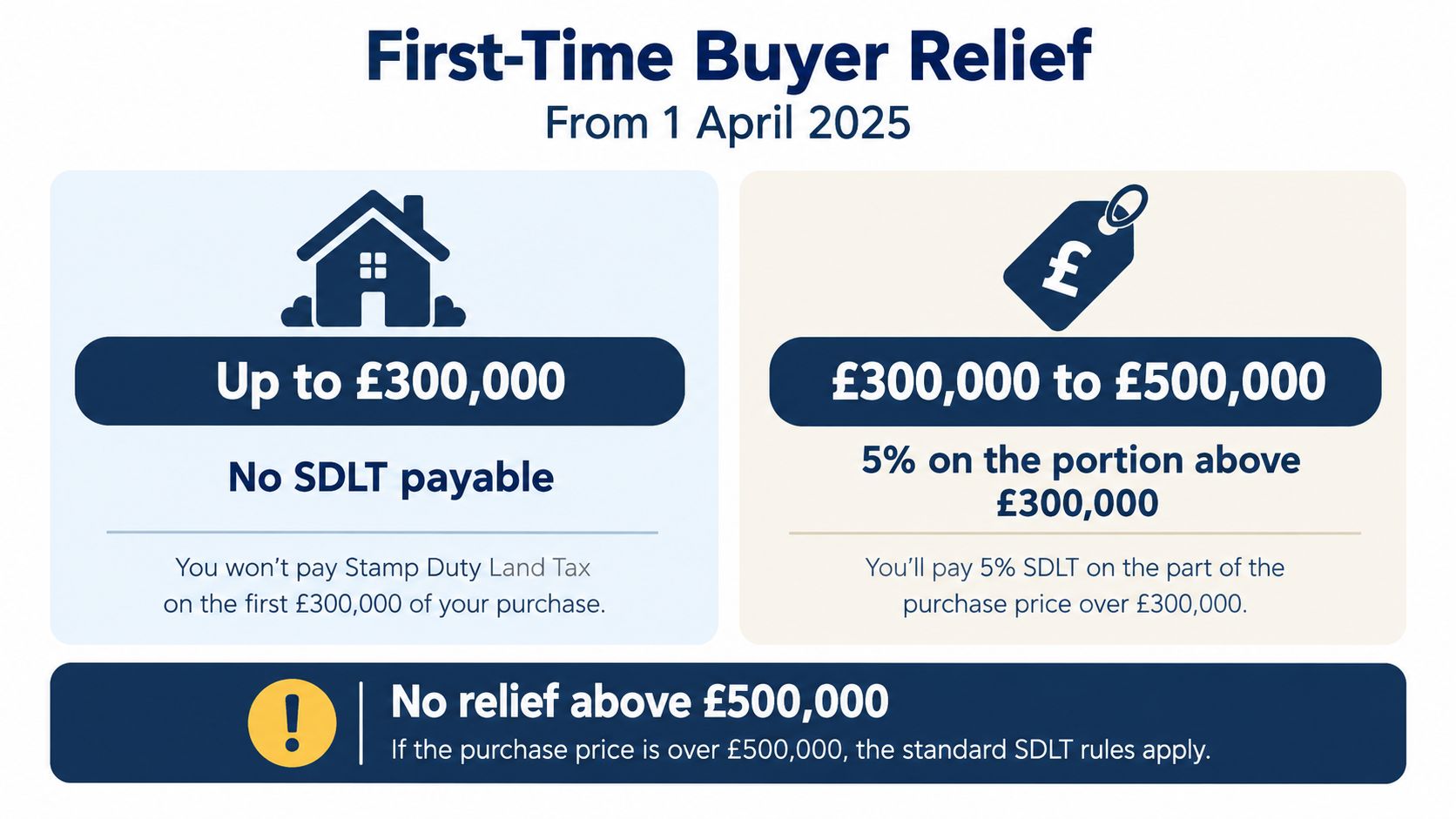
A £499,000 purchase gives a qualifying buyer relief on the first £300,000, with 5% charged on the remaining £199,000. That produces SDLT of £9,950. At £501,000, relief no longer applies, so standard rates are charged across the whole purchase price. The standard calculation produces SDLT of £15,050.
The £2,000 difference in price produces a £5,100 difference in SDLT between those examples. That's the point buyers near the limit need to understand: a small price increase can remove relief altogether, rather than adding a little tax on the extra amount.
The practical move is to model both prices before making an offer. If a survey finds significant defects, evidence of those defects may support a price discussion before exchange. A lower price isn't guaranteed, and tax advice should come from your conveyancer or tax adviser, but the buyer should understand the potential tax consequence before negotiating.
For a fuller explanation of the eligibility rules and purchase preparation, see this first-time buyer guidance. Don't assume that being a first-time buyer automatically secures relief. Your conveyancer should confirm that you meet the conditions.
Higher Rates for Additional Dwellings and the Corporate Rate
The Higher Rates for Additional Dwellings surcharge increased from 3% to 5% for transactions with an effective date on or after 31 October 2024. It generally affects buyers acquiring an additional residential property, including second homes and buy-to-let properties, as well as companies purchasing residential property under the relevant rules. The government sets out the change and transitional provisions in its guidance on higher rates for additional dwellings.
The surcharge is added to the standard residential rates. It is not the same as the separate corporate flat-rate rule. For an additional dwelling under the surcharge, the bands are 5% on the first £125,000, 7% from £125,001 to £250,000, 10% from £250,001 to £925,000, 15% from £925,001 to £1.5 million and 17% above £1.5 million.
Companies and other non-natural persons can face a 17% single rate when buying a dwelling costing more than £500,000, where the relevant corporate SDLT provisions apply. That's a distinct treatment from applying the additional-dwelling surcharge to the graduated residential bands. Buyers should ask their conveyancer which rule applies to their ownership structure and transaction.
Check the effective date and contract history
The effective date is usually completion. Transitional rules may apply where a contract was exchanged on or before 30 October 2024 but completed or was substantially performed later. A buyer in that position should have the conveyancer check the contract history rather than assume the newer surcharge applies automatically.
Sellers should also understand the buyer's SDLT position. A buyer paying an additional-property surcharge has a different acquisition budget from a buyer purchasing a main home. That can affect what the buyer can afford and how strong their offer is, even though the seller isn't responsible for the buyer's tax bill.
Worked Stamp Duty Calculations for London Prices
Calculations are easier to compare when the buyer's status is clear. The examples below use the post-change rules and assume no additional reliefs or surcharges unless stated.
| Purchase | Calculation | SDLT |
|---|---|---|
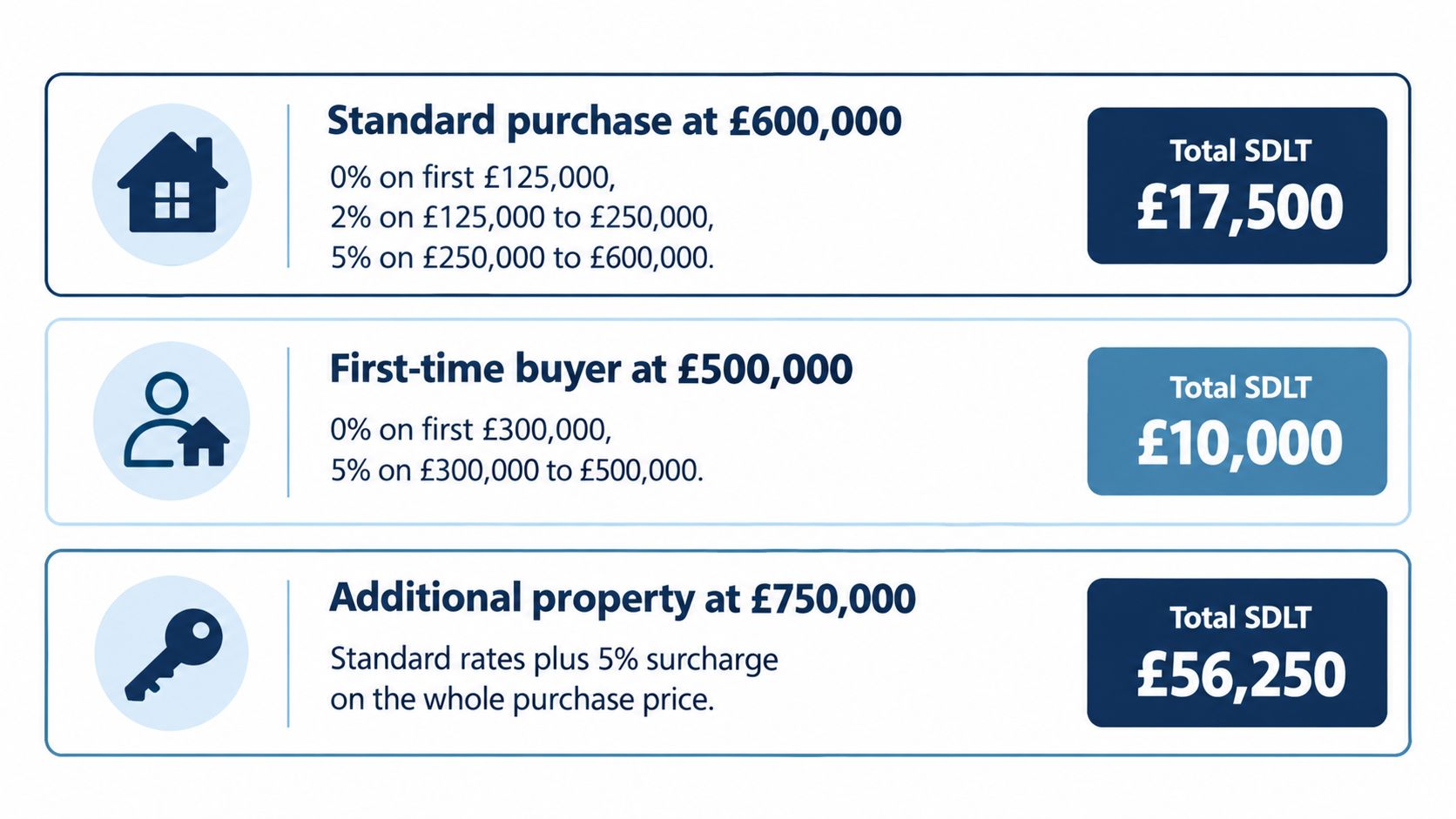
| Standard purchase at £500,000 | 2% on £125,000, then 5% on £250,000 | £15,000 |
| Qualifying first-time buyer at £500,000 | 0% on the first £300,000, then 5% on £200,000 | £10,000 |
| Standard purchase at £600,000 | 2% on £125,000, then 5% on £350,000 | £20,000 |
For the £600,000 standard purchase, the first £125,000 is taxed at 0%, the next £125,000 at 2%, and the remaining £350,000 at 5%. That gives £20,000. If the buyer purchases an additional dwelling at the same price and the 5% surcharge applies, the bill becomes £50,000.
A standard purchase at £1,200,000 gives another useful check: 2% applies to the £125,000 slice between £125,001 and £250,000, 5% to the £675,000 slice up to £925,000 and 10% to the £275,000 above that. The total is £70,000 before any reliefs or surcharges.
The examples are templates, not a substitute for checking eligibility. A buyer's status, transaction date and ownership of other properties can change the result. For an independent view of the property's condition and evidence about its value, start with a guide to checking a property's value, then have the conveyancer confirm the tax calculation.
Planning the Transaction Around Stamp Duty Changes

Treat SDLT as one part of the completion-risk budget, not as a figure to check after the offer is accepted. A chain can be delayed, mortgage arrangements may need attention and survey findings can change the price being negotiated. Each can affect whether the buyer completes on time and what the final acquisition cost looks like.
Before exchange, keep four figures and decisions visible:
- The tax estimate: Ask the conveyancer to calculate SDLT using your completion date and ownership position.
- The valuation evidence: Check whether the agreed price is supported by the property's condition and market evidence.
- The survey findings: For a Victorian terrace in Lewisham, for example, pay attention to roof condition, damp, timber decay and signs of movement.
- The chain and mortgage position: Don't rely on an assumed completion date if other parts of the transaction remain unresolved.
A survey is useful here for a practical reason. If a RICS Homebuyer Survey or RICS Building Survey identifies defects before exchange, the buyer can decide whether to proceed, seek further investigation or discuss the price with the seller. Where a first-time buyer is near a tax threshold, a negotiated price below the boundary may be worth more than the same reduction above it.
For a checklist of physical and legal matters to investigate before committing, use this guide to what to check when buying a house. If part of the deposit is being given by family, make sure the lender's required gift letter documentation for lenders is prepared early, rather than leaving it until the transaction is ready to complete.
The video below provides another overview of the purchase process. Use it as background, then ask your conveyancer to confirm the SDLT treatment for your own transaction.
A surveyor can assess condition and provide valuation evidence. A surveyor shouldn't replace a conveyancer or tax adviser on SDLT eligibility, relief claims or the legal effect of a contract. Keep those responsibilities clear, and you'll have a more reliable budget before exchange.
Frequently Asked Questions About Stamp Duty Changes
Does the 2025 threshold change affect a purchase already in progress?
The transaction's effective date, normally completion, generally determines which rules apply. If completion was near the changeover, ask your conveyancer to confirm the date and any relevant transitional provisions.
What if exchange happened before the deadline but completion came later?
Don't assume exchange alone fixed the tax treatment. The conveyancer should review the contract date, effective date and any transitional rules that apply to the particular transaction.
What evidence is needed for first-time buyer relief?
Your conveyancer will check that all purchasers meet the eligibility conditions and will handle the SDLT return. Tell them about any previous ownership of residential property, including ownership outside the UK, and get advice if your circumstances aren't straightforward.
Can a surveyor advise on SDLT?
A surveyor can report on defects and provide valuation evidence that may inform a price negotiation. A conveyancer or tax adviser should confirm the SDLT calculation and whether relief applies. For survey advice in London, call 0800 00 16 422 before you commit.
Corinthian Surveyors London LTD provides RICS Homebuyer Surveys, RICS Building Surveys and residential valuations across London, with independent advice and no ties to lenders or estate agents. If survey findings or valuation evidence could affect your offer and SDLT budget, speak with the practice on 0800 00 16 422 or visit Corinthian Surveyors London LTD.