
Homebuyer Survey Comparison: RICS Levels 1, 2 and 3
You've found the flat you want. The seller wants an answer. Your solicitor wants an instruction. And you're staring at three survey options, each one looking like a compromise if you don't know what matters.
Don't choose by fee alone. Choose by property risk. That means age, alterations, construction type, location and the chance of hidden defects, not the cheapest report on the page. A good guide if you're weighing the knock-on effects of a poor decision is Stewart Accounting Services tax guidance, because the actual cost of buying badly rarely stops at the survey fee.
| RICS survey level | Typical property | Inspection depth | Reporting style | Best for |
|---|---|---|---|---|
| Level 1 | Straightforward modern homes in apparent good order | Basic visual snapshot | Short condition summary | Simple purchases where you only need a broad check |
| Level 2 | Conventional houses, flats or bungalows in reasonable condition | More detailed visual inspection | Condition ratings with advice, survey-only or with valuation | Standard homes where you want sensible protection without overbuying detail |
| Level 3 | Older, altered, unusual or higher-risk buildings | Deep inspection with fuller analysis | Detailed technical report | Period property, conversions, listed buildings and anything with obvious uncertainty |
Table of Contents
- Why the Survey Decision Matters Before You Commit
- The Three RICS Survey Levels Side by Side
- What the National Housing Data Says About Defect Risk
- When a Cheaper Survey Can Cost You More
- Matching Survey Level to London Property Type
- Reading a HomeBuyer Report and Using the Findings
- Survey Costs and What You Are Paying For
- Choosing the Right Survey for Your Purchase
Why the Survey Decision Matters Before You Commit
The seller wants an answer, your solicitor is ready to instruct, and the survey options look like competing compromises. Start with the building's risk. Ask what could remain hidden until after exchange, when repair costs become your responsibility.
That question matters because a survey should identify material defects early and guide further investigation. In Lewisham, Bromley, Southwark and other areas with older housing, the property's construction and condition deserve more attention than polished brochure language. A bright, recently decorated home may still have a tired roof, poor alterations, damp or defective drainage.
A useful guide to the wider financial consequences of a poor purchase is Stewart Accounting Services tax guidance. The survey fee is only one part of the cost if defects appear later.
Practical rule: choose the deeper report where the building could be expensive to repair. Keep the scope tighter only when the property is conventional, accessible and appears sound.
The cheapest inspection can produce the most expensive outcome if it fails to prompt proper follow-up. A survey comparison should weigh the likely defect risk of the building first, with the asking price as a secondary factor.
Focus on the property's exposure to problems: older construction, alterations with uncertain approval, hidden areas, flood or water risk, communal parts and non-standard work. Several of these risks together justify moving up a survey level. A straightforward home in visible good order may support a lighter inspection, provided the surveyor can properly access the relevant areas.
The Three RICS Survey Levels Side by Side
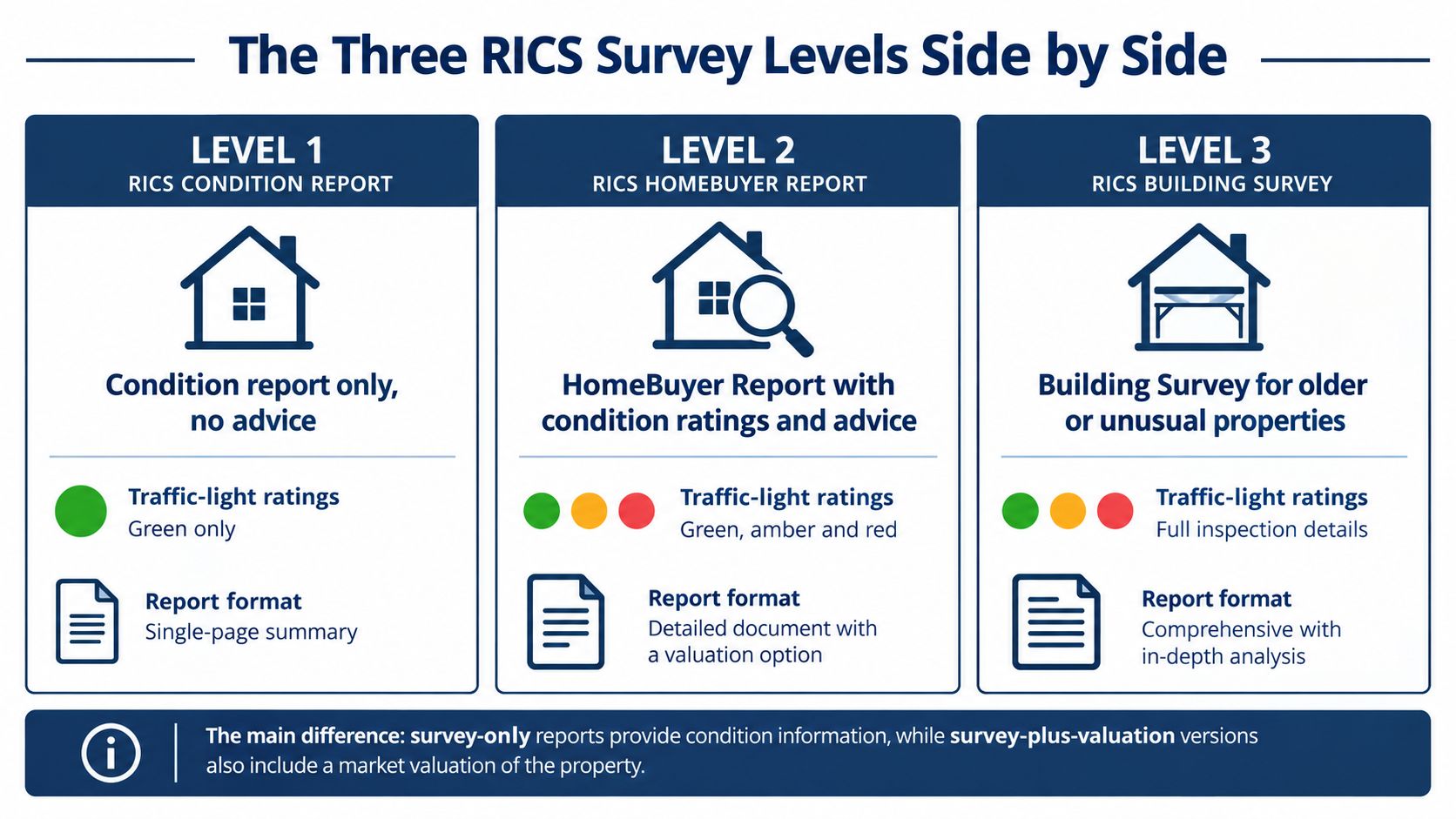
The important thing is not the label. It's the level of professional opinion you're buying, and how much of the building the surveyor is looking at.
| RICS survey levels at a glance | |||
|---|---|---|---|
| Level | Typical property | Report format | Best for |
| Level 1 | Modern, simple, apparently low-risk homes | Short condition report, green-style summary only | A basic snapshot where you mainly want reassurance |
| Level 2 survey only | Conventional houses, flats and bungalows in reasonable condition | Standardised report with traffic-light ratings and advice | Most standard purchases where you need visible defects flagged |
| Level 2 survey and valuation | The same kind of property, but where you want valuation included | Survey plus market value and reinstatement-cost style output | Buyers who want both condition and valuation in one instruction |
| Level 3 | Older, altered, unusual or potentially troubled buildings | Fuller technical report with deeper analysis | Period homes, conversions and properties with known or suspected defects |
The level label is only the starting point. What you are really paying for is the inspection scope, the reporting depth and whether the surveyor tells you to investigate further.
RICS set the consistency baseline through the Home Survey Standard, first published in 2019 and effective from 1 March 2021. That matters because the same level should mean the same kind of service in principle, even though the actual value still depends on how the surveyor inspects the building and how clearly they write it up. RICS also recognises Level 1, Level 2 survey only and Level 2 survey and valuation as the principal home-survey levels RICS Home Survey Standard.
If you want a plain-English summary of the middle option, this Level 2 survey guide is a useful reference point. It is the sort of report most buyers start with, but only if the property is conventional.
What the levels really buy you
Level 1 gives you the lightest touch. It is a condition snapshot, not a deep opinion.
Level 2 gives you a proper visual inspection of visible parts and accessible areas, with advice on defects and maintenance.
Level 3 goes further again. It is the choice when a simple check would be false economy, especially on older London stock with hidden unknowns.
What the National Housing Data Says About Defect Risk
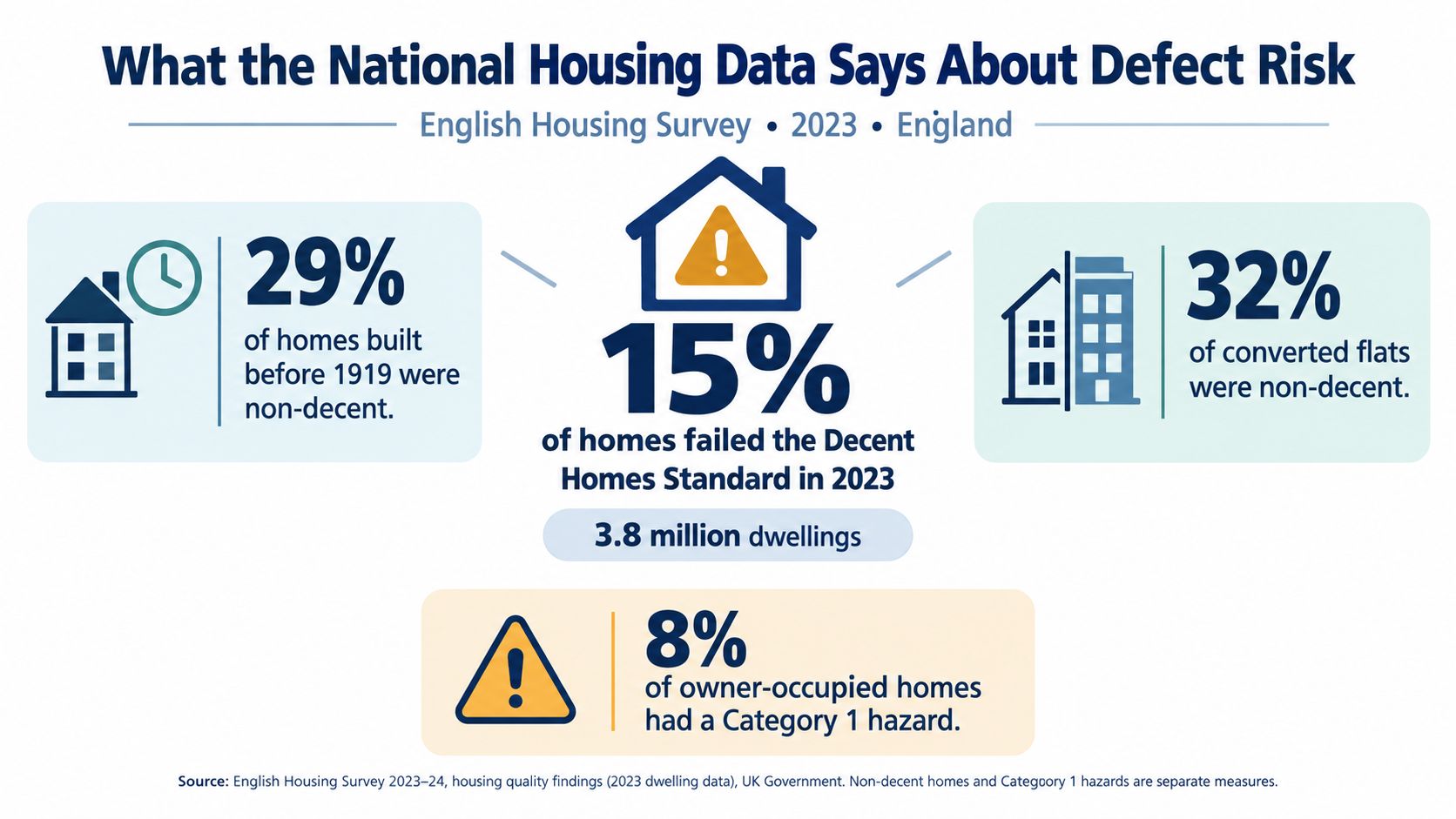
Start with the building's risk, not its age label. National housing data shows why a quick visual report can leave buyers exposed where defects are concentrated. In 2023, about 3.8 million dwellings, 15% of the housing stock, failed the Decent Homes Standard, while around 2 million dwellings, 8%, contained a serious Category 1 hazard under the Housing Health and Safety Rating System English Housing Survey 2023 to 2024.
The same survey recorded poor windows in 1.8 million dwellings, noise problems in 1.6 million, bathroom problems in 1.3 million, and poor external doors in 1.1 million. These are ordinary building defects, but they can involve substantial repair, disruption or investigation, particularly in older or altered homes.
Age and property type sharpen the warning. Homes built before 1919 had a 29% non-decent rate, compared with 14% of occupied homes overall. Converted flats recorded a 32% non-decent rate. For a buyer, those figures make a Victorian terrace in Peckham or a converted flat in Bermondsey a higher-risk proposition than a clean-looking modern flat in a new block.
Flood exposure, older construction, hidden alterations and communal repair obligations can matter more than the property's apparent condition. That is the basis for comparing survey levels: assess the likely defect risk first, then choose the inspection depth that can address it.
When a Cheaper Survey Can Cost You More
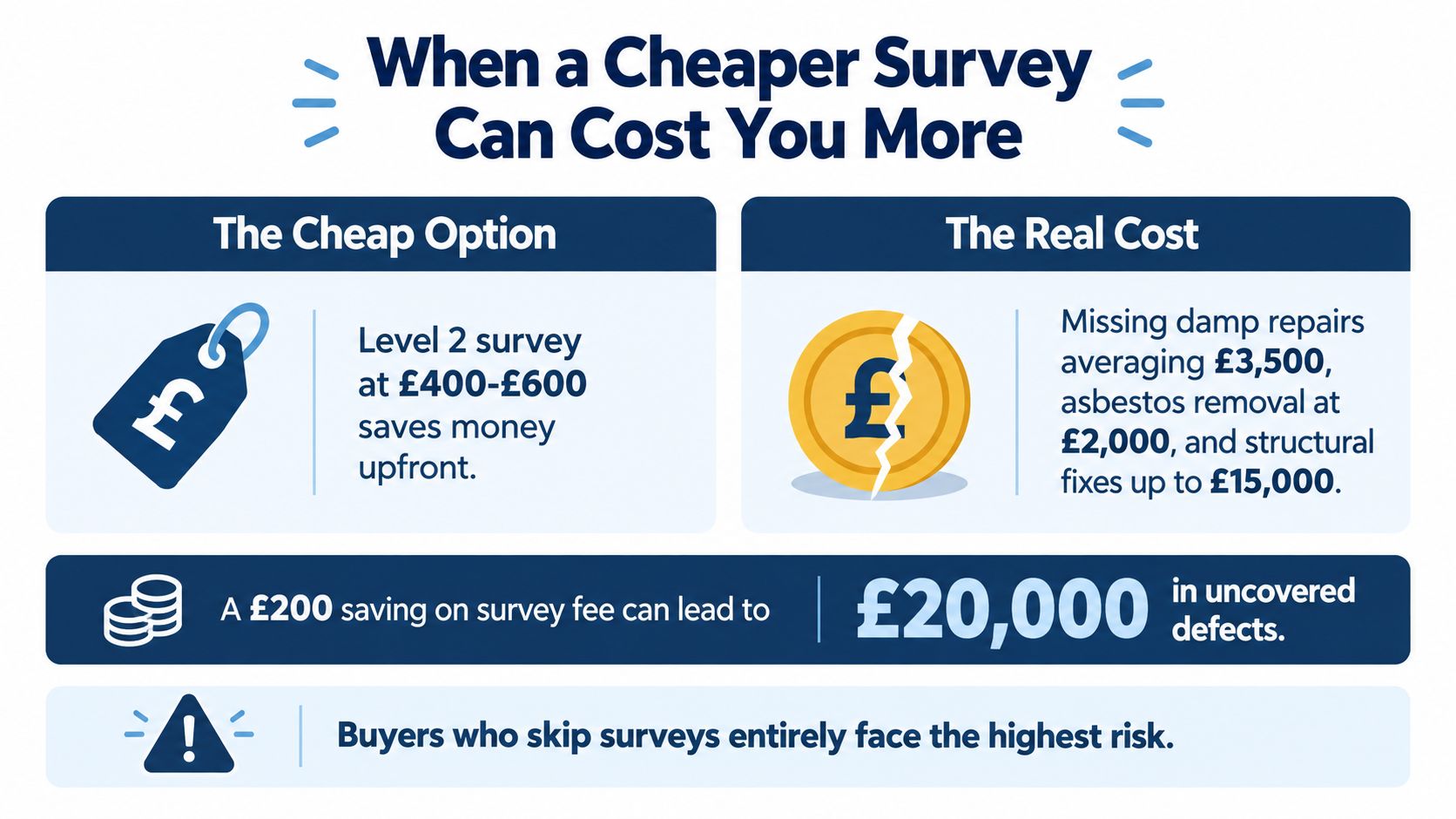
A low fee does not make a survey good value if it misses the defect that blows up your budget. Buyers who skipped a survey most often missed damp at 22%, asbestos at 18% and missing building-regulation approval for alterations or extensions at 12% IFA Magazine evidence, January 2025. Those are not small snags. They are the kind of problems that force renegotiation, slow the purchase, or land on your lap after completion.
The repair bills are the warning. The same source puts average damp treatment at about £2,750 and asbestos treatment at roughly £1,750 per square metre. A survey fee is small beside that kind of outlay.
Flood risk raises the stakes again. The Law Society says the Environment Agency's 2024 national assessment identifies 6.3 million homes and businesses in England at risk from river, coastal or surface-water flooding, with that figure projected to reach 8 million by 2050, while UK Finance separately says about 4.6 million English properties are at risk from surface-water flooding Law Society climate change and property practice note. That does not mean every property needs the same report. It means the buyer should expect the survey to flag drainage, flood history and any structural follow-up where the location demands it.
A cheaper survey that fails to trigger the next question can be the most expensive instruction you ever make.
Weigh the fee against the cost of the defect it might miss, and the right level usually picks itself.
Matching Survey Level to London Property Type
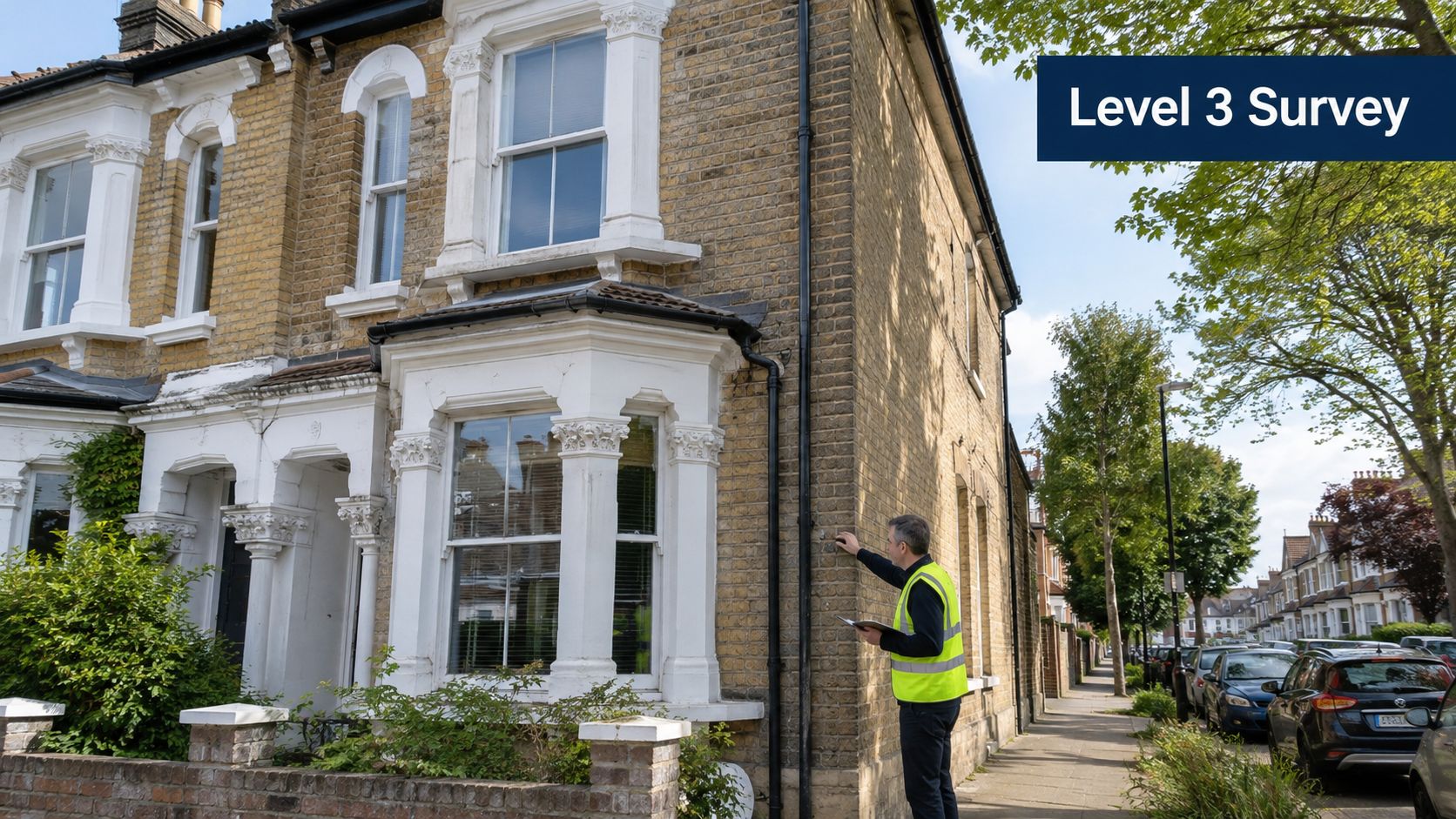
A Victorian semi in Lewisham, a 1930s terrace in Bromley, and a warehouse conversion flat in Bermondsey carry different risks. Choose the survey around the defects and unknowns the property could contain, rather than relying on age alone.
A Victorian semi with original joinery, patchy alterations, chimney breast work and party-wall sensitivities warrants Level 3. Ask for detailed reporting on movement, damp, roof structure, timber and signs of poorly executed previous work. This Level 3 survey guide explains why older or altered homes need closer inspection.
A 1930s terrace in Bromley may suit a Level 2 survey and valuation if its construction is standard, its condition appears sound and it has already been modernised. The report should identify visible defects, record maintenance concerns and provide a market valuation within the same instruction. That is a sensible balance for a conventional house, provided there are no signs of movement, damp, unauthorised alterations or extension work.
A warehouse conversion in Bermondsey needs a different question. The main risk may sit in the leasehold and communal arrangements, not the visible structure. Service charges, shared systems, fire precautions, conversion approvals and hidden alteration history can all affect the purchase. Start with Level 2 survey only when the flat and paperwork appear straightforward, then require targeted follow-up if the report identifies communal, structural or conversion uncertainty.
For conversion flats specifically, ask the surveyor to confirm what the report covers on communal systems before you instruct. In London, the right level is often driven by conversion risk, not just age.
Reading a HomeBuyer Report and Using the Findings
Start with the page that identifies what needs attention now. Deal with the biggest issue first, then work through routine maintenance. A Level 2 report helps separate significant defects from ordinary upkeep, so use its findings to test whether the property remains a sound purchase.
The traffic-light ratings guide your next move:
- Read the headline issues first. They show where the main risk sits.
- Separate maintenance from defect. A tired finish calls for upkeep; a failing roof demands investigation and possible repair.
- Treat red items as a trigger. Arrange further checks before you commit.
- Use amber items to renegotiate. They may support a price reduction, repair request or allowance for works.
Use the report as a decision tool, not a comfort blanket. A green rating means no urgent action was identified. Amber indicates a defect requiring monitoring, repair or further consideration. Red signals serious concern or a need for investigation before exchange.
A standardised HomeBuyer report is designed to flag significant defects, not every minor imperfection. Treat the report as a defect screen: it exists to stop you buying into a bigger problem than you thought.
Property risk, rather than age alone, should guide your response. In London, flood exposure, conversion uncertainty, older construction and previous alterations can make a seemingly acceptable finding more significant. Read each comment in the context of the building and its history.
If the report flags structural movement, damp, timber decay or electrical uncertainty, appoint the right specialist before exchange. Use a structural engineer, damp and timber specialist or electrician as appropriate. Confirm the diagnosis, likely scope of work and practical consequences before committing, rather than discovering the problem after moving in.
Survey Costs and What You Are Paying For
A survey fee is small beside a serious repair bill, but price alone is a poor selection method. Ask what the inspection covers, how much uncertainty the building carries and whether the report gives you enough evidence to renegotiate or walk away. London conversions, older construction and flood-exposed homes deserve more scrutiny than a standard, modern property.
| Survey fees against likely defect costs | Typical cost |
|---|---|
| Level 1 survey | Typically £300–£400 for a straightforward property, subject to a property-specific quote |
| Level 2 survey | Typically £400–£600 for a standard London house, subject to a property-specific quote |
| Level 3 survey | Typically £600–£1,000 or more for an older, altered or complex property, subject to a property-specific quote |
| Damp treatment | About £2,750, as reported in the IFA Magazine evidence, January 2025 |
| Asbestos treatment | About £1,750 per square metre, as reported in the IFA Magazine evidence, January 2025 |
These fee bands are examples, not fixed tariffs. Size, access, construction, location and the surveyor's scope can change the quote. A Level 1 survey keeps the cost down but offers limited detail. Level 2 gives a broader condition assessment for conventional homes. Level 3 costs more because it requires closer examination and more detailed judgement.
A lender's valuation serves the lender's lending decision. It does not give you the same buying protection as a survey. The landlord inspection guide illustrates why an inspection checklist must match its purpose. A landlord's check and a buyer's building assessment answer different questions.
For a closer explanation of fee structures, read this Level 2 survey cost guide before requesting quotes. Compare like with like, then choose the level that matches the property risk, not the lowest figure on the page.
Choosing the Right Survey for Your Purchase
Ask yourself three things. How old and altered is the property. What is the local risk profile, including flood and subsidence concerns. How much uncertainty can you tolerate before exchange.
If the answer is “modern, standard and low-risk”, Level 1 can be enough for a basic condition snapshot. If it is a conventional home and you already have valuation cover elsewhere, Level 2 survey only is the practical choice. If you want condition and valuation together, choose Level 2 survey and valuation.
If the property is older, altered, listed or non-standard, choose Level 3. If you want detailed repair advice rather than just a condition tick-box, choose Level 3. If you are unsure, err on the side of more information, especially on London stock where the hidden problems are often in the fabric, not the sale particulars.
A useful way to think about timing is the buyer's inspection window. The inspection contingency timeline and negotiation guide mirrors the same logic, get the facts first, then negotiate with them. That is the whole game.
Independent RICS surveyors are the right people for this decision, because they're there to test the building, not to please the lender or the agent. In London, Corinthian Surveyors London LTD handles that sort of choice every day, and a per-property quote is the only sensible way to price it properly. Call 0800 00 16 422 if you want the level matched to the building rather than guessed from the asking price.
If you want a clear recommendation on your own purchase, Corinthian Surveyors London LTD can assess the property, explain which RICS level fits and tell you what it does and doesn't cover. Visit Corinthian Surveyors London LTD for independent residential surveying and valuation advice across London and surrounding areas.