
Getting Home Ready to Sell: A London Seller’s Guide

Staged homes in the UK sell in roughly half the time, around 24 days compared with 69 for unstaged properties, and can achieve 8% to 10% more. That depends on fixing the right things first, not just filling the house with attractive furniture.
You may be at the point where the estate agent has taken a quick look, suggested decluttering and asked whether the spare room can be made to look more useful. That advice has value, but it only deals with what buyers see. Buyers, conveyancers and lenders also want evidence about the property's condition, energy performance and history.
Getting home ready to sell in London means managing both sides. Present the house properly, then deal with damp, roof defects, movement, paperwork and known repairs before they become reasons for a buyer to renegotiate.
Table of Contents
- What It Costs to Get Your Home Ready to Sell
- Energy Performance and Market Value
- A Practical Staging Sequence for London Homes
- Fixing Defects or Disclosing Them
- Why a Pre-Sale Survey Protects Your Profit
- Final Administrative Steps Before Listing
What It Costs to Get Your Home Ready to Sell
A well-presented property may attract the viewing, but buyers still test the condition and paperwork. UK staging figures commonly place staged homes at about 24 days on the market, compared with 69 days for an unstaged property. Other UK reporting gives a wider range of roughly 24 to 41 days for staged homes and 69 to 99 days for unstaged homes, alongside an 8% to 10% higher sale price for staged properties (UK home-staging statistics).
Use those figures as a reason to present the property properly, not as permission to hide problems. A clean, bright Victorian terrace in Forest Hill can still attract difficult questions if the rear roof slope shows staining or a survey reveals movement around a bay window. An immaculate flat in Bermondsey can still lose momentum if you cannot produce information about alterations, leases or previous remedial work.
Getting home ready to sell requires two jobs at once: make the house easy to view, then establish the condition and evidence buyers will demand.
Spend in the right order
Start outside. Clean the windows, clear the entrance, repaint a tired front door and make sure the house number is visible. For practical ideas on improving the approach to your property, use this curb appeal guide for homeowners.
Work through the interior in this order:
- Remove excess furniture: Buyers need to understand each room's proportions. Oversized sofas and crowded hallways make London homes feel smaller.
- Give every room a clear function: A box room used for storage should read as a bedroom, office or useful storage space. Do not leave the buyer to interpret it.
- Repair visible minor defects: Tighten loose handles, replace failed bulbs, stop dripping taps and renew cracked sealant.
- Use neutral presentation: You are making the property easy for a broad range of buyers to understand online, not redecorating for your own taste.
- Photograph after the work: Professional photography should show the finished property, not the version you plan to create.
A typical UK staging budget is reported at around 1% of property value, while reported costs range from £200 to £5,000 or more, depending on whether the work is partial, DIY or fully professional (UK staging cost guidance). Establish the defects before committing that money. A pre-sale inspection can show whether the priority is paint, roof repairs or technical investigation. This guide to building survey costs in London explains why property type and inspection scope affect the choice.
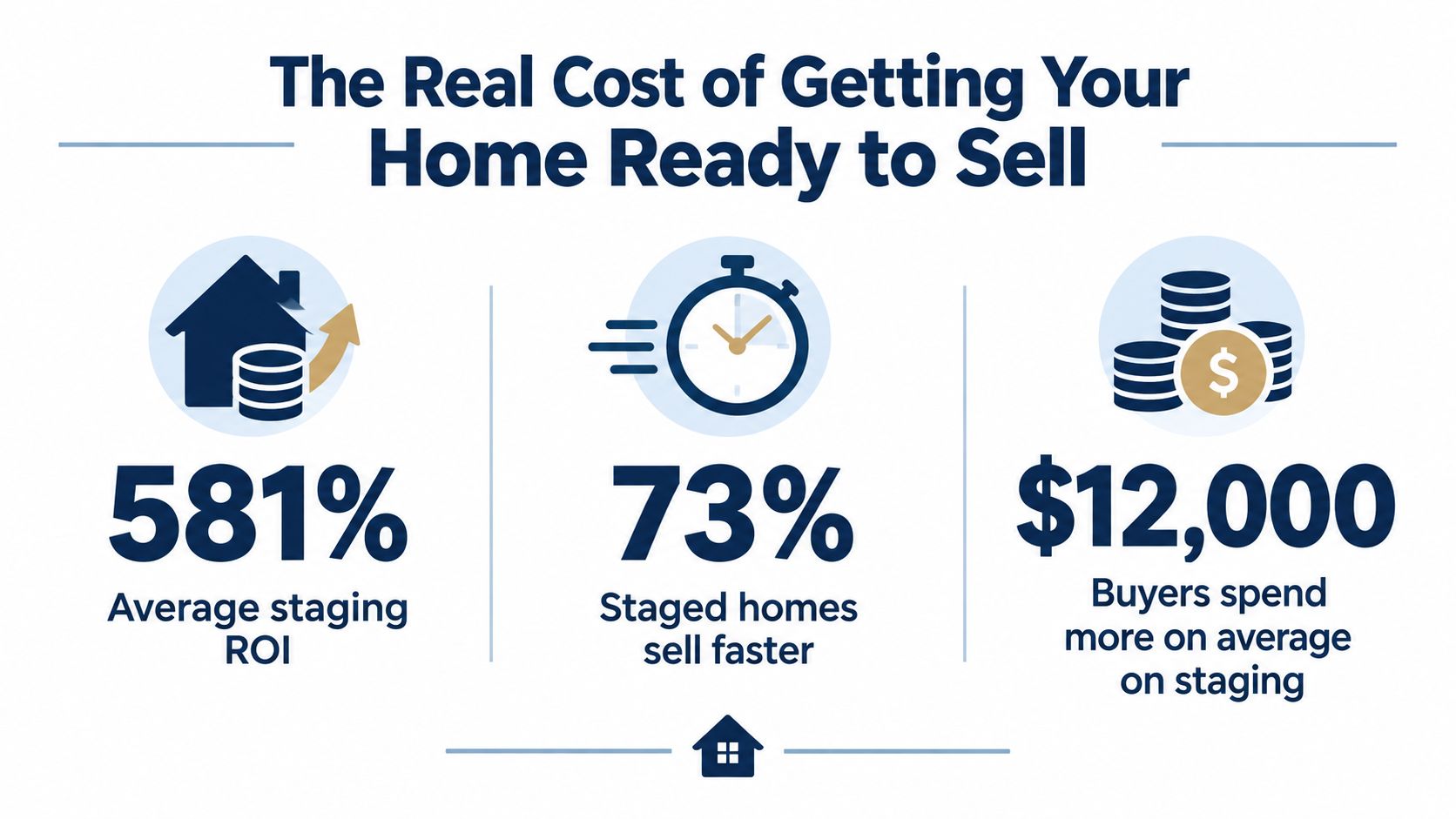
Presentation may bring the buyer through the door. Condition and evidence protect the agreed price, so a pre-sale survey is often the smarter investment than spending first on cosmetic work.
Energy Performance and Market Value
An EPC is a legal requirement before a home is marketed for sale in England and Wales. There isn't a minimum EPC rating required to sell, but that doesn't mean the rating is irrelevant. Buyers see the certificate as an indication of likely running costs and the condition of the building's thermal performance.
University of Cambridge research found that, compared with homes rated EPC G, properties rated F or E sold for about 6% more, those rated D for 8% more, those rated C for 10% more and those rated A or B for 14% more (University of Cambridge research on energy efficiency and property values). These figures don't mean every improvement will return its cost. They show that energy performance can influence what buyers are prepared to pay.
A separate UK analysis found that the share of houses for sale with an EPC rating of A to C rose from 30% in 2019 to 36% in 2023 (UK energy-efficient homes analysis). Sellers should read that as a change in buyer expectations, not as a reason to undertake a wholesale refurbishment.
Improve the evidence before the works
Check the current EPC first. If it has expired, arrange a new assessment. Rightmove states that a valid EPC must be provided to the estate agent within one week of listing (Rightmove guidance on selling a property). Treat that as a deadline in your launch plan.
Prioritise improvements that are proportionate to the property:
- Draught-proofing: Deal with obvious gaps around doors and windows where practical.
- Insulation: Check whether accessible loft or other suitable insulation work is missing.
- Boiler information: Keep service records and installation documents together.
- Heating controls: Make sure thermostats and controls work and are easy to understand.
- Windows and ventilation: Repair damaged seals or obvious defects, but don't replace sound windows to chase a higher rating.
A low EPC rating may reflect the age and construction of a house. Victorian properties in Lewisham, Brockley and Sydenham often need a more careful approach than a modern flat. Covering original ventilation or using unsuitable materials can create damp and condensation problems. The aim is to improve performance without damaging the building.
For sellers who need to understand what a property inspection can and can't establish, this energy performance survey guide provides useful context. An EPC is not a structural survey. It won't tell you that a roof is failing, that a chimney breast removal needs evidence or that a crack requires a structural engineer's opinion.
A Practical Staging Sequence for London Homes
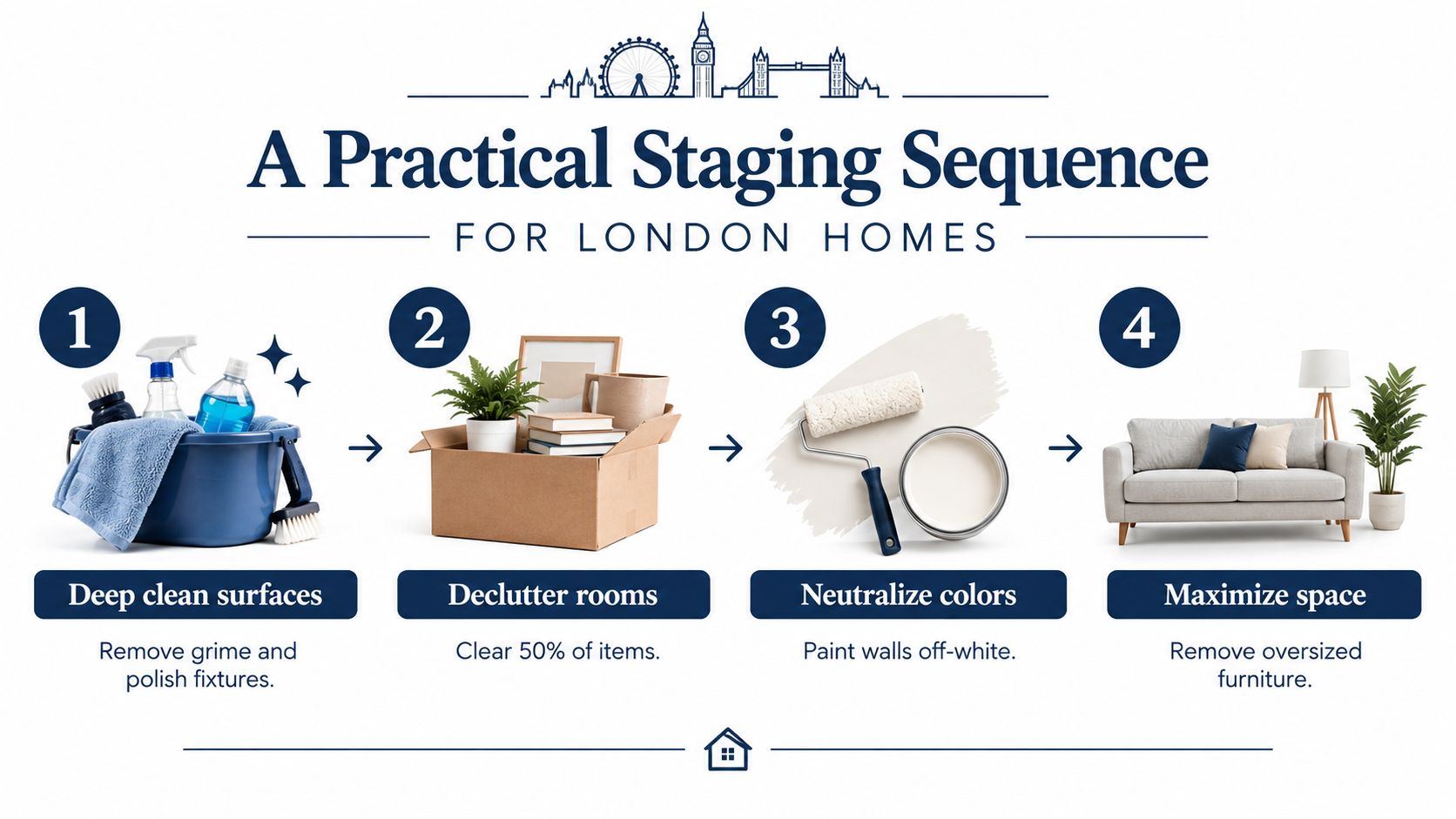
Use a fixed sequence. It stops you spending money twice and prevents the common mistake of listing before the property is ready.
Start with the defects buyers notice first
Walk through the property with a notebook. Look at the front path, entrance, windows, ceilings, walls, floors, kitchen and bathroom. Write down what a buyer will notice within the first few minutes, then separate cosmetic work from matters that need professional advice.
In a Victorian terrace in Catford, that might mean repairing damaged plaster around a chimney breast and cleaning roof-level staining before repainting. In a 1930s semi in Bromley, it might mean dealing with failed sealant, a leaking gutter or a tired front path. Don't hide a problem behind fresh paint.
The recommended order is:
- Pre-inspection: Identify cosmetic defects and anything that might indicate a deeper issue.
- Minor repairs: Complete straightforward work with a clear benefit, such as fixing handles, doors, taps and damaged finishes.
- Deep cleaning: Clean windows, floors, kitchens, bathrooms and light fittings. Remove odours at their source.
- Decluttering: UK staging guidance commonly recommends removing around 30% to 50% of excess belongings before listing (HomeOwners Alliance staging guidance).
- Room definition: Give each room one obvious purpose and use furniture that shows circulation and scale.
- Photography: Take professional photographs only after cleaning, repairs and staging are complete.
Don't stage over evidence
A staged room should help the buyer understand the space. It shouldn't conceal a damp mark, block access to a consumer unit or make a loft hatch impossible to inspect. Keep guarantees, invoices and certificates organised so the presentation matches the property's actual condition.
If a room is empty, limited furniture can show its likely use. If you're considering virtual staging for listing images, this guide to staging a room for agents explains the basic approach. Virtual furniture must never misrepresent the size, layout or condition of the property.
This video provides another visual reminder of the staging sequence. Use it as a prompt, not as a replacement for inspecting the building.
The final check should happen before the photographer arrives. Open cupboards, test windows, inspect ceilings and look behind furniture. A buyer's surveyor will do much the same, with greater technical focus.
Fixing Defects or Disclosing Them
You don't need to refurbish every part of a property before selling. You do need to understand what is wrong, decide what deserves attention and disclose known material information properly.
That distinction matters. Buyers can face post-move repair bills of £5,000 to £15,000 for immediate works, rising to £10,000 to £25,000 or more where larger defects such as roof problems, rewiring or damp have been missed (UK guidance on defects and disclosure). A seller who documents an issue is in a stronger position than one who paints over it and hopes nobody asks.
Repair vs Disclosure Strategy
| Action | Best For | Risk if Ignored |
|---|---|---|
| Repair a leaking gutter or failed seal | Visible defects with a straightforward remedy | Buyers assume water ingress is more serious |
| Investigate cracking or movement | Cracks that affect structure or have changed over time | A buyer may request a large reduction after their survey |
| Disclose known damp | Defects that are understood but not economical to remedy before sale | Misleading answers can create legal and negotiation problems |
| Keep warranties and invoices | Recent roof, boiler, electrical or damp works | The buyer may treat completed work as unverified |
| Obtain specialist advice | Possible subsidence, asbestos, timber decay or structural alteration | A vague explanation weakens confidence |
Use the TA6 property information form carefully. Sellers in England and Wales are expected to tell their estate agent about relevant material facts, and known issues must not be withheld from the buyer's enquiries. Your solicitor should advise on the wording and documents required.
For a staircase, loose balustrade or damaged handrail, practical repair tips for homeowners may help with minor work. Structural defects need a qualified professional, not a cosmetic fix.
Practical rule: Repair defects that are cheap, obvious and certain. Investigate defects that may affect structure. Disclose known matters you decide not to remedy.
A pre-sale survey can help you make that decision with evidence. It also gives you time to obtain quotations rather than negotiating under pressure after an offer has been accepted.
Why a Pre-Sale Survey Protects Your Profit
The smartest investment before listing is often not new flooring or a staged dining table. It's finding out what a buyer's surveyor is likely to find.
A pre-sale survey can identify damp, roof defects, timber decay, subsidence indicators and structural movement before they interrupt the transaction. It can also expose less dramatic issues that still affect confidence, such as poor loft ventilation, defective rainwater goods or inappropriate repairs to an older building.
Know the property before you price it
A seller with a clear condition report has choices. You can repair a defect, obtain a specialist report, adjust the asking price or disclose the matter from the start. A seller who discovers the issue only after accepting an offer has fewer options and more pressure.
This is particularly important in London. Victorian and Edwardian homes in Dulwich, Peckham, Forest Hill and Blackheath may contain lime mortar, lath and plaster, altered chimney breasts and roof structures that need experienced interpretation. Converted flats in Deptford, New Cross and Rotherhithe can raise different questions about communal parts, alterations and the relationship between the leasehold property and the wider building.
A Level 2 RICS Homebuyer Survey may suit a conventional property in reasonable condition. A Level 3 RICS Building Survey is more appropriate for an older, altered, listed or non-standard home where the construction and defects need closer examination. The right report depends on the building, not just on its asking price.

Use independent advice
Corinthian Surveyors London LTD is an independent firm of RICS Chartered Surveyors and Valuers based in Forest Hill. Clive Thompson holds RICS and CABE qualifications and has over 30 years of experience in the built environment. The practice has no ties to lenders, estate agents or developers, which matters when you need an impartial view of condition and value.
A private valuation can also help you set an asking price that reflects the property's actual condition. The distinction between an estate agent's marketing estimate and an independent valuation is covered in this guide to surveys and valuations.
Don't confuse a mortgage valuation with a survey. A lender's valuation protects the lender's security. It isn't a detailed inspection for the seller and it won't give you the evidence needed to plan repairs or answer technical buyer enquiries.
Final Administrative Steps Before Listing
A property isn't ready to launch when the rooms look tidy. It's ready when the presentation, condition file and legal information are aligned.
Check the mortgage first. GOV.UK advises sellers to establish what they owe, whether an early repayment charge applies and whether moving the mortgage creates additional fees (GOV.UK guidance on selling a home). Ask the lender or mortgage adviser for the figures in writing.
Then prepare the property information:
- TA6 information: Tell your solicitor about alterations, disputes, guarantees, known defects, planning matters and other relevant facts.
- EPC: Confirm that the certificate is valid and provide it to the estate agent within the required timeframe.
- Building work records: Gather planning permissions, building control completion certificates, warranties and invoices.
- Leasehold papers: For a flat or maisonette, locate the lease, service charge information, buildings insurance details and notices relating to works.
- Survey evidence: Keep the pre-sale report and any specialist opinions together. Don't give buyers a verbal explanation when a document is available.
- Valuation basis: Make sure the asking price reflects location, condition and the evidence available. A Victorian terrace in Brockley is not assessed in the same way as a 1930s semi in Beckenham or a converted warehouse flat in Bermondsey.
Your estate agent should understand the local housing stock and your surveyor should explain technical matters plainly. That combination reduces avoidable delay, but it doesn't remove the need for accurate disclosure.
If you're preparing a residential property for sale in London, the Home Counties or the wider South of England, Corinthian Surveyors London LTD offers RICS Homebuyer Surveys, RICS Building Surveys, market valuations and defect analysis. Call 0800 00 16 422 or visit Corinthian Surveyors London LTD to arrange independent advice before you commit to repairs or launch the listing.