
Energy Performance Survey Explained for London Buyers
Most buyers are told to check the energy performance survey and move on if the rating looks respectable. That's poor advice. There's no formal document called an energy performance survey. In most cases, the buyer means an Energy Performance Certificate, or EPC, and an EPC is only one part of the evidence needed before committing to a London property.
An EPC can show how a building has been modelled for energy efficiency. It can't tell you whether the roof leaks, the walls are damp, the boiler is failing or a proposed insulation measure would damage a Victorian façade. For that, you need the EPC read alongside an independent RICS condition survey.
Table of Contents
- What an Energy Performance Survey Actually Means
- How an Energy Performance Survey Is Carried Out
- How It Differs from a HomeBuyer Report and a Building Survey
- Reading the EPC Band and the Recommendation List
- What Buyers Sellers and Landlords Should Do Next
- London Specific Considerations for Flats and Period Homes
- When an Energy Performance Survey Should Change Your Decision
- Common Questions About Energy Performance Surveys
What an Energy Performance Survey Actually Means
An EPC is a government-recognised document prepared by a qualified Domestic Energy Assessor. It places a dwelling on an A to G scale and lists standardised recommendations intended to improve its energy performance. The phrase energy performance survey usually refers to the assessor's visit and the assessment process that produces the certificate.
The document has an important role. EPCs have been an official UK property-energy record since 2008, with government statistics covering certificates lodged from Quarter 4 2008 onwards across England and Wales. By the 2020 statistical release, 21,679,000 EPCs had been lodged in England and Wales, including 20,711,000 domestic certificates, representing 96% of the total. The figures are set out in the government's Energy Performance of Buildings Certificates collection.
That volume makes EPCs useful for comparing homes and supporting national housing policy. It doesn't turn an EPC into a building survey.
The practical point: an EPC describes energy assumptions. A RICS surveyor investigates condition, risk and the consequences of proposed work.
A rating may look reasonable because the property has modern heating, even though the roof covering is deteriorated or the solid brick walls are suffering from penetrating damp. Conversely, a period home may have a modest rating because the software has limited information about its construction, while the building itself is well maintained.
The EPC becomes useful when you ask a more precise question: does the recommendation make sense for this building, in this location and under this lease? In Forest Hill, Lewisham, Dulwich or Greenwich, that often means considering solid walls, original windows, converted flats and conservation-area controls. A RICS condition report supplies the judgement that the certificate cannot.
How an Energy Performance Survey Is Carried Out
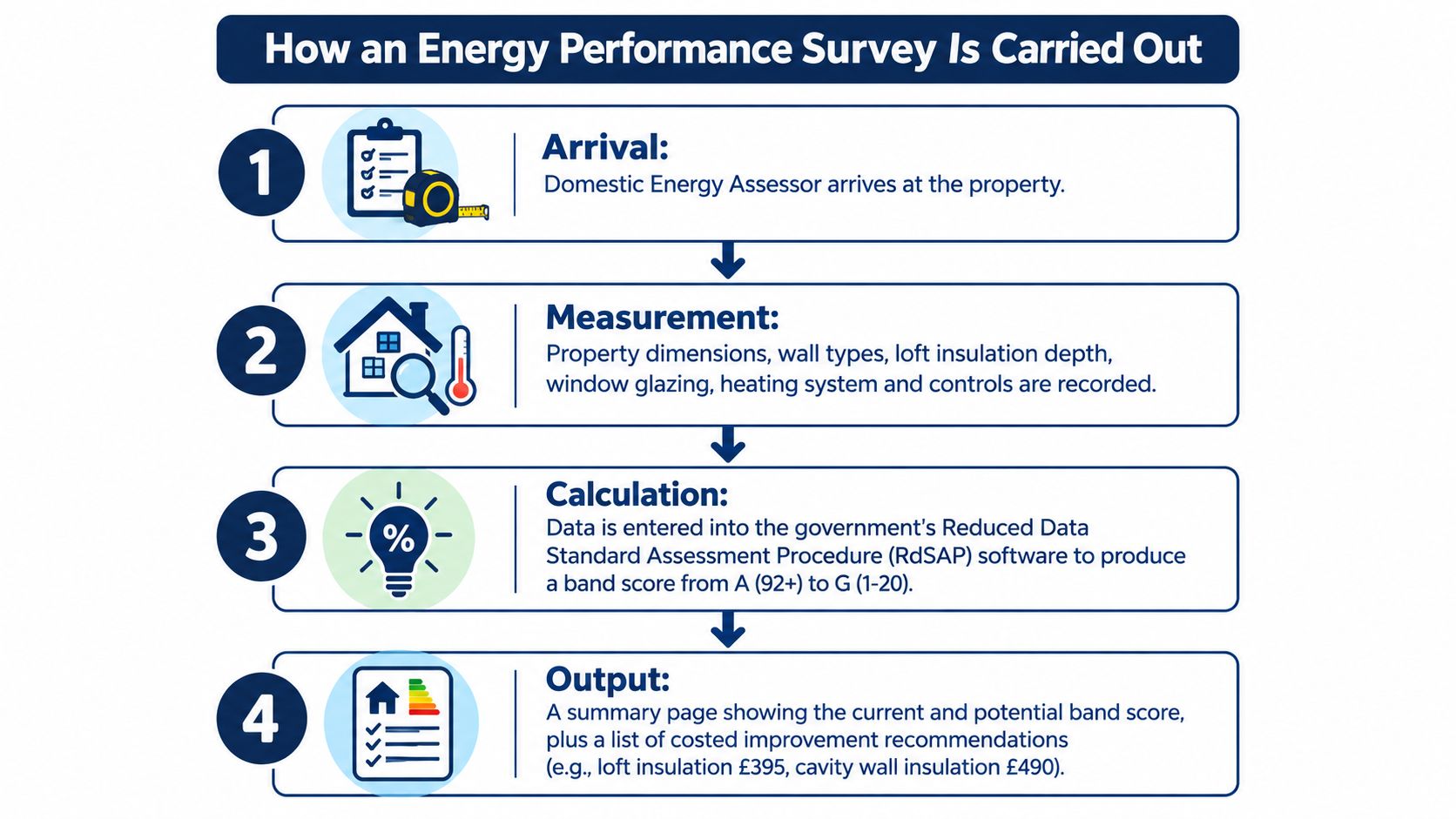
A Domestic Energy Assessor starts by collecting information about the dwelling. The assessor measures the property and records details such as floor area, construction type, wall and roof build-up, glazing, heating, hot water arrangements, loft insulation and lighting.
The information is entered into the government's Reduced Data Standard Assessment Procedure, known as RdSAP, to produce a modelled score and an A to G band. The current thresholds in England and Wales are A, 92 or above, B, 81 to 91, C, 69 to 80, D, 55 to 68, E, 39 to 54, F, 21 to 38 and G, 1 to 20, as summarised in the government guidance on selling a home.
The visit should include sensible visual checks. These may include the relationship between an extension and the original house, whether a conservatory is thermally separated, the presence of draught-proofing, secondary glazing and visible retrofit work. The assessor records what can be reasonably established during the inspection. They don't open up the building or carry out destructive investigation.
What the assessment does not test
An EPC is not an air-tightness test. It doesn't include thermographic imaging, a boiler service history review or a damp investigation. It also won't confirm that insulation has been installed correctly behind a wall lining.
The output normally consists of a front-page certificate showing the current and potential rating, followed by recommendations. Those recommendations are standardised software suggestions. They aren't a specification for contractors and they shouldn't be treated as a guarantee of savings.
For a useful preparation checklist before reviewing energy information, see this energy efficiency audit checklist. It can help you organise documents and observations, but it doesn't replace a qualified EPC or a RICS inspection.
An EPC must be provided for a marketed sale. Government technical notes also confirm that an EPC can be reused for sale or letting for 10 years, unless a newer certificate is produced for the same building, in which case the newer certificate becomes valid. The official technical notes explain the validity rule.
How It Differs from a HomeBuyer Report and a Building Survey
These documents answer different questions. Confusing them is how buyers end up believing they've checked a property when they've only checked one narrow aspect of it.
An EPC asks, “How energy efficient is this dwelling under the assessment model?” A mortgage valuation asks, “Is this property suitable security for the lender?” A RICS survey asks, “What is the condition of the building and what risks should the buyer understand?”
| Document | Who orders it | Energy coverage | Typical cost London |
|---|---|---|---|
| EPC | Seller or landlord | Energy rating and standard recommendations | Depends on the property and assessor |
| RICS Level 2 HomeBuyer Report | Buyer | Condition findings with an energy-efficiency rating from 1 to 5 | Quote varies by property |
| RICS Level 3 Building Survey | Buyer | Detailed condition assessment with commentary on fabric and retrofit issues | Quote varies by property |
| Mortgage valuation | Lender | Usually no meaningful energy assessment | Arranged by the lender |
A Level 2 HomeBuyer Report is often suitable for a conventional flat or house in reasonable condition. It includes an energy-efficiency rating from 1 to 5, alongside condition ratings and commentary on defects visible during the inspection. It isn't designed to investigate every construction detail.
A Level 3 Building Survey is the better choice for an older Victorian terrace in Brockley, a substantial Edwardian house in Blackheath, a listed property or a non-standard conversion. It allows more detailed commentary on wall construction, roof spaces, alterations, damp, movement and the practical implications of proposed improvements. You can compare the two approaches in this guide to HomeBuyer Reports and Building Surveys.
The mortgage valuation is different again. The lender appoints it to assess lending security. It isn't a substitute for a survey and may not draw attention to a poor EPC band or explain what energy works would involve.
An EPC describes the building as the assessor records it. A condition report explains what may be wrong and what is worth doing about it.
Only an experienced chartered surveyor can join those two pieces of information properly. A low rating in a solid-wall Victorian terrace may reflect genuine heat loss, limited glazing and an old heating system. It may also conceal issues such as damp masonry, failed pointing or unsuitable previous alterations.
Reading the EPC Band and the Recommendation List
The rating scale needs translating into decisions. The official thresholds range from A at 92 or above to G from 1 to 20. A band is not a bill forecast and it isn't a promise about comfort. It's a modelled indicator based on the recorded characteristics of the property.
The national direction is clear. The Office for National Statistics analysis records that homes in bands A to C rose from 26% in 2014 to 56% in 2024, while homes in bands E to G fell from 23% to 9%. London had the highest median EPC score among English regions, at 70, band C, over the 10 years to March 2024. That doesn't mean every London home performs well. It means buyers should judge the individual building rather than rely on the regional picture.
The recommendation page deserves more attention
Start with the first recommendation, then ask whether it's practical.
- Low-disruption measures: Draught-proofing, LED lighting and hot-water-cylinder insulation may be relatively straightforward.
- Fabric measures: Wall, roof and floor insulation need careful checking in older properties. Poor detailing can trap moisture or hide defects.
- Major installations: Solar photovoltaic panels, heat pumps and replacement heating systems may depend on roof access, electrical capacity, flue routes, freeholder consent and planning controls.
- Indicative costs: The figures on the certificate are broad guidance. They aren't a contractor's quotation and they don't account for scaffolding, access, leasehold consent or conservation requirements.
A solid-wall terrace in Catford or Peckham won't respond to cavity wall insulation because it doesn't have a cavity. External wall insulation may alter the appearance of the building and could require planning consent. Internal insulation may reduce room dimensions and create junction details that need proper design.
For general context on window-related regulation, this window regulations guide from Equity Building Materials is not UK-specific, so don't use it as a substitute for London planning or conservation advice. The relevant point is broader: window replacement and glazing decisions must be judged against the building's location, construction and permissions.
| EPC band | Typical meaning | MEES status | Resale implication |
|---|---|---|---|
| A | Very high modelled efficiency | Above the minimum | Strong energy credentials, but condition still needs checking |
| B | High modelled efficiency | Above the minimum | Usually presents fewer immediate energy concerns |
| C | Moderate to good performance | Above the minimum | Often a more comfortable starting point for buyers |
| D | Below the stronger efficiency bands | Above the minimum | Investigate recommendations and likely future works |
| E | Lowest band normally permitted for private letting | Meets the current minimum, subject to the rules | Can limit flexibility for landlords |
| F | Poor modelled efficiency | Below the current private-rented minimum unless exempt | Requires immediate investigation and may affect negotiations |
| G | Very poor modelled efficiency | Below the current private-rented minimum unless exempt | Treat as a significant risk, not merely a cosmetic issue |
For private rented homes, the current minimum legal standard is E. Government-linked landlord guidance explains that properties below E can't lawfully be let unless an applicable exemption applies, and the rule extended to existing tenancies on 1 April 2020. The minimum energy efficiency standards guidance sets out the landlord position.
What Buyers Sellers and Landlords Should Do Next
The right response depends on your role. Buyers need to understand future liability. Sellers need accurate information before marketing. Landlords need to check legal compliance and keep evidence of works.
Buyers
Read the recommendation page rather than stopping at the band. Identify the first three measures and ask what each would involve in this particular building.
Ask the seller for invoices, guarantees and commissioning records for recent heating or insulation work. If the EPC assumes loft insulation or modern glazing, verify that the work exists and appears correctly installed.
Leasehold buyers need another check. Review the lease and ask the freeholder or managing agent whether external insulation, solar panels, replacement windows, flues or communal heating changes need consent. In a converted flat, the answer may determine whether an EPC recommendation is deliverable at all.
Pair the EPC with a Level 2 HomeBuyer Survey for a conventional property, or choose a Level 3 survey where the building is old, altered or visibly defective.
Sellers
A certificate is valid for 10 years, but an old certificate may not reflect recent works or the property's present condition. Check the register and arrange a new assessment where the existing information is out of date or inaccurate.
Deal with sensible low-cost measures before listing if they're properly installed. Don't spend heavily on a headline band improvement without understanding the building and the likely buyer response. A new rating won't cure damp, defective roof coverings or poor workmanship.
Give buyers a clear record of improvements. It's better to explain what was installed and retain supporting paperwork than to rely on a rating alone.
Landlords
Check the current band before granting or continuing a tenancy. A rating of F or G needs an immediate review of the legal position, likely works and any exemption.
Plan works before a tenancy change. In a flat, coordinate with the freeholder and managing agent early because access to roofs, risers, façades and communal plant can take time.
Keep a proper record of works and supporting documents. For detailed property sustainability considerations, see the residential sustainability guidance. Where energy costs are divided between occupiers, landlords may also need to understand submetering for property owners, particularly in buildings with shared systems.
A RICS condition survey should sit beside this process. It can identify fabric defects that make an energy recommendation unsafe, uneconomic or technically unsuitable.
London Specific Considerations for Flats and Period Homes
London's housing stock makes simple EPC advice unreliable. A Victorian terrace in Lewisham is not a 1930s semi in Bromley, and neither is comparable with a converted warehouse flat in Bermondsey.
Victorian and Edwardian houses commonly have solid brick walls. That rules out cavity wall insulation and makes external wall insulation a planning and appearance issue. In conservation areas, including parts of Westminster, Kensington and Wandsworth, external cladding, replacement windows and new external flues may face additional scrutiny.
An EPC may recommend insulation without explaining how the work interacts with lime mortar, suspended timber floors, lath and plaster or existing ventilation. Covering a damp solid wall can worsen the defect. Sealing a building without a sensible ventilation strategy can create condensation problems.
Flats create different restrictions
A purpose-built flat may have no loft space under the leaseholder's control. Roof access may belong to the freeholder. Solar panels may require agreement over structure, maintenance, cabling and future repairs.
Internal wall insulation can reduce room size. It may also affect skirting, architraves, sockets, radiators and the relationship between private and communal areas. Service charges can rise where works affect common parts or require a coordinated programme.
Converted flats need particular care. Look beyond the EPC to the lease, planning history, fire separation and the condition of the roof and external walls. Guidance on flat fire regulations is relevant where alterations have changed layouts or common escape routes.
A surveyor should test the recommendation against the building. In Forest Hill, Sydenham, Brockley, Greenwich and Woolwich, that means recognising local period stock and leasehold arrangements rather than treating the certificate as a standalone specification.
When an Energy Performance Survey Should Change Your Decision
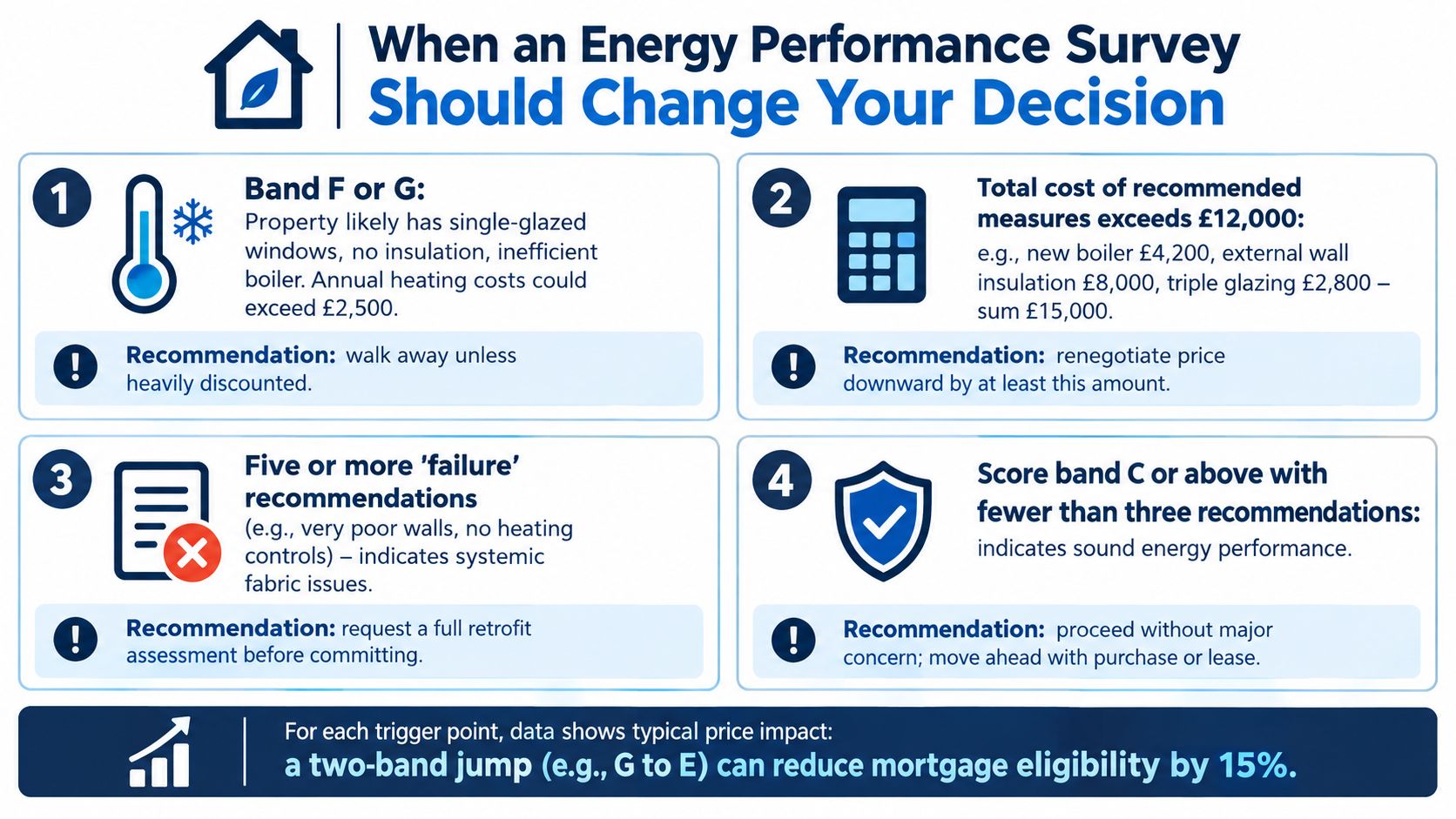
A poor EPC shouldn't automatically make you walk away. It should change the questions you ask.
A band C period flat with sound roof insulation, working heating controls and no obvious fabric defect is a different proposition from a band E converted flat with single glazing, damp staining and no credible route for external improvement. The letter matters, but the construction and the works matter more.
Pause and investigate when:
- The EPC recommendation depends on external alterations that the lease or conservation controls may prevent.
- The certificate assumes insulation or heating improvements that the seller can't evidence.
- A low band appears alongside damp, timber decay, roof defects or structural movement identified in a RICS Level 2 or Level 3 survey.
- The property is rented and the rating is below the current minimum standard, with no clear exemption or improvement plan.
A low EPC on its own is a question. A low EPC combined with defects is a negotiating position.
The certificate may be too thin to support a major decision where the building is listed, traditionally constructed, heavily altered or split into flats. In those cases, targeted follow-up may include opening-up investigations, moisture assessment, roof inspection or specialist retrofit advice. Don't commission expensive work until you know what problem it's solving.
An independent RICS surveyor can interpret the EPC alongside condition, construction and lease constraints. That judgement is especially valuable in London, where a theoretical recommendation may be blocked by a freeholder, a conservation-area restriction or a period-building detail.
Common Questions About Energy Performance Surveys
How much does an energy performance survey cost in London?
There's no fixed national EPC price. Government guidance for non-domestic buildings confirms that cost depends on the building being assessed, and domestic quotes also vary with property size, layout and access. Flats may be quicker to inspect than houses, but leasehold access and managing-agent arrangements can add time where communal systems or roof areas are relevant.
Be cautious about treating a low quote as a full energy investigation. An EPC is a modelled certificate, not a measured retrofit assessment.
How long is an EPC valid?
An EPC is valid for 10 years and can be reused for sale or letting during that period. If a newer EPC is produced for the same building, the newer certificate replaces it as the valid document.
Listed buildings aren't automatically exempt in every situation. The exemption depends on whether meeting the required energy-performance standards would unacceptably alter the building's character or appearance, so obtain proper advice before relying on that assumption.
Is an EPC a true energy survey?
No. It's a standardised, modelled assessment based on the property data recorded by the assessor. It doesn't measure actual energy consumption, air leakage, damp or the condition of the heating system.
What does MEES mean for landlords?
Private rented properties generally need to reach at least band E, unless a valid exemption applies. Landlords should check the current rules before a new letting and retain evidence of works, permissions and any exemption relied upon.
Corinthian Surveyors London LTD provides independent RICS HomeBuyer Surveys, Level 3 Building Surveys and residential valuation advice across London. Led by Clive Thompson, who holds RICS and CABE qualifications and has over 30 years' built-environment experience, the firm can interpret an EPC alongside defects, construction and leasehold constraints. To discuss the right inspection for a property in Forest Hill, Lewisham, Bromley, Southwark or elsewhere in London, visit Corinthian Surveyors London LTD or call 0800 00 16 422.