
Building Survey Cost London: What to Expect in 2026
A standard London house building survey typically costs £900 to £1,500, rising to £1,200 to £2,000+ for larger period or listed properties. Smaller flats can sometimes start at around £850. These figures reflect the London market in 2026, where property value, age and complexity all affect the quote.
You've found a Victorian terrace in Lewisham, an extended house in Bromley or a converted flat in Bermondsey. The mortgage valuation is arranged, the solicitor is asking for instructions and the survey fee is one more cost on the list. The sensible question isn't just, “What's the cheapest survey?” It's, “What level of inspection protects me from buying the wrong building?”
A RICS Level 3 Building Survey is the detailed option. It examines the building's visible fabric and condition, then explains defects, likely causes, repair implications and areas needing further investigation. It's particularly suited to older, altered, listed or unusual homes.
The price changes because London homes aren't uniform. A straightforward modern flat doesn't require the same inspection time as a large period house with a loft conversion, basement works and several roof junctions. The sections below map the main London price bands, explain what pushes fees higher and show how to compare a Level 3 survey with other survey products.
Table of Contents
- Introduction to Building Survey Costs in London
- Typical Building Survey Price Bands in London
- What Drives Building Survey Costs Up in London
- Building Survey vs Other Survey Types
- Real London Survey Scenarios and What They Reveal
- Choosing a RICS Surveyor in London
- How to Plan Your Survey Budget and Next Steps
- Frequently Asked Questions
Introduction to Building Survey Costs in London
The broad London range is useful, but a flat fee can be misleading. Surveyors need the property address, type, age, size and construction before they can scope the work properly. A quote for a one-bedroom flat in Forest Hill shouldn't be compared directly with a quote for a listed house in Dulwich.
National guidance places Level 3 surveys in a broad band of about £600 to £1,500+, while London-facing guidance commonly places them higher, often from about £850 and into the £900 to £1,500 range for standard houses. Larger period properties can reach £1,200 to £2,000+ because the inspection and report require more time. (HomeOwners Alliance guidance)
A building survey can identify issues that a viewing won't reveal clearly. Those may include damp, roof defects, timber decay, inadequate alterations, chimney breast removal, signs of movement or problems where an extension joins the original structure.
Practical rule: The right survey is cheaper than the wrong property. Don't choose a lower level simply because its headline fee looks easier to absorb.
Cost transparency matters because a proper quote should tell you what you're buying. Check the survey level, inspection scope, report format, turnaround, valuation inclusion and any exclusions. A surveyor who asks detailed questions before quoting is usually doing the right work at the right stage.
The rest of this guide focuses on property types buyers encounter across London, from converted flats in Southwark to Victorian terraces in Catford and larger period homes in Blackheath.
Typical Building Survey Price Bands in London
London fees make more sense when you place the property in the correct bracket. The following bands reflect London market guidance for Level 3 Building Surveys, not a promise of a fixed price for every address.
| Property type | Typical Level 3 survey range |
|---|---|
| Smaller flat or straightforward modern home | Around £850 to £1,000 |
| Standard London house | Around £900 to £1,500 |
| Larger, older or period property | Around £1,200 to £2,000+ |
| Listed or unusual building | Around £1,200 to £2,000+ |
London-specific guidance places standard houses commonly in the £900 to £1,500 bracket, while larger or period properties move into £1,200 to £2,000+. Smaller properties can sit nearer the lower end when access is straightforward and the construction is conventional. (Hampstead Chartered Surveyors' London cost guide)
A flat isn't automatically simple. A modern purpose-built flat may have a relatively direct inspection scope, but a Victorian conversion in Brockley or a warehouse conversion in Bermondsey can involve altered layouts, shared structures, roof access questions and uncertainty about past works. The lease, communal areas and block management also create issues that need to be separated from the condition of the individual dwelling.
How to place your property in the range
Start with three questions:
- Is it a flat or a house? Flats often cost less than houses, but complex conversions can change that assessment.
- Is it modern and conventional? Newer construction in reasonable condition usually needs less analytical work than a period building.
- Has it been altered? Extensions, loft conversions, basement works and removed chimney breasts increase the need for careful inspection.
A typical three-bedroom house can sit around £700 to £1,000 nationally, with London-facing fees commonly higher because of property values and housing complexity. (Homebuyer Check's Level 3 cost guide)
For another valuation-related cost comparison, see this guide to how much a house valuation costs. Don't use a national average as your budget. Use the property's age, type and alteration history to decide which London band is realistic.
What Drives Building Survey Costs Up in London
The surveyor's fee reflects the work required to inspect and report on the building. London costs tend to sit above the UK average because the capital combines higher property values with a large supply of older, altered and densely configured homes. (UK property survey cost guidance)
A surveyor doesn't spend the same time on a clean-lined modern house as on a Victorian terrace with a rear extension, parapet roof and converted loft. The latter presents more junctions, more potential defect paths and more questions about how the work was carried out.
The main cost mechanics
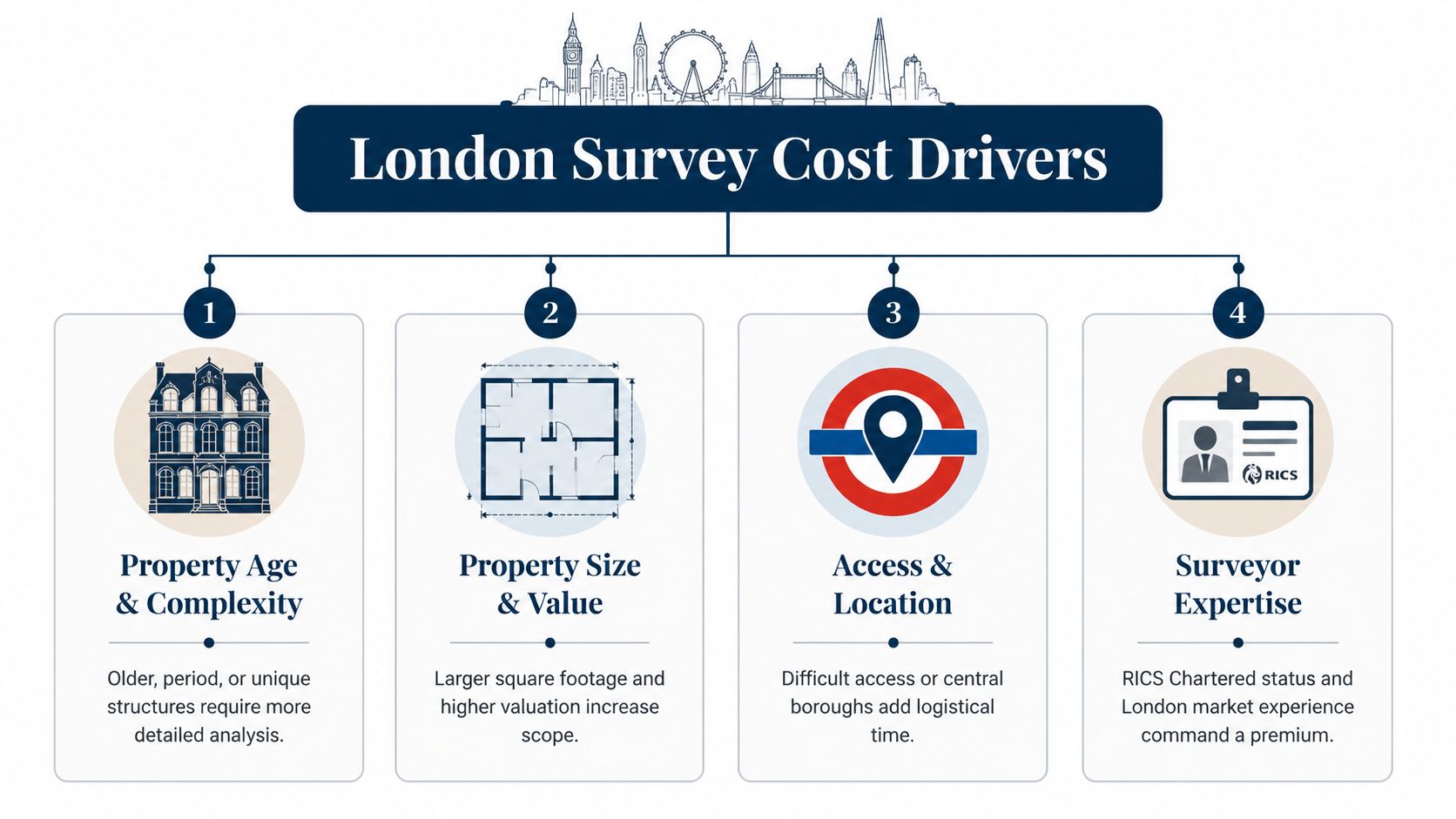
Property age and construction matter first. Victorian and Edwardian houses across Lewisham, Lambeth and Southwark may contain solid masonry walls, lime mortar, lath and plaster, suspended timber floors and later cement repairs. Each material behaves differently, so the surveyor needs to interpret the building rather than apply a modern-house checklist.
Alterations add inspection time. A loft conversion in Sydenham, a basement dig in Clapham or an extension in Croydon creates transition points between old and new work. Roof coverings, drainage, damp proofing, structural openings and wall junctions all need attention.
Listed status and conservation controls also change the context. A listed property or a home in a conservation area may require more careful commentary about fabric, alterations and maintenance. The survey doesn't replace planning or building control checks, but it can identify physical signs that deserve closer legal or technical review.
Size and value influence the scope. Larger homes have more roof, walls, rooms, floors and external areas to inspect. Higher-value properties can also attract valuation-based pricing, so the fee may rise with the significance and risk of the asset being assessed.
Access matters too. Narrow streets, restricted parking, shared entrances and difficult roof or loft access can affect the time needed on site. Ask the surveyor whether the quote assumes normal access and whether any inaccessible areas will be identified clearly in the report.
Building Survey vs Other Survey Types
Choosing the wrong survey level is a common buying mistake. The three RICS products serve different purposes, so the property should decide the inspection, not the estate agent's preference or the lender's minimum requirement.
Level 1, Level 2 and Level 3
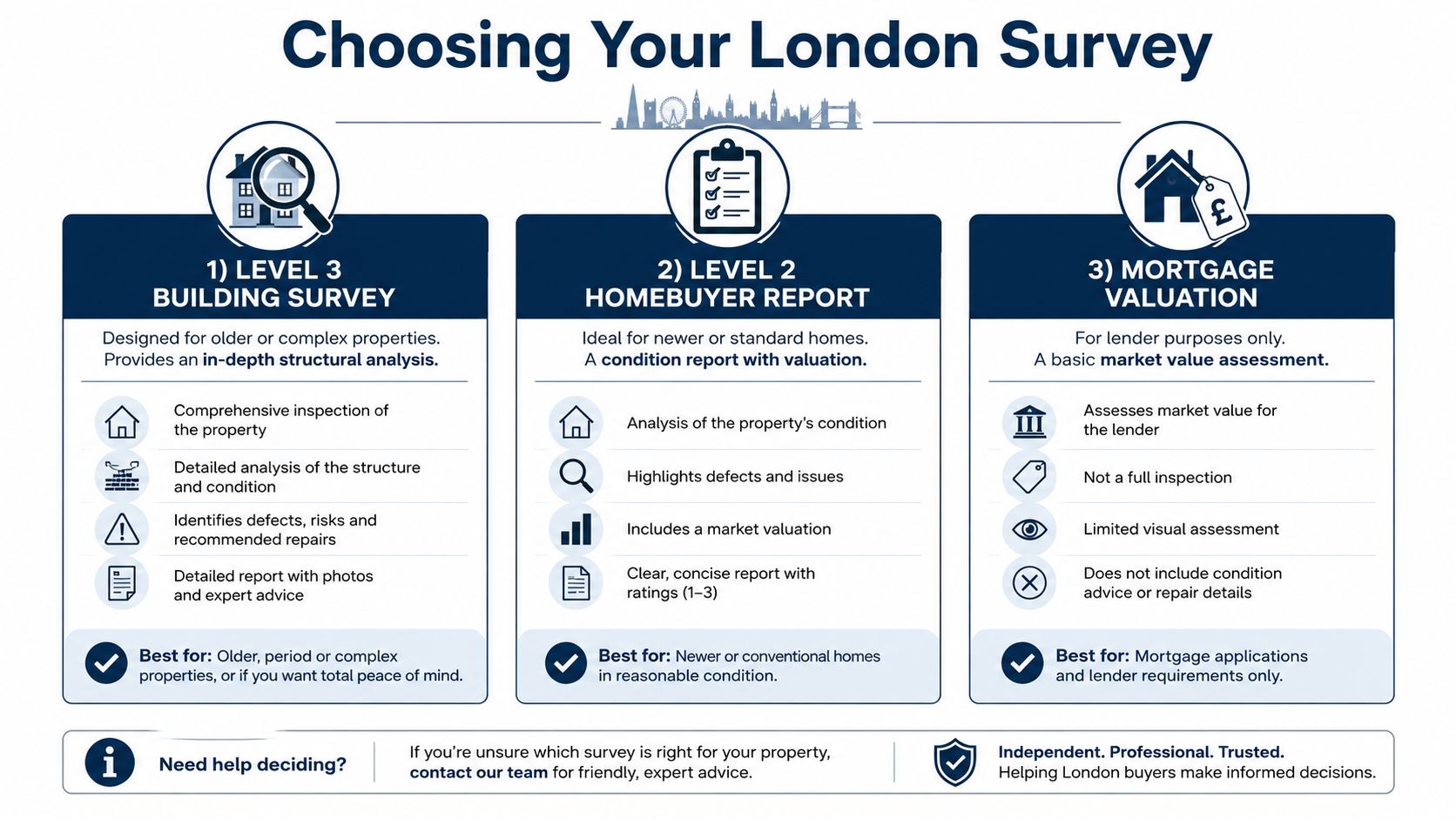
A Level 1 Home Condition Survey gives a basic condition overview. It uses traffic-light reporting and suits a straightforward property where the buyer needs a limited snapshot. It doesn't provide the depth of defect analysis associated with a Level 3 report. See the RICS Home Condition Survey service for the product context.
A Level 2 HomeBuyer Report is designed for a conventional home in reasonable condition. It provides a more useful assessment of visible defects and commonly includes a valuation, depending on the service instructed. It may suit a standard flat or modern house, but it's not the right tool for every London conversion or period building.
A Level 3 Building Survey goes further. It's the sensible choice for older properties, listed buildings, unusual construction, substantial alterations or homes where the viewing has raised concerns. The report should explain the defect, its likely significance and the next sensible step.
Read this comparison of a HomeBuyer Report and Building Survey before deciding. The difference isn't just report length. It's the depth of inspection and explanation.
The mortgage valuation is different
A mortgage valuation is for the lender. It assesses the property as security for the loan and doesn't give you the detailed condition advice needed to make an informed purchase.
The lender's valuation won't replace an independent Level 2 or Level 3 survey. If the property has damp, roof problems or structural movement, you need an inspection commissioned for your interests, not just a valuation prepared for the mortgage provider.
Real London Survey Scenarios and What They Reveal
A survey earns its fee when it turns a vague concern into a clear decision. London properties often look familiar from the street, but the construction behind the façade can vary substantially.
Victorian terraces
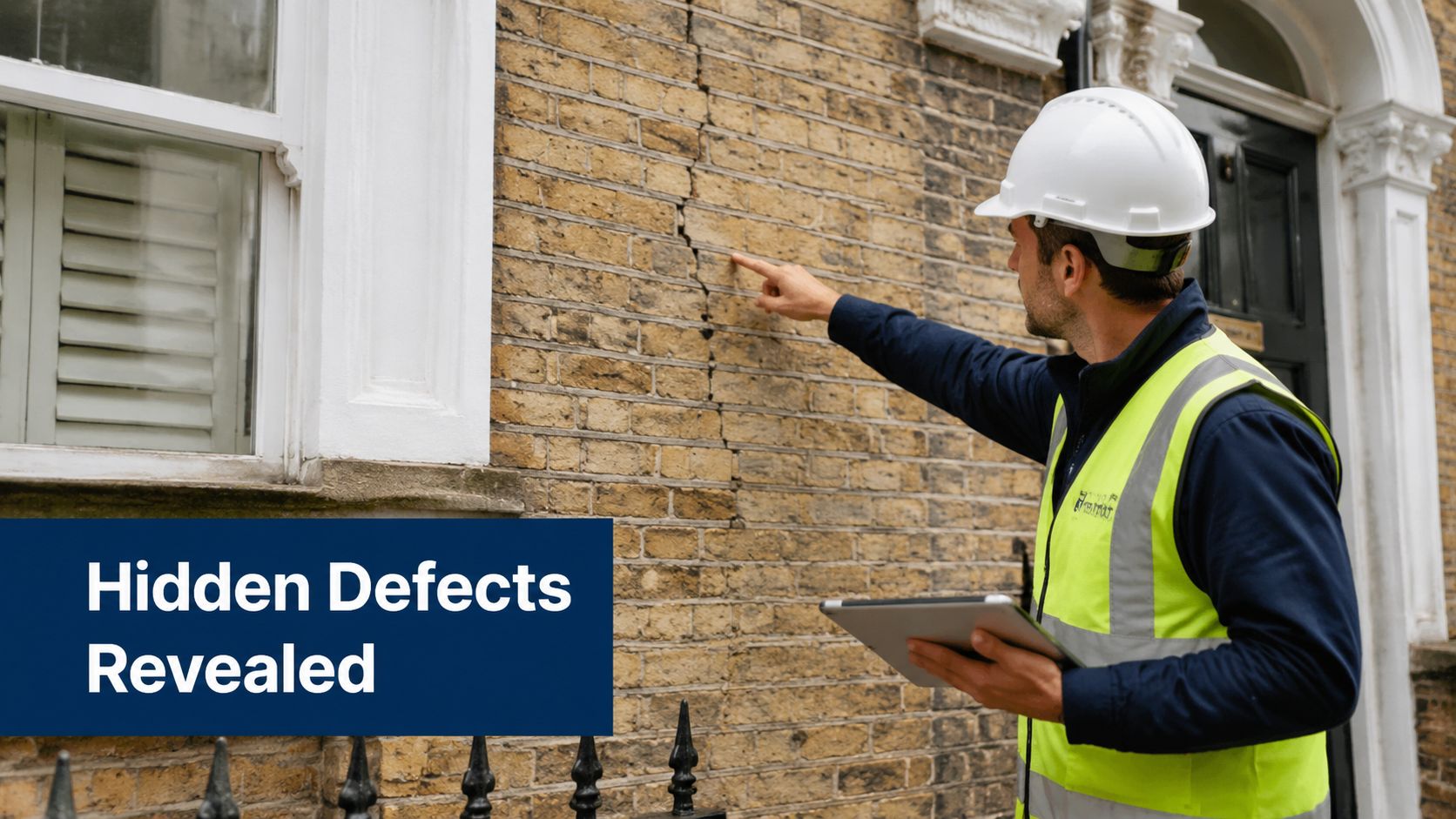
Take a Victorian terrace in Catford or Forest Hill. The front elevation may appear sound while the survey identifies defective pointing, cracked render, blocked air bricks or damp affecting the suspended timber floor. Cement pointing over softer brickwork can trap moisture, while poor ventilation can contribute to timber decay.
The report should distinguish between ordinary maintenance and a defect that needs urgent attention. That distinction gives the buyer something practical to discuss with the seller. If the findings alter the expected cost of ownership, the buyer can seek a price renegotiation or ask for further investigation before exchange.
Movement and drainage
In parts of London, buyers also need to take signs of movement seriously. Cracks, distorted openings, sloping floors and sticking doors can have several causes, including settlement, drainage problems, thermal movement or subsidence. A building survey can identify the pattern and recommend specialist investigation where the evidence doesn't support a firm conclusion.
It shouldn't pretend to provide an engineer's calculation where one is needed. The useful report tells you what has been observed, what it may mean and what evidence should be obtained next.
Altered flats and period details
A maisonette in Peckham, a conversion in Deptford or a period flat in Greenwich may contain original lead pipework, lime mortar, lath and plaster or removed chimney breasts. Those details affect maintenance, ventilation, fire separation and the way later work interacts with the original structure.
A survey also helps with planning after completion. You may learn that a roof needs attention, an extension junction requires monitoring or damp repairs should use compatible materials. You can then prioritise work instead of discovering each issue through an emergency.
Choosing a RICS Surveyor in London
Start with qualifications. Look for a RICS Chartered Surveyor and check whether the practice is regulated by RICS. CABE qualifications can also be relevant to built-environment knowledge, particularly where the inspection involves construction detail and defect diagnosis.
Independence matters just as much. A surveyor with no ties to the lender, estate agent or developer can report the building without having to protect another party's transaction. That doesn't guarantee a particular conclusion, but it removes a clear conflict of interest.
Questions to ask before instructing
Ask these questions before accepting a quote:
- Which RICS survey level is suitable? The surveyor should explain the choice using the property's age, construction and alterations.
- What does the inspection include? Clarify lofts, roofs, basements, outbuildings, communal areas and inaccessible spaces.
- Is a valuation included? Don't assume a Level 3 survey automatically includes one.
- Who will inspect the property? Confirm the person's qualifications and experience with London housing stock.
- What insurance and regulation apply? Ask whether the firm is RICS regulated and professionally insured.
Corinthian Surveyors London LTD is an independent residential practice based in Forest Hill, SE26 5T3. Clive Thompson holds RICS and CABE qualifications and has over 30 years' experience in the built environment. The firm serves London boroughs, the Home Counties and the wider South of England, with no ties to lenders, estate agents or developers.
You can also review this guide to choosing a building surveyor with RICS qualifications. Local understanding matters in areas such as Sydenham, Brockley, Blackheath and Bromley, where period construction and later alterations are common.
How to Plan Your Survey Budget and Next Steps
Use the property itself to set your expectation. A smaller, straightforward flat may sit near the lower London end. A standard house commonly falls within the main London band. A large Victorian, Edwardian, listed or heavily altered property belongs nearer the upper end.
Choose a Level 3 Building Survey when the property is old, extended, listed, unusual or visibly defective. Choose Level 2 only where the building is conventional and the inspection scope matches the risk. Don't let a mortgage valuation make that decision for you.
Before instructing, send the surveyor the address, property type, approximate age and details of extensions or conversions. Ask what's included, identify access restrictions and confirm whether the report includes a valuation or only condition advice.
If the survey identifies an ageing boiler, you may also want to find boiler replacement quotes while assessing the wider repair budget. Keep that separate from the survey fee, since a surveyor's report identifies condition and risk rather than pricing every specialist replacement.
Corinthian Surveyors London LTD provides RICS Level 2 and Level 3 surveys, valuations and defect advice for residential properties across London. For a property-specific discussion, call 0800 00 16 422 with the address and details of the building.
Frequently Asked Questions
Is a building survey worth the cost in London?
Yes, particularly for older, extended, listed or unusual properties. The report can identify defects that aren't obvious during viewings and give you a sound basis for further investigation, repair planning or renegotiation.
Does a mortgage valuation count as a building survey?
No. A mortgage valuation serves the lender's lending decision. It isn't an independent inspection of the property's condition and shouldn't replace a Level 2 or Level 3 survey.
Why does a period house cost more to survey?
Period houses often contain mixed-age construction, older materials, extensions and complicated roof or wall junctions. The surveyor needs more time to inspect and interpret those elements, so the fee can rise.
Should I choose Level 2 or Level 3 for a London flat?
A conventional modern flat may suit Level 2. A period conversion, basement flat, maisonette or property with visible defects, major alterations or unusual construction is more likely to justify Level 3.
Corinthian Surveyors London LTD provides independent RICS HomeBuyer Reports, Level 3 Building Surveys and residential valuations across London, including Forest Hill, Lewisham, Greenwich, Bromley, Southwark and the surrounding boroughs. Visit Corinthian Surveyors London LTD to discuss the property and request a quote based on its actual size, age, construction and condition.